This site is supported by our readers. We may earn a commission, at no cost to you, if you purchase through links.
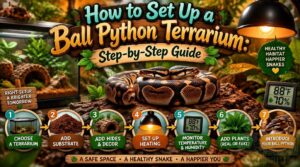
Ball pythons squeeze with enough force to pop a poorly latched lid open in minutes. That kind of escape isn’t bad luck; it’s a setup problem.
Getting your ball python terrarium setup right from the start protects your snake and saves you the headache of chasing a stressed animal behind your refrigerator at midnight. The wrong enclosure, the wrong substrate, or a heat gradient that’s two degrees off can trigger refusal to eat, poor sheds, and respiratory infections that cost far more to fix than to prevent.
This guide walks you through every decision, in order, so your snake moves in and stays comfortable.
Table Of Contents
- Key Takeaways
- Choose a Secure, Properly Sized Ball Python Enclosure
- Add Substrate, Snug Hides, and Safe Climbing Décor
- Set Up Heating, Humidity, and a Day–Night Light Cycle
- Add Water, Check Conditions, and Keep The Terrarium Clean
- Top 7 Products for a Ball Python Terrarium Setup
- Frequently Asked Questions (FAQs)
- What kind of terrarium does a ball python need?
- What is the best enclosure setup for a ball python?
- What do ball pythons like in their enclosure?
- How to set up a ball python terrarium?
- How do I set up a ball python terrarium?
- Can a ball python live in a 40 gallon terrarium?
- How do I set up a habitat for a ball python?
- What kind of terrarium do ball pythons need?
- How do you make a terrarium look like a ball python?
- Do ball python terrariums need a hideout?
- Conclusion
Key Takeaways
- A secure, front-opening enclosure with locking latches is the single most important first purchase, because even a slightly loose lid is an escape waiting to happen.
- Your thermal gradient (88–92°F warm side, 78–82°F cool side) and humidity (50–60%) aren’t optional tweaks—get them wrong and your snake will stop eating, shed poorly, and get sick.
- Every ball python needs two snug hides, one per temperature zone, sized so the snake barely fits; anything roomier defeats the purpose and keeps your snake stressed.
- Daily spot-cleaning, weekly substrate patches, and monthly deep sanitizes aren’t busywork—they’re what stand between your snake and ammonia buildup, mold, and respiratory infections.
Choose a Secure, Properly Sized Ball Python Enclosure
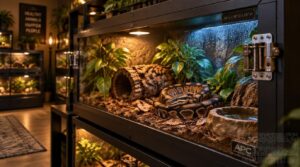
Before you buy anything else for your ball python terrarium setup, get the enclosure right first. Size matters more than most beginners think. Adult ball pythons reach 4–5 feet, so your minimum enclosure size is 36 x 18 x 12 inches, but going bigger is always the smarter call.
Many keepers find that jumping straight to a 4x2x2 ball python enclosure setup saves money and stress in the long run.
Glass enclosures are popular, but they lose humidity quickly. PVC or solid wood panels with vented sides hold heat and moisture far more efficiently, which cuts down on your daily maintenance headaches considerably.
Don’t underestimate enclosure security either. Ball pythons are surprisingly strong and stubborn about finding gaps. Loose screen lids are basically an open invitation. Stick with front-opening designs and locking spring latches for reliable escape prevention and low-stress handling.
Add Substrate, Snug Hides, and Safe Climbing Décor
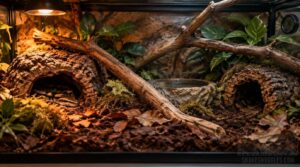
Once your enclosure is sorted, it’s time to fill it with the right stuff. Start with coconut chip substrate, packed 2–3 inches deep. It holds humidity well, gives your snake something to push against, and looks clean.
Every ball python needs two snug hide boxes, one on the warm side and one on the cool side. Snug means snug. Your snake should barely fit. A loose, open hide isn’t a hide; it’s just furniture. Cork bark rounds and snug reptile hide caves both work well, as long as your snake has to curl into them rather than rattle around inside.
A ball python’s hide should fit like a secret, not a room
For climbing, add 2–3 branches at 30–60 degree angles with roughly one-inch diameters. Smooth, toxin-free wood only. Secure everything firmly. Nothing should shift when your snake tests it, and ball pythons absolutely will test it.
Set Up Heating, Humidity, and a Day–Night Light Cycle
With your décor in place, focus shifts to environment. Your snake needs a solid thermal gradient, 88–92°F on the warm side and 78–82°F on the cool side. Get this wrong and nothing else matters.
- Use a thermostat-controlled ceramic heater for steady warmth
- Check both sides with probes for accurate thermometer placement
- Monitor moisture with a mid-tank hygrometer for hygrometer accuracy
Target 40–60% humidity daily. Your substrate does most of the work, but still mist during sheds, raising it to 60–70% for 24–48 hours. That’s humidity control done right.
For a closer look at why moisture matters so much during this window, corn snake shed humidity needs breaks it down in practical detail.
Run a UVB lighting cycle on a 12:12 timer. It’s optional but genuinely useful. Gradual ramp transitions at dawn and dusk keep feeding rhythms on track without stressing your naturally nocturnal snake.
Add Water, Check Conditions, and Keep The Terrarium Clean
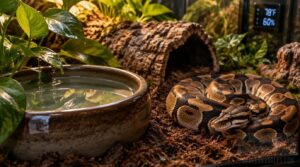
With your thermal gradient dialed in, water management is next. Your water dish should be large enough for soaking and swapped out daily. Stagnant water grows mold and bacteria faster than you’d think.
Spot-clean waste daily to stay ahead of ammonia buildup. Pull soiled patches and replace the substrate in those zones each week. It only takes a couple of minutes.
Monthly deep sanitizing is non-negotiable. Pull everything out, disinfect the terrarium with a reptile-safe cleaner, rinse thoroughly, and let it dry completely before decor goes back in. Replace all substrate at the same time.
Weigh your snake weekly and keep an eye on your hygrometer. Sudden weight loss or a retained shed tells you something’s off. Catch it early.
Top 7 Products for a Ball Python Terrarium Setup
Getting the right gear makes everything else easier. These seven products cover the essentials, from lighting and substrate to enrichment, so you’re not guessing what to buy. Pick what fits your setup and your snake’s stage of life.
1. Reptile Uvb Lighting Solution Bulb

Ball pythons technically won’t die without UVB light, but they’ll thrive with it. The Reptile UVB Lighting Solution Bulb delivers 5% UVB intensity, giving your snake a reliable path to vitamin D3 synthesis. That means stronger bones, better appetite, and noticeably more activity. These UVB supplementation benefits are ones you’ll actually see.
Position the bulb 12 to 18 inches above the basking spot. Tie your UVB lighting cycle to daytime hours to keep your snake’s rhythms stable. Replace it every 6 to 12 months since UVB output degrades well before the bulb burns out.
Want visible light layered in as well? The Natural Full Spectrum Terrarium Light takes care of that part.
2. Natural Full Spectrum Terrarium Light
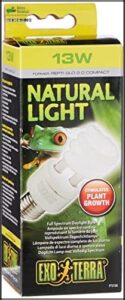
Beyond UVB rays, your python needs consistent visual light for a proper 12-hour light-dark cycle. A Natural Full Spectrum Terrarium Light, like the Exo Terra 13W, delivers 6700K at 98 CRI, so colors look true and natural.
It produces no heat, so run heating equipment separately. The full-spectrum fluorescent output reinforces feeding responses and healthy circadian rhythms within a consistent UVB lighting cycle.
Four things to get right:
- Mount it above the basking zone for even light coverage
- Target 0.3–0.5 µW/cm² irradiance at substrate level
- Use a timer to run a strict 12-hour light-dark cycle
- Replace it every 6–12 months before output quietly drops
3. Organic Coconut Reptile Bedding Substrate
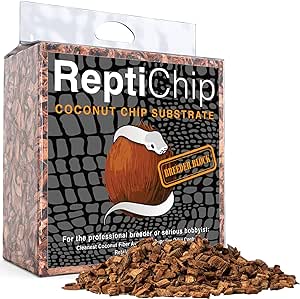
Picture your snake nosing confidently through loose, earthy bedding like it truly owns the place. That’s exactly what good substrate does.
The Organic Coconut Reptile Bedding Substrate starts as a compact brick and expands into 10 pounds of soft, breathable bedding. Its moisture retention keeps humidity steady without turning your enclosure into a swamp. Low dust is a genuine win for substrate safety, benefiting both you and your snake.
Follow substrate depth guidelines: lay 2-4 inches to support natural digging. For a solid substrate mixing ratio, mix coconut fiber with sphagnum moss to boost humidity consistency near hides. Spot-clean daily, and you’re sorted.
4. Natural Aspen Snake Bedding Supply
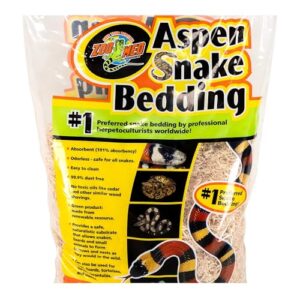
Think of aspen as your enclosure’s moisture thermostat. Its 191% absorbency rating pulls ambient humidity without trapping it, keeping the surface dry while your air stays right in the 50-60% sweet spot ball pythons need.
Spread it 2-3 inches deep. That depth gives your snake real room to burrow and settle into natural resting places, which genuinely reduces stress over time. This Zoo Med bedding is 99.9% dust-free, so your snake’s respiratory system stays out of trouble.
Spot-cleaning is fast, mold resistance is solid, and full substrate changes are simple. It’s the low-fuss pick.
- Exceptional 191% absorbency rating pulls moisture from the air without leaving the surface wet, making humidity control effortless.
- 99.9% dust-free composition protects your pet’s respiratory health and keeps the enclosure looking clean.
- Supports natural burrowing and nesting instincts, helping reduce stress in reptiles and other small animals.
- Some customers have found it dustier than the label suggests, which could be a concern for sensitive animals.
- Retains moisture for several days after wetting, so damp spots need prompt attention to prevent mold buildup.
- Only available as a single unit with no bulk purchasing option, which can be inconvenient for owners of larger or multiple enclosures.
5. Galapagos Green Sphagnum Terrarium Moss
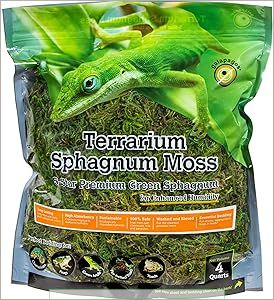
Sphagnum moss is a humidity sponge that works harder than you’d think. The Galapagos Green Sphagnum Terrarium Moss holds up to 30 times its weight in water, making humid microclimate creation simple when your python’s shedding and needs that 70-75% sweet spot.
Layer it over hides or tuck it near the cool side for shedding assistance and substrate moisture retention without waterlogging your main bedding.
- Rehydrate every 2-3 days during warm, dry stretches
- Keep it pliable but not dripping
- Position near air vents to prevent mold buildup
- Dull color signals a need for humidity control adjustment
6. Natural Forest Floor Bedding Substrate
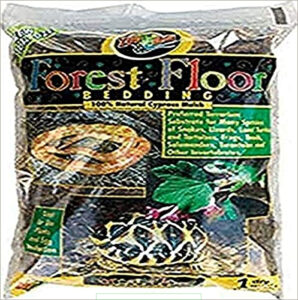
Zoo Med’s Natural Forest Floor is woodland texture in a bag. Spread 2–3 inches across the enclosure floor to cushion your snake’s belly and encourage natural burrowing.
The cypress mulch holds moisture for 48–72 hours, keeping humidity in the 55–65% range without constant misting. It’s also compatible with bioactive setups if you’re running isopods or other cleanup crew. Its neutral pH reduces skin irritation risk, which matters more than most keepers realize.
One heads-up: the dark color makes spotting waste tricky, so check often. Rinse it before use to cut down on dust, and pull out any oversized chunks to avoid impaction hazards.
- Holds moisture well, keeping humidity stable for 48–72 hours without constant misting
- Works with bioactive setups, making it a good fit for keepers running isopods or other cleanup crews
- Mimics a natural forest floor, encouraging burrowing and digging behaviors
- Dark color makes it hard to spot waste, so you’ll need to check the enclosure more frequently
- Some users have reported pest infestations coming in with the substrate
- Can be dusty straight out of the bag and may need rinsing and drying before use
7. Realistic Pothos Terrarium Vines Decor
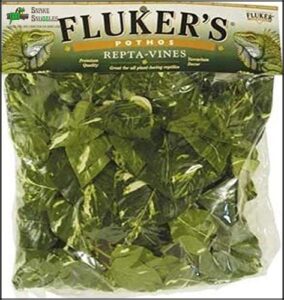
Once your substrate’s sorted, it’s time to go vertical. Fluker’s Realistic Pothos Terrarium Vines Decor gives your ball python real environmental enrichment without the mess of live plants. The debate around plastic vs live plants in tanks is real, but artificial wins in high-humidity setups: no root rot, no substrate fouling, no mold risk.
The 6-foot polyethylene stem bends around hides and mounds, creating climbing branches and a naturalistic setup your snake will actually use. Suction cups anchor to glass instantly; use hooks for PVC. Leaf clusters trap humidity locally, nudging levels up 5-10% to support shedding. Rinse it monthly.
Frequently Asked Questions (FAQs)
What kind of terrarium does a ball python need?
Ball pythons need a 20-gallon long enclosure at minimum. A secure, locking lid matters just as much as tank size. These snakes are notorious escape artists, and a loose lid is basically an open invitation.
What is the best enclosure setup for a ball python?
Adult ball pythons hit 3 to 4 feet long, so they need a 40-gallon tank minimum with a lockable lid, coconut or aspen substrate for burrowing, two snug hides, consistent heating, and stable humidity. Simple.
What do ball pythons like in their enclosure?
What does a ball python really want? Warmth, security, and routine. Give it a temperature gradient, proper humidity control, substrate safety, two cozy hide boxes, and a predictable feeding schedule and it’ll settle right in.
How to set up a ball python terrarium?
Most new snake owners get the whole terrarium setup wrong because they skip temperature and humidity. Pick a secure enclosure, lay down solid substrate, add two snug hides, keep fresh water available, then spot-clean weekly.
How do I set up a ball python terrarium?
Your Ball Python Terrarium Setup starts with a secure, properly sized glass enclosure of 40-60 gallons. Layer moisture-retaining substrate, add two snug hides, set the hot spot temperature to 88-92°F, and keep humidity at 50-60%.
Can a ball python live in a 40 gallon terrarium?
For most adults, yes. A 40 gallon terrarium gives them enough floor space to set a proper temperature gradient and maintain humidity control. Just prioritize substrate safety and smart hide box placement from the start.
How do I set up a habitat for a ball python?
Think of your ball python terrarium setup as a simple set of building blocks: start with the right enclosure size, layer substrate 2-4 inches deep, add dual hideouts, install heating, and hold humidity at 50-60%.
What kind of terrarium do ball pythons need?
Your snake needs at least 40 gallons of enclosure space. Choose a glass or PVC tank type with proper ventilation, stable heating zones, a thermostat, carefully controlled humidity, and substrate deep enough for comfortable burrowing.
How do you make a terrarium look like a ball python?
Ball pythons need 70–80% humidity to stay healthy. Layer dark coconut substrate, position snug hideouts at each temperature zone, tuck in climbing branches, and weave artificial plants throughout to mirror their West African grassland home.
Do ball python terrariums need a hideout?
Absolutely. You need at least two hiding spots, one placed on the warm side and one on the cool side. They cut down stress, support cleaner sheds, and satisfy your python’s instinct to stay hidden.
Conclusion
Most keepers who lose a snake trace it back to one skipped step during setup. The enclosure was a little too small, the hide was too exposed, or the warm side crept five degrees high.
Your ball python terrarium setup isn’t complicated, but it is sequential. Get the box right, then the substrate, then the heat. Each layer you lock in reduces the chance of the next problem. Do it once, do it right, and your snake won’t give you much reason to worry.