This site is supported by our readers. We may earn a commission, at no cost to you, if you purchase through links.

A ball python can sit on a 24°C hide for hours and still refuse to eat, all because the other end of the enclosure never cracks 28°C. Snakes don’t regulate heat internally, so they rely on you to build the thermometer they’ll read with their whole body.
A proper temperature gradient in a ball python terrarium gives your snake a choice: a 28 to 32°C warm side for digestion, a 24 to 26°C cool side for rest. Get it wrong and you’ll see skipped meals, stuck sheds, even burns.
Here’s how to place heat, set thermostats, and read your numbers like a pro.
Table Of Contents
- Key Takeaways
- Ideal Temperature Ranges for a Ball Python Terrarium
- Choose Safe Heat Sources for Your Ball Python Terrarium
- Create a Temperature Gradient With Warm and Cool Hides
- Monitor and Maintain Terrarium Temperatures Day and Night
- Fix Temperature Extremes and Uneven Terrarium Heating
- Frequently Asked Questions (FAQs)
- What is the ideal temperature gradient for ball pythons?
- Is 70 degrees too cold for a ball python?
- Is 90 degrees too hot for a ball python?
- What is a normal temperature gradient?
- What temperature should a ball python terrarium be?
- Do ball pythons need a terrarium?
- Do ball pythons like temperature gradients?
- How to control the temperature inside a ball python vivarium?
- How hot should a ball python be?
- How do you heat a Python terrarium?
- Conclusion
Key Takeaways
- You’ll want a gradient with a 28 to 32°C warm side, a 24 to 26°C cool side, and a brief basking spot of 32 to 34°C, because your snake can only digest, rest, and eat well when it can choose its own temperature.
- You should control your ceramic heat emitter or heat mat with a thermostat whose probe sits at the hotspot where your snake actually touches the surface, and add a guard so it can’t reach the heat source.
- You can keep temperatures steady by putting a probe in each hide plus one for ambient air, letting the night temperature drop 5 to 10°F, and running the thermostat separately from the light timer.
- You’ll fix uneven heat by checking heat source placement, probe position, drafts, and substrate depth first, changing one thing at a time, and never letting any zone stay above 34°C, since burns and stress follow fast.
Ideal Temperature Ranges for a Ball Python Terrarium
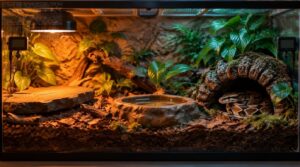
The ideal temperature ranges for a ball python terrarium come down to three numbers. Memorize them.
Getting the warm side, cool side, and basking spot right is easier with this ideal temperature gradient for ball pythons, which shows how to build it step by step.
Keep warm side temperatures between 28 and 32°C (82 to 90°F) all year. Cool side temperatures should sit at 24 to 26°C (75 to 78°F), which is where your snake rests and digests. Add a basking zone of 32 to 34°C (90 to 93°F), but only for brief periods to spark activity.
Together, these numbers create a temperature gradient of roughly 6 to 12°C across the enclosure. That spread lets your snake regulate itself, moving to warmth or coolness as it needs. You’re the architect, and it’s the picky tenant.
Don’t let any zone climb past 34°C for long. Stress and burns follow fast.
Choose Safe Heat Sources for Your Ball Python Terrarium
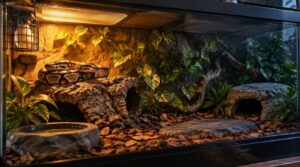
Your heat source is the most important piece of equipment in your ball python’s enclosure, so it’s worth getting right. Some setups warm a terrarium evenly and safely, while others create hot spots and burn risks. Here are the two points to understand before you buy anything.
Overhead Heating Versus Heat Mats
A ceramic heat emitter warms the air and your snake’s basking spot, while a heat mat warms the belly. Each helps thermoregulation differently. Which one gives you the most control? Picture these moments:
If you’re still weighing options, this breakdown of the difference between a heat lamp and a heat mat shows which setup suits your snake’s species and enclosure best.
- Your python stretches out, calm and relaxed.
- Its belly digests in comfort.
- You stop worrying about cold spots.
- Your thermostat holds steady.
- Heat source placement finally clicks.
Thermostat Control and Burn Prevention
Your thermostat answers that question. Pair it with a ceramic heat emitter or a heat mat, and thermal burns prevention starts with a probe at the hotspot, not a guess.
For setup details like ideal temperature gradients and where to place the probe, this corn snake care guide walks through each step.
| Setting | Target |
|---|---|
| Warm side | 88–92°F |
| Cool side | 78–80°F |
| Night drop | 70–75°F |
| Shutoff | 95°F |
Add a guard so your snake can’t touch the heat source. Daily temperature monitoring catches drift early.
Create a Temperature Gradient With Warm and Cool Hides
Once your heat source is in place, it’s time to give your snake a choice. A ball python doesn’t want one steady temperature. It wants a temperature gradient, so it can shuffle between warm and cool like you moving between a sunny porch and a shady kitchen.
Aim for a warm side in the low 90s and a cooler side in the high 70s, which this best temperature gradient for ball python care guide breaks down further.
A ball python craves a temperature gradient, shuffling between warm and cool the way you drift from a sunny porch to a shady kitchen
Put the warm hide on the warm side and keep it between 28 and 32°C. Place the cool hide on the cool side, at floor level, where it should sit at 22 to 26°C. Leave 10 to 15 cm of substrate between them so heat doesn’t bleed across. Cypress mulch or aspen helps insulate the cool side.
Never let a heat source sit under a hide. Stay below 34°C on the warm side.
Monitor and Maintain Terrarium Temperatures Day and Night
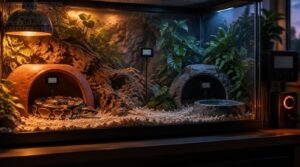
Monitoring your terrarium is essential, because your snake can’t tell you when the room feels off. Place a digital thermometer probe in the warm hide, another in the cool hide, and a third for ambient air, keeping them away from damp substrate. Set alarms for a warm side above 95°F or a cool side below 75°F.
Log readings every 15 to 30 minutes, then review them weekly. Trends show you whether your temperature gradient holds steady or drifts with the seasons. A digital reptile thermometer hygrometer with a probe can also track humidity, so you’ll spot gradient and moisture shifts in a single glance.
At night, let temperatures fall 5 to 10°F from the daytime peak, just like a natural evening. Run your thermostat independently of the light timer, so lights-out never means heat-out. Good heat source placement keeps temperature stability pretty simple.
Fix Temperature Extremes and Uneven Terrarium Heating
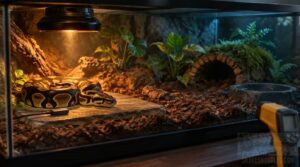
Fixing uneven heat starts with finding the cause, and it’s rarely mysterious.
Check your heat source placement first. If everything sits on one end, the cool side may be too cool and the warm side too hot. Shift the heater so warmth fades gradually instead of dropping off a cliff.
Next, test your thermostat probe. It’s important that it sits where your snake actually touches the surface, not floating in air. A misplaced probe makes the thermostat guess wrong, and your snake pays for it.
Seal drafty gaps and add substrate where it’s thin. Deep bedding holds heat steady. Recheck probes on both hide floors after every tweak, and change one thing at a time. Your temperature gradient will settle.
Frequently Asked Questions (FAQs)
What is the ideal temperature gradient for ball pythons?
Ball pythons evolved in African burrows, where shade beats the sun by double digits. Your proper temperature gradient mirrors that: a warm side with a basking surface temperature of 88–92°F and a 75°F cool side.
Is 70 degrees too cold for a ball python?
Seventy degrees isn’t too cold on the cool side at night. It’s too cold as an all-day constant.
Your snake needs a proper temperature and a temperature gradient for thermoregulation, protecting its health and wellbeing.
Is 90 degrees too hot for a ball python?
No, 90°F is right on target for the basking surface temperature, as long as it’s the hot spot and not the whole enclosure. Keep the warm side ambient near 80°F, the cool side ambient cooler, and run thermostat-controlled systems for a steady thermal gradient.
What is a normal temperature gradient?
A 10–12°C spread is the norm. Your normal temperature gradient runs 85–92°F on the warm side and 78–80°F on the cool side. That proper temperature range helps with thermal regulation, so your snake can choose comfort.
What temperature should a ball python terrarium be?
Aim for 88–92°F on the warm side and 78–82°F on the cool side. That temperature gradient lets your snake choose exactly what it needs. Use a reliable thermostat to hold the proper temperature, especially overnight.
Do ball pythons need a terrarium?
Think of a terrarium as your snake’s private kingdom.
Yes, your ball python terrarium is essential: it holds proper temperature, heat gradient stability, and humidity, while the right enclosure size allows thermoregulation, hiding, and burrowing.
Do ball pythons like temperature gradients?
Yes, they do. A temperature gradient lets your snake handle thermoregulation itself, basking on the warm side to digest, then retreating to the cool side. That thermal gradient keeps it calm, healthy, and truly stress-free.
How to control the temperature inside a ball python vivarium?
A 4°C swing between sides matters. Connect a dual-probe thermostat to your heat mat or ceramic emitter, then adjust wattage and placement carefully so the temperature gradient holds steady: warm side 28–32°C, cool side 24–28°C.
How hot should a ball python be?
Why would a snake want one temperature when it can have two? Your ball python needs a temperature gradient, with a hot spot of 88-92°F for digestion and a cool side of 78-82°F. A thermostat keeps it steady.
How do you heat a Python terrarium?
Heat rocks don’t work; they burn snakes.
Enclosure heating uses a ceramic heat emitter or heat pad on one side, controlled by a thermostat. Build a temperature gradient, 88-92°F warm and 75-82°F cool, for thermoregulation.
Conclusion
Picture Mango, a two-year-old ball python who ignored every rat for three weeks. Her owner moved the heat mat, added a thermostat, and set a 31°C basking spot. Two days later, she ate.
That’s the power of a well-built temperature gradient ball python terrarium. You’re not heating a box. You’re giving your snake a map she can read. Check your numbers daily, trust your thermostat, and let her choose. She’ll tell you when it’s right.