This site is supported by our readers. We may earn a commission, at no cost to you, if you purchase through links.
You spot a snake sunning itself on the trail ahead, and your pulse quickens—but is that fear justified? Most people can’t tell a harmless garter snake from a venomous copperhead at a glance, and that gap in knowledge turns every encounter into unnecessary panic.
The truth is, only about 20% of North American snake species pose any danger to humans, yet we treat them all like threats. Learning how to identify common snake species transforms anxiety into appreciation, because once you know what to look for—head shape, pupil type, scale texture, and color patterns—you can assess risk in seconds.
The differences between venomous and harmless species follow predictable patterns that anyone can master with a bit of practice.
Table Of Contents
- Key Takeaways
- Snake Identification Basics
- Identifying Common Snake Species
- Venomous Snakes Found Regionally
- Non Venomous Snake Identification
- Frequently Asked Questions (FAQs)
- Can you tell what type of snake by its shedded skin?
- Can Google Lens identify snakes?
- How can I tell what kind of snake I found?
- Can I upload a picture to identify a snake?
- Is there a free app that identifies snakes?
- What if you can’t identify the snake that bit you?
- How do I tell what kind of snake I found?
- Is there an app that identifies snakes?
- How do you differentiate juvenile snakes from adults?
- What behaviors indicate a snake is about to strike?
- Conclusion
Key Takeaways
- You can identify venomous snakes by their triangular heads, vertical slit pupils, heat-sensing pits between the eyes and nostrils, and hollow front fangs, while harmless species show round pupils, smooth scales, and slender heads that taper into the neck.
- Only about 20% of North American snake species pose any danger to humans, yet over 7,000 venomous snake bites occur annually—nearly half involving people who tried to handle or kill the snake instead of maintaining a safe distance.
- Field identification relies on observable patterns like scale texture (smooth versus keeled), color band sequences (red touching yellow in coral snakes versus red touching black in harmless mimics), and body proportions that you can assess from six feet away.
- Regional field guides from state wildlife agencies and herpetological societies provide more practical identification tools than general references because they map specific species distributions, habitat preferences, and county-level population data for your area.
Snake Identification Basics
When you encounter a snake in the wild, knowing whether it’s venomous or harmless can mean the difference between a safe observation and a dangerous situation.
For instance, identifying black and yellow snakes requires careful attention since both harmless species and dangerous coral snakes share similar warning colors.
The good news is that snakes display distinct physical features that, once you know what to look for, make identification straightforward. Let’s break down the key characteristics that separate venomous species from their harmless cousins.
Venomous Snake Characteristics
Venomous snake characteristics aren’t just textbook details—they’re field-tested survival knowledge that could save your life. When you’re looking at a potentially dangerous species, focus on the fang structure first: hollow fangs positioned at the front of the mouth enable efficient venom delivery. Most venomous snakes display triangular heads that house venom glands, vertical slit pupils, and heat sensing pits between their eyes and nostrils that detect warm-blooded prey.
Venomous snakes reveal themselves through triangular heads, vertical pupils, heat-sensing pits, and hollow front fangs—field-tested markers that could save your life
Key identification markers include:
- Bold warning coloration paired with distinctive patterns that advertise danger
- Defensive snake behavior like tail rattling or flattening displays when threatened
Understanding venom composition helps you recognize the urgency of venomous snake safety protocols during any encounter. For an in-depth description of, experts recommend reviewing thorough identification guides.
Harmless Snake Physical Traits
Now shift your attention to the hallmarks of harmless species. Nonvenomous snakes usually show round pupils, smooth scales, and slender head shapes that taper gently into the neck.
Their body patterns display muted colors—browns, grays, and soft greens—that blend into natural surroundings rather than flashing warning signals. You’ll notice the body profile remains uniform from head to tail, and the scale texture feels sleek under close observation.
For more details on these characteristics and their role in ecosystems, see the ecological importance of non-venomous snakes. Recognizing these traits sharpens your nonvenomous snake identification skills in the field.
Scale Patterns and Coloration
Beyond head and body shape, you’ll examine scale texture and body patterns to pin down snake species. Smooth scales reflect light evenly and feel sleek, while keeled scales carry raised ridges that create a rough surface.
Color pattern variations—crossbands, blotches, or lengthwise stripes—help you distinguish one species from another. Iridescence effects shift with sunlight, and camouflage strategies mimic leaf litter or dappled shade, so color morphs can fool the untrained eye.
Identifying Common Snake Species
Once you’ve learned the basics, you can apply these Snake Identification Techniques to distinguish between Venomous Snakes and Nonvenomous Snakes in the field. Here’s how to approach common Snake Species:
Knowing the non-venomous snake types common to your area can help you quickly rule out harmless species and focus your attention on potentially dangerous ones.
- Snake Body Types: Note whether the body is slender or stout, cylindrical or slightly flattened.
- Scale Analysis: Check for keeled or smooth scales, and observe back patterns like bands or blotches.
- Geographic Distribution: Regional range narrows your options considerably, so know your local fauna.
- Snake Behavior Patterns: Watch for tail rattling, movement speed, and activity times for Venom Detection clues.
Venomous Snakes Found Regionally
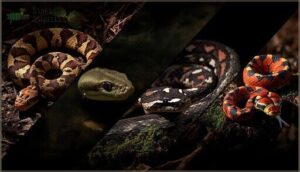
Knowing which venomous snakes live in your region can mean the difference between a calm response and a dangerous misstep.
The eastern United States hosts several pit vipers and one coral snake species, each with distinct features you can learn to recognize from a safe distance.
Let’s examine the four most common venomous snakes you’re likely to encounter and the specific markers that set them apart.
Timber Rattlesnake Identification
If you spot a heavy-bodied snake with dark chevron crossbands and a black tail bearing a distinctive rattle, you’re looking at a Timber Rattlesnake. This venomous snake identification relies on keeled scales, heat-sensing pits, and jagged V-shaped patterns ranging from yellow to gray.
Habitat analysis points to rocky forests where these rattlesnakes hide in leaf litter. Listen for rattle sounds—their warning before defensive strikes—and maintain distance to avoid venom effects.
Eastern Copperhead Characteristics
You’ll spot a Copperhead by its broad hourglass patterns that connect along the back, creating saddles across a copper-tan body. These venomous snakes blend into Copperhead habitat like wooded hillsides and leaf litter through exceptional snake camouflage.
Head shapes distinguish them from nonvenomous snakes—triangular with heat-sensing pits and vertical pupils. Adults measure 22 to 36 inches with weakly keeled scales. Watch for tail vibration when they’re threatened, and keep your distance.
Their venom delivery system requires immediate medical attention if you’re bitten. Snake identification means respecting venomous snake safety and awareness, especially in rocky swamps where they ambush prey.
Northern Cottonmouth Features
The Northern Cottonmouth earns its name from that startling Mouth Display—a white to yellowish interior that flashes open when you get too close. This venomous snake identification marker separates it from Nonvenomous Snakes like harmless watersnakes. Adults stretch 3.5 to 4.5 feet with a heavy, thick body and keeled Scale Texture that feels rough to the touch.
Their Habitat Preferences lean toward wetland edges, swamps, and slow-moving water where they bask on logs near shorelines. Watch for these key features:
- Olive brown to black coloration with variable dark crossbands
- Broad triangular head with distinct heat-sensing pits
- Cotton-white mouth lining displayed during Defensive Behavior
- Thick neck that’s noticeably narrower than the head
- Hemotoxic Venom Composition requiring immediate medical attention
Understanding Venomous Snake Safety and Awareness means recognizing this Cottonmouth before you’re within striking range.
Coral Snake Identification
Coral snakes rank among the most misidentified venomous species in North America, often confused with harmless mimics that share similar color patterns. You’ll find these secretive snakes in forested areas and sandy habitats across the southeastern United States, where they spend most of their time hidden under leaf litter or buried in loose soil. True coral snakes measure 12 to 30 inches long with smooth, glossy scales and a small head that blends into the neck.
Their distinctive pattern shows bright red, yellow, and black bands encircling the entire body—crucially, red bands touch yellow bands in venomous species. That color sequence separates them from scarlet kingsnakes, where red touches black instead.
Feature | Coral Snake | Mimic Species
— | — | —
Band Pattern | Red touches yellow | Red touches black
Head Shape | Small, not distinct | Slightly wider
Scale Texture | Smooth and glossy | Smooth but variable
Venomous symptoms include muscle weakness, slurred speech, and breathing difficulty, though effects may appear hours after a bite. When you encounter any brightly banded snake, maintain several feet of distance and contact wildlife authorities for proper Snake Identification.
Non Venomous Snake Identification
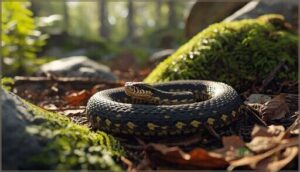
Most snakes you’ll encounter in the wild are harmless species, and learning to identify common non-venomous species can ease your concerns during outdoor activities. These species often display rounded heads, smooth scales, and consistent body patterns that distinguish them from their venomous counterparts.
Let’s examine several non-venomous snakes you’re likely to see, along with their key identifying features and the resources that can help you confirm what you’ve found.
Eastern Hog-nosed Snake Traits
An upturned snout sets the Eastern Hognosed Snake apart from other nonvenomous snakes you might encounter. This distinctive hog nose anatomy helps it burrow through sandy soil hunting toads, its exclusive prey.
When identifying snake species, look for keeled scales that create a rough texture along its stout body. Its defensive behaviors are theatrical—it flattens its neck cobra-style, hisses aggressively, then flips belly-up playing dead with tongue dangling. Don’t let this drama fool you; unlike venomous snakes, it’s completely harmless despite its convincing performance.
Northern Pine Snake Characteristics
You’ll recognize this impressive nonvenomous snake by its powerful build and distinctive pointed snout shape, stretching 4.5 to 6.5 feet as it moves through sandy pine forests. The Northern Pine Snake shows rough, keeled scale texture with color patterns of pale tan or cream marked by dark brown blotches. Its burrowing behavior sets it apart from venomous snakes—watch for that shovel-like rostral scale digging through loose soil.
Key identification features include:
- Heavy, cylindrical body with strongly keeled scales creating a rough texture
- Light background with dark brown to black dorsal blotches for woodland camouflage
- Enlarged, pointed snout perfectly adapted for burrowing through sandy soils
- Habitat preferences for well-drained pine barrens and open sandy woodlands
- Defensive hissing and mock strikes when threatened, despite being completely harmless.
Common Ribbonsnake and Eastern Garter Snake
You’ll encounter these two slender nonvenomous snakes in wetland habitats across their regional distribution, where aquatic adaptations help both thrive.
Eastern ribbonsnakes display three bright stripes on scale rows three and four, averaging 18 to 26 inches with keeled scale texture. Eastern garter snakes grow stockier at 24 to 54 inches, showing stripes positioned lower on their bodies.
Watch their defensive behaviors—ribbonsnakes flee to water while garter snakes strike and thrash when threatened.
Queen Snake and Eastern Glossy Swampsnake
Both snake species share wetland margins and crayfish-focused diets, yet you’ll distinguish them through careful observation. Queen Snakes show olive-brown bodies measuring 15 to 24 inches with smooth dorsal scales, thriving in rocky stream habitats where water quality enhances crayfish populations. Eastern Glossy Swampsnakes prefer slower marshes, displaying glossy black coloration.
- Snake identification: Queen Snakes feature light lateral striping absent in Swampsnakes
- Aquatic ecology: Species coexistence depends on habitat conservation and prey availability
- Snake behavior: Both nonvenomous snakes escape threats by diving underwater
Location-Specific Guides and Books
Field Guides authored by regional herpetologists give you the most reliable Snake Identification tools for your area. Look for Regional Directories that map Snake Species in Florida by county, showing where Venomous Snakes like rattlers overlap with Nonvenomous Snakes. Snake Encyclopedias provide thorough coverage, but you’ll find Local Histories from state wildlife agencies more practical for everyday encounters.
Geographic Maps in quality guides show habitat preferences—swamps for cottonmouths, uplands for pine snakes. Pair physical books with smartphone apps for quick field reference. Your state’s natural resources department often publishes free downloadable guides featuring all Florida Snakes, complete with scale counts and pattern photographs that confirm your observations.
| Guide Type | Content Focus | Best Source |
|---|---|---|
| State field guides | Native species profiles | Wildlife agencies |
| County directories | Local population data | Herpetological societies |
| Habitat atlases | Geographic distribution | University presses |
| Digital databases | Photo comparisons | Museum collections |
| Reference encyclopedias | Detailed taxonomy | Scientific publishers |
Safety Precautions and Emergency Procedures
Books and apps help you in the field, but knowing what to do during a live encounter matters even more. Safe Distance rules demand you stay at least six feet from any snake—whether you’ve confirmed Venomous Snake Identification or not. If a bite occurs, Bite First-Aid begins immediately: keep the affected limb below heart level, remove jewelry near the wound, and dial 911 without delay.
Wildlife Safety Precautions include these non-negotiable steps:
- Monitor for venom symptoms like nausea, rapid swelling, or breathing difficulty
- Avoid tourniquets or ice application, which worsen tissue damage
- Note the snake’s color and pattern to help medical staff
- Contact wildlife control for Snake Relocation instead of handling it yourself
- Seek Medical Attention for all bites, even from species you believe harmless
Snake Bite Prevention and Treatment protocols save lives when Venomous Snakes strike.
Frequently Asked Questions (FAQs)
Can you tell what type of snake by its shedded skin?
Herpetologists correctly classify roughly 70% of shed skins to genus level using scale texture examination and pattern identification. You can distinguish venomous snakes from nonvenomous snakes through skin texture examination, scale pattern identification, and shedding behavior study combined with species classification methods.
Can Google Lens identify snakes?
Yes, Google Lens can identify snakes through image analysis by comparing snake photos against its species database.
However, AI recognition has limitations—lens accuracy varies, so always verify venomous versus nonvenomous species using a trusted snake identification guide.
How can I tell what kind of snake I found?
You’ll think you’ve got it all figured out—until that “harmless” watersnake nearly makes your heart stop.
Note head shape, eye pupils, body patterns, and scale texture, then cross-check with regional guides for accurate snake identification.
Can I upload a picture to identify a snake?
You can upload a clear photo to snake ID apps that use AI identification and image recognition for instant visual verification.
These tools analyze pattern, color, and scale details to distinguish venomous snakes from nonvenomous species.
Is there a free app that identifies snakes?
Several free apps provide instant snake identification through photo recognition and AI identification capabilities.
Snake Snap, Snakesnap, and Snakefy offer mobile safety features, distinguishing venomous snakes from nonvenomous snakes while providing detailed reptile identification for various snake species.
What if you can’t identify the snake that bit you?
Medical response matters more than snake identification after a bite—call 911 immediately, keep your limb still, and describe the snake’s color, pattern, and size to emergency responders for proper venom effects assessment.
How do I tell what kind of snake I found?
You’ll need to observe head shape, pupil form, body patterns, and scale texture from a safe distance.
Triangular heads with elliptical pupils and heat-sensing pits usually indicate venomous species in your habitat.
Is there an app that identifies snakes?
Your smartphone can become a powerful field guide with specialized snake ID apps.
Tools like Snakes Snap, Snake Name, and Snakefy use AI identification to analyze photos, offering quick venom detection and species data.
How do you differentiate juvenile snakes from adults?
You can tell juvenile snakes apart by their brighter color patterns, proportionally larger heads and eyes, slimmer body girth, and smoother scale texture compared to the tougher, more uniformly textured scales of adults.
What behaviors indicate a snake is about to strike?
A coiled body anchors the strike, while the head lifts and locks on you.
Watch for an S-shaped neck, flicking tongue, open mouth revealing fangs, and tail vibration—classic defensive posturing signaling imminent attack.
Conclusion
Studies show that over 7,000 venomous snake bites occur annually in North America, yet nearly half involve people who attempt to handle or kill the snake.
When you learn how to identify common snake species accurately, you replace fear-driven reactions with informed decisions. The field marks you’ve studied—pupil shape, scale patterns, head structure—become second nature with practice.
Distance and observation beat confrontation every time, because identification skills don’t just protect you; they protect the snakes too.