This site is supported by our readers. We may earn a commission, at no cost to you, if you purchase through links.

Most people don’t think twice about their thermostat—until it becomes a problem. For older adults, a tiny screen, fiddly buttons, or a confusing menu can turn a simple temperature adjustment into a daily frustration.
Thermostats for seniors have come a long way. Today’s best models offer large backlit displays, voice control through Alexa or Google Assistant, and even remote access so a family member can check in from miles away. Some learn your schedule automatically. Others strip everything back to two buttons and a clear number.
The right choice depends on what matters most—ease, independence, or energy savings.
Table Of Contents
- Key Takeaways
- 10 Best Thermostats for Seniors
- 1. Google Nest Smart Thermostat
- 2. Honeywell T9 Smart Thermostat
- 3. Emerson Sensi Touch Smart Thermostat
- 4. Ecobee Smart Thermostat with Alexa
- 5. Riseem Non Programmable Thermostat
- 6. Suuwer Digital Thermostat Single Stage Heating
- 7. Garystat Digital Non Programmable Thermostat
- 8. Suuwer Non Programmable Digital Thermostat
- 9. Heagstat Non Programmable Thermostat
- 10. Aowel Non Programmable Thermostat
- Senior-Friendly Features to Prioritize
- Smart Vs Non-Programmable Thermostats
- Compatibility and Installation Basics
- Choosing by Senior Needs
- Frequently Asked Questions (FAQs)
- What is the best thermostat setting for seniors?
- Is 72 a good temperature for heat in the winter for seniors?
- What is the best thermostat setting for the elderly?
- What thermostat is good for people with poor eyesight?
- What is the best thermostat for seniors?
- What temperature should a house be in winter for the elderly?
- Can thermostats help reduce monthly energy bills?
- What temperature range is safest for seniors?
- Do smart thermostats work during power outages?
- How often should thermostats be replaced?
- Conclusion
Key Takeaways
- Smart thermostats like the Google Nest and Ecobee offer voice control, remote caregiver access, and automatic scheduling — making them the strongest choice for seniors who want hands-free comfort and family peace of mind.
- For seniors who prefer simplicity over technology, non-programmable models like the Heagstat H701 and Aowel AW701 deliver large backlit displays, oversized buttons, and battery-powered installation with zero learning curve.
- The features that matter most for senior users — high-contrast displays, tactile buttons, voice control, and caregiver monitoring — directly address common challenges like vision loss, limited dexterity, and living alone.
- Before buying any thermostat, confirm your home’s HVAC type and whether you have a C-wire, since these two factors determine which models will actually work in your home.
10 Best Thermostats for Seniors
Finding the right thermostat doesn’t have to feel overwhelming. The ten options below cover everything from voice-controlled smart models to simple one-knob designs — so whether you’re tech-savvy or prefer to keep things straightforward, there’s something here for you. Here’s a closer look at each one.
If you’re just getting started, this guide to thermostats for beginners walks you through exactly what to look for before you buy.
1. Google Nest Smart Thermostat
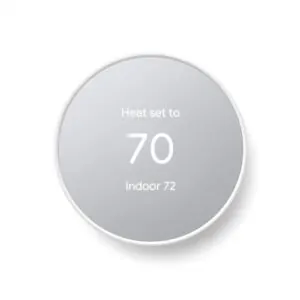
The Google Nest Smart Thermostat earns its spot at the top for good reason. It learns your schedule within the first week and adjusts automatically — so you’re not fiddling with settings every day. Remote control via the Google Home app means a family member can check or change the temperature from miles away.
It’s ENERGY STAR certified and works with Matter, so it plays nicely with most smart home setups. At just 3.2 ounces, installation is surprisingly simple too.
| Best For | Homeowners who want a hands-off, energy-saving thermostat that fits into a Google or Matter-based smart home setup. |
|---|---|
| Connectivity | Wi-Fi 2.4/5 GHz + Bluetooth LE |
| Voice Control | Google Assistant, Matter |
| Smart App Control | Yes (Google Home app) |
| Power Source | 24V hardwired (C-wire or accessory) |
| Display Type | 1.07-inch touchscreen |
| HVAC Compatibility | Forced air, limited heat pump |
| Additional Features |
|
- Automatically learns your schedule and adjusts temperatures without any manual input
- Energy Star certified, helping cut down monthly heating and cooling costs
- Works with Matter and Google Assistant, making it easy to add to an existing smart home
- Some HVAC systems may need a C wire or extra power accessory to install
- Doesn’t support simultaneous 2-stage heating and 2-stage cooling, limiting compatibility with certain systems
- All remote features depend on a stable Wi-Fi connection and the Google Home app
2. Honeywell T9 Smart Thermostat
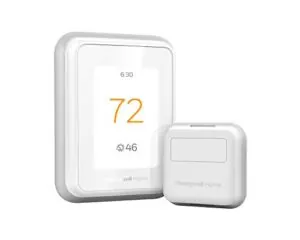
Where the Nest shines on simplicity, the Honeywell T9 wins on awareness. Its standout feature is the Smart Room Sensor system — small wireless sensors you place in bedrooms, living rooms, or wherever comfort matters most. The thermostat then prioritizes those spaces, so you’re not heating an empty hallway while the bedroom stays cold.
The full-color touchscreen is clear and easy to read, and it pairs with Alexa or Google Assistant for hands-free control. ENERGY STAR certified, too.
| Best For | Homeowners with multi-room comfort challenges, large or multi-story homes, or anyone who wants room-by-room temperature control without constant manual adjustments. |
|---|---|
| Connectivity | Wi-Fi 2.4/5 GHz |
| Voice Control | Alexa, Apple HomeKit, Google Assistant |
| Smart App Control | Yes (Resideo app) |
| Power Source | 24V control system (C-wire or adapter) |
| Display Type | Color touch display |
| HVAC Compatibility | Forced air, hot water, steam, heat pump |
| Additional Features |
|
- Smart Room Sensors actively prioritize occupied spaces, eliminating hot and cold spots throughout the home
- Works with Amazon Alexa, Apple HomeKit, and Google Assistant for seamless voice and smart home control
- ENERGY STAR certified with utility demand response support, making it a solid choice for cutting energy bills
- Incompatible with electric baseboard heating (120–240V systems), limiting who can use it
- Advanced settings can only be changed on the thermostat itself — not through the app — which feels like a step backward
- Sensor mounting uses double-sided tape, which may not hold reliably on all wall surfaces without extra hardware
3. Emerson Sensi Touch Smart Thermostat
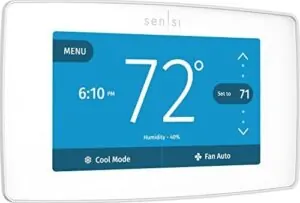
The Sensi Touch hits a sweet spot — smart enough to be genuinely useful, but not so complicated it becomes a chore. Its full-color HD touchscreen is easy to read, even from across the room, and the backlit display makes nighttime glances easy without any fumbling.
Geofencing and 7-day scheduling work quietly in the background, cutting energy use by around 23%. It connects with Alexa, Google Assistant, and Apple HomeKit, and installation usually wraps up in under 30 minutes.
| Best For | Homeowners who want a capable smart thermostat that’s easy to install and works with all the major voice assistants without a steep learning curve. |
|---|---|
| Connectivity | Wi-Fi 2.4 GHz only |
| Voice Control | Alexa, Apple HomeKit, Google Assistant, SmartThings |
| Smart App Control | Yes (Sensi app) |
| Power Source | C-wire required (adapter supported) |
| Display Type | Backlit touch display |
| HVAC Compatibility | AC, boiler, furnace, heat pump |
| Additional Features |
|
- Saves around 23% on energy bills through geofencing and flexible 7-day scheduling
- Works with Alexa, Google Assistant, Apple HomeKit, and Samsung SmartThings
- Quick DIY setup — most people are done in under 30 minutes
- Requires a 2.4GHz Wi-Fi network, which can cause headaches with routers that blend 2.4GHz and 5GHz signals
- Full remote features are only available to users in the USA and Canada
- Needs a C-wire connection, which not every older home has in place
4. Ecobee Smart Thermostat with Alexa
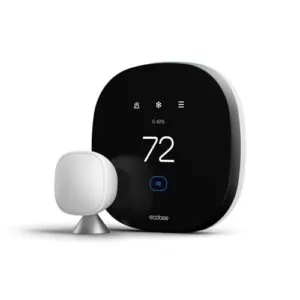
The Ecobee takes things up a notch. Its 4-inch glass touchscreen is sharp and easy to read, and the built-in Alexa speaker means you can adjust the temperature, check the weather, or even make a call — all without touching a thing.
The included SmartSensor detects occupancy, so your home stays comfortable wherever you actually are. Eco+ mode quietly saves energy when you’re asleep or out. Remote app access lets caregivers check in anytime.
| Best For | Homeowners who want hands-free voice control, smart home integration, and energy savings without sacrificing style or convenience. |
|---|---|
| Connectivity | Dual-band Wi-Fi + Bluetooth 5.0 |
| Voice Control | Alexa, Google Assistant, Apple HomeKit, SmartThings |
| Smart App Control | Yes (mobile, tablet, smartwatch) |
| Power Source | C-wire or included power adapter |
| Display Type | Vivid touch display |
| HVAC Compatibility | Heat pump systems |
| Additional Features |
|
- Built-in Alexa lets you control temperature, music, and calls completely hands-free
- The included SmartSensor eliminates hot and cold spots by tracking where you actually spend time
- Eco mode and GeoFencing can cut annual heating and cooling costs by up to 23%
- Requires a stable 2.4 GHz Wi-Fi connection and may need a C-wire or power adapter for some HVAC setups
- Alexa features may be limited or unavailable depending on your region
- Time zone and date settings need to be configured through a web browser, which adds a small setup hurdle
5. Riseem Non Programmable Thermostat
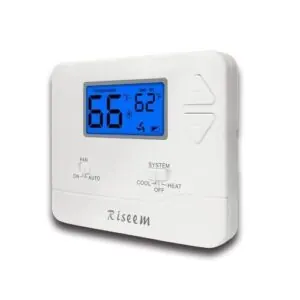
Sometimes simple is exactly right. The Riseem Non Programmable Thermostat skips the apps, schedules, and setup headaches — giving you a clear backlit LCD display and two buttons to raise or lower the temperature. That’s it.
It runs on 24VAC or AAA batteries, installs in under 30 minutes, and works with forced air, gas, and electric furnaces. The adjustable swing setting even prevents annoying short cycling in drafty rooms. Clean, quiet, no learning curve required.
| Best For | Anyone who wants straightforward, no-fuss temperature control without apps, schedules, or complicated setup. |
|---|---|
| Connectivity | None |
| Voice Control | None |
| Smart App Control | No |
| Power Source | 24VAC or 2 AAA batteries |
| Display Type | Backlit LCD |
| HVAC Compatibility | Forced air, electric furnace, gas fireplace |
| Additional Features |
|
- Simple two-button operation with a clear backlit LCD — no learning curve at all
- Flexible power options (24VAC or AAA batteries) and fast DIY install in under 30 minutes
- Adjustable swing setting helps prevent short cycling, which is great for drafty spaces
- Not compatible with heat pumps, mini splits, or dual fuel/hybrid systems
- Requires a C-wire for heat-only or cool-only setups, which some older homes may lack
- Battery life takes a hit if the C terminal isn’t connected to 24VAC power
6. Suuwer Digital Thermostat Single Stage Heating
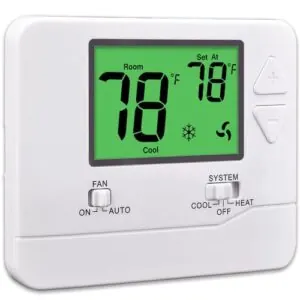
Cut from the same cloth as the Riseem, the Suuwer Digital Single Stage takes no-fuss living seriously. Its large backlit LCD makes the numbers easy to read at a glance — even in dim hallways — and the oversized push buttons don’t require a steady hand.
It runs on 24VAC or AAA batteries, covers a range of 44°F to 90°F, and holds temperature within 1°F. No C-wire needed. Works with gas, oil, and electric furnaces — just not heat pumps.
| Best For | Seniors or anyone in an older home who wants a dead-simple thermostat they can read and adjust without fuss — no smart features, no C-wire, no hassle. |
|---|---|
| Connectivity | None |
| Voice Control | None |
| Smart App Control | No |
| Power Source | 24VAC or 2 AAA batteries |
| Display Type | Large green backlit LCD |
| HVAC Compatibility | Gas, oil, electric furnace (single-stage) |
| Additional Features |
|
- Large backlit display with oversized buttons makes it genuinely easy to use, especially in low light or for those with limited dexterity
- No C-wire required, so it drops right into older wiring setups without any extra work
- Runs on batteries or hardwired 24VAC, giving you flexibility if your system doesn’t supply power to the thermostat
- Won’t work with heat pumps, multi-stage systems, or mini-splits — compatibility is limited to single-stage heating
- No programmable scheduling, so you’ll be adjusting it manually every time you want a change
- Installation requires manual configuration of a gas/electric switch on the back, which may trip up less handy users
7. Garystat Digital Non Programmable Thermostat
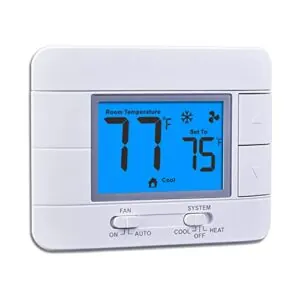
The Garystat G701 keeps things refreshingly uncomplicated. No C-wire, no scheduling menus — just a bright blue-backlit LCD that shows temperature and humidity clearly, even in a dim room.
It runs on 24VAC or two AAA batteries and holds temperature within ±1 degree. A built-in 3-minute compressor delay protects your HVAC from short cycling. Works with single-stage gas, oil, or electric furnaces — not heat pumps or multi-stage systems.
Simple buttons, easy wiring, and a 2-year warranty. Reliable and fuss-free.
| Best For | Anyone who wants straightforward temperature control without the fuss — especially elderly users or those with vision impairments who appreciate the large, bright display. |
|---|---|
| Connectivity | None |
| Voice Control | None |
| Smart App Control | No |
| Power Source | 24VAC or 2 AAA batteries |
| Display Type | Large blue backlit LCD |
| HVAC Compatibility | Single-stage gas, oil, electric furnace |
| Additional Features |
|
- Large blue-backlit LCD makes it easy to read temperature and humidity at a glance, even in low light
- Runs on 24VAC or AAA batteries, so no C-wire is needed for installation
- Built-in 3-minute compressor delay protects your HVAC system from short cycling damage
- Not compatible with heat pumps, multi-stage systems, or hydronic/mini-split setups
- No programmable scheduling, so you’ll need to adjust the temperature manually
- Limited to single-stage systems only, which may not suit more complex home HVAC configurations
8. Suuwer Non Programmable Digital Thermostat
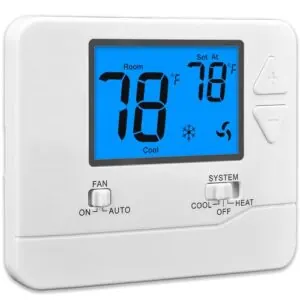
The Suuwer S701 takes the same no-fuss approach as the Garystat — but stretches the temperature control range to 44°F–90°F, giving you a little more flexibility. The blue backlit display reads clearly across the room, and the adjustable temperature swing (0.2°F to 2°F) lets you fine-tune how often your system kicks on.
It runs on 24VAC or two AAA batteries, skips the C-wire entirely, and includes a 5-minute compressor delay. Backed by a 2-year warranty and 24/7 support.
| Best For | Anyone who wants a straightforward, no-frills thermostat — especially elderly users or DIYers who’d rather just set a temperature and forget it. |
|---|---|
| Connectivity | None |
| Voice Control | None |
| Smart App Control | No |
| Power Source | 24VAC or 2 AAA batteries |
| Display Type | Large blue backlit digital display |
| HVAC Compatibility | Conventional single-stage heating and cooling |
| Additional Features |
|
- Wide 44°F–90°F control range gives you more flexibility than most basic thermostats
- Works without a C-wire and runs on batteries as a backup, making installation easy
- The blue backlit display and adjustable temperature swing make it easy to read and fine-tune
- Only works with single-stage systems — no heat pumps, mini-splits, or multistage setups
- Requires manual configuration of a gas/electric switch during installation
- Not compatible with electric baseboard heaters or hydronic systems
9. Heagstat Non Programmable Thermostat
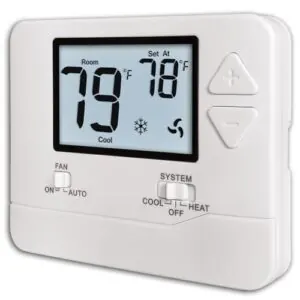
The Heagstat H701 keeps things refreshingly straightforward. Its 4.5-inch backlit LCD is one of the largest displays in this price range — easy to read from across the room, day or night.
It runs on 24VAC or two AAA batteries, so a C-wire isn’t required. You also get a built-in compressor delay and manual temperature calibration. One thing to confirm: it’s designed for single-stage systems only, so check your setup before purchasing.
| Best For | Anyone who wants a simple, no-fuss thermostat — especially seniors or those with visual impairments who’ll appreciate the large, easy-to-read display. |
|---|---|
| Connectivity | None |
| Voice Control | None |
| Smart App Control | No |
| Power Source | 24VAC or 2 AAA batteries |
| Display Type | Large 4.5-inch backlit LCD |
| HVAC Compatibility | Forced air gas/oil/electric, ventilation, AC |
| Additional Features |
|
- Huge 4.5-inch backlit LCD is one of the most readable displays at this price point
- Flexible power options (24VAC or AAA batteries) mean no C-wire needed
- Built-in compressor delay and manual calibration add useful protection and accuracy
- Only works with single-stage systems — not compatible with heat pumps, multi-stage, or baseboard heating
- Batteries and mounting hardware aren’t included
- No programming options at all, so scheduling temperature changes requires manual adjustment
10. Aowel Non Programmable Thermostat
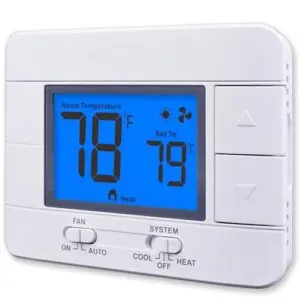
The Aowel AW701 takes a no-frills approach that many seniors genuinely appreciate. Its large backlit display shows temperatures clearly, and the controls are straightforward — no menus to wade through, no scheduling to figure out.
It runs on 2 AAA batteries, with a C-wire optional, making installation easier in older homes. A built-in 3-minute compressor delay protects your HVAC equipment. Just note it’s single-stage only — not suited for heat pumps or multi-stage systems.
| Best For | Seniors and budget-conscious homeowners who want simple, reliable temperature control without complicated programming or touchscreens. |
|---|---|
| Connectivity | None |
| Voice Control | None |
| Smart App Control | No |
| Power Source | 2 AAA batteries (C-wire optional) |
| Display Type | Large backlit LCD |
| HVAC Compatibility | Conventional single-stage gas/oil/electric |
| Additional Features |
|
- Large backlit display makes temperatures easy to read at a glance
- Runs on batteries with optional C-wire, so it works well in older homes without extra wiring
- Built-in 3-minute compressor delay helps protect your HVAC system from wear
- Not compatible with heat pumps, multi-stage systems, or mini-splits
- No programming or scheduling features for those who want set-it-and-forget-it convenience
- Requires AAA batteries, which need replacing over time if you skip the C-wire
Senior-Friendly Features to Prioritize
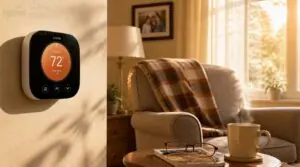
Not every thermostat is built with seniors in mind — and the difference really shows in daily use. A few key features can make all the difference between a device that frustrates and one that just works. Here’s what to look for before you buy.
Large Backlit Displays
Squinting at a dim thermostat screen is nobody’s idea of a good morning.
A large backlit display — usually 3 to 5 inches — makes reading the temperature easy, even without glasses nearby. Anti-glare coatings cut down on reflections, while color temperature tuning shifts the light from cool white to warmer tones depending on the room. Most modern displays also maintain viewing angle consistency, so the numbers stay sharp whether you’re standing straight or glancing from the side.
High-contrast Screen Readability
A bright screen means nothing if the numbers blur into the background. Look for black digits on white — or dark text on off-white — with a luminance contrast ratio of at least 4.5:1, which meets WCAG standards for readability. Proper color contrast guidelines(color contrast rules) are essential for enhancing readability.
Thin font strokes and light gray text are the real culprits behind squinting. Bold, thick characters with consistent stroke width keep things sharp at a glance.
Oversized Buttons
Sharp contrast helps you read the screen — but finding the right button to press matters just as much. Oversized buttons, usually 14–20mm across, cut mis-taps by roughly 20% compared to smaller targets.
Many thermostats pair them with haptic feedback and a quick color change on press, so you always know your tap registered. No guessing, no second-pressing.
Voice Control Support
Buttons get you far — but sometimes you just want to say it out loud. Most smart thermostats now work with Alexa, Google Assistant, or Siri, so adjusting the temperature is as simple as asking.
Say "make it warmer," and the thermostat responds with an audio confirmation cue so you know it worked. No touching required — true hands-free management.
Remote Caregiver Access
When a family member lives alone, peace of mind matters as much as comfort. Smart thermostats for seniors let caregivers check in remotely — viewing real-time temperatures, receiving anomaly alerts, and adjusting settings without driving over.
Shared account permissions mean a daughter in another city and a visiting nurse get exactly the access they need. Nothing more, nothing less.
Smart Vs Non-Programmable Thermostats
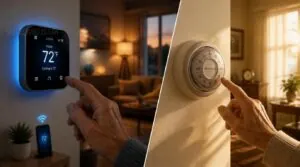
Choosing between a smart thermostat and a non-programmable one isn’t just about technology — it’s about what actually fits your life. Both have real advantages depending on how you like to manage your home and how comfortable you are with new gadgets. Here’s a breakdown of the key factors worth thinking through before you decide.
Best Smart Thermostat Uses
A smart thermostat works best when your life has a rhythm — regular wake times, outings, and bedtimes. Automated geofencing settings quietly lower heating or cooling the moment you leave, then bring everything back to comfort before you’re even in the driveway.
| Smart Feature | Senior Benefit |
|---|---|
| Occupancy-based heating | Warms only lived-in rooms |
| Remote caregiver monitoring | Caregivers check temps anytime |
| Voice assistant routines | Hands-free, no buttons needed |
| Energy-saving schedules | Cuts costs up to 15% |
Voice control lets you adjust the temperature mid-conversation — no squinting at a screen required.
Simple Manual Operation
Sometimes the best thermostat is the one that just works without thinking. Turn a knob, feel it click — done. No app, no Wi-Fi, no guessing.
| Control Action | What It Does | Senior Benefit |
|---|---|---|
| Rotate dial | Changes temperature instantly | Immediate, offline control |
| Press HOLD button | Locks current setpoint | No accidental schedule changes |
| Toggle fan switch | Switches auto/on mode | Predictable, one-step adjustment |
That tactile knob feedback? Deeply reassuring. You always know exactly where you stand.
Learning Curve Concerns
Learning a new app takes real time — setup alone runs 20–40 minutes, and pairing can add another 15–25 more.
| Hurdle | What Slows You |
|---|---|
| App menus | Features buried under taps |
| Voice commands | Requires exact phrasing |
| Scheduling | 4–6 steps per day |
| Troubleshooting | Updates reset pairing |
| Setup | 60 min with old systems |
The good news? Presets cut that learning time by about 40%.
Privacy Considerations
Smart thermostats collect your name, address, and temperature habits — and data consent matters.
| What Gets Collected | Your Control |
|---|---|
| Location & usage data | Turn off in settings |
| Voice recordings | Disable cloud processing |
| Diagnostic data | Opt out anytime |
| Third-party sharing | Restrict via privacy dashboard |
Your right to delete or export data is protected under frameworks like GDPR and CCPA. Non-programmable models collect nothing.
Long-term Energy Savings
Over a year, a smart thermostat’s energy savings quietly add up — cutting annual energy use by 5 to 15 percent through smarter scheduling alone. Pair that with HVAC efficiency upgrades and you’re looking at real money back.
| Feature | Smart Thermostat | Non-Programmable |
|---|---|---|
| Annual energy savings | 5–15% | Minimal |
| HVAC efficiency boost | Up to 30% with zoning | None |
| Renewable energy connection | Yes, via app scheduling | No |
Behavioral monitoring tools help you spot waste fast.
Compatibility and Installation Basics
Before you buy anything, it’s worth taking a few minutes to make sure a thermostat will actually work with your home’s heating and cooling setup. Not every model plays nicely with every system — and a little homework now saves a lot of headaches later. Here’s what to check before you commit.
C-wire Requirements
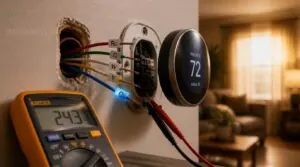
Before installing any smart thermostat, check whether your home’s wiring includes a C-wire — a small but critical conductor that delivers continuous 24VAC power to run displays and Wi-Fi. Without it, many smart models reboot unexpectedly.
No C-wire? Don’t worry. Power adapter solutions like a Common Wire Kit can simulate one. When in doubt, a multimeter confirms 24-volt potential between terminals.
Heat Pump Compatibility
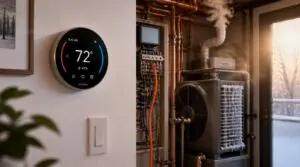
Heat pumps play by different rules than standard furnaces. They need a thermostat that can handle reversing valve controls, auxiliary heat sequencing, and defrost cycle management — all at once.
Check the manufacturer’s compatibility list before buying. Many seniors have heat pumps without realizing it. If yours has an "O" or "B" wire terminal, that’s your sign.
Single-stage HVAC Systems
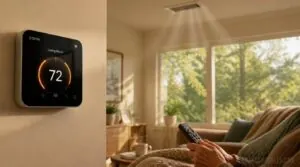
Most homes run on a single-stage heating and cooling system — one speed, full power, then off. Simple as a light switch.
That simplicity is actually good news: almost any thermostat works with it, including the easiest, most senior-accessible options available. Just confirm your system uses standard two-wire or four-wire connections, and you’re ready to shop with confidence.
Battery-powered Models

Some thermostats skip wiring entirely — running on AAA batteries or rechargeable lithium-ion cells instead.
For seniors wanting plug-and-play ease, that’s a real win. Here’s what battery-powered models bring:
- 2–8 hours runtime on a single charge
- Lithium-ion cells — compact and long-lasting
- Built-in safety cutoffs for overcharge protection
- Quick battery swaps — no tools required
Professional Installation Needs
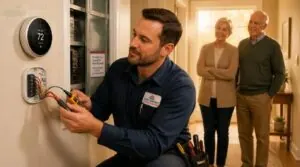
Calling in a pro isn’t admitting defeat — it’s just smart planning.
A technician will check HVAC compatibility, confirm your C-wire is present, and mount the device at the code-required 48–60 inches from the floor. They’ll also test heating and cooling cycles, verify Wi-Fi pairing, and make sure everything meets electrical code compliance. Peace of mind, fully installed.
Choosing by Senior Needs
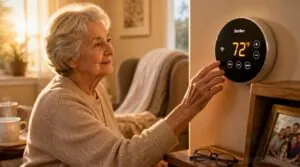
Not every senior has the same needs — and the best thermostat is the one that actually fits your life. Whether you’re managing low vision, stiff fingers, a tight budget, or just want a family member to check in remotely, there’s a solid option on this list for you. Here’s how each priority breaks down.
Visual Impairment Support
Losing sharp vision doesn’t mean losing control of your comfort. Thermostats with large backlit displays — 3 to 5 inches, with high-contrast black digits on white backgrounds — make reading settings genuinely easy.
Some models even support Braille markings for tactile navigation, while screen reader apps can translate on-screen menus into spoken feedback. That’s real independence, built right into the device.
Limited Dexterity Controls
Stiff joints and shaky hands shouldn’t turn a simple temperature tweak into a frustration. That’s why tactile button feedback and raised profile controls matter so much — your fingers know they’ve pressed something without needing to look twice.
- Single-action navigation keeps adjustments to one move
- Rocker-style switches and easy-to-turn dials need no precision grip
- Large, spaced buttons prevent accidental presses
Simple. Reliable. Built for real hands.
Caregiver Monitoring Features
When someone you love lives alone, peace of mind can feel hard to hold onto.
Smart thermostats with remote monitoring capabilities let caregivers check in without hovering — tracking activity patterns, receiving real-time emergency alerts, and adjusting settings from miles away. Some even log medication adherence and flag unusual routines. It’s quiet oversight that respects independence while keeping safety close.
Smart thermostats let caregivers monitor loved ones from miles away — quiet oversight that protects independence while keeping safety close
Fixed-income Energy Savings
Every dollar counts on a fixed income — and the right thermostat can quietly trim your utility bills year-round.
Energy-saving programs worth exploring:
- Bond-funded upgrades cover HVAC and insulation costs upfront
- Municipal prepay financing offers low interest rates
- Low-income eligibility unlocks rebates and subsidies
- Savings verification protocols confirm real bill reductions
- ENERGY STAR thermostats cut annual energy costs noticeably
Reliability and Maintenance
A thermostat that quietly fails you isn’t just inconvenient — it’s a safety risk.
That’s why hardware durability matters. Look for models with surge protection and humidity-resistant circuit boards, which hold up in typical home conditions without fuss. Weekly self-diagnostic alerts flag problems before they become breakdowns, and firmware updates install safely with automatic rollback if something goes wrong. Peace of mind, built right in.
Frequently Asked Questions (FAQs)
What is the best thermostat setting for seniors?
Around 78°F in summer and 68°F in winter keep most seniors comfortable and safe. At night, dropping to 66–68°F helps you sleep better. Humidity around 40–50% helps breathing, too.
Is 72 a good temperature for heat in the winter for seniors?
Yes, 72°F is a safe, comfortable winter setting for most seniors. It stays within the recommended 68°F–74°F range and helps offset poor circulation, reducing hypothermia risk without overheating the home.
What is the best thermostat setting for the elderly?
68–74°F suits most seniors during the day. Drop bedrooms to around 65–66°F for better sleep. Bathrooms stay safest at 71–75°F. Never let any room fall below 65°F — that’s where hypothermia risk climbs.
What thermostat is good for people with poor eyesight?
Large high-contrast numbers and a backlit digital display are your best friends here. Look for bold black digits on a bright background — at least 1 inch tall — plus audible feedback and Braille markings for added confidence.
What is the best thermostat for seniors?
Staying comfortable at home is about more than temperature — it’s peace of mind. The Google Nest Smart Thermostat is the top pick for most seniors, thanks to its large display and simple swipe controls.
What temperature should a house be in winter for the elderly?
Keep your home at 68–70°F (20–21°C) through winter. Living areas do best at 70°F, bedrooms no lower than 64°F (18°C), and bathrooms warmer — around 71–75°F — to prevent cold shock.
Can thermostats help reduce monthly energy bills?
Like a watchful helper that never sleeps, a smart thermostat cuts waste through geofencing efficiency and occupancy sensing — trimming energy usage by 10 to 33 percent, which means real savings on your monthly bill.
What temperature range is safest for seniors?
Most seniors stay safest when indoor temperatures hold between 68°F and 74°F during the day. At night, dropping to 65°F–70°F is fine — but never let rooms dip below 65°F.
Do smart thermostats work during power outages?
Smart thermostats work partially during outages — local controls stay active, backup batteries last 3–5 hours, but cloud features and remote access drop until power and Wi-Fi return.
How often should thermostats be replaced?
Most thermostats last 10 to 15 years. If yours drifts more than two degrees, drops connections, or needs constant rebooting, it’s time to replace it — don’t wait for a full breakdown.
Conclusion
What’s stopping someone you love from staying comfortable and independent at home? The right thermostat changes that.
The best thermostats for seniors aren’t just devices—they’re quiet reassurances that daily comfort doesn’t require a tech degree. Whether you’re choosing large buttons and simple controls or a smart model a caregiver can monitor remotely, the goal is the same: less frustration, more ease.
Find the fit, set the temperature, and let home feel like home again.