This site is supported by our readers. We may earn a commission, at no cost to you, if you purchase through links.

A rat goes in whole, skull and spine and all. A few days later, almost nothing of it remains.
So how do snakes digest bones? Chemistry does the heavy lifting. Within hours of a meal, your snake’s stomach turns from nearly neutral to harshly acidic, and that acid strips the minerals right out of the skeleton. Enzymes then dismantle what’s left.
This matters because it explains your snake’s feeding schedule, its enclosure temperatures, and what shows up in its waste. Get one wrong and digestion stalls.
Here’s what happens inside, from the first gulp to the final fecal pellet.
Table Of Contents
- Key Takeaways
- How Do Snakes Digest Bones?
- How Do Snakes Swallow Bones Without Chewing?
- How Do Snakes Absorb Minerals From Bones?
- How Long Does Bone Digestion Take?
- How Does Temperature Affect Bone Digestion?
- What Happens to Undigested Bones and Fur?
- Frequently Asked Questions (FAQs)
- Do snakes feel pain when cut?
- How does snake digestion work?
- Can a snake break human bones?
- What do snakes do with the bones they eat?
- What happens to bones that snakes eat?
- How do snakes break bones?
- How does a snake digest whole animal?
- Can reptiles digest bones?
- Can snakes vomit up prey if they overeat?
- How long can snakes go between meals?
- Conclusion
Key Takeaways
- Your snake’s stomach swings from nearly neutral to about pH 1.5 within hours of a meal, and that acid dissolves the minerals in bone while enzymes like pepsin break down the collagen left behind.
- Specialized gut cells trap the calcium and phosphate released from bone and send the surplus out in the feces, so your snake gets the nutrition without a toxic calcium overload.
- Digestion depends on warmth: keep a thermal gradient with a basking spot around 31-33°C (88-91°F) and never let the cool end fall below 15°C (59°F), or digestion can stall and the meal may be regurgitated or rot.
- Bones dissolve completely, but fur, feathers, and claws pass through unchanged because keratin resists every enzyme, so hair in the stool is normal, while recognizable prey in the enclosure means regurgitation.
How Do Snakes Digest Bones?
Ever wondered how a snake turns a whole rat, bones and all, into fuel? Your snake pulls it off with a two-part chemical attack inside its stomach. Here’s how bone digestion works, step by step.
Because whole prey already delivers the calcium and vitamin D3 your snake needs, it helps to review common snake feeding mistakes to avoid before adding unnecessary supplements.
Stomach Acid Dissolves Bone Minerals
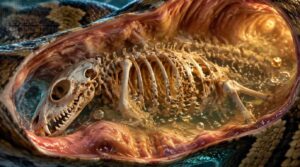
A swallowed skeleton sounds like a problem, doesn’t it? Your snake solves it with stomach acid. Once prey lands, gastric pH plunges from 7.5 to 1.5, and hydrochloric acid floods in.
That acid attacks calcium phosphate, the mineral that makes bone hard. Bone mineral dissolution starts fast and keeps going for days.
Researchers have also found that pythons have a specialized intestinal cell that processes the calcium and phosphorus released from bone and excretes any excess minerals.
No chewing needed, no pellets, no real fuss.
Digestive Enzymes Break Down Collagen
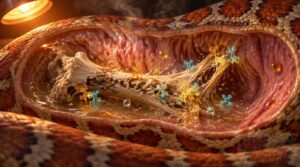
Acid dissolves the mineral, but what about the bone’s flexible scaffold? That’s collagen, and your snake’s proteolytic enzymes handle it.
Because fur passes through undigested, snakes eventually expel it as waste, and this step-by-step look at how snakes digest bones and fur walks through the whole process.
Hydrochloric acid secretion also switches on pepsin, which starts collagen breakdown. Gastric acid potency does the rest by loosening the fibers.
- Pepsin begins the work.
- Pancreatic enzymes finish fragments.
- Enzyme activity peaks in warmth.
How Do Snakes Swallow Bones Without Chewing?

So how does a rat fit through a mouth smaller than its body? Your snake doesn’t chew. It engineers its way around the problem.
Its flexible jaws do the heavy lifting. The two lower halves aren’t fused, so your snake walks them over the meal, one side gripping while the other advances. Here’s what happens next:
- Backward-curving teeth hook the prey and dig in as it struggles.
- Elastic ligaments stretch the jaw wide.
- The quadrate bone swings the jaw outward.
- Highly elastic skin expands around the meal.
- The glottis pokes out, so your snake keeps breathing.
Once the rat slides into the muscular stomach, powerful stomach acid starts the dissolution of most bone material. No chewing required. Just pure patience.
Larger meals, cooler enclosures, and a snake’s size all shift the timeline, so this guide to how long snakes take to digest their food helps owners plan feeding schedules.
How Do Snakes Absorb Minerals From Bones?
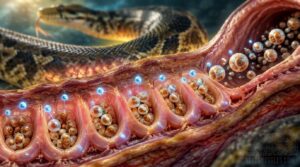
Once the acid finishes its work, what happens to all that dissolved bone? Your snake faces a problem. Bone dissolution floods the gut with calcium, and too much calcium in the blood is dangerous.
Intestinal calcium transporters handle the normal flow, but your snake adds a backup. Specialized cells line the gut with cup-shaped crypts. Here’s how they work:
- Calcium and phosphate ions from dissolved bone enter the cells.
- The cells pack them into layered particles around iron-rich cores.
- Those particles leave in the feces, not the bloodstream.
That’s smart calcium absorption control. Mineral bioavailability stays high, nutrient uptake continues, and the surplus walks out the back door. Your snake keeps what it needs and skips the toxic overload entirely.
How Long Does Bone Digestion Take?

How long does bone digestion actually take? Shorter than you’d guess, and longer than you’d like if you’re the one waiting.
Digestion duration depends mostly on what’s on the menu. A mouse is done in a few days. A rabbit or pig can take weeks. Bone dissolution in rodent-sized meals needs about six days of steady acid output, and the stomach holds a highly acidic environment at roughly pH 1.5 the whole time. Keeping the enclosure’s warm side steady matters too, since a digital thermometer hygrometer helps you confirm temperatures stay in range for proper digestion.
Here’s what shapes the timeline:
- Prey size and bone mass
- Species, since pythons and boas run slower than frequent feeders
- Meal volume, because the stomach stretches 40 to 100 percent
- Digestive enzymes activity, which ramps up as metabolism surges
Soft tissue goes first. Bones linger last.
How Does Temperature Affect Bone Digestion?

A chilly snake with a full belly is in trouble. Why? Because bone digestion is temperaturedependent digestion, plain and simple. Digestive enzymes activity climbs as your snake warms, and the enzyme thermal optimum sits around 28-33°C (82-91°F).
Here’s how to get it right:
- Build a thermal gradient, warm on one end, cool on the other.
- Put the basking spot at 31-33°C (88-91°F) so your snake can heat up after eating.
- Never let the cool end drop below 15°C (59°F), where digestion stalls.
- Skip handling until the meal is gone.
Skip this and risk regurgitation, or worse, bacteria feasting on stalled bone. Cold bellies and bones simply don’t mix. A digital reptile thermostat keeps the basking spot steady, so your snake’s temperatures never slip into that risky zone overnight.
The twist? Your heat lamp does as much digesting as the stomach.
What Happens to Undigested Bones and Fur?

Bones vanish. Fur doesn’t.
So what’s left after the feast? Almost never undigested bone fragments, because your snake’s gut dissolves bone completely. Fur is another story. The keratin found in fur, feathers, and claws resists every enzyme your snake owns, so it passes through unchanged.
A snake’s gut dissolves bone completely, but the keratin in fur, feathers, and claws resists every enzyme it owns
That’s resistant material excretion, and it’s perfectly normal. You’ll find the hair tucked into fecal matter, sometimes compacted into a neat pellet, beside chalky white urates. Nothing about it signals illness. A simple setup with easy-clean reptile substrate makes spotting and scooping those hair-filled droppings quick and mess-free.
Organ size fluctuations explain the rhythm. Your snake’s gut swells to handle a meal, then shrinks during fasting, clearing waste on its own schedule.
Recognizable prey in the enclosure is regurgitation, not digestion. Hair in the stool? That’s just your snake finishing the job.
Frequently Asked Questions (FAQs)
Do snakes feel pain when cut?
Yes, they do. Snakes have nociceptors, the nerve endings that detect tissue damage, and they pull away, go quiet, and stop eating after a cut. Pain is real for them, though conscious suffering needs more research.
How does snake digestion work?
Ever wonder why a snake can swallow a rat and leave almost nothing behind? Stomach acid does the heavy lifting. Hydrochloric acid and digestive enzymes dissolve the meal, then your snake’s gut absorbs the nutrients.
Can a snake break human bones?
No, snakes don’t crush bones. Your bones get slowly dissolved instead, over days. Stomach acid, mostly hydrochloric acid, drives bone resorption, while proteolytic enzymes digest collagen. A calcium sequestration mechanism then stores the freed minerals.
What do snakes do with the bones they eat?
Your snake doesn’t waste a crumb. Hydrochloric acid dissolves the bone, intestinal enzyme secretion finishes the job, and a calcium sequestration mechanism stores the minerals. Think bone resorption, snake style.
The rest? Fecal excretion, naturally.
What happens to bones that snakes eat?
A snake’s stomach drops to pH 5, and that acid dissolves bone.
Calcium phosphate liquefies over days, enzymes strip the collagen, and the intestine absorbs the calcium. Your snake’s skeletal digestion leaves almost nothing behind.
How do snakes break bones?
Snakes don’t snap bones. Gastric acid secretion floods the stomach, and stomach acid pH 5 dissolves calcium phosphate and hydroxyapatite.
Your snake’s muscles squeeze, but chemistry does the real breaking. Mineral absorption comes much later.
How does a snake digest whole animal?
Think a snake just crushes its meal first? It doesn’t. Whole prey consumption comes first, then stomach acid and enzymatic tissue breakdown dissolve everything. Your snake’s organs swell, digestive organ hypertrophy, ramping up, then mineral absorption finishes the job.
Can reptiles digest bones?
Yes, and snakes are built for it. Gastric pH regulation drops stomach acid to about 5, so acid hydrolysis dissolves bone minerals, while proteolytic enzyme activity digests the collagen left behind. Few bones survive whole.
Can snakes vomit up prey if they overeat?
Yes, a greedy snake can launch a meal across the room!
Oversized prey size raises regurgitation risk, because metabolic rate increase, organ reversible hypertrophy, and digestive enzyme activity can’t keep up. Your fix: feed smaller.
How long can snakes go between meals?
Worried your snake’s skipping meals? Relax. Most go weeks to months between feedings, and big pythons can coast for a year or more. Your snake’s fasting duration depends on size, age, and temperature.
Conclusion
Picture a furnace with no flame, burning quietly inside your snake’s belly. So, how do snakes digest bones? With acid, enzymes, and steady heat. Keep your enclosure warm, feed on schedule, and the furnace does its job.
Rush it or chill it, and the meal sits there, rotting instead of dissolving. Here’s the twist: the toughest part of the meal is the part your snake controls best. Bones aren’t the obstacle. They’re the real nutrition.