This site is supported by our readers. We may earn a commission, at no cost to you, if you purchase through links.
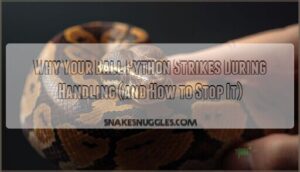
A ball python that strikes during handling doesn’t mean you’ve failed as an owner. It means the snake is communicating—and you’re not yet fluent in its language.
Ball pythons are remarkably calm animals, but they come wired with survival instincts that don’t disappear just because they live in a glass enclosure.
Fear, hunger, stress, and even the scent on your hands can flip a docile snake into a defensive one.
The good news? Striking behavior follows patterns you can learn to read. Once you understand what’s driving it, preventing it becomes less about luck and more about skill.
Table Of Contents
- Key Takeaways
- What Causes Ball Python Striking During Handling?
- Recognizing Pre-Strike Warning Signs
- Safe Handling Techniques to Prevent Strikes
- Reducing Stress and Building Trust
- When Striking Signals a Health Problem
- Solutions for Persistent Striking Behavior
- Frequently Asked Questions (FAQs)
- How to tell if ball python is stressed while handling?
- What are signs of overfeeding a ball python?
- Can ball pythons ever become permanently aggressive?
- Do ball pythons strike more at certain times of day?
- How do juvenile ball pythons differ from adults in striking?
- Can handling frequency increase or decrease striking behavior?
- Do female ball pythons strike more than males?
- Conclusion
Key Takeaways
- Ball pythons always warn you before striking — learn to spot the S-shaped neck, rapid tongue flicking, and muscle rigidity before a bite ever happens.
- Most strikes trace back to hunger, fear, or a poorly set-up enclosure, not a "mean" snake — fix the environment first, then work on your handling.
- Wash your hands, move slowly, and use tongs for feeding — your snake’s heat-sensing pits can’t tell your hand from a mouse without those habits in place.
- Trust is built in short, consistent sessions over weeks, not days — one to two calm handling sessions a week do more than daily rushed contact.
What Causes Ball Python Striking During Handling?
Ball pythons don’t strike out of nowhere — there’s always a reason behind it. Most of the time, it comes down to a handful of predictable triggers that are easy to identify once you know what to look for.
Once you can spot ball python defensive behavior signs, reading your snake’s body language becomes a lot more intuitive.
Here’s what’s actually going on when your snake decides hand looks like a threat.
Natural Defensive Behaviors
Ball pythons don’t strike because they’re mean — they strike because they’re scared. Their threat perception system kicks in fast. Before a bite ever happens, they work through a clear sequence:
- Freeze Response — sudden stillness when danger feels close
- Hide Preference — tucking the head and balling up
- Balling Mechanics — coiling tight, head centered
- Defensive Strike Mechanics — the last resort
Respect that order.
Hunger and Feeding Responses
Fear isn’t the only reason your snake strikes. Hunger plays a bigger role than most keepers expect.
A hungry pet ramps up Tongue Flick Frequency — sometimes 10 times more often — because Prey Scent Detection kicks into overdrive. Your hand near feeding time? It reads like a Heat Signature Trigger, not a friend.
| Hunger Signal | What You’ll Notice |
|---|---|
| Head peeking from hide | Ambush-ready posture |
| Nose pressed to glass | Active prey searching |
| Increased enclosure movement | Pre-feeding restlessness |
| Rapid tongue flicking | Scent-tracking mode |
Stick to a consistent Feeding Schedule Timing — every 10–14 days — and always adjust your handling techniques around it. Post-Feeding Regurgitation risk spikes within 48 hours, so give your snake space after meals.
Stress and Environmental Triggers
Even the calmest snake breaks down when its world feels wrong. Temperature gradients that drop below 75°F, humidity spikes under 50%, or hide scarcity leave your ball python in a constant low‑grade panic — and that panic fuels defensive mechanisms fast.
temperature stress triggers aggression.
Watch for these common stress triggers:
- Enclosure vibrations from nearby appliances
- Traffic noise disrupting nocturnal cycles
- Warm‑side temps climbing past 95°F
- Missing or oversized hides offering zero security
- High‑traffic placement forcing constant visual alerts
Fix the environment first. Better handling techniques and reading body language only go so far without solid environmental enrichment backing them up.
Mistaken Identity (Hand as Prey)
Your hand might just look like lunch. Ball pythons hunt using heat-sensing pits that detect warmth within 40 cm—your hand registers almost identically to a mouse.
Add prey odor confusion from unwashed skin and movement mimicry from wiggling fingers, and the snake’s brain connects the dots incorrectly. That’s not aggression. That’s mistaken identity.
Unwashed hands and wiggling fingers don’t provoke aggression — they trigger mistaken identity
Remember to wash and sanitize your hands before handling to avoid prey odor confusion, especially by practicing proper hand sanitizer use.
| Trigger | Why It Happens | Prevention |
|---|---|---|
| Heat Pit Sensitivity | Pits read your hand’s warmth as prey | Keep hands low and still |
| Prey Odor Confusion | Rodent scent lingers on skin | Use Hand Scent Elimination — sanitize first |
| Movement Mimicry | Finger movement signals struggling prey | Move slowly and deliberately |
| Constriction Misinterpretation | Snake coils believing it caught food | Stay calm; don’t pull away |
| Defensive Signals | Body language shifts before striking | Read posture before reaching in |
Recognizing Pre-Strike Warning Signs
Ball pythons don’t strike out of nowhere — they always give you a heads-up first. Learning to read those signals is what separates a smooth handling session from a surprise bite.
Feeding days especially call for extra awareness, since hunger and post-meal stress trigger most of the warning signs that lead to feeding aggression.
Here are the key warning signs to watch for.
Defensive Postures and Body Language
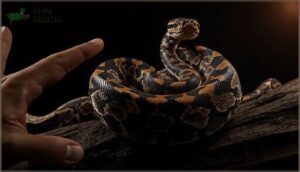
Your snake’s body is telling you something — you just have to learn the language. Before a strike, ball python behavior shifts in clear, readable ways:
- Coiled Ball Posture — tight, tucked, head buried inside
- S‑Shaped Neck — coiled like a spring, ready to launch
- Head Alignment — locked directly onto your hand
- Muscle Rigidity — body feels stiff, not loose and drippy
Retreat orientation and defensive signals like these rarely lie.
Hissing and Rapid Tongue Flicking
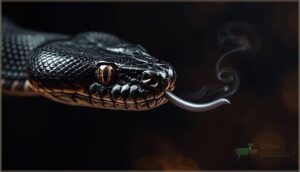
Hissing and tongue flicking are your clearest early warning system. When your ball python forces air through its glottis, that sharp rush of sound means back off — now.
Tongue flick frequency tells you just as much. Rapid, repeated flicks toward your hand signal active threat assessment, not curiosity.
| Signal | What It Means |
|---|---|
| Long, slow hiss | High stress, wants distance |
| Short burst hissing | Repeatedly on edge |
| Rapid tongue flicks toward hand | Tracking you as a threat |
| Sudden stop in tongue flicking | Decision made — act carefully |
| Tongue flicks + hissing together | Pre-feeding chemical cues or fear response |
Trust these signals before they escalate.
Balling Up Vs. Striking Position

Balling up looks like safety — but don’t be fooled. tight Ball Formation with the head tucked low is defensive, not calm.
Head Angle: when it lifts forward, Coil Tension shifts into Body Uncoiling, and that’s your Distance Cue to back off.
Shift timing is fast. One moment it’s balled, the next it’s in striking behavior mode.
Adjust your handling techniques the second you see that head rise.
Changes in Movement and Muscle Tension
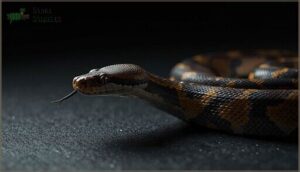
Movement tells the whole story. Watch for neck pre‑tension — the head stiffens and lifts slightly before anything else happens.
Jerky body turns replace smooth crawling, and stiff coil segments stop bending naturally.
Freeze lock moments signal the body is bracing. Accelerated crawl rhythm with short, stuttering pushes means stress is building fast.
These body language stress signals are your cue to adjust handling techniques immediately.
Safe Handling Techniques to Prevent Strikes

Good technique makes a bigger difference than most people realize. A few small adjustments to how you approach and hold your ball python can cut striking risk dramatically.
Here’s what actually works.
Approaching Your Ball Python Calmly
Your approach sets the tone before you even touch your snake. Ball pythons read heat, movement, and scent — so your prep matters.
- Slow Movement: Slide in smoothly from a side angle to avoid mimicking a predator dive.
- Low Profile: Kneel to tank level so your silhouette feels less threatening.
- Scent Neutralization + Pre Touch: Sanitize hands, then tap gently before contact.
Proper Hand Positioning and Support
Where your hands go determines everything.
Use two-point support — one hand behind the head, one under the mid-body. This distributes weight and keeps your snake from tensing up.
| Hand Position | What It Does | Why It Matters |
|---|---|---|
| Head-hand alignment | Keeps head low, facing away | Reduces false prey avoidance triggers |
| S-shape curve support | Maintains natural body posture | Prevents defensive muscle tension |
| Overhandling limits | Short, calm sessions only | Lowers stress during ball python care |
Using Tools Like Hooks or Tweezers
Good hand positioning gets you far, but sometimes a tool bridges the gap. A 1.5–2 foot hook slides under your ball python’s mid-body, keeping fingers outside striking range.
Use tongs for feeding — they teach your snake that hands aren’t prey. Wipe tools clean between uses, and approach from the side to avoid triggering defensive behavior.
When to Avoid Handling (Shedding, Post-Feeding)
Tools help, but timing matters just as much. Skip handling for 48 hours after feeding — that’s your ball python’s Digestive Recovery Window. Juveniles often need 72 hours.
During the shedding phase, cloudy blue phase eyes mean impaired vision and tight skin, so Blue Phase Caution applies: no routine handling.
Respecting these Post‑Meal Rest and shedding boundaries cuts strike risk considerably.
Reducing Stress and Building Trust

Trust isn’t built in a single handling session — it takes time, repetition, and a little patience.
Your ball python needs to feel safe before it can relax around you.
Here’s what actually helps make that happen.
Creating a Safe and Enriched Environment
Think of your ball python’s enclosure as its whole world. When that world feels right, stress drops fast. Three things make the biggest difference:
- Keep a temperature gradient: 88–92°F warm side, 76–80°F cool side.
- Maintain humidity control at 50–60% daily, rising at night.
- Offer snug hiding spots on both sides for true security.
Solid substrate options and climbing enrichment round out a calming, enriched home.
Gradual Handling Acclimation
Once your enclosure feels like home, your snake is ready for the next step. Start with an Initial No‑Handling period of 7–10 days, minimum.
Then keep early sessions short — just 5–10 minutes — using a calm Body Support Technique: scoop from beneath, never grab.
Gradual Handling Acclimation works through patience and Frequency Consistency.
One to two sessions weekly builds trust without overwhelming stress.
Positive Reinforcement and Consistent Routines
Routine is your secret weapon. Ball pythons respond well to Predictable Sessions — same time, same Calm Cue, same Gentle Touch every visit.
Try building this into your weekly rhythm:
- Handle 3–5 times per week for 5–10 minutes
- Match your timing to their crepuscular activity window
- Offer food only after a calm, relaxed session
Quiet Environment + Reward Timing = trust, fast.
Recognizing and Respecting Boundaries
Your ball python speaks clearly — you just have to listen. Learning to read body language cues and stress signals changes everything about how you handle it together.
| Signal Type | What It Means |
|---|---|
| Face pressed on door | Voluntary engagement signal — ready to come out |
| Rapid tongue flicking | Back off — return to enclosure now |
| Climbing onto your hand | Choice‑based interaction at its best |
Respect those cues consistently, and striking becomes rare.
When Striking Signals a Health Problem

Sometimes a ball python strikes not out of attitude, but out of pain.
When something’s off physically, behavior changes fast — and handling suddenly feels threatening to them. Watch for these signs that your snake might need more than just patience.
Sudden Changes in Behavior
sudden spike in striking behavior is your snake telling you something changed. temperature fluctuations, a substrate switch, feeding routine disruptions, or handling frequency shifts can all trigger stress signals within days.
Watch the body language closely — tight muscles, rapid tongue flicking, defensive postures. These aren’t random.
enclosure disturbances like deep cleans or rearranged hides also unsettle your python fast.
good handling techniques start with noticing what shifted.
Signs of Illness or Injury
A snake in pain doesn’t hide it — it strikes.
Respiratory wheezing, mouth rot, scale rot, external parasites, and thermal burns all cause real discomfort.
That discomfort shows up fast in body language.
Watch for lethargy, unusual postures, or visible sores.
When illness or injury drives the striking, better handling techniques won’t fix it.
Your vet will.
Impact of Environmental Factors
Sometimes the enclosure itself is the problem — not you.
Poor temperature gradient, low humidity levels, wrong hide placement, harsh lighting cycle, and noise vibration all quietly build stress in your ball python.
Check these three first:
- Temperature: warm side 88–92°F, cool side 76–80°F
- Humidity: keep it 55–60% consistently
- Hides: two enclosed hides, one each side
Bad enclosure conditions = a striking ball python.
When to Seek Veterinary Advice
If your ball python shows open-mouth breathing, weight loss, eye cloudiness, or neurological signs like stargazing alongside persistent striking, don’t wait. These aren’t just stress signals — they’re red flags.
Striking that continues for two or more weeks despite good ball python care almost always points to health issues requiring veterinary advice. Animal welfare depends on catching these warning signs early.
Solutions for Persistent Striking Behavior
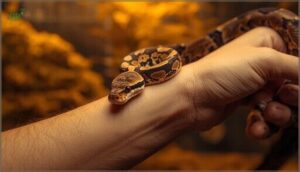
If your ball python keeps striking despite your best efforts, don’t give up — there are real solutions worth trying.
Persistent striking usually points to something fixable, whether it’s routine, habitat, or trust.
Here’s what you can adjust to finally turn things around.
Adjusting Feeding Schedules and Methods
Tweaking your feeding time routine can stop a lot of strikes before they start. Match age-based frequency to your python’s life stage — hatchlings need food every 5–7 days, adults every 14–21.
Always use tongs feeding to break food association with your bare hands.
Maintain prey warming to 98–100°F.
Stick to scent control and honor your post-feeding wait of 48 hours before handling.
Improving Habitat Conditions
Your enclosure setup can either calm your python or quietly stress it out.
Nail the thermal gradient — warm hide at 86–90°F, cool side around 72–80°F — and humidity management between 55–65%.
Moisture substrate like coconut husk keeps that humidity steady.
Add secure hides and enrichment clutter for hiding places your snake actually wants to use.
Better habitat means fewer defensive strikes.
Consulting a Reptile Specialist
When habitat tweaks aren’t enough, a specialist referral makes sense. A reptile specialist looks at behavior, husbandry, and health together — not just one piece.
Appointment preparation matters: bring feeding logs, enclosure photos, and a fecal sample. Diagnostic testing like bloodwork or fecal exams can rule out pain-driven aggression.
Costs range from £35 to £245. Follow-up protocol keeps ball python care on track.
Long-Term Trust and Handling Strategies
Trust takes months, not days.
Stick to a Consistent Handling Schedule — every other day, the same calm approach.
Use Scent Association Training by handling outside feeding times so your scent means safety.
Gradual Exposure Sessions build confidence slowly, and Positive Voice Cues reinforce calm moments.
Add Enrichment Rotation inside the enclosure too.
Body language tells you when patience is finally paying off.
Frequently Asked Questions (FAQs)
How to tell if ball python is stressed while handling?
Watch your ball python’s body language closely.
Rapid tongue flicking, rigid muscle tone, and elevated head posture are clear stress signals. Eye dilation and a twitching tail tell you it’s time to put them down.
What are signs of overfeeding a ball python?
Ironically, overfeeding looks like success — a big, healthy snake.
But watch for body shape changes, visible fat deposits, slowed movement, digestive irregularities, and rapid weight gain. These signal real health issues ahead.
Can ball pythons ever become permanently aggressive?
Rarely.
Most ball pythons mellow with consistent handling. Genetic temperament plays a role — some stay standoffish — but true long-term aggression usually traces back to chronic health issues or irreversible stress, not permanent behavioral change.
Do ball pythons strike more at certain times of day?
Yes. Ball pythons are nocturnal, so nighttime handling often meets a snake in full hunting mode.
Daytime handling benefits you both — your python is calmer, less food-focused, and far less likely to strike.
How do juvenile ball pythons differ from adults in striking?
Juveniles strike faster and more often than adults. That high defensive frequency fades with age. Consistent handling speeds up that shift — most babies calm down within weeks.
Can handling frequency increase or decrease striking behavior?
Handling cadence is a double-edged sword.
Too little contact spikes stress thresholds; too much overwhelms.
Aim for one to two sessions weekly during acclimation phases, and your ball python stays calm, curious, and rarely defensive.
Do female ball pythons strike more than males?
Not really. Sex-based temperament differences are minimal in ball pythons. Individual variation and husbandry effects matter far more than sex when predicting striking behavior during handling.
Conclusion
Like learning any language, understanding why your ball python strikes during handling takes time and patience. The strikes aren’t random—they’re signals.
Once you learn to read the warning signs, adjust your approach, and respect your snake’s boundaries, those defensive moments become rare.
Trust builds quietly, session by session. You won’t always get it perfect, and that’s fine.
What matters is that you keep showing up, paying attention, and letting the snake lead the pace.