This site is supported by our readers. We may earn a commission, at no cost to you, if you purchase through links.

A ball python that tucks its head into the center of a tight coil isn’t being aggressive. It’s afraid, and it’s telling you so with the only defense it has.
That ball protects the skull behind layers of muscle, and it usually follows quieter signals: a hissing exhale, a flattened body, a neck pulled into a tense S-curve. Miss them, and a frightened animal can escalate to repeated strikes within seconds.
Reading ball python defensive behavior signs correctly protects both of you. It separates fear from feeding drive, traces stress to its source, and tells you when to step back from the enclosure.
Table Of Contents
- Key Takeaways
- Ball Python Defensive Behavior Signs to Recognize
- Ball Python Defensive Strikes Versus Feeding Responses
- Stress Triggers Behind Ball Python Defensive Behavior
- How to Respond to Defensive Ball Pythons
- Top 9 Products for Defensive Ball Python Care
- 1. Designer Ball Python Morph Breeding Guide
- 2. New Keepers Guide to Ball Pythons
- 3. Ball Python Manual CompanionHouse Guide
- 4. Ball Python Care Guide for Beginners
- 5. Ball Python Care Handbook
- 6. Ball Python Keeper Handbook
- 7. Ball Python Care Logbook
- 8. Quilax White Snake Climbing Toy
- 9. Horsmiyala DIY Snake Climbing Ring Set
- Frequently Asked Questions (FAQs)
- How to tell if a ball python is angry?
- What are the signs that a ball python is happy?
- How to tell if your ball python trusts you?
- What are the signs that a ball python is stressed?
- How to tell if a ball python is defensive?
- How to tell if a ball python is relaxed?
- How to tame a feisty ball python?
- What are signs of stress in a snake?
- How often do snake owners get bit?
- Which smell do snakes hate?
- Conclusion
Key Takeaways
- A ball python that tucks its head into a tight coil is afraid, not aggressive, so watch for the earlier warnings (hissing, a flattened body, a tense S-curve) and stop handling the moment you see them.
- A defensive strike is fast, repeated, loud and tense, while a feeding strike is a single, deliberate lunge followed by relaxation, so read the posture first and use 12-inch (30 cm) tongs so your hand doesn’t signal food.
- Most defensive behavior comes from your setup rather than your snake’s temperament, so keep a 78-88°F (26-31°C) gradient, humidity at 50-70%, a hide on both the warm and cool sides, and avoid handling for 48 hours after meals or during shed.
- Respond by lowering stress, not forcing contact: approach from the side, support the body, never pry open a balled snake, and see a reptile vet if aggression appears suddenly.
Ball Python Defensive Behavior Signs to Recognize
Ball pythons rarely bite without warning, and the early warning signs show up in their body language first. A snake that curls its head into the center of a tight coil, shielding it with its body, is showing defensive balling. That’s fear, not aggression.
If your snake keeps balling up or hissing when you approach, this guide on why ball pythons act aggressive can help you spot the real triggers and respond calmly.
A ball python curled tightly around its own head is not being aggressive, it is afraid and warning you first
Watch for hissing, a flattened body, or a head pulled back into an S-curve. Rapid tongue flicking with jerky movement means your snake is tracking a perceived threat. Constant escape attempts or pacing along the enclosure walls count as stress signals too.
Check the setup if defensive behavior persists. Refusing meals and hiding all night suggest insecurity, often from a warm side below 88°F (31°C) or too much handling. Fix the cause and the posture relaxes. Keeping the enclosure at a stable temperature gradient of 78–88°F with 50–60% humidity, plus a hide on both the warm and cool sides, helps your snake feel secure.
Ball Python Defensive Strikes Versus Feeding Responses

A defensive strike and a feeding response look similar at speed, but they’re different behaviors. A defensive strike is fast, often repeated, and paired with loud hissing. The snake snaps and retreats, and the body stays tense. It never looks calm or patient.
A feeding response is slower and deliberate. Look for steady tongue flicking, a loose S-curve strike posture, and a single accurate lunge at warm prey, usually from 4–6 inches (10–15 cm) away. Afterward, the snake relaxes. Offering prey with long reptile feeding tongs lets the snake aim at the food instead of your fingers, keeping that single lunge clean.
If your hand triggers feeding strikes between meals, use 12-inch (30 cm) tongs so your hand stops signaling food. Avoid handling after feeding for 48 hours, since regurgitation risk rises. Read the posture first, and you’ll know which strike you’re facing.
Stress Triggers Behind Ball Python Defensive Behavior

Most defensive behavior traces back to your setup, not your snake’s temperament. Start with temperature gradients. Keep surfaces between 75°F and 92°F (24°C to 33°C), and verify them with an infrared gun, since analog thermostats drift. Unstable heat raises corticosterone, which shows up as coiling, striking, or glass surfing.
Hides matter just as much. Provide two tight hides, one warm and one cool. Without them, your snake stays vigilant and tense.
Keep humidity at 50-70%, rising to 65-70% during shed. Handle at night, never while the eyes are milky blue, and leave the snake alone for 48 hours after meals.
Slammed doors, vibrations from vacuums, and bright overhead lights register as threats to a burrow-adapted animal. Stable routines build calm.
How to Respond to Defensive Ball Pythons
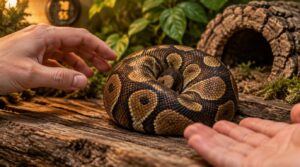
Once you’ve corrected your enclosure setup, you can address the defensive behavior itself. Watch for early warning signs: a tucked head, a tightly curved neck, or hissing. Stop handling immediately.
Follow these steps:
- Give the snake space, and let it settle before trying again.
- Approach from the side, never overhead, and keep your hand away from the head.
- Support the body in several places and keep sessions under 15 minutes, held within 12 inches (30 cm) of a secure surface.
- Never pull a balled snake open; forced contact escalates defensive behavior.
- Use a hook only if you’re trained.
If bitten, don’t jerk away. Wash the wound with soap and water. Sudden aggression can signal illness, so see a reptile vet.
Top 9 Products for Defensive Ball Python Care
Most defensive behavior traces back to husbandry and handling, so the best tools for your snake are the ones that build your knowledge and improve its environment.
Pairing a care logbook with a solid grasp of defensive ball python body language helps you spot patterns between feeding, shedding, and temperature changes and your snake’s mood.
The nine picks below include care references and logbooks that sharpen your observation, plus two climbing accessories that add enrichment at 3 to 4 feet (about 1 meter) of usable height.
You’ll notice the list contains no enclosures, since the products here support your routine rather than replace your setup.
1. Designer Ball Python Morph Breeding Guide
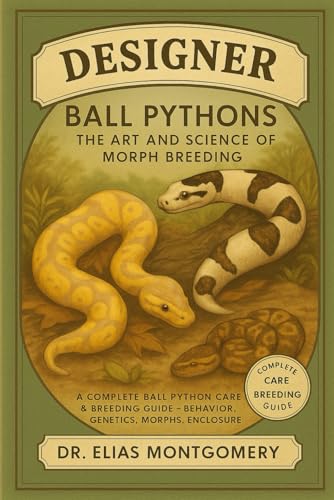
Is that head-shaking defensive, or genetic? Spider and champagne morphs can carry a neurological wobble, and this guide helps you tell the difference.
At 92 pages, 4.8 ounces (136 g) and 9 inches (23 cm) tall, it’s slim enough to keep near the enclosure. It covers dominant, co-dominant and recessive inheritance, morph identification, incubation, egg-laying and hatchling care. It’s independently published, focuses only on ball pythons, and doesn’t mention digital editions.
Know your snake’s genes before you judge its behavior.
| Best For | Ball python keepers and aspiring breeders who want a compact, focused guide to morph genetics, breeding practices, and daily care. |
|---|---|
| Weight | 4.8 oz (136 g) |
| Dimensions | 9 in tall (23 cm) |
| Format | Paperback book |
| Page Count | 92 pages |
| Target Species | Ball pythons |
| Best For | Keepers and aspiring breeders |
| Additional Features |
|
- Explains dominant, co-dominant, and recessive morph genetics, plus how to identify common morphs, color mutations, and patterns.
- Covers the full breeding process, including incubation, egg-laying, and hatchling care, with an emphasis on responsible breeding and genetic diversity.
- Includes enclosure setup, heating, lighting, humidity control, and ball python biology and temperament, all in a slim 92-page book.
- Published independently rather than through a major publishing house.
- Focuses only on ball pythons, so it won’t help with other reptile species.
- Doesn’t mention a digital edition or any supplementary materials.
2. New Keepers Guide to Ball Pythons

Most keepers who struggle with a striking snake need a reliable reference, and this 304-page guide, published August 15, 2024, delivers one. It covers habitat setup, feeding, handling, and health, so you can trace a defensive response back to its likely cause.
The clear diagrams and feeding charts make quick lookups easy, and its 6 x 0.69 x 9 inch (15.2 x 1.8 x 22.9 cm) size suits a shelf beside the enclosure.
It skips breeding, and it’s not peer-reviewed.
| Best For | New and experienced ball python keepers who want a practical, easy-to-use reference for habitat setup, feeding, handling, and health care. |
|---|---|
| Weight | N/A |
| Dimensions | 6 x 0.69 x 9 in (15.2 x 1.8 x 22.9 cm) |
| Format | Paperback book |
| Page Count | 304 pages |
| Target Species | Ball pythons |
| Best For | New and experienced keepers |
| Additional Features |
|
- Covers habitat setup, feeding, handling, and health issues in one place
- Clear diagrams and feeding charts make quick lookups easy
- Weighs the pros and cons of different care choices to help keepers decide for themselves
- Does not cover breeding or morph genetics in detail
- Focuses mainly on ball pythons, not other reptile species
- Based on the author’s experience and community input, not peer-reviewed research
3. Ball Python Manual CompanionHouse Guide
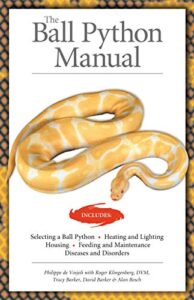
Every keeper has stood over a balled-up snake wondering what went wrong. This 88-page paperback helps you work that out before it happens. Published in 2004, it covers choosing a first python, housing, feeding, handling, plus morphs and captive breeding.
At 4.8 ounces (136 g) and 5.5 x 8.5 inches (14 x 21.6 cm), it slips onto any reptile room shelf. Some readers find it shallow, and value opinions split, so treat it as a primer, not a final authority.
| Best For | First-time ball python keepers who want a short, beginner-friendly primer on choosing a snake and covering the basics of care. |
|---|---|
| Weight | 4.8 oz (136 g) |
| Dimensions | 5.5 x 8.5 in (14 x 21.6 cm) |
| Format | Paperback book |
| Page Count | 88 pages |
| Target Species | Ball pythons |
| Best For | First-time keepers |
| Additional Features |
|
- Covers the essentials of housing, maintenance, feeding, and handling in one compact guide
- Helps new keepers choose their first ball python and introduces morphs, genetics, and captive breeding
- Lightweight 88-page paperback at 4.8 ounces that is easy to carry and shelve
- Some readers find it not in-depth enough for serious keepers
- Published in 2004, so some information may be outdated
- Opinions on value for money are divided, especially for a used copy
4. Ball Python Care Guide for Beginners

Say your new ball python balls up every time you reach into the enclosure. You need answers, not theory.
This 109-page guide, published April 19, 2025, covers ball python biology, sub-Saharan origins, and why balling is a defensive reflex. It explains handling adaptability in captivity and color morphs. At 5.6 ounces (159 g) and 6 x 0.25 x 9 inches (15 x 0.6 x 23 cm), it fits easily beside the enclosure. It skips complex breeding and is English only.
| Best For | New or first-time ball python owners who want a short, beginner-friendly guide to understanding their snake’s behavior, handling, and basic biology. |
|---|---|
| Weight | 5.6 oz (159 g) |
| Dimensions | 6 x 0.25 x 9 in (15 x 0.6 x 23 cm) |
| Format | Paperback book |
| Page Count | 109 pages |
| Target Species | Ball pythons |
| Best For | New or first-time owners |
| Additional Features |
|
- Explains why ball pythons curl into a defensive ball, so new keepers know what the behavior means.
- Covers natural history, sub-Saharan origins, and color morphs in a compact 109-page format.
- Light at 5.6 ounces and slim at 6 x 0.25 x 9 inches, so it is easy to keep near the enclosure.
- Stays at a beginner level, so experienced keepers will find little new.
- Leaves out advanced breeding techniques.
- Available only in English.
5. Ball Python Care Handbook

A defensive ball python rarely needs a bigger enclosure; it needs a keeper who reads it correctly. The Ball Python Care Handbook gives you that skill across 105 pages, in a compact 6 x 9 inch (15 x 23 cm) book weighing just 5.4 ounces (153 g).
You’ll find care charts and troubleshooting tips covering habitat setup, feeding, shedding, and taming, plus guidance on spotting early illness. It’s independently published and focuses solely on ball pythons, with no digital companion.
| Best For | New and beginner ball python owners who want a compact, step-by-step guide to setting up a habitat, feeding, handling, and spotting early signs of illness. |
|---|---|
| Weight | 5.4 oz (153 g) |
| Dimensions | 6 x 9 in (15 x 23 cm) |
| Format | Paperback book |
| Page Count | 105 pages |
| Target Species | Ball pythons |
| Best For | New and beginner owners |
| Additional Features |
|
- Covers habitat setup, feeding, shedding, taming, and breeding in one 105-page book
- Includes care charts and troubleshooting tips for quick reference
- Lightweight and compact at 5.4 ounces and 6 x 9 inches, so it is easy to carry and store
- Independently published rather than released by a major publisher
- Focuses only on ball pythons, so it won’t help with other reptiles
- Has no digital or interactive components
6. Ball Python Keeper Handbook

A ball python that balls up, strikes, or keeps hunting for an exit is telling you it’s stressed. The Ball Python Keeper Handbook teaches you to read those signals and put the snake back in its enclosure until another day.
At 90 pages (6 x 9 inches, 4.8 ounces), it covers care, feeding, breeding, and hatchling guidance, plus advice on choosing a healthy animal by age, morph, and source.
It’s independently published, with no editorial review noted, and it covers ball pythons only.
| Best For | New and first-time ball python owners who want a short, step-by-step guide covering setup, feeding, health, and breeding for this one species. |
|---|---|
| Weight | 4.8 oz |
| Dimensions | 6 x 9 in |
| Format | Paperback book |
| Page Count | 90 pages |
| Target Species | Ball pythons |
| Best For | New and first-time owners |
| Additional Features |
|
- Covers the full range of ball python ownership, from tank setup and feeding to health care, breeding, and hatchling guidance
- Helps you choose a healthy snake by age, morph, and source, and offers solutions for picky eaters
- Compact at 90 pages and 4.8 ounces, so it’s quick to read and easy to carry
- Independently published with no editorial review noted, so the quality of its information isn’t confirmed
- Focused only on ball pythons, so it won’t help with other snake species
- No digital or interactive components are mentioned, so it appears to be a print-only reference
7. Ball Python Care Logbook

The handbook teaches you what stress looks like. The Ball Python Care Logbook shows you when it starts.
Its 120 pages (6 x 9 inches, 15.24 x 22.86 cm, 6.7 ounces) let you record weight, shedding, feedings, medication, vet visits, and expenses, so a pattern like a refused meal before a shed becomes visible. It carries no veterinary advice, and you’ll enter everything by hand. Consistent notes give your vet data. The logbook ranks 86 in Reptile & Amphibian Care.
| Best For | Ball python owners who want a simple paper logbook to track their snake’s weight, feeding, shedding, and vet visits in one place. |
|---|---|
| Weight | 6.7 oz |
| Dimensions | 6 x 9 in (15.24 x 22.86 cm) |
| Format | Paper logbook |
| Page Count | 120 pages |
| Target Species | Ball pythons |
| Best For | Owners tracking care records |
| Additional Features |
|
- Covers weight, shedding, feedings, medication, vet visits, and expenses, so patterns like a refused meal before a shed become easy to spot.
- Has 120 pages in a compact 6" x 9" size that weighs only 6.7 ounces.
- Includes daily, weekly, and monthly care checklists, and the consistent notes give your vet useful data.
- Made only for ball python owners, so it won’t suit other reptiles.
- Has no veterinary or medical advice, so you’ll need other sources to learn what the entries mean.
- Requires you to write in every entry by hand.
8. Quilax White Snake Climbing Toy
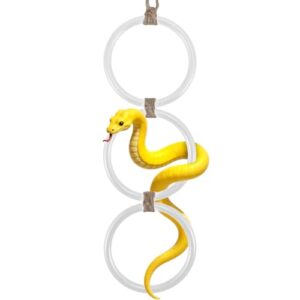
Once your logbook shows what stress looks like, give your snake a way to lower it. The Quilax White Snake Climbing Toy is a polypropylene climbing piece measuring 17.1 x 3.5 inches (43.4 x 8.9 cm) and weighing 2.95 ounces (83.6 g). Its textured, irregular surface mimics natural climbing terrain, and the light body lets you reposition it easily.
Size matters. It suits juveniles, corn snakes, and smaller climbing species, but large ball pythons may outgrow it. Color varies slightly.
| Best For | Owners of juvenile ball pythons, corn snakes, and other smaller climbing reptiles who want a lightweight, easy-to-move climbing piece that encourages natural climbing behavior. |
|---|---|
| Weight | 2.95 oz (83.6 g) |
| Dimensions | 17.1 x 3.5 in (43.4 x 8.9 cm) |
| Format | Climbing toy |
| Page Count | N/A |
| Target Species | Juvenile ball pythons, corn snakes |
| Best For | Owners of juvenile snakes |
| Additional Features |
|
- Textured, irregular surface mimics natural climbing terrain and encourages natural climbing behavior
- Lightweight at 2.95 ounces, so it’s easy to place and reposition in the enclosure
- Durable polypropylene construction and a clean white look that suits most habitats
- May not be suitable for large ball pythons because of its size
- Actual color may vary slightly from product images due to monitor settings
- Listed measurements may deviate slightly because they were taken manually
9. Horsmiyala DIY Snake Climbing Ring Set
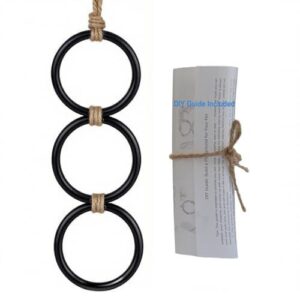
If the Quilax piece is too small for your snake, the Horsmiyala DIY Snake Climbing Ring Set (model DIY 3 Black) offers a different approach. Its interlocking rings let you build customizable climbing paths, and the slender design saves floor space.
Attachment requires a mesh lid, so check your enclosure first. No load capacity is listed and the material isn’t detailed, so test the setup before trusting a heavy snake on it.
It suits ball pythons, corn snakes, and chameleons.
| Best For | Owners of ball pythons, corn snakes, or chameleons who have a mesh-lid tank and want a customizable, space-saving climbing setup to keep their pet active. |
|---|---|
| Weight | N/A |
| Dimensions | N/A |
| Format | Climbing accessory |
| Page Count | N/A |
| Target Species | Ball pythons, corn snakes, chameleons |
| Best For | N/A |
| Additional Features |
|
- Interlocking rings let you build customizable climbing paths
- Slender design saves floor space in the enclosure
- Encourages natural coiling and climbing, which helps reduce cage boredom
- Needs a mesh lid to attach securely, so it won’t work with every tank
- No load capacity is listed, so it may not be safe for heavier snakes
- The material isn’t specified, which makes it harder to judge durability and safety
Frequently Asked Questions (FAQs)
How to tell if a ball python is angry?
Ball pythons don’t get angry; they show defensive behavior. Read the body language: a tight coil, tucked head, and hissing signal a defensive posture. Watch for stress signals, then adjust your handling methods right away.
What are the signs that a ball python is happy?
A content ball python shows relaxed muscle tone, with a body that drapes loosely rather than gripping. It emerges voluntarily, explores with slow, deliberate investigation, and feeds consistently. You’ll notice calm tongue flicks and steady, unhurried movement.
How to tell if your ball python trusts you?
Watch your snake’s body language during handling. A trusting ball python moves slowly across your hands with loose muscle tone, explores without gripping, and stays free of hissing, puffing or balling up.
What are the signs that a ball python is stressed?
Say your ball python hides constantly after you’ve handled it daily. Watch for early warning signs: tight S-coiled body language, hissing, repeated escape attempts, and a sudden break from routine. These stress signals, plus poor appetite, warrant a reptile vet.
How to tell if a ball python is defensive?
The snake that’s "just sitting there" is often shouting at you. Watch for an S-shaped neck, hissing, tight coiling, or tail vibration. These early warning signs in its body language are stress signals, so back off.
How to tell if a ball python is relaxed?
A hiding snake isn’t necessarily a stressed one. Daytime hiding behavior is normal. Look for loose coils, steady breathing, slow tongue flicking, and smooth handling. Good enclosure setup and stress reduction keep defensive behavior away.
How to tame a feisty ball python?
A tight coil’s a closed fist, not a verdict.
Read your snake’s stress signals, handle it only twice weekly, and fix your enclosure setup with snug hides. Stress reduction softens defensive behaviors; trust will follow.
What are signs of stress in a snake?
A ball python that refuses three consecutive meals isn’t always sick, it’s often stressed. Watch your snake’s stress signals: constant hiding, tight balling, hissing, glass surfing, and refusing food. These behavioral cues demand immediate enclosure parameters review.
How often do snake owners get bit?
Most keepers rarely get bitten. Survey data shows 5% never experience biting, 3% report fewer than five incidents, and only 2% exceed five.
Your handling frequency and approach method decide whether a defensive strike happens.
Which smell do snakes hate?
Most studies show sulfur granules fail, yet cinnamon, clove oil, and ammonia drive snakes off. Don’t rely on any chemical deterrent alone; scent contamination fades fast, so pair scent management with tightly sealed entry gaps.
Conclusion
Is a hissing, coiled snake really your enemy? Rarely. Learning ball python defensive behavior signs turns a perceived threat into a readable message: the flattened body, the tense S-curve, the tightening ball.
Respond by lowering stress, not raising your hand. Check enclosure temperatures, add secure hides, and wait 48 to 72 hours after feeding or handling before another attempt.
A calm keeper earns a calm snake. Fear fades when your habits stay steady and predictable.