
This site is supported by our readers. We may earn a commission, at no cost to you, if you purchase through links.

A hatchling ball python weighs roughly the same as two pennies—between 50 and 60 grams, but within three years, that same snake can tip the scale at 1,500 grams or more. This dramatic transformation doesn’t follow a strict timeline. Genetics, feeding schedules, and enclosure conditions all shift the pace, which means two pythons hatched on the same day can weigh 500 grams apart by their first birthday.
Tracking weight and length at each stage lets you spot growth plateaus, recognize feeding issues, and adjust care before minor deviations become health concerns. Understanding what’s typical—and what’s not gives you the tools to support steady, healthy development from hatchling to adult.
Table Of Contents
- Key Takeaways
- Ball Python Growth Stages and Milestones
- Average Ball Python Weight by Age
- Typical Ball Python Length at Each Stage
- Factors Influencing Ball Python Growth
- Monitoring and Measuring Ball Python Growth
- Signs of Healthy Vs. Unhealthy Weight
- Supporting Optimal Growth and Weight
- Frequently Asked Questions (FAQs)
- How long until a ball python is full grown?
- How fast should a ball python gain weight?
- Can you leave a heat lamp on 24/7 for ball python?
- How much should a 2 year old ball python weigh?
- When do ball pythons stop growing completely?
- Can overfeeding cause permanent health problems?
- How does brumation affect growth rates?
- Do different morphs have varying growth patterns?
- What causes sudden unexplained weight loss?
- Do morphs affect ball python growth rates?
- Conclusion
Key Takeaways
- Ball pythons grow from 50-60 grams at hatching to 1,200-2,500 grams as adults over 3-4 years, with females consistently outweighing males by 300-600 grams due to reproductive physiology.
- Weekly weight tracking catches growth plateaus and health issues early—healthy hatchlings gain 15-25 grams monthly while juveniles accelerate to 30-50 grams monthly before slowing at sexual maturity.
- A python’s body should show firm muscle tone with a triangular cross-section and no visible ribs or spine, while round profiles with fat deposits behind the tail signal dangerous obesity requiring immediate feeding adjustments.
- Feeding frequency must match life stage—hatchlings need meals every 5-7 days at 5-10% body weight, juveniles every 7-10 days at 12-20% body weight, and adults every 14-21 days to prevent metabolic disease.
Ball Python Growth Stages and Milestones
Your ball python won’t follow a rigid growth timeline—each snake develops at its own pace based on genetics, feeding, and environment. That said, most pythons move through four predictable stages from hatchling to full-grown adult.
Understanding these milestones helps you recognize what’s normal and catch potential issues early.
Hatchling Growth (0-6 Months)

Your hatchling ball python will weigh 10–60 grams at hatching and should gain weight steadily with each feeding. Consistent starter diets, proper temperature (88–92°F warm side), and humidity (50–60%) regulate metabolism and drive early feeding responses. Tracking weight weekly and comparing it to growth milestones for captive-bred snakes helps you confirm your hatchling is thriving through each feeding cycle.
Under good husbandry, neonates reach 20–30 cm within 4–6 months. Growth rates vary by genetics and sex—some individuals simply grow faster despite identical care. For detailed size comparisons across different garter snake species, check out this comprehensive growth guide for all well-known species.
Researchers use scientific study methods to understand the factors influencing growth patterns in ball pythons.
Juvenile Development (6-18 Months)
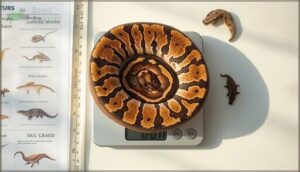
By 6 months, your juvenile should weigh 200–600 grams and measure 30–60 cm. Growth patterns accelerate through this stage—you’ll see 20–40% increases in ball python length and girth. Use a ball python growth chart to track weekly progress: For comparison, check out how corn snake growth rates differ during these early development stages.
- Nutrient needs shift to larger prey (10–15% body mass weekly)
- Environmental impact on growth rate intensifies with temperature fluctuations
- Development stages vary by genetics and feeding strategies
Monitor weight closely during these critical juvenile months.
Subadult Changes (18-36 Months)
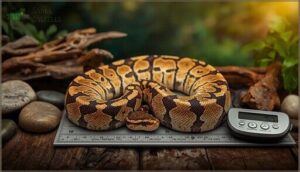
Growth patterns shift during this phase—your python’s weight gains slow as sexual maturation begins. Expect 600–1,200 grams for males and 900–1,800 grams for females. Environmental factors like temperature and nutrition optimization determine whether your ball python reaches a consistent length of 90–120 cm.
| Age (Months) | Male Weight (g) | Female Weight (g) |
|---|---|---|
| 18 | 600–800 | 900–1,200 |
| 24 | 800–1,000 | 1,200–1,500 |
| 30 | 1,000–1,200 | 1,400–1,700 |
| 36 | 1,100–1,400 | 1,600–1,900 |
Weight fluctuations occur seasonally—track your python’s growth chart monthly to catch any potential health concerns early. A good ball python vet can compare your snake’s measurements against standardized growth curves to spot issues like obesity or stunted development.
Adult Maturity (3+ Years)
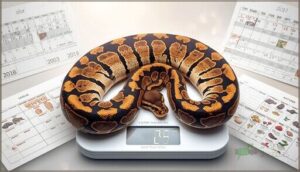
By year three, your ball python’s growth slowdown signals full maturity—most males stabilize at 1,200–1,500 grams while females reach 1,800–2,200 grams. Reproductive health becomes the priority now, with mating behaviors emerging seasonally.
Adult ball pythons require adjusted feeding schedules: For owners managing multiple species, the boa constrictor snake care approach offers useful comparison points when establishing these feeding routines.
- Feed males every 10–14 days
- Offer females every 7–10 days during breeding season
- Monitor ball python weight monthly using a digital scale
- Watch for maturity signs like thickened tail bases and courting displays
Average Ball Python Weight by Age
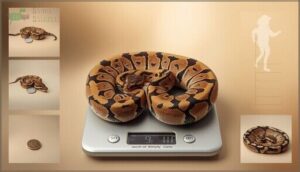
Your ball python’s weight will change dramatically over its lifetime, and knowing what’s normal at each stage helps you catch problems early. Hatchlings weigh just a few grams, while adults tip the scales at several pounds—but these ranges vary based on age, sex, and individual genetics.
Here’s what you should expect as your snake grows from a tiny hatchling into a full-sized adult.
Hatchling Weight Range
A healthy hatchling usually weighs 40 to 60 grams at birth, though your ball python weight chart may show variance from 10 to 105 grams depending on genetic factors and clutch conditions. Neonates under 20 grams require immediate attention and specialized neonate care.
Track your ball python growth chart weekly—consistent feeding strategies promote steady weight range progression during this critical hatchling size window.
Juvenile Weight Progression
From 6 to 12 months, expect your ball python to gain 20–60 grams per month—weight gains that slow to 10–30 grams between 12 and 18 months as growth patterns shift.
A juvenile usually reaches 500–900 grams by two years, though size variations depend on feeding strategies and genetics.
Update your weight chart monthly to track development rates and adjust ball python care accordingly.
Adult Weight Expectations
Adult ball pythons usually weigh 1,000–2,500 grams, a healthy weight range influenced by genetic factors and sex differences. Males generally reach 1,200–1,800 grams, while females often exceed 1,500 grams.
Use a weight chart to track your adult ball python’s progress—quarterly health monitoring helps you distinguish normal adult size variation from concerning weight management issues requiring veterinary attention.
Sex-Based Weight Differences
Female ball pythons outweigh males by a measurable margin once they reach adulthood—this sex difference reflects reproductive factors and genetic influence on growth patterns. Expect males to plateau around 1,200–1,800 grams, while females commonly exceed 1,800 grams.
Use a weight chart and growth chart to track weight variance and guarantee your ball python care and maintenance facilitates healthy weight throughout life.
Typical Ball Python Length at Each Stage
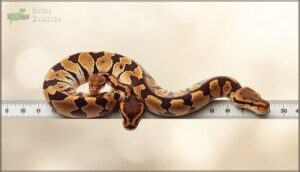
Length matters just as much as weight when you’re tracking your ball python’s development. Most owners focus on grams and pounds, but measuring your snake from nose to tail gives you a clearer picture of whether growth is on track.
Here’s what to expect at each life stage.
Hatchling and Juvenile Length
When your hatchling arrives, expect a slender 10 to 17 centimeters—most measure around 12 to 14 centimeters at birth. During the first six months, hatchlings gain roughly 1.5 to 3.5 centimeters monthly under proper care.
As juveniles (6 to 18 months), Ball Python growth stages accelerate:
- 40 to 60 centimeters becomes the typical juvenile morphology range
- Growth patterns slow to 1 to 3 centimeters per month
- Length variations depend on diet, temperature, and individual genetics
Sex-based size factors remain minimal during these early snake growth and development phases.
Subadult and Adult Size
Between 18 and 36 months, subadult development shifts your Ball Python growth stages into a slower gear. Expect 60 to 90 centimeters as growth patterns plateau, with body proportions thickening noticeably.
Adult morphology emerges by year three: most males reach 90 to 120 centimeters, while females commonly measure 120 to 150 centimeters. Size variance depends on genetics, feeding history, and overall health—track your growth chart consistently.
Maximum Documented Sizes
While most adults fit comfortably within the ranges above, extraordinary individuals push beyond typical Growth Limits. Your Ball Python Size Chart should account for these rare but documented outliers:
- Record Weights approach 2,700–3,000 grams in select females
- Maximum Lengths occasionally reach 183 centimeters (6 feet)
- Giant Morphs exhibit accelerated Python Size through selective breeding
- Size Variations depend on lineage and husbandry intensity
- Weight tracking separates healthy mass from pathological obesity
Factors Influencing Ball Python Growth

Your ball python’s final size isn’t written in stone from day one. Several key factors work together to shape how quickly your snake grows and how large it ultimately becomes.
Understanding these influences helps you provide the right care and set realistic expectations for your individual python.
Genetics and Sex
Your ball python’s sex determines more than just reproductive capacity—it shapes growth trajectory, adult size, and even color expression. Females generally reach 4–5 feet and 1,500–2,000 grams, while males plateau around 3–4 feet and 1,200 grams.
Sex-linked traits and color morphs tied to sex chromosomes can influence pattern intensity. Hormonal cycles in breeding females may suppress appetite seasonally, complicating weight tracking.
Diet and Feeding Frequency
What you feed—and when—drives growth more than any other variable under your control. Match prey size to 10–20% of body mass per feeding to fine-tune nutrient balance without risking obesity.
- Hatchlings: Pinkie mice every 5–7 days, sized to girth
- Juveniles: Fuzzies to hoppers every 7–10 days as growth accelerates
- Adults: Appropriately sized rats every 10–14 days for maintenance
- Overfeeding risk: Multiple meals weekly correlate with metabolic disturbance and fatty liver disease
Enclosure Size and Temperature
Your snake’s home shapes its metabolism just as much as its meal plan. Enclosure volume must scale with body length—aim for 40–60 gallons by adulthood—while thermal gradients (88–92°F warm side, 78–82°F cool) drive digestion and nutrient absorption.
Use thermostats to maintain temperature control, pair heating methods like ceramic emitters with overhead lamps, and monitor humidity levels near 50–60% for respiratory health and steady growth.
Health and Parasite Impact
Infection control starts with vigilance—internal parasites steal nutrients and stunt weight gain, while external mites trigger stress and skin damage. Parasite detection through routine fecal testing catches nematodes before growth plateaus.
- Weight loss despite normal appetite signals possible parasitic load or GI distress
- Lethargy and reduced activity indicate systemic parasitism impairing nutrient absorption
- Abdominal distension may reveal heavy parasite burdens requiring veterinary care
- Poor shedding and skin condition often accompany reptile health issues from infection
- Anorexia with dehydration marks late-stage cases needing immediate treatment
Growth monitoring shows 10–15% monthly gains in healthy individuals. If your underweight ball python stops gaining or an overweight ball python loses muscle tone, consult a reptile veterinarian for parasite control and health indicators assessment.
Monitoring and Measuring Ball Python Growth
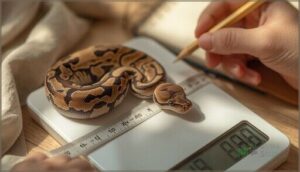
You can’t manage what you don’t measure. Tracking your ball python’s weight and length gives you hard data to spot growth issues before they become health problems.
Here’s how to collect accurate measurements and use them to keep your snake on track.
How to Weigh Your Ball Python
You’ll need a digital kitchen scale with 0.1-gram precision for accurate weight tracking. Place your ball python in a clean, breathable container, then zero the scale using the tare function before weighing. Record the weight in grams along with the date and your snake’s age.
This measurement baseline helps you monitor healthy weight trends and adjust your feeding chart accordingly for ideal snake care.
Tracking Length Over Time
Length measurement should occur monthly, using a flexible tape along your ball python’s body from nose to tail tip. Record each reading with the corresponding age estimation to track growth trends and build your own size chart for snake care comparison.
- Measure consistently at the same time each month to capture true reptile growth and development patterns
- Photograph each session with a ruler in frame to verify your data visualization later
- Watch for growth spurts during juvenile stages when size tracking reveals the steepest gains
- Compare your findings to species-typical ranges to spot any deviations early
Growth Rate Calculations
Your ball python’s growth rate—the mass change per week or month—reveals more than simple numbers. These growth trends inform your snake nutrition adjustments and size projections, helping you spot deviations before they become problems. Calculate it by dividing grams gained between weigh-ins by the number of days elapsed, then multiply by 30 for monthly rate metrics.
| Age Stage | Typical Growth Rate |
|---|---|
| Hatchling (0-6 mo) | 15-25 g/month |
| Juvenile (6-18 mo) | 30-50 g/month |
| Subadult (18-36 mo) | 20-40 g/month |
Track your data monthly to build growth models that reflect your individual ball python’s reptile growth and development pattern. Weight plateaus signal approaching maturity, while sudden drops warrant veterinary consultation.
Signs of Healthy Vs. Unhealthy Weight

You can’t adjust your ball python’s care if you don’t know what healthy weight actually looks like. A well-conditioned snake has clear visual and tactile markers that separate it from one that’s dangerously thin or carrying excess fat.
Here’s how to assess your python’s body condition with confidence.
Body Shape and Muscle Tone
A healthy ball python displays smooth body contours with firm, rounded muscle development from neck to vent. You’ll notice a triangular cross-section when viewing from above, with no visible ribs or concave flanks. Proper weight distribution ensures the spine sits level, not sunken.
Evaluate scale health during handling—consistent tension indicates adequate snake nutrition supporting animal growth, while loose skin folds signal concerns.
| Body Region | Healthy Weight Indicators | Concern Signs |
|---|---|---|
| Neck/Head | Proportional taper, distinct musculature | Pinched, overly thin appearance |
| Mid-body | Cylindrical, firm on palpation | Visible ribs, concave sides |
| Tail base | Smooth shift, consistent girth | Abrupt narrowing, flaccid feel |
| Overall posture | Level spine, active coiling | Sunken backbone, weak positioning |
| Skin/scales | Taut surface, minimal folding | Excess sag, loose draping |
Recognizing Underweight Pythons
Your python’s backbone shouldn’t tell the story—visible ribs and a pronounced waistline signal nutrition deficits requiring immediate attention. Underweight diagnosis relies on body condition scores and weight-for-length data showing readings below species-specific percentiles. Monitor for persistent weight loss despite regular feeding, which indicates potential health risks. Veterinary assessment becomes essential when appetite drops or lethargy appears alongside declining weight.
| Assessment Method | Underweight Indicators |
|---|---|
| Visual inspection | Prominent spine, visible ribs, triangular body profile |
| Weight tracking | Persistent decline, falls below age-appropriate ranges |
| Clinical signs | Poor appetite, lethargy, digestive disturbances |
Identifying Overweight or Obese Pythons
On the opposite end, a round profile with visible fat deposits behind the tail base or along the sides points to excess weight. Your python should maintain a triangular cross-section—barrel-shaped bodies signal trouble. Obesity risks include fatty liver disease and sluggish behavior. Weight management requires immediate feeding adjustments when body condition deteriorates.
| Assessment Method | Overweight Indicators |
|---|---|
| Visual inspection | Round midsection, fat pads, loss of triangular shape |
| Palpation | Soft texture, reduced muscle definition |
| Behavioral signs | Decreased activity, impaired thermoregulation |
| Health consequences | Fatty liver disease, appetite changes, metabolic dysfunction |
Supporting Optimal Growth and Weight
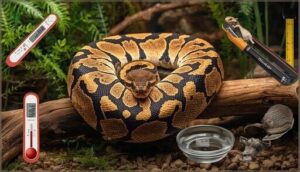
Your ball python’s growth depends on consistent care decisions you make every single day. Meeting their needs at each life stage requires adjusting feeding schedules, recognizing early warning signs, and knowing when professional help is necessary.
Here’s how to support healthy weight and growth throughout your python’s development.
Feeding Guidelines by Age
As your ball python matures, you’ll adjust feeding schedules and prey sizes to match its nutrition needs.
Hatchlings require meals every 5–7 days—about 5–10% of body weight—to sustain rapid growth rates. Juveniles shift to 7–10-day intervals with prey at 12–20% of weight.
Subadults need feeding every 10–14 days, while adults maintain healthy weight gain on 14–21-day schedules with appropriately sized prey.
Adjusting Care for Growth Issues
When growth stalls or accelerates unexpectedly, methodical care adjustments restore balance. Establish a feeding strategy customized to your ball python’s age and current weight, then monitor response through regular health checks.
Adjust calorie intake gradually—sudden changes stress underweight or overweight pythons. Document temperature gradients, prey size, and feeding intervals.
If growth monitoring reveals persistent issues despite nutrition planning modifications, underlying parasites or illness may require intervention.
When to Consult a Reptile Veterinarian
Some problems require professional Reptile Health intervention despite your best efforts. Recognize these Vet Visit Signs that demand urgent Veterinary Care for Reptiles:
- Refusal to eat for more than two weeks — appetite loss signals underlying illness
- Sudden Weight loss exceeding seven days — rapid decline indicates serious Snake Health issues
- Visible distress or abnormal Snake Behavior lasting several days — lethargy warrants Emergency Care
- Persistent discharge from mouth or cloaca — infection requires immediate Veterinary Advice
Trust your instincts when monitoring Ball Python wellness.
Frequently Asked Questions (FAQs)
How long until a ball python is full grown?
Most ball pythons reach full maturity between three and four years of age. Growth slows substantially after the juvenile stage, with genetics, feeding schedules, and environmental temperature all influencing final size.
How fast should a ball python gain weight?
Healthy weight gain ranges from 5–15 grams per week for hatchlings under ideal feeding strategies.
Your snake’s growth patterns slow as it matures, requiring adjusted nutrition advice and regular health indicators monitoring to maintain ideal body condition.
Can you leave a heat lamp on 24/7 for ball python?
You can leave a heat lamp on 24/7 for ball python care, but only with a thermostat. Unregulated continuous heat risks thermal stress, burns, and dehydration. Temperature gradients support proper thermal regulation and reptile husbandry.
How much should a 2 year old ball python weigh?
Your two-year-old snake should weigh between 400 and 700 grams, though females often tip the scale heavier than males. Growth patterns depend on feeding strategies, genetics, and overall health indicators throughout development.
When do ball pythons stop growing completely?
Most ball pythons reach their full size between four and six years of age. Growth cessation occurs once they hit adult weight—usually 1,200–1,800 grams—with stabilization signs including consistent body mass across multiple sheds.
Can overfeeding cause permanent health problems?
Yes, chronic overfeeding triggers lasting metabolic issues in ball pythons—fatty liver disease, impaired shedding, and reproductive decline don’t always reverse.
Obesity prevention through measured feeding strategies protects reptile health and ensures your snake’s longevity.
How does brumation affect growth rates?
Brumation effects include metabolic changes that slow ball python growth suppression through hormonal shifts and reduced feeding.
Post brumation recovery usually restores normal weight gain and reptile health trajectories within weeks.
Do different morphs have varying growth patterns?
Don’t judge a book by its cover—ball python morphs show minimal growth variance. Nutrition effects, environmental impact, and sex differences far outweigh morph genetics in determining weight and growth rates across python morphs.
What causes sudden unexplained weight loss?
Parasite infections, temperature stress, dehydration effects, and undiagnosed disease diagnosis cause sudden weight loss in ball pythons.
Nutritional deficits from improper feeding also trigger rapid decline, requiring immediate reptile health evaluation.
Do morphs affect ball python growth rates?
Growth tempo shows minimal morph-based genetic variance in ball pythons.
Diet, temperature, and overall reptile health dominate weight outcomes.
Breeding outcomes and color influence remain secondary to proper nutrition and husbandry in determining growth rates.
Conclusion
Your python’s weight tells a story—one written in grams, meals, and the subtle shifts between each shed. Tracking ball python weight and growth isn’t about hitting arbitrary benchmarks; it’s about reading your animal’s individual trajectory and catching problems before they escalate.
Measure consistently, compare thoughtfully, and adjust care when the numbers drift. When growth stalls or spikes without explanation, don’t wait. Early intervention keeps minor concerns from becoming veterinary emergencies.
- https://www.ncbi.nlm.nih.gov/pmc/articles/PMC4743077/
- https://www.svvspets.com/wp-content/uploads/2019/12/Ball-Python-Care-Guide.pdf
- https://academichelpexpress.blog/2024/08/please-use-the-bulleted-points-and-the-rubric-below-to-guide-your-work-your-pa/
- https://x.com/godofprompt/status/1990526288063324577
- https://www.sciencedirect.com/science/article/pii/S0749208123000268