This site is supported by our readers. We may earn a commission, at no cost to you, if you purchase through links.

A hatchling children’s python fits in the palm of your hand, stretching barely 25 centimeters. Give it three years, and you’re looking at an adult pushing past a meter long. That growth curve isn’t linear, and it isn’t identical between the sexes either—females pack on noticeably more length and weight than males by maturity.
This children’s python size guide breaks down exactly what to expect at every stage, from yolk-heavy hatchlings to full-grown adults settling into their genetic ceiling. You’ll find the numbers behind healthy growth, the enclosure dimensions that keep pace with it, and the husbandry factors that separate a thriving python from a stunted one.
Table Of Contents
- Key Takeaways
- Children’s Python Size Chart by Age
- How Fast Do Children’s Pythons Grow?
- What Affects Children’s Python Size?
- Enclosure Size for Each Growth Stage
- Tracking Healthy Growth and Development
- Frequently Asked Questions (FAQs)
- How big does a Childrens Python get?
- Do children pythons prefer long or tall tanks?
- Do children’s pythons like to be held?
- Can I put a juvenile ball python in a 120 gallon tank?
- How big do female vs male pythons get?
- Do Childrens Pythons stop growing at maturity?
- How does size compare to other python species?
- Can stunted growth be reversed in pythons?
- Are Childrens Pythons a good beginner snake?
- How long do Childrens Pythons typically live?
- Conclusion
Key Takeaways
- Children’s pythons grow from 25-40 cm hatchlings to 3-4 foot adults over 2-4 years, with growth speeding up early on and tapering off sharply once sexual maturity hits around year two to three.
- Females consistently outgrow males in weight and girth at maturity, making body condition—not just length—the more reliable way to judge sex and health.
- Steady growth depends on matching feeding frequency and prey size to age (weekly for hatchlings, tapering to every 10-14 days for adults) along with proper temperature gradients, humidity, and low-stress husbandry.
- Enclosures must scale up with each life stage, from a modest hatchling tank to an adult setup roughly 1.5 times body length, since space and security directly affect thermoregulation and stress-free growth.
Children’s Python Size Chart by Age
Children’s pythons change dramatically from hatchling to adult, and knowing what’s normal at each stage helps you spot problems early. Size varies by sex, genetics, and lineage, so a single number rarely tells the whole story. Here’s what you can expect at every step of the way.
If you’re comparing husbandry needs across dwarf species, this Savu python care sheet offers useful context for how similarly sized pythons grow and thrive.
Hatchling Length and Weight
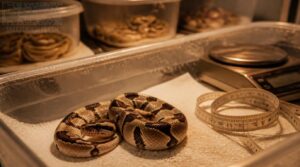
Crack open an incubator container and you’ll find hatchlings measuring 25 to 40 centimeters, weighing just 60-150 grams. Clutch mates vary by roughly 15%, with heavier hatchlings often carrying stronger yolk reserves.
| Metric | Typical Range | Notes |
|---|---|---|
| Length | 25-40 cm | Depends on incubation |
| Weight | 60-150 g | Correlates with yolk reserve |
| Clutch variation | ±15% | Reflects egg quality |
Juvenile Size Range
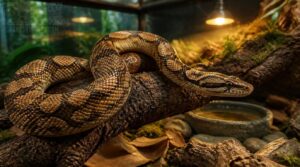
Between the hatchling stage and adulthood, your snake enters an awkward but exciting stretch: 30-90 cm long, 0.2-1.5 kg, with defined scaling patterns replacing that early, softer look.
| Metric | Juvenile Range |
|---|---|
| Length | 30-90 cm |
| Weight | 0.2-1.5 kg |
| Feeding | Weekly |
| Duration | ~2-3 years |
Regular meals drive steady length increases, while coloration stays juvenile even as proportions mature.
Adult Length and Weight
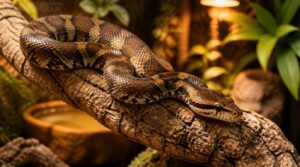
By the time that awkward juvenile phase wraps up, you’re looking at a settled adult: 3 to 4 feet long, with weight stabilizing around 500-800 grams. Some individuals push past 1,000 grams.
| Metric | Adult Range |
|---|---|
| Length | 0.7-1.5 m |
| Weight | 500-800 g |
| Timeline | 2-4 years |
Genetics and regional locality shape where your snake lands within that spread.
Male Vs Female Size
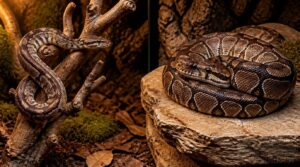
Females outgrow males, often by several inches and a hundred grams or more at maturity. This dimorphism shows up early—broader pelvic structure, higher body fat, and denser skeletal proportions in females, while males stay leaner with faster early linear growth.
| Trait | Female | Male |
|---|---|---|
| Length | Longer | Shorter |
| Weight | Heavier | Lighter |
| Build | Broader | Leaner |
Size Compared to Other Pythons

Next to reticulated or Burmese pythons, your Children’s python looks almost toy-sized—3 to 4 feet max versus 20+ feet.
That compact size is actually one of the reasons Children’s pythons make such manageable, beginner-friendly pets.
| Species | Adult Length |
|---|---|
| Children’s Python | 3–4 ft |
| Burmese Python | 12–20 ft |
| Reticulated Python | 14–20 ft |
That size progression matters practically: smaller bodies mean smaller enclosures, lighter feeding loads, and far more manageable handling than giant constrictors demand. For example, the Burmese python can reach impressive sizes, with some individuals weighing over 400 pounds as noted in size comparisons. Burmese python weight is a key factor in their ecological impact as invasive species in Florida.
How Fast Do Children’s Pythons Grow?

Growth in Children’s pythons isn’t a straight line—it speeds up, slows down, and shifts direction as your snake ages. Knowing what to expect at each stage helps you set realistic goals and catch problems early. Here’s how that growth usually unfolds, from hatchling to full adult size.
First-Year Growth Expectations
Twelve months brings dramatic transformation: expect 3.5 to 6 feet in length and 5 to 12 pounds in weight. Growth peaks between months two and six, then tapers off.
Feed every 5 to 7 days with appropriately sized frozen prey. Watch for consistent shedding cycles every 4 to 6 weeks — your clearest sign that development is on track.
Growth From One to Three
Momentum carries into the second year, but at a gentler pace: expect 6 to 10 inches of added length and steady weight gains toward that 500-800 gram range. Feeding frequency drops to every 7-10 days as growth patterns shift from explosive to measured.
Watch shedding cycles and track measurements against growth charts — your best gauge that development’s staying on course through year three.
Sexual Maturity Timeline
Somewhere around year two to three, your python crosses the invisible line into reproductive maturity — hormonal shifts drive the change, though external cues stay subtle compared to mammals.
- Growth velocity slows noticeably
- Breeding behaviors may emerge
- Body weight often exceeds 500g
- Feeding response can shift
- Hormonal changes drive internal development
Unlike Tanner-staged mammals, pythons don’t show obvious external maturity markers — you’re mostly tracking weight and age benchmarks instead.
When Growth Slows
Growth doesn’t stop on a birthday — it eases off gradually once genetic growth limits kick in near sexual maturity. Watch for smaller weight-gain increments despite steady feeding, longer stretches between shed cycles, and a nutritional plateau where increased food doesn’t add much size.
Stable temperatures and low stress help, but genetics ultimately caps how big your snake gets.
Full Adult Size Range
Once your python settles into adulthood, expect 3 to 4 feet overall, though genetics and locality can stretch some individuals closer to 5 feet.
Weight lands anywhere from 500-800 grams, with occasional outliers hitting 1,000. Females usually outweigh males. Keep monitoring weight gain even after growth plateaus — it’s your best clue that husbandry, not just age, is keeping your snake healthy.
What Affects Children’s Python Size?
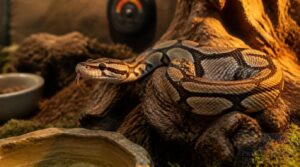
Size isn’t just a matter of age or species—several factors work together to shape how big your Children’s python ultimately gets. Some of these you’ll control directly, like feeding schedules and enclosure conditions, while others, like genetics, are set before you even bring your snake home.
Here’s what actually moves the needle on growth.
Genetics and Locality
Before you ever pick a feeder, ask where your snake’s ancestors came from. Regional genetic variation across northern and northwestern Australia, home turf named for John George Children, means lineage history shapes hereditary features like adult size.
Geographic isolation and microenvironmental selection produce distinct population structure by locale—so two "Children’s pythons" from different valleys may mature at noticeably different weights.
Feeding Frequency
Genetics sets the ceiling, but your feeding schedule decides how fast your python climbs toward it.
Genetics may set a python’s size limit, but feeding schedule determines how quickly it gets there
- Hatchlings: every 5-7 days
- Juveniles: every 7-10 days
- Adults: every 10-14 days
- Weight and body condition guide adjustments
- Watch appetite for growth cues
Skipping meals or overfeeding disrupts natural growth patterns, so consistency matters more than speed.
Prey Size Guidelines
Mouth gape matching matters as much as feeding frequency: prey should never exceed your snake’s widest point. Hatchlings take prey at 1-2% body weight; juveniles, 2-4%; adults, 8-12%. Increase size gradually—sudden jumps stress your python and invite refused feeds.
Rotating prey type variety (mice, rats) prevents selectivity, while watching feeding response tells you when it’s time to size up.
Temperature and Humidity
Get the gut working right, and growth follows: thermal gradients drive digestion efficiency, with basking spots at 78-88°F and cool zones near 75-80°F.
- Nighttime dips to 68-75°F support natural cycling
- Maintain 50-60% humidity, rising to 70% for sheds
- Use humidity hides near substrate
- Poor humidity correlates with stuck sheds
- Monitor with a digital hygrometer, not guesswork
Stable thermal regulation keeps growth steady, not stalled.
Stress and Husbandry
A python that never feels safe rarely grows well. Chronic stress slows feeding response and digestion, so watch for pacing, refusal to eat, or defensive strikes during handling.
Stick to a predictable feeding schedule, use slow, gentle handling techniques, and keep enclosure design calm—solid hides, stable temperature gradient, steady humidity regulation. Consistency here does more for growth than any supplement ever could.
Enclosure Size for Each Growth Stage

Your python’s enclosure needs change dramatically as it grows, and matching the right size to each stage keeps your snake safe and comfortable. What works for a hatchling won’t cut it for a juvenile, and what suits a juvenile falls short for an adult. Here’s what you’ll need at every stage, from the first tank to the final setup.
Hatchling Enclosure Size
Hatchling Enclosure Size should stay modest: something around 20"L x 12"W x 10-12"H works well, giving room to move without triggering stress.
Skip loose substrate; smooth reptile carpet or paper towels reduce injury risk.
Make sure secure ventilation and a tight-fitting lid—hatchlings are escape artists.
Add a shallow water dish, cleaned daily, and you’re set for healthy early growth.
Juvenile Enclosure Upgrades
Somewhere between the 12x12x12 starter tank and full adulthood, your snake needs a bigger world. Bump up toward 36L x 18W x 18H, add proper substrate depth for burrowing, and build in real temperature gradients.
Modular panel systems and climbing ladder rungs support growth spurts, while humidity misting controls, self-draining waste trays, and escape-proof door latches keep maintenance simple and secure.
Adult Minimum Dimensions
Full-grown Children’s pythons need room to actually stretch out, not just coil in a corner. Adult Minimum Dimensions usually mean 36L x 18W x 18H, though many keepers size up from there:
- Enclosure Length Requirements: 1.5 times body length
- Width Clearance Guidelines: 2.5–3x body diameter
- Height Clearance Standards: 20-30% above vertical reach
- Substrate Depth Specifications: 6-12 inches for burrowing
Hiding Space Allocation matters too—dedicate a third of the floor to secure retreats.
Larger Habitat Benefits
Bigger isn’t just better—it’s biologically necessary. Beyond the 36L x 18W x 18H baseline, extra space creates thermal gradient variety, lets your python express natural behaviors, and reduces stress.
| Benefit | Effect | Result |
|---|---|---|
| More floor space | Gradient choice | Better thermoregulation |
| Vertical complexity | Climbing outlets | Muscle tone |
| Bioactive substrate | Enrichment | Lower stress |
Escape-Proof Setup Tips
Children’s pythons are notorious escape artists, so lock integrity matters as much as tank size. Use two-hand latches, seal gaps under 1mm, and size ventilation holes smaller than your snake’s head.
Weekly safety audits catch loosened screws or shifting substrate before they become an exit. A secure substrate base and consistent temperature gradient keep your reptile enclosure both escape-proof and comfortable.
Tracking Healthy Growth and Development
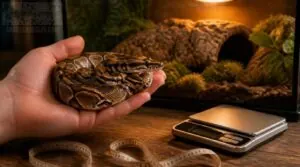
Numbers only tell you so much about a snake’s wellbeing. You’ll want a system for checking growth that catches problems early, before they become real setbacks. Here’s what steady, healthy development actually looks like, and how to keep tabs on it.
Weighing and Measuring
Grab a gram-scale and a flexible tape, since consistency beats fancy gear every time.
Weigh hatchlings weekly, juveniles biweekly, adults monthly—same scale, same flat surface, same time of day.
- Weight fluctuation often follows feeding or shedding
- Length should be measured snout-to-vent when possible
- Recheck outliers within a week
Log everything. Your growth log becomes the earliest warning system you’ve got.
Healthy Body Condition
Numbers only tell half the story. Body condition assessment relies on your hands and eyes as much as the scale.
| Sign | Healthy Indicator |
|---|---|
| Muscle tone | Firm, no ribs felt |
| Skin | Tight, no sunken spots |
| Weight-length balance | Proportional, no bony tail |
Handle weekly. A snake that feels floppy or shows hollowed sides needs a feeding review, not panic.
Shedding as Growth Clue
Your snake’s shed cycle tells you what the scale can’t. Frequent, complete sheds paired with steady weight gain signal a genuine growth spurt, especially in juveniles feeding weekly. Watch skin elasticity—easier molts mean healthy mass increase.
Skipped or partial sheds often point to dehydration or stress, not growth. Document each shed date alongside monthly weigh-ins; consistency across cycles confirms healthy growth rates, not guesswork.
Growth Record Keeping
Consistent logging turns scattered observations into real data. Record date, weight, length, and shed cycles in one dedicated file, using the same measurement method—digital scale, tape or calipers—every time.
Review growth monthly, flagging any change over 10% for a closer look. Save charts as PNGs, back up weekly, and restrict access to protect your records long-term.
When to Call a Vet
When your feeding response logs, weight gain monitoring, or body condition scoring reveal something off, don’t wait it out.
- Breathing difficulties: gasping, wheezing, open-mouth breathing
- Neurological signs: tremors, seizures, loss of righting ability
- Sudden weight loss or thinning despite normal feeding
- Digestive issues: bloody stool, straining, no bowel movement
- Skin injuries, blistering, or signs of respiratory infection
Persistent shedding problems also warrant a vet call.
Frequently Asked Questions (FAQs)
How big does a Childrens Python get?
Don’t expect a giant: adult length tops out around 90 to 120 cm (occasionally 135 cm), with weight settling between 200-800 grams. Growth stages run hatchling to sexual maturity by year two or three, then slow considerably.
Do children pythons prefer long or tall tanks?
Length over height wins here — these pythons are terrestrial, so they need horizontal space for stretching and thermal gradient efficiency, not climbing room. Vertical height stays largely irrelevant to their comfort, welfare, or enrichment suitability.
Do children’s pythons like to be held?
Tolerance beats enthusiasm here: most accept gentle, supported handling without seeking it out. Watch for wrist-coiling as a comfort sign. Skip handling during moulting or within 48 hours of feeding, and keep sessions brief and calm.
Can I put a juvenile ball python in a 120 gallon tank?
A 120-gallon tank is like giving a toddler an entire ballroom — technically fine, but overkill. Tank size benefits matter less than proper temperature gradients, hides placement, and consistent feeding frequency for healthy juvenile development.
How big do female vs male pythons get?
Sexual dimorphism stays subtle here: both sexes reach 30-40 inches, but females often pack on noticeably more girth at maturity. Males stay leaner and slightly shorter, so weight—not length—is your best clue when sexing adults visually.
Do Childrens Pythons stop growing at maturity?
Not entirely. By 2-3 years, most reach full length, and growth rate declines sharply. You’ll still see slow, continued length gain and weight stabilization over the years, just nothing dramatic like those first juvenile growth spurts.
How does size compare to other python species?
Picture a David-versus-Goliath matchup: your Children’s python tops out near four feet, while Ball pythons stretch to six and Burmese pythons routinely surpass twenty in captivity—a size gap reflecting real differences in growth rate and adult morphometrics.
Can stunted growth be reversed in pythons?
Some stunted snakes never top 400 grams, even years later. Growth plate closure limits length permanently, but weight gain recovery is possible.
Fixing early life nutrition and husbandry improvements won’t reverse genetic growth limits, though condition often improves noticeably.
Are Childrens Pythons a good beginner snake?
Yes—their calm temperament and manageable adult enclosure size (75-125 gallons) make handling and care simple. Predictable growth patterns, easy feeding response, and a decades-long lifespan commitment suit patient beginners ready for steady, hands-on responsibility.
How long do Childrens Pythons typically live?
With excellent husbandry, expect 15 to 20 years, sometimes stretching into the low 20s. Wild populations rarely reach that mark, usually living 10 to 15 years given harsher conditions, predation, and inconsistent food availability compared to captive care.
Conclusion
A seedling doesn’t rush toward the canopy; it grows ring by ring, trusting time over haste. Your python follows that same quiet logic.
This children’s python size guide gives you the benchmarks, yet growth still hinges on what you do daily: feeding right, housing properly, watching closely. Master those habits, and size takes care of itself. Your python’s growth is simply proof you’re doing it right.
Numbers on a chart won’t guarantee a healthy snake, but attentive care will.