This site is supported by our readers. We may earn a commission, at no cost to you, if you purchase through links.

A hatchling corn snake fits in your palm at 8 to 14 inches and weighs about as much as a few paperclips. Two to three years later, that same animal can stretch past four feet.
That’s a lot of change to track, and it’s easy to wonder if your snake is on schedule or falling behind. Understanding corn snake size and growth rate gives you real control over feeding, housing, and health checks. A female and a male raised side by side can end up several inches apart, and that’s perfectly normal.
Here are the numbers, the timeline, and the warning signs that separate normal variation from a real problem.
Table Of Contents
- Key Takeaways
- Typical Corn Snake Size at Each Life Stage
- Corn Snake Growth Rate Timeline: When Are They Fully Grown?
- How Genetics, Feeding, and Care Affect Corn Snake Growth
- Measuring and Tracking Your Corn Snake’s Growth
- Slow Corn Snake Growth: Normal Variation or a Health Concern?
- Frequently Asked Questions (FAQs)
- How big should a 3 year old corn snake be?
- What is the biggest trouble with corn snakes as pets?
- Do corn snakes bond with their owners?
- Is a 40 gallon tank enough for a corn snake?
- Do corn snakes ever stop eating completely?
- Can lighting affect corn snake growth rate?
- How does brumation impact overall snake size?
- Whats the smallest recorded adult corn snake?
- Do wild corn snakes grow faster initially?
- How big should a corn snakes enclosure be?
- Conclusion
Key Takeaways
- Your corn snake starts at 8 to 14 inches, grows fastest in its first year, and reaches its adult size of roughly 3 to 5 feet by age 2 to 3, with females ending up bigger and bulkier than males.
- Genetics sets your snake’s size ceiling, but you control the rest by feeding on a steady schedule and keeping the warm side at 28 to 30°C, since a cool snake will eat without growing.
- Weigh and measure your snake monthly, log it all, and look at the trend over time, because a snake gaining length without weight needs its feeding adjusted.
- Slow growth is usually a husbandry problem or normal variation, but if your snake loses weight, looks thin, or stalls for months, call an exotics vet.
Typical Corn Snake Size at Each Life Stage
Knowing what’s normal for your corn snake at each stage gives you real control over its care. Below, you’ll find the typical size ranges for hatchlings, juveniles, and adults, so you can see where your snake fits. Use them as your guide and you’ll spot a healthy, well-grown snake with confidence.
If you’re still deciding on housing for a young snake, this guide to which snakes can live in a 20-gallon tank shows how enclosure size fits each growth stage.
Hatchling Length and Weight
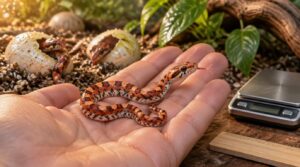
A hatchling corn snake will emerge measuring 8 to 14 inches and weighing 8 to 14 grams, roughly pencil-thin. Hatchling length and weight look nearly identical in males and females, so don’t guess sex by size.
- Length: 20–35 cm
- Weight: 8–14 grams
- Feeding starts within 1–2 weeks
- Birth weight often doubles in a month
Track these numbers from day one.
Juvenile Size and Growth Milestones
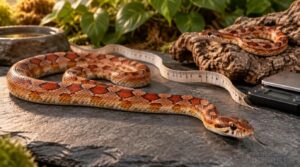
Once your hatchling outgrows its pencil-thin stage, your Juvenile Growth Rate takes off. By 12 months, expect 30–40 inches and 100–180 grams. Monthly Length Gains stay steady early on.
Since females end up 20–50% larger than males, a boa constrictor size variations guide helps you plan enclosure upgrades well before your snake reaches adulthood.
Even when snakes eat nearly identical amounts of food, genetics likely drives growth, so siblings can differ noticeably in size.
Follow your Juvenile Feeding Protocol: one meal every 7 days. Weigh and measure twice monthly for Weight and Length Monitoring.
After 18 months, Growth Rate Decline Patterns appear: length slows first.
Adult Size and Sex Differences

matter less than you’d think early on, since males and females show minimal size differences until year two. Then females pull ahead.
If you’re planning ahead for an enclosure, this corn snake size and growth guide shows how quickly they reach adult length during those first two years.
- Females usually stretch 4 to 5 feet.
- Adult snakes that are male measure 3 to 4 feet.
- Average length: males 90–120 cm, females 110–150 cm.
- Expect a bulkier build in females.
- Genetics can flip these averages.
Corn Snake Growth Rate Timeline: When Are They Fully Grown?
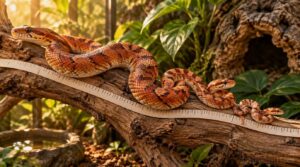
Once you know the size ranges, the growth rate timeline shows you how fast your snake gets there.
Neonate care sets the pace. Feed on schedule, and your hatchling can reach 15-30 inches by 12 months, then 30-40 inches by year two. Growth rate declines after 18 months, so expect the gains to slow.
Most corn snakes reach full adult size between 2 and 3 years, though some need 3-4. You can call yours fully grown when its length holds steady at 90-150 cm for 6+ months. Adult morphology settles too, with weight stabilizing around 450-900 g.
Growth rate varies with feeding schedule, genetics, and husbandry, so this corn snake size and growth timeline can help you judge whether yours is on track.
Don’t read a plateau as a reason to stop feeding. Complete feeding cessation isn’t part of adult care, so keep offering right-sized meals.
How Genetics, Feeding, and Care Affect Corn Snake Growth

The way genetics, feeding, and care affect corn snake growth comes down to three levers, and you hold two of them. Genetics set the size blueprint: Okeetee lines reach 140-150 cm, while Florida Keys lines stay near 90-110 cm.
You handle the rest:
- Feeding protocols: pinkies every 5 days double hatchling growth; juveniles thrive on prey at 10-15% of body weight.
- Temperature: keep ambient at 82-86°F with a 88-92°F basking spot, since cool snakes eat but don’t grow.
- Enclosure: give adults a 40-gallon breeder with hides and branches to keep cortisol low.
Power-feeding speeds early growth, but it risks obesity and a shorter lifespan, so don’t chase size. Steady heat and sensible meals beat rushing every single time. Stay patient.
Measuring and Tracking Your Corn Snake’s Growth

You can master Measuring and Tracking Your Corn Snake’s Growth with a soft tape, a 1 g digital scale, and a notebook. Measure snout to tail tip along the snake’s natural curves, never stretching it, and weigh it in a ventilated container using tare.
Do both monthly, before feeding or 24 to 48 hours after a meal. Log length, weight, feeding dates, and sheds together. Don’t panic over one odd reading; a tense snake can understate its true length. A dedicated reptile care log book keeps lengths, weights, feeding dates, and sheds in one place, making monthly trends easy to spot.
Your growth chart tracking reveals weight and length correlation: a snake gaining length but not weight needs feeding schedule adjustments. Compare against age and length correlation too, like 20 to 30 inches by six months, but remember lineage shifts the numbers.
Slow Corn Snake Growth: Normal Variation or a Health Concern?

A slow snake isn’t always a sick snake, but a sick snake can look just like a slow one.
Slow growth in a snake can be harmless variation or hidden illness, and the two often look exactly alike
First, check body condition. If your snake’s ribs and spine stay hidden, the shape is gently rounded, and sheds come off whole, you’re likely seeing normal genetic variation. Males also stay smaller than females. Corn Snake Size and Growth Rate vary, and a smaller sibling isn’t a problem.
Still, stunted growth stems primarily from husbandry mistakes. Inadequate feeding practices often stand as the primary culprit, and environmental stress from suboptimal temperatures slows metabolism by 15–30%. Keep the basking spot at 28–30°C.
Growth rate declines 20–30% when it transitions from juvenile to subadult, which is normal. Weight loss? See a vet.
Frequently Asked Questions (FAQs)
How big should a 3 year old corn snake be?
Your three-year-old corn snake should be adult-sized by now, usually 43 to 60 inches long and 250 to 450 grams. Adult morphology arrives around two to three years, so expect steady, slow growth from here.
What is the biggest trouble with corn snakes as pets?
The biggest trouble is husbandry mistakes, and you can fix them. Keep the warm side near 28–30°C, match prey to body width, and stick to steady feeding protocols. Skip those, and your snake’s growth stalls.
Do corn snakes bond with their owners?
Your corn snake likely knows your scent, and that’s about it. It tolerates you, not true bonding. A calm adult or juvenile growth stage snake shows habituation, not affection. Keep housing enriched, handling gentle, and routines predictable.
Is a 40 gallon tank enough for a corn snake?
A 40-gallon tank is a sturdy starter apartment, not a forever mansion. It’s fine for adults near 3 to 4 feet, but a 4-footer can’t stretch fully. Choose a 4 x 2 x 2 enclosure.
Do corn snakes ever stop eating completely?
Wondering if your snake can quit eating? Complete feeding cessation is rare, usually tied to shedding or stress factors. Stick to your feeding schedule, fix husbandry, and watch your Corn Snake Size and Growth Rate.
Can lighting affect corn snake growth rate?
Yes, but indirectly. Lighting can influence corn snake growth rate by supporting thermal regulation, circadian rhythms, and UVB-linked calcium metabolism.
Your temperature gradient matters most, since warmth drives digestion and feeding. Weigh your snake monthly.
How does brumation impact overall snake size?
Brumation effects on reptiles are temporary: your snake loses growth time, not genetic adult size.
Cooler body temperature regulation shifts energy allocation to survival, so growth recovery lags 1–3 months post-emergence, normal growth taper resumes.
Whats the smallest recorded adult corn snake?
There’s no verified smallest recorded adult corn snake. That 9-inch claim matches a hatchling corn snake emergence size, not true adult corn snake size. Check your corn snake growth chart and factors affecting growth rate.
Do wild corn snakes grow faster initially?
You might assume wild means faster, but it doesn’t. Wild corn snake hatchlings usually grow slower than captive ones, because unpredictable prey, cooler seasons, and hunting effort all eat into growth. Captive feeding wins early.
How big should a corn snakes enclosure be?
Your adult corn snake needs a 4 × 2 × 2 ft enclosure, the ideal tank size for adults. Enclosure size directly shapes its growth trajectory, so upgrade hatchlings and juveniles as they quickly grow.
Conclusion
Most corn snakes reach 3.5 to 5 feet by age three, and that’s your finish line.
Knowing your corn snake size and growth rate turns guesswork into a simple routine: weigh monthly, measure quarterly, and log everything. A steady upward line beats any single number. If growth stalls for months, or your snake looks thin and sluggish, call an exotics vet.
Your snake sets the pace. Keep honest records, and let that tiny hatchling grow.