This site is supported by our readers. We may earn a commission, at no cost to you, if you purchase through links.
Your bearded dragon basks under its heat lamp, but without ultraviolet B radiation in the 280-320 nanometer range, its bones are slowly weakening—even if you’re providing calcium supplements. This invisible wavelength triggers vitamin D3 synthesis in reptilian skin, a process that transforms dietary calcium into strong skeletal structure and powers immune defenses you can’t see but your pet desperately needs.
Unlike mammals who can synthesize vitamin D3 internally, reptiles evolved under full-spectrum sunlight and require direct UVB exposure to maintain basic physiological functions, from bone mineralization to disease resistance.
The benefits of UVB for reptile health extend far beyond preventing metabolic bone disease; proper lighting influences growth rates, reproductive success, and even behavioral patterns that signal wellness in captive environments.
Table Of Contents
- Key Takeaways
- What is UVB and Why Reptiles Need It
- Key Health Benefits of UVB for Reptiles
- Choosing The Right UVB Lighting for Reptiles
- Proper UVB Lighting Setup and Maintenance
- Species-Specific UVB Requirements
- Frequently Asked Questions (FAQs)
- What are the benefits of UVB exposure?
- Is too much UVB bad for reptiles?
- Is 7% UVB good for bearded dragons?
- What does 7% UVB mean?
- Can reptiles overdose on UVB exposure?
- How does UVB affect reptile skin shedding?
- Do nocturnal reptiles need UVB lighting?
- What UVB meters measure lamp effectiveness?
- Does UVB penetrate through mesh screen tops?
- Conclusion
Key Takeaways
- UVB radiation between 280-320 nanometers triggers vitamin D3 synthesis in reptilian skin, enabling calcium absorption that prevents metabolic bone disease and supports skeletal strength, immune function, and reproductive success.
- Proper UVB intensity varies dramatically by species—desert dwellers require Ferguson Zone UV Index readings of 6-10, while forest species thrive at 3-5, making species-specific research essential for effective lighting setup.
- UVB bulbs lose effectiveness within 6-12 months despite appearing functional, requiring scheduled replacement and regular monitoring with a UVB meter to maintain therapeutic radiation levels at basking spots.
- Emerging research indicates even nocturnal species like ball pythons benefit from low-level UVB exposure (2-5% output), challenging traditional assumptions and improving overall health outcomes when combined with proper distance and photoperiod management.
What is UVB and Why Reptiles Need It
Understanding UVB lighting starts with knowing what it is and why your reptile can’t thrive without it. This invisible band of ultraviolet radiation, measured between 280 and 315 nanometers, triggers essential biological processes that keep your pet healthy, from bone development to immune function.
Choosing the right UVB lighting systems for desert species ensures your reptile receives the correct intensity and spectrum for optimal vitamin D3 synthesis.
Let’s break down the fundamentals of UVB, compare natural sunlight to artificial options, and clear up the most common misunderstandings that lead to preventable health problems.
The UVB Spectrum Explained
UVB radiation sits in the middle tier of the ultraviolet spectrum, spanning wavelengths from 280 to 320 nanometers. This photobiology-driven band carries enough energy to trigger vitamin D3 synthesis in your reptile’s skin, making spectrum analysis critical when selecting UVB lighting.
Understanding these UVB wavelengths helps you:
- Match UVB intensity to your species’ habitat
- Position fixtures at safe, effective distances
- Recognize when radiation effects turn harmful
- Fine-tune Ultraviolet B exposure for calcium metabolism
Natural Sunlight Vs. Artificial UVB
Direct sunshine delivers the full UVB spectrum your reptile evolved to use, enabling rapid Vitamin D3 synthesis during outdoor basking sessions and supporting natural basking behavior.
Indoor UVB lighting offers controlled light cycles and consistent UVB dosage year-round, preventing metabolic bone disease when you can’t provide safe outdoor access.
Both approaches deliver measurable UVB lighting benefits for reptile health, though each requires distinct placement and exposure strategies. Research in humans shows that using indoor UVB devices safely can effectively boost vitamin D levels when natural sunlight isn’t available.
Common Misconceptions About UVB
Many keepers wrongly assume that all UVB bulbs deliver equal benefits regardless of species-specific reptile lighting requirements, or that more UVB dosage automatically prevents metabolic bone disease.
These UVB myths lead to lighting errors that create health risks rather than UVB lighting benefits. You’ll see the impact in reptile behavior: shy animals hiding constantly, refusing food, or developing skeletal deformities despite your best intentions.
If you want to understand more about search functions and publication types related to UVB research, explore these multiple resource categories.
Key Health Benefits of UVB for Reptiles
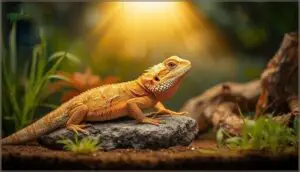
When you provide your reptile with proper UVB exposure, you’re doing much more than checking a box on a care sheet—you’re supporting a cascade of essential physiological processes that determine whether your animal thrives or merely survives.
Pairing quality UVB bulbs with the right heat lamps for large enclosures ensures your reptile gets both the light spectrum and thermal gradient needed for proper calcium metabolism and natural behavior.
From bone development to immune response, UVB lighting influences nearly every aspect of reptilian health in ways that aren’t always visible until problems arise.
Let’s examine the specific, measurable benefits that make UVB supplementation non-negotiable for responsible reptile husbandry.
Vitamin D3 Synthesis and Calcium Absorption
When your reptile basks beneath a UVB lamp, a striking biochemical cascade begins, converting 7-dehydrocholesterol in the skin into previtamin D3, which heat then transforms into active vitamin D3. This vitamin travels through the bloodstream to the liver and kidneys, where it becomes the hormone-like molecule driving calcium metabolism, ensuring proper bone health and preventing deficiencies that compromise reptile nutrition.
UVB exposure triggers a biochemical cascade that converts skin compounds into vitamin D3, driving calcium metabolism and bone health in reptiles
- UVB converts skin compounds into vitamin D3 through a multi-step process involving liver and kidney activation
- Active vitamin D3 enhances intestinal calcium absorption via specialized channels and binding proteins in gut cells
- Proper UVB dosage maintains calcium metabolism by working alongside parathyroid hormone to regulate blood mineral levels
Prevention of Metabolic Bone Disease
Without consistent UVB lighting, your reptile faces the specter of metabolic bone disease, a devastating condition where inadequate vitamin D3 disrupts calcium metabolism and bone health.
To prevent MBD diagnosis, you’ll need proper UVB exposure alongside dietary supplements that balance calcium and phosphorus at ratios near 1.5:1 to 2:1, safeguarding reptile nutrition and ensuring sturdy skeletal mineralization throughout growth and reproduction.
Enhanced Immune Function
Proper UVB therapy strengthens your reptile’s immune system by enabling vitamin D3 production, which activates white blood cells and modulates inflammatory responses to pathogens. This vitamin D benefit fosters microbiome health in the gut, where beneficial bacteria interact with immune cells to guard against infection—a critical defense mechanism that complements calcium metabolism and prevents complications beyond metabolic bone disease.
Support for Growth and Reproduction
Healthy developmental stages depend on vitamin D3 from UVB lighting, which facilitates calcium absorption essential for skeletal mineralization during your reptile’s growth patterns—reducing deformities in hatchlings and supporting steady somatic development.
UVB exposure also regulates reproductive cycles by maintaining hormone regulation in breeding adults, improving follicular development, egg shell quality, and hatch viability while preventing metabolic bone disease that compromises reproductive success and overall reptile health.
Positive Effects on Behavior and Activity
You’ll notice dramatic shifts in activity levels when your reptile receives adequate UVB lighting for reptile health—basking habits become more consistent, exploratory behaviors increase, and feeding routines stabilize.
UVB exposure bolsters behavioral health by regulating circadian rhythms and metabolic cues, encouraging natural social interactions, environmental enrichment engagement, and territorial displays that reflect normal reptile behavior and psychology essential for reptile care and maintenance and overall reptile health and wellness.
Choosing The Right UVB Lighting for Reptiles
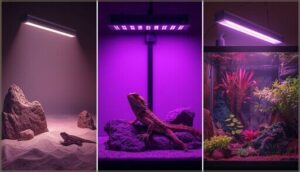
Selecting the right UVB lighting system requires understanding the different bulb types available, each offering distinct advantages regarding intensity, coverage area, and operational characteristics. You’ll need to match the lamp’s output to your reptile’s natural habitat requirements, whether they’re adapted to intense desert sun or filtered forest canopy light.
Proper evaluation of placement distance ensures your pet receives therapeutic UVB exposure without the risk of overexposure or inadequate coverage.
Types of UVB Bulbs (T5, T8, Mercury Vapor, LED)
Selecting the right UVB lighting requires understanding how each bulb type delivers radiation to your reptile. T5 UVB tubes offer high output at closer distances, making them ideal for tall enclosures, while T8 fluorescent tubes provide lower intensity suitable for smaller setups.
Mercury vapor bulbs combine heat and strong UVB for desert species, whereas LED UVB lighting runs cooler with extended lifespans but varies in effectiveness across models.
Matching UVB Intensity to Species Needs
You can’t apply a one-size-fits-all approach to UVB intensity—desert dwellers demand Ferguson Zones with UV Index targets around 6 to 10, while forest species thrive at 3 to 5.
Species research guides your basking platforms and lighting gradients, ensuring UVB lighting requirements align with wild behaviors.
UVB metering confirms you’re hitting target zones, safeguarding reptile health and wellness through precise reptile care and maintenance.
Evaluating UVB Lamp Placement and Distance
Once you’ve matched intensity to species, lamp placement and distance testing determine whether your basking zones actually deliver that UVB lighting.
Position linear fluorescents 12 to 18 inches above for T8s, 18 to 24 for T5s, ensuring unobstructed sight lines in your reptile enclosure.
Safety guidelines demand regular monitoring—distance adjustments prevent burns while maximizing UVB lighting benefits across your entire UVB setup.
Proper UVB Lighting Setup and Maintenance
Installing the right UVB bulb is only the first step—you’ll need to maintain a proper lighting schedule, keep the equipment in good working order, and monitor your reptile’s response to guarantee ideal health outcomes. Without consistent maintenance and careful attention to placement, even the best UVB system won’t deliver the physiological benefits your reptile requires.
The following guidelines will help you establish and maintain an effective UVB lighting regimen that promotes long-term wellness.
Establishing Daylight Cycles and Photoperiods
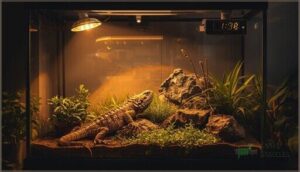
Beyond simply turning lights on and off, you’ll need to establish a consistent photoperiod timing that aligns with your reptile’s circadian rhythm. A reliable day-night cycle duration of 12 to 14 hours promotes normal activity, feeding, and hormone regulation.
Use a timer to control UVB lighting and maintain steady light intensity throughout the enclosure, ensuring your reptile care routine mimics natural ultraviolet B exposure patterns essential for reptile enclosure design and overall lighting design.
Ensuring Unobstructed UVB Exposure
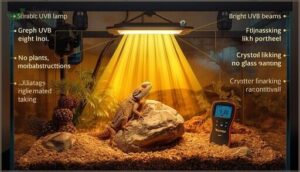
Your UVB setup works only when nothing blocks the UVB rays between the lamp and your reptile’s basking zone. Position the bulb 12 to 18 inches above the basking surface, angle it toward the primary basking area, and remove any dense decorations that cast shadows.
Use a UVB meter to confirm intensity at the basking spot, ensuring proper UVB path clearance for effective reptile lighting and enclosure optimization.
Bulb Replacement and Equipment Care
Even with unobstructed UVB exposure, your reptile lighting setup loses effectiveness as bulbs age; most T5 UVB lights maintain peak output for only six to twelve months, and mercury vapor lamps decline after twelve to fourteen months.
Replace bulbs on a regular schedule, inspect fixtures every two months for corrosion or loose sockets, and clean housings with a dry microfiber cloth to preserve UVB output and equipment safety.
Monitoring Reptile Health and Adjusting Lighting
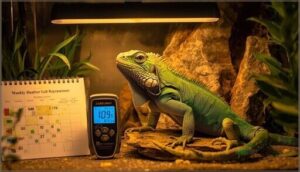
Once your UVB lighting for reptiles is in place, consistent health checks and environmental monitoring reveal whether your setup truly meets your animal’s needs. Watch for changes in reptile behavior—reduced activity or poor feeding often signals inadequate exposure, while soft bones indicate metabolic bone disease prevention requires urgent lighting adjustments. Use UVB metering to verify intensity, then adapt:
- Record appetite, shedding quality, and basking frequency weekly to detect early deficiencies
- Compare basking spot distance to species-specific guidelines using a reliable UVB meter
- Increase photoperiods gradually if lethargy develops during shorter daylight cycles
- Replace bulbs every six to twelve months to maintain effective reptile care and health
Species-Specific UVB Requirements
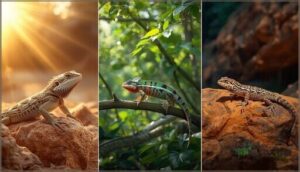
Not all reptiles require the same level of UVB exposure, and understanding your pet’s natural habitat is essential for providing appropriate lighting. Desert species, for instance, need high-intensity UVB to replicate the direct sun they’d receive in arid environments, while forest-dwelling reptiles thrive under lower, filtered UVB levels.
Let’s examine how different species categories and specific popular reptiles require customized UVB setups to maintain ideal health.
Desert-Dwelling Vs. Forest Species
Your reptile’s native habitat determines its UVB lighting needs, since desert adaptations and forest ecology create vastly different environmental factors. Desert-dwelling species like bearded dragons require intense UVB rays mimicking direct sunlight, often exceeding 10% UVB output, while forest species such as crested geckos thrive with lower intensity around 2-5%.
This habitat diversity demands careful species comparison to match UVB lighting for reptiles with their natural conditions, ensuring peak reptile health through proper reptile care and health practices.
Ball Pythons, Corn Snakes, and Boa Constrictors
Three popular snake species demonstrate contrasting UVB requirements in reptile husbandry, though emerging research suggests even nocturnal species benefit from low-level UVB rays for reptile health. While traditional reptile care assumed these snakes didn’t require UVB lighting, current evidence aids modest exposure to prevent health issues and improve snake behavior:
- Ball pythons thrive with 2-5% UVB output, aiding calcium metabolism despite nocturnal habits.
- Corn snakes benefit from similar low-intensity UVB, enhancing feeding strategies and activity patterns.
- Boa constrictors, reaching 6-10 feet, require proportionally larger enclosure maintenance with gentle UVB exposure.
- All three species show improved reptile health with proper habitat design including UVB access.
- Monitor shedding quality and appetite as indicators of adequate UVB provision in your setup.
Consulting Experts for Specialized Needs
When your species defies standard care guides or exhibits puzzling symptoms, expert guidance from a veterinary medicine professional specializing in herpetology becomes essential. Consulting services provide customized solutions designed to meet the needs of rare morphs, imported specimens, or complex health challenges.
Specialized care assessments evaluate your entire husbandry setup—including UVB lighting for reptiles—to diagnose gaps that general reptile health resources might overlook.
Frequently Asked Questions (FAQs)
What are the benefits of UVB exposure?
Light therapy really brightens the outlook for your scaled companion. UVB exposure allows vitamin D3 synthesis, which drives calcium metabolism, prevents metabolic bone disease, bolsters immune function, fosters growth and reproduction, and promotes natural basking behavior.
Is too much UVB bad for reptiles?
Yes, excessive UVB lighting poses health risks including eye damage, skin irritation, and reptile burn from UVB overexposure.
Proper distance, intensity matching your species’ requirements, and adequate shade prevent these concerns while supporting ideal reptile health.
Is 7% UVB good for bearded dragons?
A 7 percent UVB bulb can work for bearded dragons if you place it 12 to 18 inches above the basking area, creating a UVB gradient that aids calcium metabolism and dragon health effectively.
What does 7% UVB mean?
The seven percent rating indicates the proportion of UVB radiation a lamp emits relative to its total output.
However, the actual UVB dosage your reptile receives depends on lamp placement, enclosure materials, and exposure duration.
Can reptiles overdose on UVB exposure?
Although your scaly companion won’t technically “overdose” like swallowing pills, excessive UVB radiation can trigger eye irritation, skin burns, and metabolic stress.
This is especially true when UVB lighting lacks proper distance, shading refuges, or UVB metering for overexposure risks and burn prevention.
How does UVB affect reptile skin shedding?
UVB lighting promotes skin renewal by stimulating keratin production and accelerating epidermal turnover. This process helps reptiles shed more completely and reduces retained shed fragments on toes and joints during molt cycles.
Do nocturnal reptiles need UVB lighting?
The blanket rule doesn’t apply here—nocturnal reptiles usually don’t require UVB lighting for vitamin D3 synthesis. They rely on dietary calcium supplements and prey items to maintain bone health instead.
What UVB meters measure lamp effectiveness?
These meters quantify UVB irradiance in microwatts per square centimeter, revealing how lamp output, distance factors, reflective surfaces, and enclosure materials affect actual exposure levels your reptile receives at its basking spot.
Does UVB penetrate through mesh screen tops?
When you mount UVB lights above your reptile enclosure’s mesh screen, expect reduced UVB transmission rates depending on screen material impact and weave density.
Positioning lamps closer or using a UV index meter helps compensate for losses.
Conclusion
Like the ancient reptiles that once dominated sun-drenched ecosystems, your captive lizards and snakes carry the same physiological blueprint—one that demands ultraviolet radiation to thrive.
The benefits of UVB for reptile health aren’t optional enhancements; they’re biological necessities that determine whether your animal merely survives or genuinely flourishes.
Provide the correct spectrum, intensity, and duration, and you’ll witness skeletal strength, immune resilience, and natural behaviors that confirm you’ve replicated what millions of years of evolution designed.