This site is supported by our readers. We may earn a commission, at no cost to you, if you purchase through links.

Your ball python stopped eating three weeks ago, and you’ve checked everything—temperatures are stable, humidity is dialed in, substrate is fresh—but you haven’t measured the one variable that might be suffocating its physiology: enclosure dimensions.
Undersized housing doesn’t just limit movement; it disrupts thermoregulatory behavior, suppresses immune function, and triggers stress-mediated pathologies that manifest as feeding refusals, respiratory infections, and muscular atrophy. The correlation between inadequate space and compromised welfare isn’t subtle—studies document measurable declines in digestive efficiency and exploratory behaviors when snakes can’t access proper thermal gradients or express natural movement patterns.
Calculating the right enclosure space requires more than guesswork; you need species-specific formulas that account for adult morphology, activity level, and behavioral repertoire to prevent the physiological harm that comes from confining a predator designed to patrol territories into a box barely larger than its coiled body.
Table Of Contents
- Key Takeaways
- Why Snake Enclosure Size is Important
- Key Factors for Calculating Enclosure Space
- Step-by-Step Enclosure Size Calculation
- Example Calculations for Popular Snake Species
- Special Considerations by Snake Type
- Optimizing Enclosure Layout and Features
- Frequently Asked Questions (FAQs)
- What is the rule of thumb for snake tank size?
- How big should a snake’s enclosure be?
- How small a gap can a snake fit through?
- How often should I upgrade my snakes enclosure?
- Can multiple snakes share one larger enclosure?
- What materials are best for custom snake enclosures?
- How do I maintain humidity in large enclosures?
- Should I use bioactive substrates for all species?
- Conclusion
Key Takeaways
- Undersized enclosures trigger measurable physiological harm by preventing proper thermoregulation, suppressing immune function by 30-35%, and forcing stress-mediated diseases like feeding refusals and respiratory infections.
- Minimum enclosure dimensions must equal at least 2× your snake’s adult body length for floor space and 0.5× girth for width, with species-specific adjustments for arboreal snakes requiring vertical climbing zones of 1.5× body length in height.
- Growth projections demand building in a 20-25% dimensional buffer beyond anticipated adult size to prevent chronic stress from repeated habitat relocations as juveniles reach their genetic ceiling within 12-24 months.
- Proper habitat design requires strategic placement of thermal gradients (88-92°F basking to 75-80°F cool zones), multiple hiding spots sized at 2.5× body girth, and species-appropriate enrichment structures that facilitate natural movement patterns rather than decorative clutter.
Why Snake Enclosure Size is Important
Your snake’s enclosure isn’t just a container—it’s the foundation of every physiological process that keeps your animal alive, from thermoregulatory cycles to stress-mediated immune function. When you miscalculate spatial requirements, you’re not making a minor oversight; you’re setting the stage for chronic health decline that manifests in respiratory infections, incomplete sheds, and behavioral stereotypies.
Choosing between glass and plastic enclosure materials directly impacts your ability to maintain these gradients consistently, making material selection a critical early decision in habitat design.
Your snake’s enclosure isn’t just a container—it’s the foundation of every physiological process keeping your animal alive
Understanding why enclosure size matters requires examining three interconnected dimensions: the direct physiological impact on your snake’s health, the cascading risks that emerge from spatial deprivation, and the measurable welfare improvements that adequate space delivers.
Impact on Snake Health and Behavior
The connection between enclosure size and snake health isn’t subtle—inadequate space triggers measurable physiological harm through three critical pathways.
- Thermoregulation collapse: Cramped quarters prevent natural temperature-seeking behaviors, compromising digestive efficiency and immune function by 30-35%.
- Stress-mediated disease: Confinement elevates cortisol, manifesting as feeding refusals and respiratory vulnerability.
- Behavioral enrichment deficit: Restricted movement eliminates exploratory patterns essential for muscle tone and cognitive stimulation.
Risks of Undersized Enclosures
When thermoregulation collapses, the dominoes fall fast. You’ll see defensive aggression when you approach—your snake striking because cramped quarters magnify perceived threats. Improper shedding follows restricted movement; physical deformities emerge from persistent curling. Undersized enclosures don’t just limit space—they architect suffering through suppressed immunity, respiratory distress from ammonia buildup, and the quiet tragedy of stunted behavioral development that robs your snake of its natural curiosity.
| Welfare Impact | Manifestation in Undersized Enclosures |
|---|---|
| Stress Factors | Repetitive pacing, mouth gaping, chronic defensive posturing |
| Health Risks | Respiratory infections, incomplete sheds, obesity or muscle atrophy |
| Behavioral Suppression | Elimination of climbing, exploration, and prey-capture practice |
Benefits of Adequate Space for Enrichment
Flip the script: adequate space doesn’t just prevent harm—it unlocks your snake’s full behavioral repertoire. When you provide enough room for branches, hides, and thermal zones without crowding, activity jumps up to 40 percent and enrichment strategies actually work.
Space requirements tied to species-specific requirements transform static enclosures into active environments where environmental stimulation fosters natural behaviors, animal welfare, and the exploratory drive evolution intended. Research shows that the use of can further reduce stress and encourage desirable behaviors in captive animals.
Key Factors for Calculating Enclosure Space
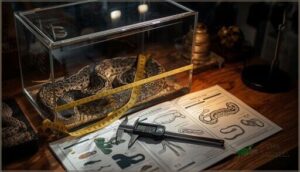
Before you calculate a single dimension, you need to understand what drives those numbers—because treating a ball python like a corn snake, or a hatchling like an adult, creates the kind of husbandry failures that lead to chronic stress and compromised thermoregulation.
The math itself is straightforward, but the variables you plug into it determine whether your snake thrives or merely survives. Three critical factors shape every enclosure calculation: the species’ inherent biology, the individual’s projected growth trajectory, and the activity patterns hardwired into its behavior.
Species-Specific Requirements
Species-specific needs determine everything about your snake enclosure’s design—ignoring morphology and natural behavior compromises animal welfare at the most fundamental level. Research each species’ ecological niche before planning habitat dimensions.
A naturalistic snake environment mirrors these ecological requirements through substrate depth, temperature gradients, and species-appropriate hiding structures.
- Ball pythons require 36×18-inch footprints; their sedentary, terrestrial lifestyle demands secure hides over vertical climbing space.
- Corn snakes thrive in 36×12-inch enclosures with enrichment structures promoting exploration across 4–6 feet of length.
- Arboreal species necessitate vertical climbing zones at least 1.5× body length in height—horizontal space alone causes chronic stress.
- Boa constrictors demand 6–8-foot enclosures reflecting their substantial adult size and active foraging patterns.
Conservationists emphasize the importance of species-specific behavior insights when designing enclosures to support animal welfare.
Predicting Adult Size and Growth
You can’t design an appropriate size enclosure without forecasting your snake’s adult size—growth rate predictions separate adequate habitats from cramped disasters.
Ball pythons reach 50–60% adult size within 12–24 months; corn snakes follow similar development stages.
Use species-specific maturity indicators and scaling factors to calculate enclosure dimensions 20–25% larger than current needs, preventing the costly mistake of undersized replacements.
Activity Level and Natural Behaviors
Your snake’s activity level—whether it’s a restless forager or a sedentary ambusher—directly determines the floor space and vertical climbing zones you’ll need to prevent chronic stress and support natural behaviors.
Activity-driven enclosure calculations must account for:
- Thermal gradient navigation: Active species traverse longer distances between basking and retreat zones, requiring extended linear space for thermoregulatory movement
- Foraging behavior intensity: Ambush hunters need fewer square feet than active-search predators that patrol enclosures hunting prey
- Shelter preferences and frequency: Snakes spending 70–80% of time hidden tolerate smaller footprints than highly exploratory species
- Crepuscular activity bursts: Dawn-dusk movers concentrate movement into shorter windows, demanding enriched but not necessarily expansive layouts
- Species-specific movement patterns: Arboreal climbers require vertical space; terrestrial cruisers need horizontal runs—mismatches between activity level and enclosure design suppress exploratory behaviors by 30–60%
Snake movement data reveals that undersized habitats force sedentary postures in naturally active species, collapsing normal foraging rhythms into stress-induced lethargy.
Step-by-Step Enclosure Size Calculation
Now that you understand what influences enclosure requirements, let’s translate those factors into actual numbers. The process involves three core calculations—minimum dimensions, spatial proportions for each axis, and built-in adjustments for anticipated growth—that work together to prevent the chronic stress and physical compromise associated with undersized habitats.
Here’s how to calculate each component systematically.
Minimum Size Formulas and Guidelines

You can’t house a snake humanely without a baseline formula—so start with enclosure dimensions that span at least 2 times your snake’s adult length for the minimum length, and 0.5 times girth for minimum width.
Growth projections demand you build in a 15-25% buffer, because habitat requirements shift as juveniles approach their genetic ceiling. This isn’t guesswork; it’s welfare arithmetic.
Calculating Length, Width, and Height
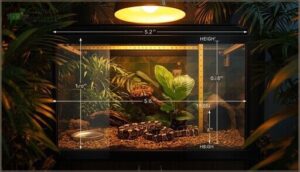
Enclosure dimensions translate directly into welfare outcomes—so you’ll measure length as the primary horizontal axis (using flexible measuring tape to the nearest millimeter), width as the perpendicular floor span, and height as vertical clearance from substrate to lid.
For volume calculations, multiply all three: length × width × height determines total usable space. Minimum length should match 2× adult body length; minimum width covers 0.5× girth, ensuring proper space planning for thermoregulatory behavior and natural movement patterns within your snake enclosure.
Adjusting for Growth and Future Needs
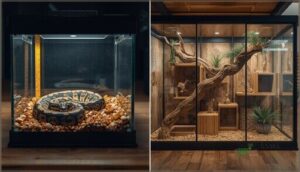
Growth projections demand visionary design: plan your enclosure size with a 20% cushion beyond anticipated adult size, incorporating modular enclosures that expand in stages rather than forcing stressful relocations.
Species-specific requirements dictate whether you’ll need vertical or horizontal scaling—arboreal snakes require height adjustments; terrestrial species need extended length. Adaptive enrichment (adjustable climbing structures, additional hides) maintains activity level and welfare as your snake matures into larger enclosures.
Example Calculations for Popular Snake Species
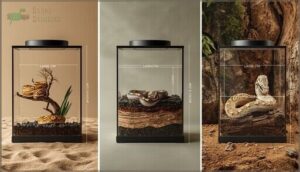
Now that you understand the formulas, let’s apply them to three of the most commonly kept snakes—species that represent fundamentally different space requirements based on adult morphology and behavioral ecology.
Each calculation demonstrates how body length, girth, and activity patterns translate into minimum enclosure dimensions that support thermoregulation, exploration, and stress reduction. These examples will give you concrete benchmarks for sizing habitats correctly.
Ball Python Enclosure Dimensions
You’ll need a minimum 4 feet long by 2 feet wide by 2 feet high enclosure for adult ball pythons—anything smaller compromises thermoregulatory behavior and triggers chronic stress responses.
This species-specific requirement isn’t arbitrary; proper enclosure size facilitates natural movement patterns across thermal gradients while PVC enclosure materials improve temperature control and humidity management through better heat retention compared to glass alternatives.
Corn Snake Enclosure Sizing
Adult corn snakes demand a 48 inches long by 24 inches wide by 24 inches high minimum footprint—this appropriate size facilitates vertical climbing behavior while maintaining thermoregulatory gradients across horizontal distance. Species-specific requirements for corn snake habitat prioritize floor area plus climbing opportunities, since these semi-arboreal colubrids exhibit both terrestrial hunting and vertical exploration patterns throughout their active periods.
- Undersized enclosures restrict natural foraging circuits—you’re forcing repetitive coiling behaviors that wouldn’t occur in properly dimensioned snake enclosure spaces
- Adequate ventilation systems prevent respiratory compromise in larger setups where airflow dynamics directly influence pathogen concentrations
- Strategic heating elements placement across extended floor space allows for precise thermal gradient establishment from 80–85°F warm zones to 75–78°F cool retreats
- Multiple substrate options like aspen shavings work effectively in appropriately sized enclosures, facilitating waste management while supporting burrowing tendencies
Boa Constrictor and Other Common Species
Boas—reaching 10 to 13 feet and occasionally exceeding 14 feet—require substantially larger snake enclosures than corn snakes: you’re looking at a 6 to 7 foot minimum length for mid-sized adults, with widths accommodating three times their girth.
Species-specific requirements for boa constrictors demand secure locks against their muscular frames, 80–85°F thermal gradients supporting constrictor feeding metabolism, and 40–60% humidity ensuring proper reptile health during shedding cycles.
Special Considerations by Snake Type
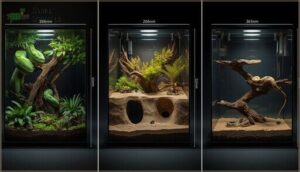
Not all snakes occupy the same ecological niche—arboreal species demand vertical climbing space that terrestrial snakes don’t require, while burrowing species need substrate depth that tree-dwelling colubrids would never use.
Your calculations must account for morphology and natural behavior: a green tree python‘s enclosure needs height above all else, whereas a hognose snake won’t thrive without adequate substrate for fossorial activity. Beyond lifestyle, you’ll also need to adjust dimensions based on whether you’re housing juveniles or adults, since growth trajectories directly influence both immediate and long-term spatial requirements.
Arboreal Vs. Terrestrial Snake Needs
Climbing behavior separates arboreal from terrestrial species—and your snake enclosure design must reflect this physiological divide. Arboreal snakes require vertical space with sturdy branches for forest mimicry, while terrestrial species demand horizontal floor area; mismatched dimensions compromise thermoregulatory access and induce chronic stress in both groups.
The design of the enclosure is crucial for the well-being of the snakes.
- Arboreal snakes need height-to-length ratios exceeding 2:1 with dense foliage at multiple elevations for security
- Terrestrial snakes thrive in wide, shallow enclosures emphasizing floor space over vertical climbing structures
- Tree-dwelling species utilize temperature stratification—warmer basking zones near elevated perches, cooler retreats below
- Species-specific requirements determine whether snake agility is expressed vertically (green tree pythons) or horizontally (king snakes)
- Enclosure size calculations must prioritize the morphology that dictates natural movement patterns and spatial needs
Burrowing and Semi-Aquatic Species
Fossorial species demand substrate depth reaching 2 to 6 times body girth—anything less prevents tunnel systems that reduce stress by 70 percent in captivity.
Semi aquatic snakes require dual-zone enclosures: water zones with graded depth for diving behaviors and dry basking areas for thermoregulatory control. Your snake enclosure must replicate burrow design and aquatic access to satisfy species-specific requirements tied to natural behaviors and morphology.
Juveniles Versus Adults
Juvenile snakes aren’t just smaller adults—developmental differences demand recalibrated housing as growth velocity outpaces static enclosures within 12 to 18 months for most species. You’ll prevent chronic stress and musculoskeletal deformities by anticipating adult size now.
- Ball pythons reach 50 to 60 percent adult length by 24 months, requiring phased upgrades.
- Corn snakes grow rapidly in year one, demanding proactive enclosure size adjustments.
- Boa constrictors need 20 to 25 percent dimensional increases annually during peak growth.
- Activity level intensifies with age—juveniles explore less but require full thermoregulatory gradients immediately.
Plan enclosures around species-specific requirements and confirmed adult size, not current dimensions.
Optimizing Enclosure Layout and Features
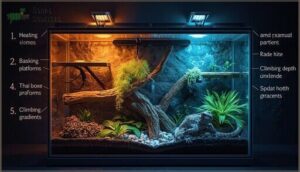
You’ve done the math and secured the right footprint—now it’s time to make that space actually work for your snake’s welfare. The difference between an empty box and a functional habitat comes down to strategic placement of features that support thermoregulation, security-seeking behaviors, and species-appropriate movement patterns.
Let’s break down the essential elements that transform calculated square footage into a biologically sound environment.
Essential Environmental Enrichment
Environmental enrichment transforms a sterile box into a functional territory—your snake’s enclosure demands complexity that mirrors wild microhabitats, not empty glass. Proper species-specific needs integration through naturalistic environments reduces stress indicators by 35% while promoting thermoregulatory precision and exploratory behavior.
| Enrichment Category | Implementation Strategy | Welfare Impact |
|---|---|---|
| Thermal Gradients | Basking zone (88-92°F) to cool refuge (75-80°F) with calibrated monitoring | Facilitates thermoregulation; prevents metabolic dysfunction |
| Sensory Stimulation | Rotate scent trails, textures, visual barriers weekly | Reduces habituation; encourages investigation |
| Environmental Complexity | Layer substrate depths, stagger perches, vary hide placement | Increases activity 30-60%; mimics natural terrain |
| Naturalistic Landscaping | Live plants, cork bark, stone formations matching habitat | Provides microclimate diversity and psychological security |
| Behavioral Enrichment | Puzzle feeders, foraging opportunities, movement-based training | Stimulates problem-solving; maintains cognitive health.” |
This isn’t decoration—it’s meeting reptile enclosure requirements through deliberate habitat architecture that honors your snake’s morphology and fossorial or arboreal tendencies.
Climbing Structures and Hiding Spots
Your snake’s enclosure demands vertical space that matches its climbing abilities—arboreal snakes require textured panels angled 60-75 degrees with ledges spaced 3-6 inches apart for safe ascent.
Pair climbing variety (cork bark, stone slabs, secured branches) with hiding spot design that’s 2.5 times your snake’s girth; these dual elements of snake enrichment reduce stress by creating functional microhabitats, not decorative clutter.
Ensuring Secure and Escape-Proof Design
Secure latches aren’t optional—they’re the barrier between your carefully calculated snake enclosure and a full-scale household search. Material strength and escape proofing determine whether your reptile enclosure design functions as intended or becomes a liability that undermines every other aspect of your snake habitat.
The following elements are crucial for a secure and functional enclosure:
- Install corrosion-resistant metal latches requiring two simultaneous actions to open
- Apply continuous rubber gaskets compressed to 0.5 mm for tight seals
- Use cam latches with locking pins on all service panels
- Construct walls from 3 mm PVC with internal reinforcements every 40 cm
- Conduct 48-hour pressure tests on new enclosure designs
Frequently Asked Questions (FAQs)
What is the rule of thumb for snake tank size?
Think of your snake’s home like a custom-made suit—the enclosure length should match at least 5 to 2 times their adult size, balancing floor space with species-specific requirements for ideal well-being.
How big should a snake’s enclosure be?
Your captive must move freely, stretch fully, and access thermal gradients—so minimum enclosure size equals 5 times adult body length, adjusted upward for species-specific requirements, activity level, and habitat design demands including climbing or burrowing.
How small a gap can a snake fit through?
Most snakes can squeeze through gaps as narrow as 1/4 to 1/2 inch—head width dictates passage, not body girth.
Escape prevention demands thorough sealing: inspect ventilation, door edges, and panel junctions relentlessly.
How often should I upgrade my snakes enclosure?
You should upgrade your snake’s enclosure when it reaches two-thirds of the current length—usually every six to twelve months during rapid growth—monitoring substrate use, thermoregulatory movement, and species-specific requirements to improve habitat expansion timing.
Can multiple snakes share one larger enclosure?
Most snake species are solitary—cohabitation risks severe stress, injuries, and death.
Even in spacious multi-zone enclosures with separate hides, aggression and dominance conflicts usually outweigh any theoretical space-sharing benefits for species-specific requirements.
What materials are best for custom snake enclosures?
PVC panels and HDPE enclosures dominate custom-built enclosures because they resist moisture intrusion and maintain stable thermoregulatory gradients.
Glass options and acrylic sheets offer visibility but demand fastidious sealing to prevent humidity loss in naturalistic habitats.
How do I maintain humidity in large enclosures?
Large enclosures lose moisture rapidly—your snake’s respiratory health depends on strategic substrate management, adjustable ventilation systems, automated mist automation, and shallow water features distributed across multiple zones to stabilize humidity levels and prevent dangerous fluctuations.
Should I use bioactive substrates for all species?
No—bioactive substrates aren’t universally ideal. Desert-dwelling species often fail in moisture-rich bioactive setups due to humidity intolerance, while tropical snakes thrive; always match substrate diversity to species-specific requirements for best environmental enrichment.
Conclusion
A glass box can be a tomb or a habitat—the difference hinges on your willingness to calculate snake enclosure space with the same precision you’d apply to your own living quarters.
You’ve now got species-specific formulas, thermal gradient requirements, and growth projections that convert abstract square footage into physiological security. Your snake’s next feeding response, respiratory health, and muscular development will reflect whether you measured carefully or guessed generously—so measure twice, build once, and prioritize welfare over convenience.