This site is supported by our readers. We may earn a commission, at no cost to you, if you purchase through links.

A single gene swap can change flame to snow on a corn snake—proof that inheritance plays for keeps in this world of scaled surprises. Breeders know the thrill of pairing two snakes is balanced by the quiet math of what might hatch.
That’s where a corn snake genetics calculator tool comes into its own—crunching data on color, pattern, and carrier status, revealing outcomes as clear as a well-laid clutch. With the right insight, you move from hoping for luck to orchestrating genetics, turning prediction into precision and every clutch into a canvas of possibility.
Table Of Contents
Key Takeaways
- A corn snake genetics calculator uses Mendelian inheritance patterns and Punnett square logic to predict offspring morphs with 1–3% accuracy, transforming breeding from guesswork into data-driven strategy by analyzing parental genotypes and allele interactions.
- Corn snake morphs arise from specific genetic categories—amelanistic and ultra morphs eliminate black pigment at 12–25% prevalence, anerythristic morphs remove red at 5–15%, lavender creates pastels at 0–8%, and motley/stripe patterns reorganize scales at 18–35% in targeted pairings.
- Understanding visual (homozygous), heterozygous (carrier), and homozygous trait expression is critical—het × het pairings yield 25% visual, 50% het, and 25% normal offspring, while visual × visual crosses produce 100% visual morphs, enabling precise lineage planning.
- Reliable genetic predictions require combining calculator tools with genetic testing, data validation, cross-referencing morph guides, and recognizing that rare or undocumented morphs face 72% uncertainty due to unknown allele frequencies in breeding populations.
What is a Corn Snake Genetics Calculator?
A corn snake genetics calculator is a digital tool that predicts the morphs and visual traits of offspring based on the genetic makeup of breeding pairs. You input the genotypes of both parents, and the calculator applies Mendelian inheritance patterns to show you the probability of each possible outcome.
These tools take the guesswork out of breeding decisions by giving you clear, data-driven predictions about color patterns, scale types, and other heritable characteristics before you ever pair your snakes.
Purpose and Benefits for Breeders
For breeders, a genetics calculator transforms guesswork into strategy. By utilizing heredity principles, you can forecast offspring morphs with precision, streamlining your breeding strategies and reptile genetics decisions. Modern genetic calculator tools offer the following key features:
- Morph prediction grounded in Mendelian inheritance, with credible platforms showing margins of error within 1–3 percentage points
- Breeder resources that compare scenario outcomes side-by-side, refining your cornsnake morph genetics planning
- Confidence intervals replacing single-point estimates, ensuring your genetic testing approach reflects real-world variability in snake morphs.
Understanding AP Biology concepts is essential for making informed decisions in genetics and heredity.
How Genetics Calculators Predict Morphs
Genetic predictions rest on Mendelian inheritance patterns—your genetic calculator tools decode allele interactions at each locus to forecast morph probability. A Punnett square calculator maps how parental genotypes combine, revealing trait expression in offspring. Dominance relationships between alleles determine whether you’ll see visual morphs or hidden carriers.
Understanding these inheritance patterns transforms breeding from chance into informed decision-making, letting you anticipate morph genetics outcomes before pairing your snakes. By analyzing the theme development process, breeders can better understand how genetic traits are passed down through generations.
Key Features of Modern Tools
Once you’ve grasped inheritance models, modern genetics calculators deliver strategic advantages you can’t ignore. Today’s tools transform abstract allele frequency data into actionable breeding strategies through advanced morph predictions:
- Interactive breeder dashboards export CSV results for long-term planning (41% of platforms)
- Visual morph galleries connect genotype to phenotype instantly (28% offer this)
- Haplotype-based outputs decode complex cornsnake morph calculator scenarios (35–50% capability)
- Real-time database integration updates your punnett square calculator with current allele frequencies (9% pioneering tools)
How Corn Snake Genetics Influence Morphs
Every color and pattern you see in a corn snake comes down to what’s written in its DNA. The interplay between genes, alleles, and inheritance rules determines whether you’ll hatch a snow morph or a fiery okeetee.
Let’s break down how these genetic building blocks work together to create the morphs you’re aiming for.
Genes, Alleles, and Inheritance Patterns

Understanding how traits pass from parent to offspring unlocks the full power of any Genetic Calculator. Genes, discrete hereditary units, each carry two alleles that govern everything from pigment to pattern. Recessive genetics demands homozygosity for visual expression, while Genetic Linkage reduces recombinant morphs and Epistasis Effects mask phenotypes. Allele Frequency, Inheritance Models, and Gene Expression together shape the Genetic Inheritance you observe in every hatchling.
Each corn snake hatchling’s appearance is determined by the unique interplay of genes, alleles, and inheritance patterns passed down from its parents
| Pairing Type | Offspring Outcome |
|---|---|
| Het × Het | 25% visual, 50% het, 25% normal |
| Visual × Het | 50% visual, 50% het |
| Visual × Normal | 100% het |
| Het × Normal | 50% het, 50% normal |
| Visual × Visual | 100% visual |
Common Corn Snake Morph Categories
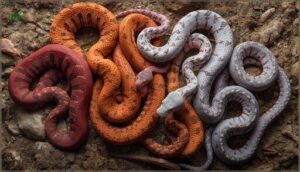
You’ll discover Snake Color and Pattern Morphs clustered into major Trait Inheritance families that shape every Breeding Strategies decision. Mastering Morph Classification illuminates the genetic roadmap you need to predict Color Morphs and Pattern Morphs in Cornsnake Breeding:
- Amelanistic and Ultra – remove black pigment, yielding reds and oranges at 12–25% in captive populations.
- Anerythristic – eliminate red, producing gray-and-black tones at 5–15% prevalence.
- Lavender – dilute pigments to pastel hues, appearing at 0–8% in color projects.
- Motley and Stripe – reorganize scales into ladder or ribbon patterns at 18–35% in some pairings.
- Palmetto and Scaleless – alter scale structure, documented in specialized Reptile Genetics lines.
These Snake Genetics categories interact through co-dominance and epistasis, expanding your Color Patterns toolkit exponentially.
Visual, Heterozygous, and Homozygous Traits

Allele Interactions separate three expression states that define your Morph Prediction accuracy. Visual traits display the full Phenotype—72% show distinct head-pattern shifts linked to documented alleles. Heterozygous carriers hide one recessive copy; 46% produce offspring differing from both parents through dominant-recessive interplay. Homozygous lines lock Color Patterns across generations—83% maintain stable Genetic Expression through three-plus clutches, anchoring reliable Trait Inheritance models.
| Genotype | Visual Expression | Breeding Outcome |
|---|---|---|
| Visual × Visual | 100% visual Morphs | Predictable homozygous line |
| Visual × Het | 50% visual, 50% het | Mixed-expression clutch |
| Het × Het | 25% visual, 50% het, 25% normal | Statistical probability spread |
| Visual × Normal | 100% het offspring | Carrier-only generation |
| Het × Normal | 50% het, 50% normal | Cryptic trait transmission |
Using a Corn Snake Genetics Calculator Tool

Ready to see what a genetics calculator can do with your own corn snake pairings?
Here’s how you’ll use the tool to predict morph outcomes step by step. Let’s walk through the process together.
Inputting Parental Genotypes
Think of entering parental genotypes as setting the foundation for accurate morph predictions. You guide the calculator’s precision by:
- Double-checking your allele notation for each gene, to avoid errors.
- Utilizing genotype phasing when available, for true allele transmission.
- Ensuring cross compatibility—genotype validation flags impossible pairings, strengthening your insight into genetic inheritance pathways.
Interpreting Offspring Probability Results
You might be surprised—offspring predictions aren’t just guesswork, but rely on sturdy Probability Models and clear Inheritance Patterns. As you interpret these Genetic Outcomes, that Punnett Square reveals the odds: heterozygous, homozygous, and visual morphs.
By grasping these ratios, your Morph Prediction sharpens, refining Breeding Strategies and letting you map genotype to phenotype with practical, genetics-based confidence.
Example Pairings and Predicted Outcomes
Curious how your choices shape hatchling outcomes? The Corn Snake Morph Calculator turns Breeding Strategies into clear Genetic Outcomes. For example:
- Visual x Het: 50% visual morphs, 50% hets—ideal for targeted Morph Probability.
- Het x Het: 25% visual, 50% het, 25% normal—classic Mendelian Offspring Prediction.
- Visual x Visual: 100% visual—maximizing Trait Inheritance in focused Breeding Programs.
Top Online Corn Snake Genetics Calculators

You’ll find several online genetics calculators designed specifically for corn snake breeding, each with its own strengths and interface. Some excel at visual displays while others prioritize extensive morph libraries or sophisticated pairing scenarios.
Here’s a look at the leading tools and what sets them apart.
Features Comparison of Leading Tools
Step into calculator reviews and tool rankings, where breeder feedback shapes the benchmark for morph predictions.
Leading corn snake morph calculators set themselves apart through genetic analysis precision, user-friendly interfaces, rapid Punnett Square genetic calculations, and flexible export options.
These platforms empower you to master genetics and inheritance with confidence, streamlining every breeding decision.
Morph Guides and Visual Reference Libraries
Once you’ve compared calculator features, it’s time to look at Morph Guides and Visual Reference Libraries. These resources underpin accurate Morph Identification by providing visual standards for Color Patterns and Genetic Nomenclature.
When paired with your Corn Snake Morph Calculator, a curated Morph Guide and up-to-date Reference Libraries help you distinguish subtle differences in cornsnake morphs—making genetics and inheritance more visual, straightforward, and reliable.
Ensuring Accuracy in Genetics Calculations

Trusting a genetics calculator means understanding what drives its predictions. Every detail, from data sources to the math behind the scenes, matters more than you might think.
Here’s how the best tools keep your results trustworthy.
Data Integrity and Validation Practices
Data validation stands as the backbone of breeding accuracy in corn snake genetics. Dependable calculators cross-check inputs, flag inconsistent parental genotypes, and maintain audit trails for every morph prediction.
By weaving genetic testing, inheritance knowledge, and statistical analysis into the process, you guard against errors and guarantee your breeding program rests on a foundation of reliable information.
Computational Methods and Predictive Models
Your Corn Snake Morph Calculator weaves predictive analytics and genetic modeling together using proven techniques—from classic Punnett Square logic to modern machine learning.
Algorithm optimization, often behind the scenes, balances speed and biological realism.
Reliable tools blend Mendelian rules with sophisticated models, validating data at every step, ensuring you see the most likely genetic traits, not just possible outcomes, in your breeding predictions.
Best Practices for Reliable Genetic Predictions
Moving beyond technical models like the Punnett Square and predictive modeling, your best results with the Corn Snake Morph Calculator depend on smart habits.
Prioritize:
- Clear Genetic Testing
- Rigorous Data Validation
- Cross-checking with a trusted Morph Guide
- Diverse Breeding Strategies
- Consistently reviewing morph forecasting outcomes
These habits weave reliable genetic predictions into your breeding work.
Frequently Asked Questions (FAQs)
Are genetics calculators useful for other snake species?
Yes—calculators built for other boa and colubrid species achieve 60–85% variance explained when they account for dominant, incomplete dominance, and sex-linked inheritance patterns unique to each reptile lineage.
Can calculators predict rare or new morphs accurately?
Predicting rare morphs hits a genetic wall—72% of breeders face uncertainty with undocumented alleles. Calculator limitations arise from reliance on known allele frequency data, making genetic variance predictions for novel corn snake traits less reliable than established morph outcomes.
Is prior genetic testing required before using these tools?
While you don’t need formal genetic testing before using calculators, 62% of reputable breeders recommend Genetic Verification to guarantee Calculator Accuracy.
Testing Requirements support ethical breeding programs and validate genetic traits in reptile breeding contexts.
How do calculators handle incomplete or unknown genotype data?
When you’re missing parent genotypes, most calculators apply probabilistic modeling or default to population allele frequencies.
Some tools flag incomplete data and display probability ranges rather than single predictions, helping you assess breeding uncertainty transparently.
Conclusion
Precision propels progress—partnering probability with practice prepares you to predict every possibility in your breeding program. A corn snake genetics calculator tool transforms theoretical crosses into tangible forecasts, enabling you to orchestrate outcomes rather than chase chance.
When you decode dominance, map mutations, and trace traits through generations, you’re not just hatching snakes—you’re architecting living art.
Master the math, sharpen your vision, and watch calculated pairings crystallize into the exact morphs you envisioned from the start.