This site is supported by our readers. We may earn a commission, at no cost to you, if you purchase through links.

Apartment terrariums don’t behave like the reptile rooms in spacious houses with central air and forgiving square footage. Thinner walls, shared HVAC, and a single circuit breaker that can’t handle constant heavy draw change how you pick a heat source for your tank.
A mat rated for a 40-gallon enclosure in a drafty farmhouse can become a hot-spot hazard inside a sealed bedroom that never drops below 72°F. That mismatch trips up more apartment keepers than bad husbandry does.
The right reptile heat mats for apartment setups balance low wattage, tight thermostat control, and coverage sized for tanks wedged into tight corners.
Table Of Contents
- Key Takeaways
- Top 6 Reptile Heat Mats for Apartments
- Choosing The Right Apartment Heat Mat
- Safe Setup in Small Spaces
- Running Costs and Maintenance
- Frequently Asked Questions (FAQs)
- How much electricity does a reptile heat mat use?
- Do heat mats go inside or outside the vivarium?
- What surface can I put a heat mat on?
- Where to place a reptile heat mat?
- Can I put a heat mat under reptile carpet?
- Where to put a reptile heating pad?
- Do reptile heating pads use a lot of electricity?
- Can you leave a heat mat on 24/7?
- Can heat mats affect apartment humidity levels?
- How do heat mats impact monthly electricity bills?
- Conclusion
Key Takeaways
- Apartment reptile setups demand lower-wattage heat mats with tight thermostat control, since sealed rooms that stay warm can turn an oversized mat into a dangerous hot spot.
- Every heat mat should cover only one-third of the tank floor, positioned at one end, so your reptile can move freely between a warm zone and a cool zone.
- Pairing any mat with a thermostat cuts energy use by 30–50%, keeping a typical 15–20W setup under a dollar a month to run.
- Watch for signs it’s time to replace your mat—most last 3–5 years with proper maintenance.
Top 6 Reptile Heat Mats for Apartments
Finding the right heat mat for an apartment setup comes down to matching size, wattage, and thermostat compatibility to your specific reptile’s needs.
If your apartment setup specifically houses a ball python, this ball python lighting and heating setup guide breaks down thermostat pairing and ideal positioning.
Each of the six options below covers a different combination of those factors, so there’s a practical fit whether you’re housing a leopard gecko in a 10-gallon or a ball python in a 40-gallon. Here’s what made the cut.
1. iPower Reptile Heat Mat Under Tank Warmer
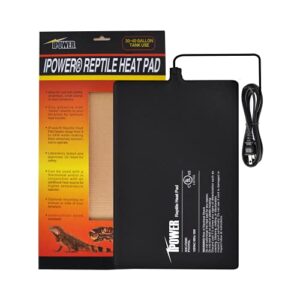
The iPower Reptile Heat Mat Under Tank Warmer takes a no-fuss approach to belly heat, using PTC heating material to spread warmth evenly across the surface rather than concentrating it in one spot. The 8×12 inch, 16W version suits 30–40 gallon tanks well, and the 3M adhesive backing keeps it flush against the glass.
One real limitation: there’s no built-in thermostat. Pair it with an external controller, or you’re running it unregulated — which is a risk worth taking seriously.
| Best For | Reptile and small animal owners who want reliable, even belly heat for 30–40 gallon terrariums and don’t mind pairing the mat with a separate thermostat for temperature control. |
|---|---|
| Power | 16W |
| Dimensions | 8×12 inches |
| Adhesive Backing | 3M adhesive |
| Thermostat Required | External required |
| Surface Compatibility | Glass and PVC |
| Reptile Suitable | Yes |
| Additional Features |
|
- PTC heating material distributes warmth evenly, avoiding hot spots that could harm your animal
- 3M adhesive backing holds the mat securely against glass or PVC enclosures
- Heats up quickly and works well beyond just reptiles — handy for germination or home brewing too
- No built-in thermostat or on/off switch, so an external temperature controller is basically a must
- Adhesive can leave residue or lose grip over time, especially with repeated repositioning
- Can dry out the substrate in high-humidity setups like hermit crab tanks
2. Aiicioo Under Tank Heater Thermostat
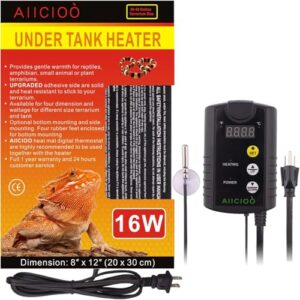
Where the iPower leaves you hunting for a separate controller, the Aiicioo solves that problem right out of the box. The built-in digital thermostat covers a 32–140 °F display range, with a three-button interface that’s genuinely easy to navigate.
The 16W pad works well for 20–40 gallon tanks, and the suction-cup probe lets you position the sensor precisely against the substrate. One caveat: at low ambient room temperatures, the 16W output can struggle to hit higher setpoints consistently.
| Best For | Reptile, amphibian, and hermit crab owners who want precise temperature control without buying a separate thermostat. |
|---|---|
| Power | 16W |
| Dimensions | 8×12 inches |
| Adhesive Backing | Upgraded adhesive |
| Thermostat Required | Built-in included |
| Surface Compatibility | Glass only |
| Reptile Suitable | Yes |
| Additional Features |
|
- Built-in digital thermostat with a wide 32–140 °F display range eliminates the need for a separate controller
- Suction-cup probe lets you place the sensor exactly where you need it for accurate readings
- Simple plug-and-play setup works for 20–40 gallon glass tanks and even low-temp uses like dough proofing
- Struggles to hit higher temperature setpoints in cooler rooms due to the modest 16W output
- Only compatible with glass tanks — plastic, acrylic, and water-filled enclosures are a no-go
- The adhesive can bond permanently to glass, and the pad must never be fully covered
3. Repti Zoo Adjustable Reptile Heat Pad
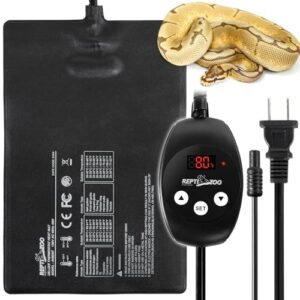
The Repti Zoo steps up the wattage considerably — 24W with carbon fiber heating across an 8×12 inch surface — making it a strong fit for 20–40 gallon enclosures housing leopard geckos or ball pythons.
The built-in thermostat holds temperatures between 68–122 °F, with an automatic cut-off near 122 °F as a safety backstop. One thing to watch: heat has a tendency to concentrate toward the center, so independent temperature verification with a probe thermometer isn’t optional — it’s just good practice.
| Best For | Reptile owners with 20–40 gallon enclosures housing species like leopard geckos, ball pythons, or bearded dragons who want a higher-wattage pad with built-in temperature control. |
|---|---|
| Power | 24W |
| Dimensions | 12×8 inches |
| Adhesive Backing | Adhesive backing |
| Thermostat Required | Built-in included |
| Surface Compatibility | Glass |
| Reptile Suitable | Yes |
| Additional Features |
|
- 24W carbon fiber heating warms up quickly and works well across a range of reptiles, hermit crabs, and even non-reptile uses like seed germination or fermentation
- Built-in adjustable thermostat (68–122°F) gives you precise control without needing a separate controller
- Waterproof PVC surface is durable and easy to clean, holding up well with daily use
- Heat tends to concentrate in the center rather than spreading evenly, making a probe thermometer a must
- The adhesive backing can lose its grip over time and may need additional securing
- Thermostat reliability has been flagged by some users, with occasional reports of overheating or struggling to hit target temps in cold rooms
4. iPower Reptile Heat Mat with Temperature Controller
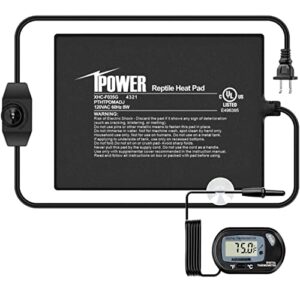
Where the Repti Zoo leans on higher wattage, this mat takes a more measured approach. The 6×8 inch, 8W footprint suits small enclosures well, and the integrated controller knob lets you dial in surface temperature without a separate device.
If you’re still deciding on wattage or size, this guide to choosing the right ball python heating pad walks through the key factors to consider.
PTC heating film distributes warmth evenly, avoiding the hot-center problem. The 3M adhesive backing secures cleanly to glass — just don’t rush the placement, since repositioning later isn’t really an option.
| Best For | Small reptile and amphibian owners, hobbyist brewers, or anyone needing gentle, consistent heat for compact enclosures or plant germination setups. |
|---|---|
| Power | 8W |
| Dimensions | 6×8 inches |
| Adhesive Backing | 3M adhesive |
| Thermostat Required | External required |
| Surface Compatibility | Glass |
| Reptile Suitable | Yes |
| Additional Features |
|
- PTC film spreads heat evenly across the mat, so there are no hot spots to worry about
- The built-in controller knob and included LCD thermometer mean you can monitor and adjust temperature right out of the box
- At 8W, it runs efficiently without drawing much power
- The adhesive is permanent, so you need to get placement right the first time
- 8W may not be enough to heat larger tanks or make a significant temperature bump in cooler environments
- For precise temperature safety, you’ll likely still want an external thermostat on top of the built-in knob
5. Bn-Link Reptile Under Tank Heater
At just 8W across a 6×8 inch footprint, the BN-LINK keeps things simple without sacrificing reliability. It accommodates 10–20 gallon tanks comfortably, with a 104–122°F surface range that suits leopard geckos and small colubrids well.
The waterproof, wipeable surface is a quiet win for apartment keepers — spills don’t become crises. You do need an external thermostat here, since there’s no built-in control. Pair it with one, and the 15-month warranty backs a genuinely low-maintenance setup.
| Best For | Budget-conscious keepers housing leopard geckos, small colubrids, or amphibians in 10–20 gallon tanks who want a simple, reliable heat source without extra features. |
|---|---|
| Power | 8W |
| Dimensions | 6×8 inches |
| Adhesive Backing | Strong adhesive |
| Thermostat Required | External required |
| Surface Compatibility | Glass only |
| Reptile Suitable | Yes |
| Additional Features |
|
- Waterproof and wipeable surface makes cleanups easy and stress-free
- Energy-efficient 8W draw keeps running costs low over time
- Backed by a solid 15-month manufacturer warranty
- Requires a separate thermostat to use safely — an added cost and setup step
- Only works on glass surfaces, so alternative enclosure materials are a no-go
- Bulkier profile may need extra clearance under the tank for airflow
6. Exo Terra Reptile Heat Mat
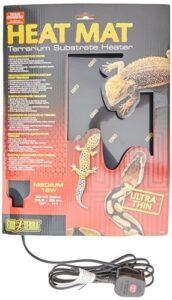
Exo Terra’s self-regulating design sets it apart — the mat actively adjusts heat output as enclosure temperatures shift, reducing hotspot risk without relying solely on an external thermostat. The 16W, 10×11 inch version suits 30–40 gallon setups well, and rubber spacers are included to maintain safe airflow underneath.
If you’re using a glass enclosure, comparing the best heating pads for glass tanks can help you match wattage and placement more precisely.
That self-regulation doesn’t replace a thermostat for sensitive species, but it does add a useful layer of protection. For tropical reptiles needing continuous 24-hour warmth, this mat takes care of the job reliably.
| Best For | Small reptile owners — gecko, snake, or amphibian keepers — who need gentle, energy-efficient belly heat for tanks up to 10 gallons. |
|---|---|
| Power | 4W |
| Dimensions | X-Small/Medium |
| Adhesive Backing | Strong adhesive |
| Thermostat Required | External required |
| Surface Compatibility | Glass, plastic, wood |
| Reptile Suitable | Yes |
| Additional Features |
|
- Thin 2mm profile with strong adhesive makes installation quick and clean under any tank
- 4W power draw is very energy-efficient for long-term, continuous use
- Provides even, gentle warmth that’s ideal for belly-heat species and humid hides
- Must be paired with an external thermostat — using it alone risks overheating
- Adhesive is single-use; removing the mat can damage it or the surface it’s on
- Slow heat-up time (up to 30 minutes) means it’s not ideal if you need quick temperature adjustments
Choosing The Right Apartment Heat Mat

Picking the right heat mat isn’t just about wattage — it’s about matching the mat to your specific tank, species, and apartment setup. Get these factors wrong and you’re either cooking your reptile or wasting electricity on a pad that can’t keep up. Here’s what to keep in mind before making your choice.
A guide to corn snake morph temperament differences can help you prioritize husbandry needs over color-based assumptions.
Tank Size Matching
Getting the mat size wrong is the most common mistake apartment keepers make — and it throws off your entire thermal gradient.
- 6×8 inch mats suit 10–20 gallon enclosures
- 8×12 inch pads fit 20–40 gallon terrariums
- 8×18 inch mats work for 50–60 gallon tanks
- Juvenile tank sizing favors 8–12 inch mat lengths
- Irregular tank layouts need mats covering the widest cross section
Match mat length to your enclosure’s longest axis for mat length optimization.
One-third Coverage Rule
Why cover only a third of the floor? Full coverage erases your temperature gradient, risking hot spots in any smallspace enclosure.
| Tank Length | Coverage Target | Mat Placement |
|---|---|---|
| 12" | 4" | One end |
| 18" | 6" | One end |
| 24" | 8" | One end |
This one-third rule uses area calculation, not guesswork, sizing your reptile heating pad to the floor’s actual area for stable thermoregulation.
Wattage by Enclosure Size
Wattage scales with surface area ratios, not tank labels. Small reptile enclosure setups under 20 gallons need 1.5–6 watts per square foot; medium runs 6–12; large habitats need 12–24 for temperature control.
- Small ( Hot spots never announce themselves—they silently cook a reptile from below while uneven substrate hides the danger from your probe
Five checks that keep your reptile enclosure safe:
- Test the safety shutoff monthly by simulating fault conditions
- Verify infrared temperature across multiple floor points weekly
- Use an insulation barrier between mat and tank base
- Recalibrate your probe every two months
- Flatten substrate irregularities that concentrate heat
Warm Side Temperature Ranges
Most reptiles need a warm side between 28–32°C (82–90°F), though species matter enormously — leopard geckos push toward 32°C, while crested geckos cap around 28°C to avoid stress. That’s why a single setting rarely fits all.
Scan multiple floor points with an infrared thermometer weekly to catch temperature drift before your reptile does.
Safe Setup in Small Spaces
Setting up a heat mat in an apartment takes a bit more intention than just plugging it in and calling it done. The right placement, airflow, and cord routing can mean the difference between a safe, functional enclosure and a genuine fire hazard. Here’s what you need to know before you get started.
Under-tank Placement Tips
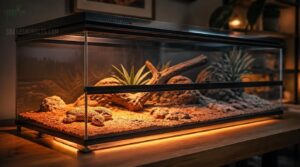
Where you set your under-tank heater matters as much as the unit itself. Rest it on a rigid, flat surface, never carpet, so contact stays even and heat doesn’t sag unevenly.
Skip décor that traps warmth, keep cords off the substrate, and let placement protect your thermal gradient before temperature control even kicks in.
Airflow Under Enclosures
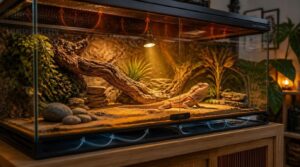
Heat doesn’t just sit there once your mat warms the tank floor; it needs somewhere to go. Position vents low for intake and high for exhaust, letting warm air rise naturally while pulling fresh air underneath.
This prevents stagnant pockets where heat concentrates near the substrate. A slight inward pressure keeps room dust out, while balanced flow distributes warmth evenly instead of creating isolated hot spots around your reptile heating pad.
Avoiding Carpet and Wood
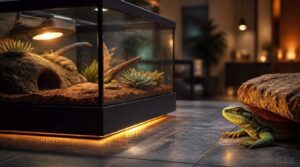
Carpet traps moisture and heat near substrate, risking scorch marks beneath your reptile heating pad. Place glass tanks on:
- Heat distribution tiles (slate/ceramic)
- A moisture barrier on wood floors
- Hard, nonporous, easy-clean surfaces
- Sealed flooring to cut fire risk
Skip bare wood or carpet for safer reptile enclosure temperature control.
Cord Management for Apartments
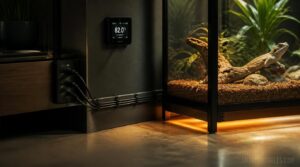
A tangle of cords behind your terrarium isn’t just messy—it’s a tripping hazard waiting to happen in tight apartment layouts. Run your reptile heating pad cord along the back wall using adhesive clips, never across open floor.
Mount power strips on furniture edges, off the ground, and skip daisy-chaining. Good cord routing protects your digital thermostat connections and keeps electrical load manageable.
Cool Zone Positioning
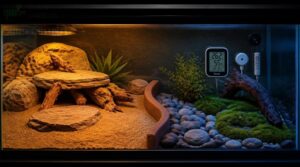
Once your cords are tucked away, give equal thought to the tank’s far corner. Position the cool zone clear of heat sources, using non-insulating dividers to protect thermal gradient stability along the heat gradient.
Substrate moisture impact and ambient light interference can skew readings, so keep sensor placement accuracy tight and microclimate airflow steady for habitat management and temperature regulation.
Running Costs and Maintenance

Running a heat mat day to day costs more than just the price you paid for it, and keeping it safe takes a little ongoing care. Your electric bill, your thermostat settings, and even how often you wipe down the mat all play a part. Here’s what you should keep an eye on to get the most out of your setup.
Keeping humidity in the right range is especially important if you’re also running a humidifier for your ball python’s enclosure, since the two systems can quickly push moisture levels past the 80% mold threshold.
Daily Electricity Use
Rarely do renters realize a basic 20-watt mat can burn roughly 0.48 kWh daily running unregulated for 24 hours.
Wattage vs. consumption matters here: oversized mats on small tanks raise that daily kWh estimate by 15–30 percent, while correct sizing and shallow substrate keep your electrical footprint low and energy-efficient.
Thermostat Energy Savings
Pairing your reptile heating pad with a digital thermostat cuts power consumption by 30–50%, since regulated units cycle off once the target temperature holds. That alone can drop a 15–20 W setup to roughly 0.38 kWh daily.
Smart thermostat automation refines this further — adaptive learning trims unnecessary run cycles, so your temperature controller works smarter, not longer.
Weekly Surface Cleaning
Once your energy savings are dialed in, keeping that efficiency steady comes down to basic upkeep. Run a damp microfiber cloth along your reptile heating pad weekly — never soaking it, just a light pass to lift dust and adhesive residues that sneak around mat edges.
Log each cleaning date. A quick note helps you catch patterns before they become problems.
Cord and Adhesive Checks
Lift each mat corner gently — adhesive delamination signs like curling edges or air pockets mean bonding has failed. Sniff for any chemical odor, which signals adhesive degradation.
Along the cord, check that insulation integrity holds near the mat edge where heat concentrates most. Avoid tight bends that strain wiring connections, and confirm the edge bonding stays flush with no lifting beyond 2 millimeters.
When to Replace Mats
How do you know it’s time? Watch for visible wear—cracks, curling edges, or warped backing—plus odors that linger after cleaning. Reptile heating mats usually last 3-5 years, but failing thermostat compatibility or temperature instability ends that early.
Schedule inspections every six months, log replacement dates, and swap mats immediately if you smell burning. Your reptile enclosure safety depends on it.
Frequently Asked Questions (FAQs)
How much electricity does a reptile heat mat use?
A 16-watt mat running continuously draws just 384 kWh daily — roughly 8 cents. Add a thermostat, and that figure can drop by half, keeping monthly costs under a dollar.
Do heat mats go inside or outside the vivarium?
Heat mats go outside the vivarium, mounted beneath the tank floor. External placement prevents direct skin contact, reduces moisture exposure to the mat, and lowers the risk of electrical shorts or corrosion inside the enclosure.
What surface can I put a heat mat on?
Flat, non-flammable surfaces work best — a solid stand or table keeps heat transferring evenly. Skip carpet and bare wood. For glass or plastic tanks, the mat sits cleanly underneath with no gaps.
Where to place a reptile heat mat?
Place the mat under one end of the enclosure — never inside — so the substrate warms gradually and your reptile can move between a warm zone and a cool zone freely.
Can I put a heat mat under reptile carpet?
Yes, but place the mat under the tank exterior, not beneath the carpet inside. Carpet over the mat causes hot spots and uneven thermal transfer. Exterior mounting keeps heat conduction consistent and safer.
Where to put a reptile heating pad?
Think of your heating pad as a compass — it directs warmth where it’s needed. Mount it on the exterior bottom or side wall, covering one-third of the tank toward the warm end.
Do reptile heating pads use a lot of electricity?
Reptile heating pads are genuinely low-draw appliances. A 20W pad running 12 hours uses roughly 24 kWh daily — less than most phone chargers running overnight.
Can you leave a heat mat on 24/7?
Burning the candle at both ends — running a heat mat 24/7 without a thermostat risks thermal runaway, substrate mold growth, and overheating. A temperature safety cutoff cycles power to keep enclosure temperatures reliably safe.
Can heat mats affect apartment humidity levels?
Heat mats can nudge apartment humidity levels, though the effect is indirect. Warm substrate drives evaporation, and in poorly ventilated rooms, that released moisture accumulates — place humidity sensors near the enclosure to catch any microclimate shifts early.
How do heat mats impact monthly electricity bills?
Surprisingly, keeping a reptile warm costs less than your morning coffee. A 15–20 W mat with thermostat cycling uses roughly 38 kWh daily, translating to under a dollar monthly at standard rates.
Conclusion
A keeper in a studio apartment switched from a 16-watt mat to an 8-watt model with a pulse-proportional thermostat — overnight temps stabilized within two degrees, and the enclosure never spiked again.
That’s the real promise of reptile heat mats for apartment setups: precise, low-draw heating that works with your building’s quirks, not against them. Get the wattage right, let the thermostat do its job, and your animal stays comfortable without taxing your circuit.