
This site is supported by our readers. We may earn a commission, at no cost to you, if you purchase through links.

Most snake owners face this moment eventually: your serpent needs medication, and you’re holding a creature that can’t be reasoned with, bribed, or distracted by treats. Unlike giving pills to a dog, handling snakes for medication purposes demands specific techniques because these animals interpret restraint as a threat.
One wrong move triggers defensive strikes, stress-induced regurgitation, or injuries to both handler and patient. The challenge isn’t just administering the medication—it’s doing so while keeping a calm, predatory animal secure without triggering its fight-or-flight response.
You’ll need the right equipment, proper restraint methods, and species-specific knowledge to turn this high-stakes procedure into a routine task that protects everyone involved.
Table Of Contents
Key Takeaways
- Proper snake medication requires species identification, risk assessment, and specialized equipment like snake hooks, tubes, and restraint bags before you ever touch the animal.
- Effective restraint relies on gentle body support and controlled positioning rather than force, with tubes containing head movement while towels distribute pressure evenly across the snake’s body.
- Accurate dosage calculations based on species-specific mg/kg charts and administration route are critical, as errors in concentration or delivery method can turn treatment into a medical emergency.
- Venomous snake medication demands certified handlers, rigid safety protocols, chemical restraint options, and immediate antivenom readiness with documented emergency procedures in place.
Preparing for Safe Snake Handling
Before you even touch a snake, you need to know what you’re dealing with and set yourself up for success. Proper preparation isn’t just about safety—it’s about making the process smoother for both you and the animal.
Here’s what you need to handle before handling.
Identifying Snake Species and Assessing Risk
Before you touch a single scale, you need to know exactly what you’re dealing with. Species Identification and Risk Assessment aren’t just academic exercises—they’re your safety net.
Start with these five essentials:
- Examine morphological features and scale patterns to distinguish venomous from non-venomous snakes using field guides
- Check geographic distribution and habitat preference for probabilistic identification when visibility is limited
- Observe behavioral cues like striking posture, active time, and defensive displays for short-term risk assessment
- Review local venom toxicity data and species-specific envenomation records to gauge urgency
- Consult historical sighting reports in your area to corroborate identification
Understanding snake behavior and recognizing reptile behavior patterns gives you the upper hand. A coiled posture or S-curve warns you immediately. Color, head shape, and pupil structure matter—but geography narrows your options fast. Is this species even found here? That question alone eliminates dozens of possibilities.
Venom Detection isn’t always visual. Some venomous snakes mimic harmless ones. Cross-reference every detail before proceeding with snake handling, because one misidentified snake species can turn a routine medication into a medical emergency. Effective writing techniques, such as using clear science guides, are essential for communicating research findings accurately.
Gathering Proper Handling Equipment
Once you’ve confirmed the species, assemble your gear. Snake hooks lift snakes from containers without hand contact. Snake tubes and restraint bags secure the body during procedures. Handling gloves and protective gear—long sleeves, eye protection, non-slip footwear—shield you from defensive strikes.
Understanding the main topic and its subtopic branches is essential for effective information organization.
| Equipment Type | Primary Function |
|---|---|
| Snake hooks | Lift and position snakes safely |
| Snake tubes | Contain body during restraint |
| Restraint bags | Secure transport and handling |
Clean all animal handling equipment between uses. Equipment sanitation prevents cross-contamination and keeps both you and your reptile safe.
Creating a Calm and Stress-Free Environment
Your gear is ready—now set the stage. Environmental Control starts with ambient temperature between 26–28°C and humidity around 40–60%. Stress Reduction demands soft lighting and minimal noise.
Let your snake acclimate on a non-slip surface for five to ten minutes before you begin. Calm Handling means no sudden movements.
Confident Handling flows from a stress-free space where gentle handling and safe snake restraint become second nature through Snake Acclimation.
Personal Protective Measures and Hygiene
Once your snake feels settled, suit up. Protective Gear means nitrile gloves, long sleeves, and eyewear—skin exposure invites trouble. Hand Hygiene before and after each session slashes contamination risk by 60–90%.
Disinfection Methods keep your tools and surfaces spotless. Biosecurity Protocols demand dedicated handling zones where eating and cosmetics stay out, turning safe handling and gentle animal handling into stress-free routines.
Effective Snake Restraint Techniques
Restraining a snake for medication isn’t about force—it’s about finesse and understanding how the animal moves. You need techniques that keep both you and the snake safe while giving you enough control to deliver treatment effectively.
Restraining a snake for medication demands finesse over force—understanding movement keeps both handler and animal safe during treatment
Let’s walk through the core methods that work in real-world scenarios.
Using Snake Tubes and Soft Towels
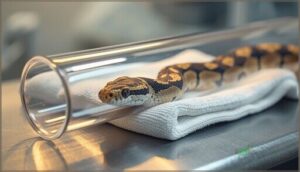
When you need to restrain a snake for medication, tubes and towels become your best allies. Tube Handling creates a controlled space where the snake can move but not strike, while soft towels cushion the body without squeezing scales.
- Choose rigid, inert tubes that match your snake’s girth without compression
- Use clean, lint-free towels to distribute pressure evenly across the body
- Combine both for maximum safety: the tube restricts head movement while the towel cradles midbody
- Secure tube ends tightly to prevent escape during dosing
This dual approach minimizes stress and keeps both you and your snake safe.
Gentle Support and Body Positioning

Body alignment matters more than grip strength when you’re holding a snake for medication. Support the entire length—head to tail—with both hands underneath, never pinching or twisting. Proper restraint methods distribute pressure evenly, turning tense coils into calm cooperation. Safe handling starts with respecting the spine’s natural curves.
Keep movements slow and predictable to encourage snake relaxation. Use padded surfaces for stable contact, and watch for tail twitching or gaping.
Enlisting Assistance for Control and Safety

When two sets of hands work in sync, snake restraint transforms from risky solo work to controlled precision. You’ll need trained assistants who understand safe handling and can anticipate each movement. Clear team communication through verbal cues prevents sudden shifts that stress the animal or compromise control measures.
- Assign one lead handler for all safety protocols and decision-making authority
- Document assistant training records and review roles before each procedure
- Establish emergency response signals that every team member recognizes instantly
Recognizing and Responding to Defensive Behaviors

A coiled body with raised head signals immediate danger—you’re watching a threat response unfold in real time. Defensive postures include neck flattening, hissing, and strike positioning that demand your immediate attention.
Read these behavioral cues early: tail flicking, gular flutter, and rigid coils.
Aggression management starts with stepping back, giving the snake space, then resuming safe handling with slower movements and supportive restraint.
Administering Medication to Snakes

Once you’ve got your snake properly restrained, the real work begins—getting the medication into them safely and effectively. This step demands precision, patience, and a steady hand, especially when you’re working with an animal that doesn’t understand you’re trying to help.
Let’s walk through the key steps to administer medication correctly while keeping both you and your snake safe.
Calculating Accurate Dosages
Getting the dose wrong can turn a healing moment into a disaster, so you must nail your calculations every time. Species Verification and precise Pharmacokinetics data anchor safe Reptile Medicine and Veterinary Care for snakes.
- Base dose calculation on validated mg/kg weight charts customized to your snake’s species
- Cross-check concentrations with at least two credible reptile pharmacology references
- Adjust for administration route—oral, topical, venipuncture—since Bioavailability Factors shift dramatically
- Document weight, species, drug lot, and dose in your medication administration log
- Reassess dosage if hydration or body condition changes to prevent Medication Errors during Snake Handling and Restraint
Oral Medication Delivery Methods
You’ll want to choose a method that keeps both you and your snake calm during medication administration. Syringe-based dosing gives you precise volume control, but oral suspensions reduce aspiration risk if you dose slowly. Medication tubes work well for aggressive species, while mixing doses with prey suits routine Veterinary Care for Snakes—just confirm the formulation allows it. Gradual delivery and proper Snake Handling and Restraint make every administration safer.
Securing The Snake’s Head Safely
Once you’ve delivered the dose, secure the head with a controlled grasp just behind the jaw. Use a rigid head restraint tool or clean snake tubes if the animal resists—never trust bare hands alone.
Align the snake’s head away from your body and keep restraint materials puncture-resistant. A partner stabilizing the body adds serious safety.
If the snake fights back, release immediately and regroup.
Post-Medication Care and Observation
After you’ve secured the head and finished medication administration for snakes, watch your animal closely for the next 24 hours. Recovery monitoring means tracking weight, feeding response, and any medication reactions like vomiting or lethargy. Stress reduction is key—dim the lights, keep noise low, and check injection sites daily for swelling or infection.
- Monitor activity level and appetite for 24–72 hours post-treatment
- Inspect wound care sites for redness, discharge, or abscess formation
- Document behavioral analysis notes including hiding frequency and movement quality
- Maintain quiet conditions to support reptile health and wellness and animal welfare and conservation goals
Proper reptile care and management after dosing protects both you and your snake.
Handling Venomous Snakes During Medication

Handling venomous snakes for medication isn’t something you improvise—it requires specialized training, strict protocols, and equipment designed to keep both you and the snake safe. The stakes are higher, the margin for error is smaller, and every step demands precision.
Let’s walk through the essential protocols, personnel requirements, emergency readiness, and sedation techniques that make venomous snake medication possible.
Specialized Equipment and Protective Protocols
When dealing with venomous species, you’ll need rigid safety shields and venom-resistant gauntlets—not just any protective gear. Snake tubes and containment systems prevent escape during restraint procedures.
Always inspect your animal handling equipment before use; equipment maintenance logs track readiness. Disposable, leak-proof bags minimize contamination risks.
These reptile restraint methods and snake handling techniques form your first defense against bites.
Role of Trained Personnel and Certification
Only certified handlers should work with venomous snakes. Training Programs cover species identification, safety protocols, and emergency response skills. Certification Standards demand documented competency verification through written exams and hands-on assessments.
You can’t learn this from videos alone—standardized curricula guarantee you master animal handling best practices and veterinary medicine principles. RACE-approved courses teach safe and stress-free snake handling techniques that protect both you and the animal.
Emergency Procedures and Antivenom Readiness
Preparedness saves lives when venomous bites occur. You need written emergency procedures that map out communication steps, antivenom protocols, and transport routes before any incident happens.
Keep antivenom stocked on-site with expiration tracking and trained staff ready for snakebite treatment.
Run regular drills so your team coordinates smoothly between handlers, veterinarians, and emergency response units when seconds count.
Chemical Restraint and Sedation Techniques
Chemical restraint becomes essential when physical handling poses too much risk during medication administration. Ketamine remains the primary sedation agent for venomous species, with dosage calculations based on body weight and species-specific metabolism. Your veterinarian will determine the safest anesthesia options and medication protocols.
- Injectable sedatives offer predictable onset times for controlled handling
- Inhalant anesthesia provides rapid recovery with minimal residual effects
- Monitoring heart rate and respiratory function prevents complications during sedation
- Reversal agents must be ready before any chemical restraint procedure begins
Ensuring Animal Welfare and Regulatory Compliance

When you’re handling snakes for medication, doing it right means more than just keeping yourself safe—it’s about protecting the animal and staying on the right side of the law. Every decision you make, from how you restrain the snake to how you document the treatment, carries ethical weight and legal responsibility.
Let’s walk through the key practices that keep your snake healthy, your conscience clear, and your procedures compliant.
Minimizing Stress and Promoting Snake Wellbeing
You can’t administer medication effectively if your snake is already stressed. Monitor stress signals like color shifts, rigid coiling, and reduced appetite through consistent behavioral monitoring.
Design habitats that meet welfare standards—quiet spaces, proper hides, and appropriate temperatures support stress-free reptile care. Limit handling frequency and duration. Incorporate snake enrichment between procedures.
Gentle handling and safe snake restraint techniques preserve trust while protecting both you and your animal.
Ethical Considerations in Handling and Medication
Handling a snake for medication isn’t just a technical skill—it’s an ethical responsibility. You’re protecting both animal welfare and animal rights every time you restrain an animal. Medication ethics demand you follow these principles:
- Secure informed consent from owners and follow welfare standards in all procedures.
- Document ethical approvals and track adverse events for transparent ethical governance.
- Use species conservation data to justify any invasive treatment.
- Guarantee stress-free, gentle handling that prioritizes animal safety throughout snake restraint.
Adhering to Veterinary and Legal Guidelines
You can’t medicate a snake legally without understanding the regulatory landscape. Legal frameworks vary by jurisdiction, so check state and federal species regulations before you begin.
Veterinary compliance demands licensed personnel for medication administration in many areas, especially with venomous species. Follow veterinary medicine protocols for dosing and routes.
Medication protocols must align with veterinary care standards and animal welfare laws to protect both you and your snake.
Documentation and Record-Keeping Practices
Maintain a formal log of every medication administration, snake restraint event, and handling procedure. Record date, time, dosage, route, personnel involved, and any adverse reactions with exact timestamps.
Digital storage with access controls protects sensitive data during compliance audits.
Veterinary care standards require traceability, so your record management must link each medication to a unique patient identifier and support regulatory compliance through regular reviews.
Frequently Asked Questions (FAQs)
How often should snakes receive preventative medications?
Like tailoring a suit to fit one snake at a time, preventive care depends on species, health status, and risk assessment. There’s no universal schedule—veterinary guidance shapes each medication frequency based on individual needs.
Can snakes be trained to accept medication voluntarily?
Training methods for voluntary intake show inconsistent results. Some individual snakes may accept flavored medications through conditioning, but behavioral responses vary widely.
Most veterinary protocols rely on safe restraint when medication acceptance isn’t feasible.
What medications are most commonly prescribed for snakes?
Veterinary care for reptiles relies on snake antibiotics like enrofloxacin, anti-parasite agents such as fenbendazole, and pain management with meloxicam.
Reptile dosage requires precise calculations, often delivered through venipuncture in zoological medicine.
How do you transport sick snakes to veterinary facilities?
Think of transport as a controlled mission—you need a rigid, escape-proof snake carrier with proper ventilation, stable warmth, minimal handling, and direct veterinary prep to keep your reptile safe during travel.
Are there alternative delivery methods besides oral administration?
Yes—subcutaneous injections, transdermal patches, and forced gavage offer alternatives when oral dosing fails.
Injectable sedatives ease restraint, while periocular or intracoelomic routes suit specific cases requiring venipuncture techniques during reptile physical examination.
Conclusion
A stressed snake won’t eat for weeks after mishandled medication—your technique determines whether treatment helps or harms. Handling snakes for medication purposes separates careless owners from competent ones.
You now control the variables: proper restraint equipment, species-specific approaches, stress reduction protocols, and emergency preparedness. Each administration builds your confidence and your snake’s tolerance.
When you combine knowledge with calm execution, medication becomes routine healthcare rather than traumatic intervention. Your snake’s recovery depends on that distinction.