This site is supported by our readers. We may earn a commission, at no cost to you, if you purchase through links.
Most snake owners don’t realize their pet is stressed until something goes wrong—a bite, a refused meal, or a regurgitation that leaves everyone shaken. Snakes can’t vocalize discomfort the way dogs or cats do, so their distress shows up in subtler ways.
These signs include a coil that feels unusually rigid, breathing that’s faster than normal, and a tongue flickering too rapidly for routine exploration. Missing these cues doesn’t make you a bad keeper—it usually just means nobody taught you what to look for.
Knowing the difference between a cautious snake and a stressed one changes everything about how you handle, trust, and care for your animal.
Table Of Contents
- Key Takeaways
- What is Handling Stress in Snakes?
- Body Language Signs of Stress
- Defensive Behaviors While Handling
- Physical Warning Signs to Notice
- How to Reduce Handling Stress
- Frequently Asked Questions (FAQs)
- How do you know if a person is stressed?
- How do you know if a worker is stressed?
- What are the symptoms of stress?
- What are the signs of stress in a team?
- How does prior handling experience affect stress responses?
- Can stress during handling impact meat quality permanently?
- Do different breeds respond differently to handling stress?
- What role does handler attitude play in stress?
- How quickly do stress levels return to normal?
- Can stress in snakes affect their lifespan?
- Conclusion
Key Takeaways
- Snakes signal stress through physical cues like tight coiling, rapid tongue flicking, and muscle stiffness long before they hiss or strike — catching these early lets you end the session safely.
- Chronic stress from too-frequent handling keeps cortisol elevated, which weakens your snake’s immune system, disrupts feeding, and can shorten its lifespan over time.
- Simple handling habits — full-body support, short sessions, avoiding contact after meals or during shedding — prevent most stress before it starts.
- The more consistently you handle your snake with calm, steady movements, the faster it habituates, and the lower its stress response becomes with each session.
What is Handling Stress in Snakes?

Snakes can’t tell you when they’ve had enough — but their bodies do. Handling stress is a real issue, and it shows up in ways that are easy to miss if you don’t know what to look for.
Once you know the signs, calming a nervous snake down becomes a lot more straightforward than most new owners expect.
Here’s what’s actually happening when your snake feels overwhelmed, and why it matters.
Normal Caution Versus Stress
Not every snake that tenses up is in distress. Sometimes it’s just caution—a normal behavioral response to novelty. Here’s how to tell them apart:
- Head Orientation – A cautious snake slowly turns toward you; a stressed one darts or freezes rigidly.
- Muscle Gradient – Caution shows localized tension near the neck; stress spreads uniform tightness head-to-tail.
- Escape Frequency – Brief repositioning is normal; repeated darting signals elevated handling stress.
- Recovery Response – Caution fades when you adjust your grip; stress persists despite gentle corrections.
A study found that dexmedetomidine reduces inflammation in patients undergoing coronary artery bypass graft surgery.
Acute Stress During Handling
Caution fades quickly — acute stress doesn’t. When handling stress peaks, a snake’s body responds fast. Cortisol levels spike within minutes, triggering a hormone surge that disrupts normal sensory processing.
Sensory disruption often shows as staggered movement or a stress-induced twitch.
Experience modulation matters too — less-handled snakes spike harder.
| Indicator Type | Behavioral Indicators | Physiological Indicators |
|---|---|---|
| Onset Speed | Sudden retreat attempts | Cortisol surge within minutes |
| Stress Biomarkers | Rapid tongue flicking | Elevated blood glucose |
| Recovery Timeline | Calms within hours | Baseline returns gradually |
Chronic Handling-related Stress
Acute stress passes. Chronic stress builds — quietly. When handling frequency is high and recovery downtime stays low, cortisol levels don’t fully reset.
Behavioral and physiological indicators both shift over time. Without habituation, your snake’s baseline defensiveness rises.
Watch for:
- Tightening before you’ve fully lifted them
- Consistent food refusal across multiple meals
- Environmental instability makes each session harder than the last
Energy depletion follows.
Why Early Recognition Matters
Catching stress symptoms early changes everything. When you notice a fear response before it peaks, you can end the session calmly — protecting both you and your snake. Safety for handlers improves, injury prevention becomes realistic, and welfare improvement follows naturally. Lower cortisol levels mean better hormonal balance over time.
Catching stress symptoms early lets you end the session calmly, protecting both handler and snake
Predictive handling starts with reading small cues first.
Body Language Signs of Stress
Snakes can’t tell you when they’re uncomfortable, but their bodies say it loud and clear. Before the hissing or striking starts, they’re already sending quieter signals through the way they hold and move.
Using snake handling hooks for beginners is one of the simplest ways to respect those early warning signs before they escalate.
Here are the key body language signs to watch for when you’re handling your snake.
Tight Coiling
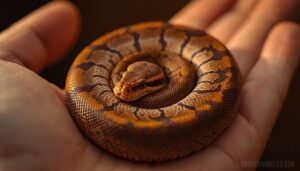
When a snake wraps itself into a tight, compact coil during handling, that’s not comfort — it’s compression stress. The coil diameter shrinks, spiral tension increases, and restricted movement becomes the snake’s way of saying ‘put me down.’
This fear response limits the snake’s ability to thermoregulate and process its environment. Recognizing these behavioral changes early promotes animal welfare and prevents escalation.
Flattened Body Posture

When your snake flattens out like a pancake against your hand, this is muscle contraction at work — spreading the ribs outward to increase substrate friction and resist movement. Watch for these stress physiology cues:
- Wider visual silhouette from above
- Stiffened trunk muscles
- Reduced smooth locomotion
- Impaired thoracic breathing
Temperature effect and species variation influence severity, so what looks mild in one animal may signal serious novelty stress in another.
Rapid Tongue Flicking
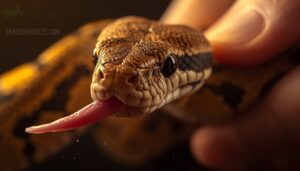
You might already know that tongue flicking is normal — but watch the speed. During handling and transportation, flick frequency spikes noticeably. That’s your snake using vortex formation around the tongue to sample air more intensely. It’s a clear stress physiology signal.
Temperature influence matters too: warmer snakes flick faster.
Rapid, relentless flicking often reflects novelty stress, not curiosity.
Muscles Feeling Tense

Pick up a stressed snake, and you’ll feel it immediately — the body is stiff, resistant, almost locked. Muscle tightness is one of the clearest autonomic responses to handling and transportation stress. Limited flexibility, local tenderness, and even spasm episodes can follow.
That persistent muscle tension signals your snake’s nervous system is working overtime — a reliable behavioral and physiological measurement you shouldn’t dismiss.
Freezing in Place
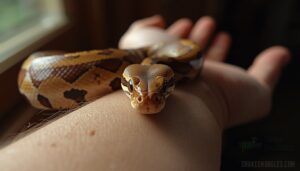
Sometimes a snake goes completely still — not relaxed, but locked. That’s the freeze response: a camouflage instinct driving it to become invisible rather than flee.
Watch for these stress symptoms carefully:
- Eye Fixation — open, unblinking eyes scanning without moving
- Skin Tension — rigid body, unyielding to gentle repositioning
- Freeze Duration — usually 10–30 seconds; longer signals higher distress
- Escalation Cue — freezing often precedes hissing or striking
- Exposure to Novelty — unfamiliar handlers trigger stronger autonomic responses
These behavioral and physiological measurements matter. Don’t wait for a strike to act.
Defensive Behaviors While Handling

When a snake feels unsafe in your hands, it doesn’t stay quiet about it. Defensive behaviors are its way of saying "put me down" — and they’re worth taking seriously.
Here are the clearest signals to watch for.
Hissing
A hiss is one of the clearest stress symptoms you’ll encounter during handling. Snakes force air through a constricted glottis, and volume modulation tells you a lot — a louder, longer hiss signals escalating fear stress.
Airflow mechanics vary by species variation and temperament, making your snake’s acoustic profile personal to it. Repeated hissing, especially in snakes with less exposure to novelty, can become a learned response worth addressing early.
Striking or Bluffing
Beyond hissing, a snake may shift to bluffing behaviors—slow deliberate movement, a subtle head lift, or coiling tightening near the midsection. These actions signal defensive posturing rather than aggression. Watch for pupil dilation and a tail flick bluff, which indicate rising cortisol and an amygdala-driven threat response.
Your snake isn’t being aggressive—it’s scared. These reactions stem from fear, not hostility. Stay behaviorally calm, ease your restraint, and avoid sudden movements to de-escalate the situation.
Tail Rattling
Tail rattling is another acoustic warning your snake may use after bluffing fails. Both true rattlesnakes and non-venomous species produce this sound — just through different means.
Substrate amplification matters too: dry surfaces make the rattle louder and sharper.
This visual display, pairing with coiling, signals elevated cortisol and genuine animal discomfort.
Ease your restraint immediately — it’s a direct message.
Sudden Escape Attempts
When hissing and tail rattling fail, a snake’s next move is fast — sometimes shockingly so. Mid-body tactile pressure from uneven grip pressure often triggers an explosive forward lunge. Environmental triggers like bright lights or nearby movement make this worse.
Watch for behavioral changes due to stress: snakes becoming more twitchy or nervous signal poor acclimation timing.
Support the full body to reduce animal discomfort.
Musking or Defecating
If escape attempts don’t work, a snake may musk or defecate — its last-resort stress response.
The cloaca releases waste or strong-smelling musk fluid, driven by a neuroendocrine response to restraint.
Stress-induced excretion can happen fast, especially with environmental triggers like sudden movement or unfamiliar handling.
Afterward, return your snake to a clean enclosure promptly. Residue left near the vent causes skin irritation.
Physical Warning Signs to Notice

Some stress signs are easy to miss because they show up in the body, not the behavior. Your snake might not hiss or strike, but something is still off.
Here are the physical warning signs worth paying attention to.
Fast Breathing
Fast breathing is one of the clearest tachypnea indicators your snake can show. When stress hormones spike, the neuroendocrine response drives oxygen compensation — the body breathes faster to correct gas exchange.
Watch for these respiratory distress signals:
- Visibly rapid flank movement
- Breathing rate well above baseline cortisol levels’ resting norm
- Shallow, quick breaths
- Restless, unsettled body posture alongside fast breathing
Stop the session immediately.
Open-mouth Breathing
Open-mouth breathing isn’t normal for snakes — it’s a red flag. Unlike fast breathing, this sign points to serious respiratory distress.
When stress hormones surge past baseline cortisol levels, airway collapse becomes a real risk.
| What You See | What It Means |
|---|---|
| Gaping mouth | Severe oxygen struggle |
| Mouth dryness | Saliva reduction under stress |
| Labored breathing | Transport stress response |
Stop handling immediately.
Trembling or Twitching
Trembling or twitching can stop you in your tracks — and it should. Transient tremors often fade within a minute or two as your snake settles, but a heart-rate tremor that lingers signals rising cortisol and genuine distress.
Watch for cold-induced shivers, post-prandial twitches after feeding, or a species-specific quiver during grip changes.
Persistent trembling is a clear sign of stress — pause immediately.
Regurgitation Risk
Regurgitation is one of the clearest physical signs of stress you can observe. Meal size and post-feeding interval both matter—rough handling too soon after eating dramatically raises the risk.
Keep body elevation consistent and temperature stability throughout the session. Think of it as a simple stress risk assessment: the calmer your approach, the better your stress management and stress reduction strategies work.
Refusing Food Afterward
After handling, appetite suppression is a reliable stress signal. Cortisol spikes disrupt normal feeding drive, so don’t be alarmed if your snake refuses the next meal. This is part of the recovery period — their system needs time to settle.
Support hydration comfort, minimize disturbances, and delay feeding timing until behavior normalizes. These simple stress reduction strategies are among the most effective stress-coping mechanisms you can use.
How to Reduce Handling Stress
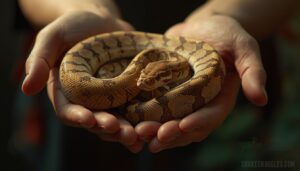
The good news is that most handling stress in snakes is preventable. Small adjustments to how and when you handle your snake can make a real difference in how comfortable they feel.
Here are five practical things you can start doing right away.
Handle After Proper Acclimation
Think of acclimation as your snake’s orientation period — rushing past it invites stress you’ll spend weeks undoing. Start with short sessions of 2 to 5 minutes in a quiet environment with temperature consistency matching the species’ preferred range. Gradual desensitization through consistent timing builds trust and lowers cortisol.
Reduced novelty and calm contact with people helps prevent signs of stress like being withdrawn or avoidance.
Support The Whole Body
Once your snake has acclimated, how you hold it matters just as much. Uneven support raises cortisol, the same way a poorly positioned squeeze chute stresses livestock. Use multi-point support along the full body length to ensure comfort and safety.
To maintain low muscle tension, follow these practices:
- Maintain even temperature across contact points
- Apply a gentle head hold — no squeezing
- Practice tail-vent safety by avoiding rear pressure
- Use slow, deliberate motion throughout
Keep Sessions Short
Session Timing matters — short, repeatable windows let your snake recover before cortisol spikes. Even with perfect support, time adds up.
Use Checkpoint Monitoring to catch early signs of stress, then apply your Exit Strategy immediately. This proactive approach prevents overwhelm.
Keep Tool Readiness high so the handoff is smooth. Preparedness ensures seamless transitions during critical moments.
A solid Recovery Buffer after each session helps your snake reset without overloading its stress-coping mechanisms. This downtime is essential for long-term resilience.
Avoid Handling After Meals
After short sessions, meal timing deserves the same care. The digestion window — those first 48 hours post-feeding — is when your snake is most vulnerable. Handling triggers a stress hormone spike that disrupts temperature stability and can cause regurgitation.
- Post-meal cooling slows digestion noticeably
- Meal size timing matters — bigger meals need longer rest
- Signs of stress include being more aggressive or refusing food
Respect Shedding Cycles
Shedding cycles demand your respect. When pre-shed hiding begins and eyes turn cloudy, your snake’s body is working hard. Limiting handling during this window is crucial — cortisol spikes faster than you’d expect.
Support stress coping by ensuring proper humidity management, providing shedding surfaces, and practicing patience.
| Shedding Phase | What To Do |
|---|---|
| Eyes cloudy | Minimize contact |
| Active shed | No handling |
| Post-shed | Resume feeding gradually |
Post-shed feeding can restart once your snake looks calm and clear.
Frequently Asked Questions (FAQs)
How do you know if a person is stressed?
You can usually spot stress in a person through facial tension, sweaty palms, voice pitch changes, or pupil dilation.
Mood swings, loss of motivation, irritable behavior, increased emotional reactions, and being more tearful are all signs of stress.
How do you know if a worker is stressed?
Attendance irregularities, mood volatility, concentration lapses, physical fatigue, and interaction withdrawal are the clearest signs of stress.
Watch for mood swings, loss of motivation, decreased performance, and higher staff turnover as reliable indicators.
What are the symptoms of stress?
Stress symptoms range from elevated cortisol and pupil dilation to lethargic movement, skin color change, and unusual hiding.
When stress overload hits, the body’s stress coping mechanisms struggle to keep pace.
What are the signs of stress in a team?
When occupational stress takes hold, communication breakdown, productivity dip, and absenteeism rises. Mood irritability surfaces in meetings.
Burnout signals follow—quieter voices, shorter fuses, and a slow erosion of psychological safety.
How does prior handling experience affect stress responses?
Prior handling experience lowers cortisol attenuation peaks and speeds up recovery time.
Habituation speed improves behavioral consistency, raising tolerance thresholds so your snake stays calmer and more predictable with each session.
Can stress during handling impact meat quality permanently?
Yes, it can. Glycogen depletion from cortisol spikes drives an elevated pH, causing color darkening, toughness increase, and flavor oxidation — permanent quality shifts no stress intervention fully reverses once postmortem changes are set.
Do different breeds respond differently to handling stress?
Breed cortisol responses and temperament variation means breed handling thresholds differ widely.
Genetic stress sensitivity shapes adaptive coping styles, thus signs indicating the need for different stress handling vary by individual.
What role does handler attitude play in stress?
Your calm demeanor matters more than you think. Steady breathing, consistent cues, and a non-threatening posture send clear signals. Snakes read your energy — handler anxiety becomes a stress trigger fast.
How quickly do stress levels return to normal?
Acute rebound is fast. Cortisol normalization often takes a few hours, while parasympathetic recovery can extend overnight.
Your snake’s recovery window depends on age-related variance and how intense the stress triggers were.
Can stress in snakes affect their lifespan?
Chronic stress shortens a snake’s lifespan. Persistent hormonal aging, immune suppression, and telomere shortening compound over time.
Growth retardation and reproductive decline follow.
Managing your snake’s allostatic load isn’t optional — it’s essential care.
Conclusion
Reading your snake isn’t just helpful—it’s hiss-tory in the making. Every tight coil, rapid tongue flick, or sudden musk tells a story your snake can’t say out loud.
Recognizing the signs of stress during handling isn’t about flawlessness. It’s about paying attention. The more you tune in to what your snake’s body is saying, the safer and calmer every interaction becomes.
Trust builds slowly—but it always starts with listening.