This site is supported by our readers. We may earn a commission, at no cost to you, if you purchase through links.

Most beginner reptile keepers discover their humidity gauge is lying to them only after their gecko suffers dysecdysis or their snake develops respiratory infection, preventable tragedies that stem from trusting a $5 analog meter with a ±15 percent margin of error.
Your humidity gauge sits between your animal’s mucosal defenses and a cascade of bacterial infections, fungal blooms, and incomplete sheds that veterinary intervention can’t always reverse.
Digital hygrometers with ±2 to ±3 percent accuracy eliminate the guesswork that costs you emergency vet visits and sleepless nights monitoring labored breathing, while analog units lag behind microclimate shifts by 20 minutes or more, introducing variation that jeopardizes narrow humidity ranges required for proper growth and shedding.
Table Of Contents
Key Takeaways
- Digital hygrometers with ±2-3% accuracy eliminate the guesswork that leads to preventable reptile health crises like dysecdysis and respiratory infections, while cheap analog meters with ±15% margins and 20-minute response lags introduce dangerous microclimate variations you won’t detect until symptoms appear.
- Humidity mismanagement causes more preventable complications than temperature errors, compromising your reptile’s mucosal defenses within 48-72 hours when levels drift outside the critical 40-60% range required for proper shedding and growth.
- Your humidity gauge must deliver readings within ±3-5% RH and respond in under 60 seconds to catch sudden environmental shifts, because sensor drift of 1-3% per year means you’ll need formal recalibration every 12 months using traceable salt solutions to maintain reliability.
- Maintaining home humidity between 30-60% prevents both reptile health disasters and household problems like mold growth above 60% and respiratory irritation below 30%, requiring strategic gauge placement at enclosure mid-height with accessible displays readable from 1.5 meters.
What Are Humidity Gauges and How Do They Work
A humidity gauge measures the amount of water vapor suspended in your air and displays it as relative humidity percentage, giving you critical data that protects everything from your respiratory health to your reptile’s shedding cycle.
Whether you’re monitoring a ball python’s enclosure or tracking basement mildew risk, choosing the right humidity gauge for your specific needs ensures you’re working with reliable data instead of guesswork.
Digital models use electronic sensors to deliver readings within ±2-5% accuracy on an LCD screen, while analog versions rely on mechanical components like metal coils or organic materials that shift with moisture changes.
Understanding how these devices function—and which type matches your monitoring needs—prevents the costly mistakes that lead to mold infestations, equipment damage, and preventable health complications.
Digital Vs. Analog Hygrometers Explained
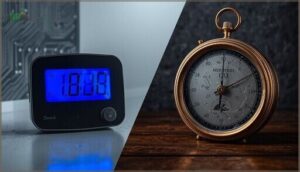
Your sensor comparison starts with a critical choice: digital hygrometers deliver precision readings within ±1 to ±3 percent RH and respond in seconds, while analog hygrometers drift over time and lag behind real humidity shifts, creating dangerous microclimate variations you won’t catch until dysecdysis or respiratory distress appears. Understanding the importance of is vital for both animal wellness and accurate environmental control.
Core differences that impact your reptile’s health:
- Digital accuracy: Electronic sensors with microprocessors provide exact values to the nearest tenth of a percent, repeatable across multiple readings under identical conditions, eliminating guesswork that jeopardizes mucosal defenses.
- Analog limitations: Physical materials like human hair or metal coils react slowly to humidity changes, introduce reading variation through visual interpretation of needle position, and require periodic recalibration with salt-solution methods to maintain any reliability.
- Response times: Digital units update within seconds for real-time monitoring of critical humidity drops, whereas analog meters lag as sensing material reacts, masking sudden environmental threats that compromise shedding cycles.
Key Features Beginners Should Know
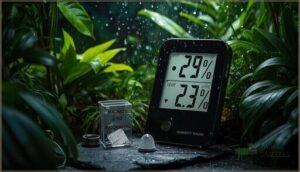
Beyond choosing digital over analog, you must prioritize sensor accuracy within ±2 to ±5 percent RH to safeguard your animal’s mucosal defenses and prevent dysecdysis.
Look for display types with large, backlit digits for instant visibility, mounting options—suction cups, magnetic backs, or wall brackets—that position the thermometer hygrometer at enclosure mid-height, battery life exceeding one year, and accessible calibration methods using salt-solution kits to verify hygrometer accuracy remains stable across fluctuating humidity levels.
Understanding Relative Humidity Readings
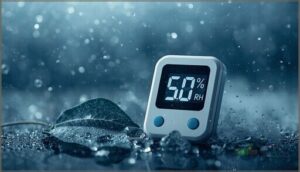
Relative humidity represents the percentage of water vapor the air holds compared to its maximum capacity at the current temperature, so a 50 percent RH reading at 20°C means air contains half the moisture it could hold—critical knowledge because hygrometer accuracy and sensor accuracy directly determine whether your digital hygrometers deliver accurate readings for moisture control, air quality, and preventing microclimate variations that jeopardize humidity levels requiring immediate RH calibration with humidity gauges.
For a deeper understanding of humidity considerations, explore these fundamentals of relative humidity.
Why Humidity Gauges Matter for Beginners
You might think a humidity gauge is just another piece of equipment, but the difference between proper moisture monitoring and flying blind can mean the difference between thriving animals and emergency vet visits, or comfortable living spaces and chronic respiratory irritation.
Humidity mismanagement causes more preventable health complications than temperature control issues, with mucosal defenses compromising within 48-72 hours when levels drift outside species-specific or comfort ranges of 30-60%. Here’s why your first hygrometer isn’t optional equipment—it’s your primary defense against conditions that spiral from uncomfortable to dangerous faster than most beginners realize.
Humidity mismanagement causes more preventable health complications than temperature errors, compromising defenses within 48-72 hours when levels drift outside safe ranges
Preventing Health Issues in Reptiles and Homes
You can’t afford to ignore humidity control—mismanagement triggers more preventable health complications than temperature errors, fueling respiratory infections in reptiles and mold growth in your home.
Monitor humidity levels with reptile humidity gauges to maintain air quality within species-specific ranges, preventing mucosal defenses from breaking down and stopping bacterial blooms before they compromise health monitoring efforts or demand costly veterinary intervention.
Supporting Proper Shedding and Growth
Your reptile’s shedding cycles depend on humidity control within narrow ranges—40 to 60 percent promotes skin health and prevents dysecdysis, while low moisture disrupts growth phases by compromising keratin formation and nutrient delivery to new scales.
Pair nutrition balance with hygrometer accuracy to track humidity levels in real time, preventing metabolic slowdowns that stall reptile care progress and demand emergency humidity management adjustments before complications escalate.
Maintaining Comfortable Living Spaces
You control air quality and home comfort solutions when you maintain humidity levels between 30 and 60 percent across rooms, using digital hygrometers to establish comfort zones that prevent respiratory irritation and static buildup.
- Position humidity gauges in living areas to monitor indoor air quality fluctuations daily
- Deploy humidity control paired with ventilation systems to distribute moisture evenly
- Adjust space planning around readings to identify problem zones requiring intervention
- Track trends to prevent mold formation above 60 percent thresholds
- Pair dehumidifiers with fans to stabilize microclimate variations rapidly
Essential Features to Look for in a Humidity Gauge
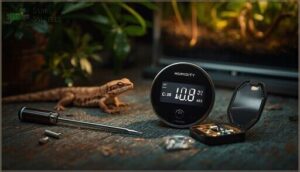
You can’t afford to gamble with a humidity gauge that delivers inconsistent readings or fails when your reptile’s mucosal defenses depend on precise environmental control. The difference between a reliable device and a budget disaster often comes down to four critical specifications that separate beginner-friendly tools from calibration nightmares.
Before you commit to any hygrometer, you need to evaluate accuracy thresholds, display functionality, power sustainability, and long-term maintenance demands—because each of these factors directly impacts your ability to prevent dysecdysis and respiratory compromise in your enclosure.
Accuracy Standards and Response Time
Your humidity measurement depends on two critical performance benchmarks: precision and speed. Most digital hygrometers deliver accuracy within ±3-5% RH under standard conditions, though sensor calibration drift can push that to ±5-10% after months of exposure to temperature humidity meters’ demanding terrarium environments—a red flag you can’t ignore when reptile health hangs in the balance.
| Gauge Type | Accuracy Benchmarks | Response Metrics |
|---|---|---|
| Digital Hygrometers | ±1-5% RH typical; drift 1-3% yearly | 10-60 seconds settling time |
| Analog Models | ±5-10% RH; requires manual recalibration | Several minutes lag after moisture shift |
| Temperature Compensation Units | Auto-adjust across 0-50°C for accurate readings |