This site is supported by our readers. We may earn a commission, at no cost to you, if you purchase through links.
Grab the wrong tool on a venomous snake call, and the situation unravels fast.
Most people assume snake hooks and tongs do roughly the same job—one just looks different from the other.
They don’t.
Each tool has a distinct mechanical purpose, a different safety profile, and a handling philosophy that can mean the difference between a clean relocation and a close call.
Whether you’re managing a captive collection or responding to a wild encounter, understanding the snake hook vs snake tongs differences shapes every decision you make from the moment the snake comes into view.
Table Of Contents
- Key Takeaways
- Snake Hooks Vs Tongs: Key Differences
- Which Tool Fits Which Snake
- Choosing The Right Snake Tool
- Top 7 Snake Hooks and Tongs
- Frequently Asked Questions (FAQs)
- What are the risks of using snake hooks?
- What animal is not afraid of snakes?
- Do snake tongs hurt snakes?
- Are snake hooks humane for snakes?
- What are snake tongs?
- What is the best tool to catch a snake?
- Can you use both tools simultaneously during handling?
- How do weather conditions affect tool performance outdoors?
- Are collapsible tools as reliable as fixed-length models?
- What legal restrictions exist for owning these tools?
- Conclusion
Key Takeaways
- Hooks guide a snake’s body with minimal contact, while tongs restrain it with a firm grip — knowing that difference is what keeps you safe.
- Match your tool to the snake: hooks work best for calm, non-venomous species, while tongs are non-negotiable for cobras, mambas, and vipers.
- Your experience level matters as much as the snake itself — beginners should start with locking tongs, since the mechanism forgives hesitation in a way hooks don’t.
- Weather, enclosure size, and tool maintenance all affect reliability, so inspect your gear before every session and never assume it’ll hold if you haven’t checked.
Snake Hooks Vs Tongs: Key Differences
Hooks and tongs look similar at first glance, but they work in completely different ways. Knowing sets them apart helps you pick the right tool before you’re face-to-face with a snake.
Once you understand how hook design affects snake handling technique, choosing between the two tools becomes a lot more intuitive.
Here’s a closer look at the key differences.
How Each Tool is Built
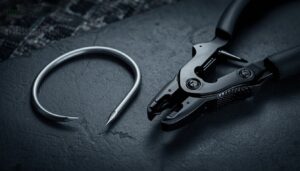
Both tools share some DNA — stainless steel shafts, ergonomic grips wrapped in non‑slip rubber — but their builds serve completely different jobs.
| Feature | Snake Hook | Snake Tongs |
|---|---|---|
| Material Selection | Aluminum or stainless steel | Fiberglass or aluminum |
| Joint Mechanism | Collapsible design with locking hinge | Rivetless pin, scissor‑action |
| Surface Treatment | Bead‑blasted, satin nickel plating | Rubber‑coated jaws, micro‑etched grip |
Hooks are lean and minimal. Tongs carry a locking system that keeps the grip secure without constant hand pressure.
Hook Tip Vs Tong Jaws
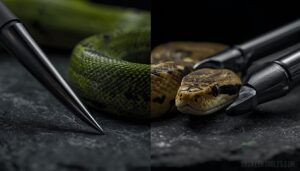
The curved metal tip of a snake hook glides along scales — minimal contact, maximum guidance. For venomous snake handling, a longer tool maintains a safer distance. Tong padded jaws work differently, closing firmly around the body.
| Feature | Hook Tip | Tong Jaws |
|---|---|---|
| Contact Style | Scale Contact Dynamics — sliding | Jaw Pad Materials — rubber grip |
| Wear Resistance | High; Replacement Frequency is low | Moderate; pads need periodic checks |
Locking jaws hold. Hook tips steer.
Restraint Vs Guidance
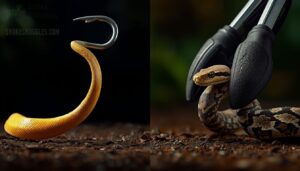
Locking jaws hold — but do they always need to? That’s the real distinction here. A hook guides; tongs restrain. Choosing between snake hook and snake tongs often comes down to this single question.
| Approach | Hook | Tongs |
|---|---|---|
| Primary Action | Steers and directs | Holds and secures |
| Operator Safety | Distance via leverage | Distance via jaw length |
| Stress Management | Lower; minimal contact | Higher if over-gripped |
| Signal Reading | Easier; snake moves freely | Requires tactile feedback |
Training progression matters — start gently.
Length and Reach Differences
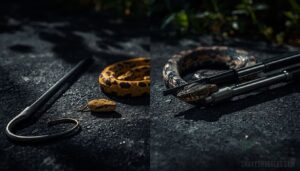
Length shapes everything — your lever arm length determines how much control you actually have. Hooks run 18 to 48 inches; that long slender pole with a curved or blunt end gives you solid reach without bulk. Tongs stretch further, some hitting 60 inches with telescopic reach. Longer always sounds better, but there’s a real reach precision tradeoff in tight spaces.
| Tool | Compact vs Extended | Safe Distance |
|---|---|---|
| Short Hook ( Every clumsy grab spikes cortisol, suppresses immunity, and turns a healthy snake into a stressed one |
| Factor | Hook | Tongs |
|---|---|---|
| Stress Level | Lower | Moderate–High |
| Metabolic Shift | Minimal | Possible if over-gripped |
| Recovery Time | Hours | Hours to days |
Calm technique is animal welfare in action.
Which Tool Fits Which Snake
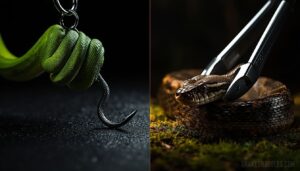
Not every snake needs the same tool — and using the wrong one can go sideways fast. The right choice comes down to the species you’re dealing with, its size, and how defensive it’s usually.
Your setup matters too — check out this guide on natural vs. artificial hides for snakes to make sure your enclosure supports low-stress handling from the start.
Here’s how each tool lines up across the most common situations you’ll actually face.
Non-venomous Snakes and Hooks
For non-venomous snakes, a snake hook is honestly your best friend. The curved tip advantage here is real — it slides under the mid-body naturally, guiding without gripping. Hook material selection matters too; aluminum keeps things light and responsive.
- Mid-body guidance reduces panic responses
- Stress reduction benefits keep the snake calm
- Training simplicity makes hooks beginner-friendly
Safety considerations in snake handling still apply, even with docile species.
Venomous Snakes and Tongs
When you’re dealing with venomous species — cobras, mambas, vipers — snake tongs aren’t optional. They’re your primary line of defense.
Locking mechanism reliability keeps the snake from twisting free mid‑transfer, while heat‑resistant jaws and jaw material coating protect against repeated stress.
Ergonomic grip design reduces handler fatigue.
Snake handling techniques for venomous snakes demand distance, control, and zero hesitation. Tongs give you all three.
Large Constrictors and Heavy-bodied Snakes
Boa constrictors are another beast entirely — some top 60 pounds of pure muscle. With constriction mechanics that powerful, a hook alone won’t cut it. You need large snake hooks for lifting support, but tongs are essential for control.
For tool selection based on snake species like these, pair both. Ball pythons and king snakes? A single hook usually manages them just fine.
Small Snakes in Tight Enclosures
Tight enclosures make tool choice matter more than people realize. A small garter snake or corn snake needs room for vertical space utilization and microhabitat enrichment — so your snake hook is ideal here. It guides without crowding.
Tongs risk over-gripping in confined spaces.
Mind thermal gradient management, watch for stress indicator monitoring cues, and prioritize substrate depth optimization.
Safety considerations in snake handling start with using the right tool.
A snake hook lets handlers safely guide even color variants like melanistic or albino individuals, as detailed in this guide to identifying eastern hognose snake color patterns.
Relocation Vs Capture Situations
Relocation isn’t just about moving a snake — it’s a whole decision tree.
- Habitat Suitability: Match the release site to the species’ needs — cover, prey, water.
- Legal Permits: Most jurisdictions require them. Check before you act.
- Stress Management: Minimize transport duration; a snake hook works for calm non-venomous moves, snake tongs for venomous.
- Release Site Selection: Safety considerations in snake handling don’t end at capture — they follow the snake home.
Choosing The Right Snake Tool
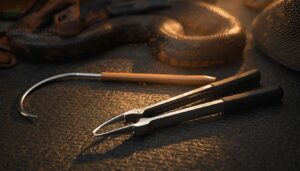
Picking the right tool comes down to more than just "hook or tongs."
Your skill level, working space, and the snake you’re dealing with all pull that decision in different directions.
Here’s what to think through before you grab either one.
Skill Level and Experience Needs
Your tool choice should match your skill level — full stop.
| Experience Level | Recommended Tool |
|---|---|
| Novice | Tongs (locking grip) |
| Intermediate | Hook or tongs |
| Proficient | Either, situationally |
| Experienced | Both confidently |
| Mentor-ready | Instructs both |
Training beginners in snake handling means starting with tongs — the locking mechanism forgives hesitation.
Supervision protocols require 10–15 supervised sessions before solo work.
Certification requirements generally demand 20–40 hours for venomous species.
Proficiency milestones and mentorship programs keep your skills sharp and honest.
Enclosure Size and Working Space
Your skill level shapes your tool choice — and so does your workspace. A cramped enclosure changes everything.
You need at least 30 inches of clearance width in front, and 78 inches of headroom requirements to swing tongs safely. Tight aisle pathway? Go with a lightweight hook — better tool ergonomics for snake capture in confined spots.
Space dictates reach.
Material and Durability Factors
Space matters, but so does what your tool is made of.
Stainless steel hooks resist corrosion for years in humid setups. Aluminum tongs — especially aircraft grade materials — give you excellent equipment durability without the extra weight.
Surface coatings like anodized finishes fight wear life problems. Watch for joint fatigue at pivot points, and check handle abrasion on grips after heavy use.
Material strength decides longevity.
Maintenance and Inspection Tips
Good materials mean nothing without upkeep.
Run through a visual inspection checklist before every session — check for corrosion, chipped coatings, and locking mechanism wear.
Stick to a lubrication schedule every three months using silicone-based lubricant on moving joints.
Functional testing procedures on a neutral object confirm grip and extension security.
Log everything: maintenance logkeeping keeps your field-tested gear genuinely reliable.
When to Choose a Hook or Tongs
Regarding comparison of snake hooks vs snake tongs, the decision really boils down to four things: snake temperament, environmental constraints, your experience level, and budget considerations.
Calm non-venomous species? A hook keeps stress low.
Rescue urgency with a defensive cobra? Grab the tongs.
Best practices for handling nonvenomous snakes favor hooks, while risk management for venomous snake encounters demands tongs control every time.
Top 7 Snake Hooks and Tongs
Good tools don’t just make handling easier — they keep you and the snake safer. After testing what’s out there, seven hooks and tongs stand out for build quality, reach, and real-world reliability.
Here’s what made the cut.
1. DocSeward Snake Hook Tool
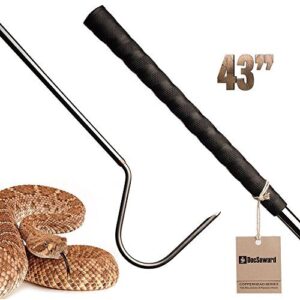
The DocSeward Copperhead Hook is built for people who handle snakes regularly, not just occasionally. At 43 inches, it keeps you at a comfortable working distance from rattlesnakes and other field species up to 7 feet.
The copper ferrule and stainless-steel hook stay light up front — around 8 ounces total — so your wrist doesn’t fatigue after repeated use. The rubber grip holds firm even when your hands are sweaty.
Made in the USA, priced at $61.
| Best For | People who handle snakes regularly in the field, yard, or during herping trips and want a durable, well-balanced hook that won’t wear them out. |
|---|---|
| Material | Stainless steel & copper |
| Tool Type | Hook |
| Max Length | 43 inches |
| Grip Type | Rubber grip |
| Collapsible | No |
| Snake Size Suitability | Up to 7 feet |
| Additional Features |
|
- Lightweight at just 8 oz, with a front-balanced design that reduces wrist fatigue during long handling sessions
- Stainless-steel hook with a beveled tip slides under snakes smoothly without harming them
- Rubber grip stays secure even with wet or sweaty hands
- At $61, it’s pricier than basic hooks—probably overkill if you’re only moving the occasional garden snake
- The 43-inch max length may not cut it for very large or heavily coiled snakes
- Built specifically for snakes, so it won’t translate well to handling other reptiles
2. OdontoMed Snake Catcher Stick
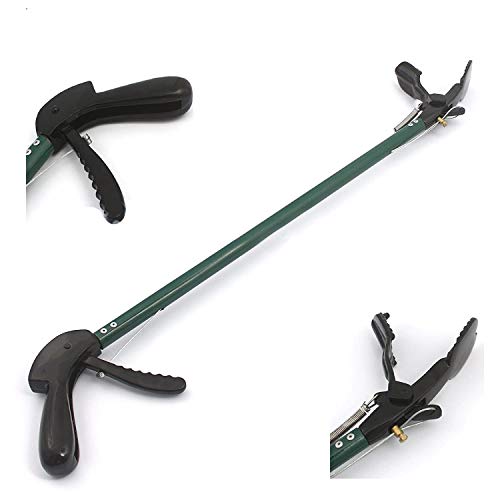
The OdontoMed Snake Catcher Stick is a smart pick if you need flexibility in the field. Its telescoping aluminum shaft adjusts from 18 to 60 inches, so you’re not locked into one working distance.
The rubber grip holds firm in wet or muddy conditions — exactly when control matters most. A curved hook tip guides the snake’s body without pinching.
It weighs around 1.2 to 1.6 pounds, making it easy to maneuver without arm fatigue. Best suited for small to medium snakes in residential or educational settings.
| Best For | Field researchers, wildlife handlers, and anyone who needs a reliable, sterilizable tool for safely capturing or relocating small snakes in clinical or outdoor settings. |
|---|---|
| Material | Aluminum shaft |
| Tool Type | Hook |
| Max Length | 60 inches |
| Grip Type | Rubber grip |
| Collapsible | Yes |
| Snake Size Suitability | Small to medium |
| Additional Features |
|
- One-piece stainless steel build means no joints to fail — it’s tough and built to last
- Easy to clean and sterilize, so it holds up well for repeated professional use
- Green high-visibility finish makes it easy to spot when you set it down in the field
- Fixed 30-inch length won’t cut it for larger snakes or situations where you need more reach
- Hand-finished production means you might get slight size differences from one unit to the next
- Only comes in green, which isn’t great if your environment calls for something less visible
3. Fnova Collapsible Snake Catcher Tool
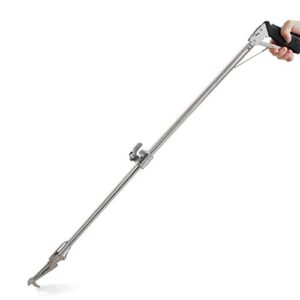
The Fnova Collapsible Snake Catcher Tool is built for handlers who need reliable gear without the bulk. Aircraft-grade stainless steel keeps it light at 1.9 lbs while staying tough enough for repeated field use.
The zigzag serrated jaws grip firmly without excessive pressure — so you’re securing the snake, not injuring it.
Its automatic locking mechanism means you won’t lose your hold mid-relocation.
Collapses under 24 inches, so it fits easily in a pack or truck.
Practical, durable, and genuinely field-ready.
| Best For | Outdoor workers, hikers, and wildlife handlers who regularly encounter venomous snakes and need a safe, portable way to capture and relocate them. |
|---|---|
| Material | Aircraft-grade stainless steel |
| Tool Type | Tongs |
| Max Length | Extended field length |
| Grip Type | Handle grip |
| Collapsible | Yes |
| Snake Size Suitability | Small to large venomous |
| Additional Features |
|
- Collapsible and compact enough to toss in a saddlebag or truck — easy to bring anywhere you might cross paths with a snake
- Serrated zigzag jaws grip securely without harming the snake, so relocation stays humane
- The auto-lock mechanism keeps your hands free when you need them, which is a real plus mid-transfer
- The lock can feel unreliable if both pins aren’t fully engaged — something you don’t want to second-guess when holding a rattlesnake
- At 1.9 lbs and fully extended, it gets heavy fast during prolonged use
- The jaw teeth are sharp enough to damage objects or nick your hand if you’re not careful — a quick file or some tape can help
4. Fnova Professional Snake Tongs
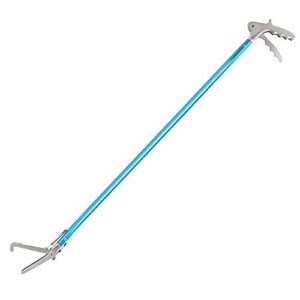
Built from aluminum alloy and stretching 52 inches, the Fnova Professional Snake Tongs hit a sweet spot most handlers appreciate — enough reach to stay safe, light enough to use one-handed.
The spring-loaded jaws distribute pressure evenly, so you’re not guessing whether you’re gripping too hard.
No external wires to snap mid-capture, either.
It doubles as a walking stick on rough terrain, which sounds like a bonus until you actually need it.
Solid choice for homeowners and field workers alike.
| Best For | Homeowners, hikers, and wildlife handlers who need a reliable, lightweight tool to safely capture and relocate snakes without getting too close. |
|---|---|
| Material | Aluminum alloy |
| Tool Type | Tongs |
| Max Length | 52 inches |
| Grip Type | Standard handle |
| Collapsible | No |
| Snake Size Suitability | Small to large |
| Additional Features |
|
- Spring-loaded jaws grip evenly without injuring the snake — no guesswork, no wire failures
- At 52 inches, you’ve got solid reach, and the aluminum keeps it light enough to use one-handed
- Doubles as a walking stick on rough terrain, so it earns its carry weight on longer trips
- The jaws aren’t thin enough to slide under snakes resting on rocks, so you may need a hook as backup
- No locking mechanism on the jaws, which can feel risky when you’re moving a feisty catch
- Struggles with small or juvenile snakes where a secure grip is harder to get
5. Repti Zoo Snake Hook Tool
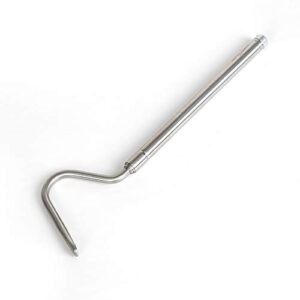
Small enclosures don’t leave much room to maneuver, and that’s exactly where the Repti Zoo Snake Hook earns its place.
It collapses to just 7.8 inches — genuinely pocket-sized — and extends to 23.6 inches when you need to reach.
The duckbilled stainless steel tip is gentle on scales, and the non-slip grip holds steady in humid conditions.
Best suited for small, non-venomous snakes during feeding or health checks.
Don’t push it with heavier or more aggressive animals; it’s not built for that.
| Best For | Snake keepers who work with small, non-venomous species and want a compact, easy-to-carry hook for daily enclosure tasks like feeding and health checks. |
|---|---|
| Material | Stainless steel |
| Tool Type | Hook |
| Max Length | 23.6 inches |
| Grip Type | Non-slip grip |
| Collapsible | Yes |
| Snake Size Suitability | Small non-venomous only |
| Additional Features |
|
- Collapses to under 8 inches, so it fits in a pocket and goes wherever you go
- Adjustable length up to 23.6 inches gives you real reach inside deeper tanks
- Stainless steel build with a rounded tip keeps handling safe and stress-free for your snake
- Not suitable for venomous or larger, more aggressive snakes — the hook can lose rigidity under heavy force
- The wrist strap attachment point is tiny and may need a workaround to actually use
- Hook may retract unexpectedly under pressure, which isn’t ideal if you need a firm, consistent hold
6. Repti Zoo Snake Catcher Pole
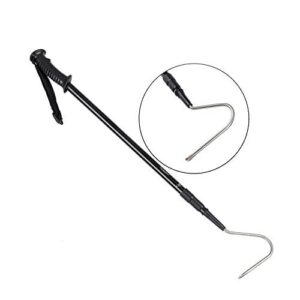
If you need more reach than the Repti Zoo Hook offers, the Catcher Pole steps up nicely. It telescopes from 16 to 61 inches — enough distance to work safely with snakes you’re less certain about.
The stainless steel build manages humidity without complaint, and the riveted head stays put under tension.
That rubberized grip makes a real difference during longer sessions.
It’s a solid middle-ground tool: more reach than a basic hook, without the complexity of tongs.
| Best For | Hobbyists, field rescuers, and anyone who needs a bit more reach when handling unknown or potentially venomous snakes safely. |
|---|---|
| Material | Stainless steel |
| Tool Type | Hook |
| Max Length | 61 inches |
| Grip Type | Rubberized grip |
| Collapsible | Yes |
| Snake Size Suitability | Small to medium |
| Additional Features |
|
- Telescopes from 30 to 57 inches, giving you a comfortable buffer when you’re not sure what you’re dealing with
- The duck-billed stainless steel hook is built to handle moisture and won’t hurt the snake
- Collapses down small and weighs just over a pound, so it’s easy to toss in a bag and go
- The locking joints can get loose if you’re not careful, which is the last thing you want mid-wrangle
- A few users have had the hook detach — not ideal, especially around venomous species
- Tops out at a 4.4 lb weight limit, so it’s not the right tool for bigger adult snakes
7. Ayamaya Collapsible Snake Hook Tool
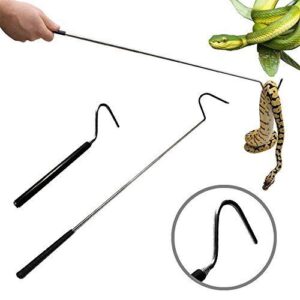
The Ayamaya takes compact portability seriously. It collapses to just 11 inches — genuinely pocket-sized — then extends to 39.3 inches when you need it.
Stainless steel keeps rust out of the equation, and the soft-grip handle is comfortable for one-handed use.
It’s built for small snakes under 2 lbs, so don’t push it past that limit.
Terrarium cleaning, transferring a shy pet, moving hides without stress — this is where it earns its place.
| Best For | Pet snake owners and field herpers who need a lightweight, packable hook for handling small snakes under 2 lbs. |
|---|---|
| Material | Stainless steel |
| Tool Type | Tongs |
| Max Length | 39.3 inches |
| Grip Type | Soft-grip handle |
| Collapsible | Yes |
| Snake Size Suitability | Up to 2 lbs |
| Additional Features |
|
- Collapses to 11 inches — fits in a pocket or day bag without any hassle
- Stainless steel build resists rust, and the soft-grip handle makes one-handed use easy
- Great for low-stress terrarium cleaning, transfers, and moving hides without spooking your snake
- Not built for larger or heavier snakes — the 2 lb limit is real, and pushing it risks failure
- The unblunted hook tip can cause injury on bigger specimens, and some users report the telescoping mechanism feels flimsy over time
- Smooth-scaled snakes like rat snakes can slip off the jaw if the grip doesn’t catch properly
Frequently Asked Questions (FAQs)
What are the risks of using snake hooks?
Snake hooks can slip, spook a snake into striking, or stress its spine if used wrong. Poor technique puts both you and the animal at real risk.
What animal is not afraid of snakes?
Some animals simply don’t take the bait.
Mongooses, honey badgers, secretary birds, monitor lizards, and certain owls all confront snakes without flinching — each using speed, thick skin, or sheer aggression to come out on top.
Do snake tongs hurt snakes?
Tongs won’t hurt snakes if you use them correctly. The key is controlled, mid-body gripping with gentle, even pressure.
Squeeze too hard or too fast, and you risk bruising or internal injury.
Are snake hooks humane for snakes?
Like a gentle nudge rather than a grab, hooks guide snakes without pinching or squeezing. Used correctly, they’re humane — keeping your hands back while letting the snake move naturally.
What are snake tongs?
Think of them as long-armed grippers — metal tools with hinged jaws that let you pick up and move a snake without getting close enough to regret it.
What is the best tool to catch a snake?
There’s no single best tool — it depends on the snake. Use a hook to guide, tongs to restrain. Match the tool to the species, the space, and your experience level.
Can you use both tools simultaneously during handling?
Yes, you can.
Experienced handlers often use a hook to guide the body while tongs secure the head. It cuts handling time and gives you better control over long or unpredictable snakes.
How do weather conditions affect tool performance outdoors?
Weather hits your tools harder than you’d expect — like rust finding a crack overnight.
Heat loosens grips, cold stiffens joints, and humidity corrodes metal, cutting tool strength and reliability when you need it most.
Are collapsible tools as reliable as fixed-length models?
Collapsible tools can absolutely hold their own — if the locking mechanism is solid. Fixed-length models win on rigidity, but a well-maintained collapsible won’t let you down when it counts.
What legal restrictions exist for owning these tools?
In most countries, snake hooks and tongs are unregulated tools — no license needed. Germany is stricter; carrying them publicly without a clear professional purpose can raise legal eyebrows.
Always check local laws first.
Conclusion
Studies show that over 70% of snakebite incidents during handling happen within the first three seconds of contact—before most handlers even realize something went wrong. That’s exactly where understanding snake hook vs snake tongs differences pays off.
A hook guides; tongs restrain. Neither replaces the other, and neither replaces good judgment.
Know your snake, match your tool, and keep your movements deliberate. The right call happens before you ever reach into that enclosure.