
This site is supported by our readers. We may earn a commission, at no cost to you, if you purchase through links.

Your gecko’s clouded eyes and labored breathing aren’t signs of aging—they’re red flags pointing to humidity levels sitting dangerously outside the 60-80% range tropical species require to maintain respiratory function and complete healthy sheds.
While temperature control dominates beginner reptile care discussions, humidity mismanagement quietly causes more preventable health complications, from respiratory infections developing when mucosal defenses dry out to skin conditions emerging when improperly hydrated scales trap bacteria beneath the surface.
Selecting the right reptile humidity gauges for beginners transforms guesswork into precision, enabling you to catch microclimate variations before they escalate into veterinary emergencies requiring antibiotic intervention and intensive supportive care.
Table Of Contents
- Key Takeaways
- Why Humidity Matters for Reptile Health
- Key Features of Beginner Humidity Gauges
- How to Use a Humidity Gauge in Terrariums
- Top 9 Reptile Humidity Gauges for Beginners
- 1. Repti Zoo Reptile Thermometer Hygrometer Gauge
- 2. Jedew Digital Hygrometer Thermometer
- 3. Paizoo Reptile Thermometer Hygrometer
- 4. Reptile Thermometer Humidity Gauge
- 5. QZQ Reptile Thermometer Hygrometer
- 6. Fluker’s Digital Thermometer Hygrometer
- 7. Zoo Med Dual Thermometer Humidity Gauge
- 8. Repti Zoo Digital Thermometer Hygrometer
- 9. ThermoPro Digital Hygrometer Thermometer
- Common Mistakes With Reptile Humidity Monitoring
- Frequently Asked Questions (FAQs)
- What is the best hygrometer for reptiles?
- Are cheap digital hygrometers accurate?
- How to measure humidity in a reptile enclosure?
- How often should I calibrate my humidity gauge?
- Can I use household hygrometers for reptile enclosures?
- What humidity level is best for shedding reptiles?
- Do humidity gauges need battery replacement or maintenance?
- How do I increase humidity without a misting system?
- Conclusion
Key Takeaways
- Humidity mismanagement causes more preventable reptile health complications than temperature control issues, triggering respiratory infections when levels fall outside the species-specific 30-90% range and skin conditions when improper hydration allows bacteria to accumulate beneath retained shed.
- Digital hygrometers deliver superior accuracy (±2-3% RH) compared to analog models and require strategic placement at mid-height in well-ventilated zones away from heat sources or water dishes to capture true enclosure conditions rather than misleading microclimate extremes.
- Common monitoring failures include sensor placement errors that skew readings by up to 20%, reliance on uncalibrated devices that drift 5-15 percentage points within weeks, and ignoring seasonal HVAC shifts that alter baseline humidity by 10-20% across months.
- Budget-friendly options like the ThermoPro TP49 ($8.99) and Repti Zoo RHT01 provide adequate monitoring for beginners, though annual calibration against known standards remains essential to maintain the ±3-5% accuracy needed to prevent veterinary emergencies.
Why Humidity Matters for Reptile Health
Your reptile’s humidity levels isn’t just about comfort—it’s a cornerstone of their physiological health, affecting everything from respiratory function to successful shedding cycles.
Choosing the right monitoring equipment ensures you can maintain those precise conditions your reptile needs to thrive.
When humidity levels drift outside your species’ natural range, you’re not just creating discomfort; you’re opening the door to serious medical complications that can compromise their immune system and overall vitality.
Humidity drift beyond your species’ range invites serious medical complications that compromise immune function and vitality
Understanding these humidity-dependent health mechanisms will help you recognize why precision monitoring isn’t optional—it’s essential preventive care.
Effects of Improper Humidity on Reptiles
Precision in humidity levels separates thriving reptiles from those facing serious medical complications. When your terrarium’s hygrometer readings stray from species-appropriate ranges, you’re inviting a cascade of health problems:
- Reptile respiratory infections develop when humidity stress compromises mucosal defenses in the lungs and airways.
- Skin infections emerge as improperly hydrated scales fail to shed completely, trapping bacteria beneath retained layers.
- Dehydration risks escalate rapidly when environmental moisture falls below threshold levels, affecting kidney function and electrolyte balance.
- Thermal imbalance occurs because humidity directly influences your reptile’s thermoregulation capacity and metabolic efficiency.
- Chronic dehydration signs include sunken eyes, loss of skin elasticity, and decreased appetite, often requiring veterinary intervention.
Monitoring humidity levels with an accurate hygrometer protects your reptile’s respiratory health and prevents these preventable conditions from developing.
Understanding the importance of species-specific humidity requirements can help you provide the best care possible for your pet.
Species-specific Humidity Requirements
Each reptile brings unique humidity demands shaped by its natural habitat. Ball pythons thrive between 60 to 70 percent humidity, while leopard geckos prefer drier conditions at 30 to 40 percent.
Tropical species like red-eyed tree frogs require 70 to 90 percent for proper respiration, whereas Russian tortoises need 30 to 50 percent to avoid respiratory stress.
Your hygrometer readings must match your pet’s species-specific needs to support healthy shedding cycles and metabolic function. For a deeper understanding of ideal humidity requirements, consult thorough guides tailored to specific reptile species.
Common Health Issues From Incorrect Humidity
When humidity levels drift outside your reptile’s range, you’ll see respiratory problems emerge within days—wheezing, labored breathing, and mucus buildup signal airway distress.
Skin issues like retained shed and cracked scales appear alongside dehydration risks that stress kidney function.
Eye infections thrive in overly moist conditions, while metabolic disorders develop when your hygrometer readings ignore species-specific needs.
Proper reptile humidity directly protects reptile health and hydration.
Key Features of Beginner Humidity Gauges
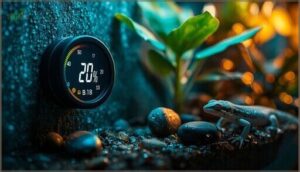
When you’re just starting out with reptiles, choosing the right humidity gauge can feel overwhelming, but understanding a few core features will make the decision much easier.
The right device doesn’t need to be complicated—it just needs to give you accurate readings, be easy to read at a glance, and fit your enclosure setup without constant adjustments. Let’s break down what actually matters when you’re comparing gauges so you can confidently monitor your reptile’s environment.
Analog Vs. Digital Hygrometers
You’ll encounter two main types when shopping for a reptile thermometer hygrometer: analog and digital.
Digital hygrometers deliver precise readings—often accurate within plus or minus 2 percent RH—using high-tech digital sensors that display exact numeric values, whereas analog models rely on mechanical components like springs and dials, offering straightforward analog reliability without batteries but requiring periodic calibration methods to maintain sensor durability and hygrometer accuracy over time.
Importance of Measurement Accuracy
A gauge that misreads by five or more percentage points can mask dehydration symptoms or respiratory risks.
You need accuracy standards within plus or minus 2 to 5 percent for reliable humidity variance tracking, so calibration methods and strategic sensor placement become your first line of defense against dysecdysis and fungal infections.
Measurement reliability determines whether your thermometer hygrometer truly safeguards health or creates false confidence in faulty humidity levels.
Display Readability and Mounting Options
Quick glance checks require digital display panels with high-contrast LCD screens, so you can spot humidity shifts without peeling away substrate or disturbing basking zones.
Mounting flexibility through suction cups, magnetic brackets, or adhesive strips lets you position your thermometer hygrometer at eye level or against glass, ensuring screen visibility from multiple angles while terrarium meters track microclimates and readability features prevent fogged panels that obscure critical gauge placement data.
Dual Sensors and Data Logging
Two sensors let you capture ambient humidity and substrate humidity separately, so your dual sensor setup can track terrarium microclimates with time-aligned readings that support microclimate monitoring across basking and hiding zones.
Logging features store timestamped values at intervals you define, enabling data analysis through CSV exports or real-time graphs that reveal seasonal shifts and guide reptile terrarium management decisions when sensor calibration keeps both probes synchronized.
How to Use a Humidity Gauge in Terrariums
Placing your humidity gauge correctly determines whether you’ll get accurate readings that actually protect your reptile’s health. You’ll need to understand where moisture accumulates in the terrarium, how to track different zones within the enclosure, and what monitoring schedule prevents health complications before they start.
The following guidance covers proper sensor positioning, microclimate assessment strategies, and routine checking protocols that beginners can implement immediately to maintain species-appropriate humidity levels.
Optimal Placement Within The Enclosure

You’ll get the most accurate humidity levels by positioning your gauge in the enclosure’s central vertical zone where air flow naturally mixes, roughly four to six inches above the substrate.
Mount it at eye level for easy daily checks, avoiding direct contact with heat sources or water splashes that skew readings. This sensor placement ensures your humidity gauge reflects the true conditions your reptile experiences throughout its habitat.
Monitoring Multiple Microclimates
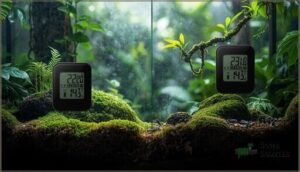
Most terrariums harbor humidity gradients that shift by 10 to 25 percent between substrate and canopy, so you’ll need at least two hygrometer sensors to capture real microclimates your reptile actually inhabits.
Position one near the ground and another mid-height, avoiding direct water splashes, to assess zone calibration and guarantee terrarium monitors reflect true conditions rather than isolated pockets of moisture.
Tips for Regular Humidity Checks
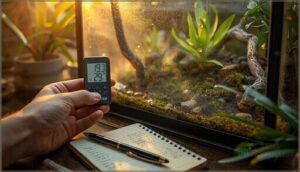
Humidity tracking works best when you check at the same time each day—morning readings paired with evening data reveal the day-night fluctuations that matter for hydration and shedding cycles.
During seasonal adjustments, especially when heating kicks in, increase your daily checks and log readings weekly so you’ll catch gradual drift before respiratory stress or dehydration appear.
Top 9 Reptile Humidity Gauges for Beginners
You’ll find that choosing the right humidity gauge doesn’t have to be overwhelming, especially when you understand what features matter most for your reptile’s health.
The following nine devices represent reliable options that combine measurement accuracy with easy-to-use designs, making them particularly suitable for those new to reptile keeping. Each gauge has been selected based on its ability to provide consistent readings, ease of installation, and value for beginners building their first monitoring setup.
1. Repti Zoo Reptile Thermometer Hygrometer Gauge
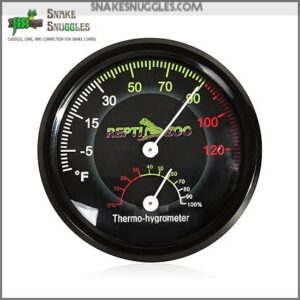
You’ll appreciate the Repti Zoo Reptile Thermometer Hygrometer Gauge (RHT01) for its straightforward dual monitoring in a single 3.14-inch unit, which eliminates the need for separate instruments. This adhesive-backed device displays temperature and humidity through color-coded segments that you can read from across the room, requiring no batteries while maintaining accuracy within typical ranges of ±1–2°F and ±5% RH.
Its compact plastic construction mounts easily on glass or exterior panels, though some keepers report variability in precision compared to digital alternatives or thermal guns.
| Best For | Reptile owners who want a simple, battery-free way to monitor both temperature and humidity at a glance without investing in pricier digital equipment. |
|---|---|
| Display Type | Analog |
| Temperature Accuracy | Not specified |
| Humidity Accuracy | Not specified |
| Power Source | None required |
| Mounting Method | Adhesive pad |
| Weight | 1.44 oz |
| Additional Features |
|
- No batteries needed, so you never have to worry about it dying or replacing power sources
- Color-coded display makes it easy to check conditions quickly from across the room
- Sticky backing lets you mount it inside or outside the enclosure without tools or hardware
- Accuracy can be inconsistent compared to digital thermometers or infrared guns
- Doesn’t include repositionable velcro, so moving it around can be tricky
- May not be precise enough for reptiles that need tightly controlled humidity levels
2. Jedew Digital Hygrometer Thermometer
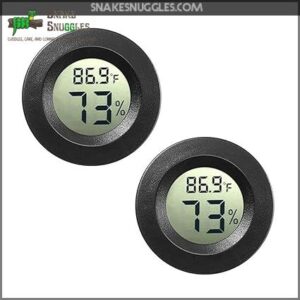
You won’t struggle to read the Jedew Digital Hygrometer Thermometer’s clear LCD display, which updates every ten seconds across a temperature span of 0 to 70°C and humidity range of 10 to 99% RH. Weighing just over an ounce and measuring 1.78 inches wide, this compact unit mounts via adhesive or sits freestanding while operating on a single LR44 button cell.
Accuracy holds within ±1°F for temperature and ±3% RH for humidity, making it a practical choice for your first terrarium monitoring setup.
| Best For | Anyone needing a simple, affordable hygrometer for basic indoor monitoring in homes, offices, greenhouses, or small terrariums where precise humidity tracking isn’t critical. |
|---|---|
| Display Type | Digital LCD |
| Temperature Accuracy | ±1°F |
| Humidity Accuracy | ±3%RH |
| Power Source | LR44 battery |
| Mounting Method | Adhesive |
| Weight | 1.06 oz |
| Additional Features |
|
- Quick 10-second updates give you near real-time readings without waiting around
- Compact 1.78-inch design fits practically anywhere, from desktops to reptile tanks
- Comes with extra batteries included, so you’re covered when the first one dies
- No backlight means you’ll need decent lighting to read the display
- Won’t measure humidity below 10%, limiting its usefulness for dryboxes or ultra-dry environments
- Mounting adhesive tends to be weak and may not hold long-term
3. Paizoo Reptile Thermometer Hygrometer
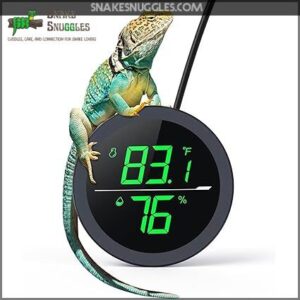
You’ll appreciate that the Paizoo Reptile Thermometer Hygrometer runs on USB power rather than batteries, delivering continuous monitoring through a 140-centimeter cable that keeps the display accessible while sensors track your terrarium’s internal conditions.
Its 3-inch backlit LED screen switches between Celsius and Fahrenheit, updating real-time humidity percentages for quick glances through glass. The dual-sensor system measures both parameters simultaneously, though some keepers report inconsistent humidity accuracy, so you should cross-check readings against a calibrated reference hygrometer during initial setup.
| Best For | Reptile owners who want continuous temperature and humidity monitoring without dealing with battery replacements and have a USB outlet near their terrarium. |
|---|---|
| Display Type | Digital LED |
| Temperature Accuracy | ±1°F |
| Humidity Accuracy | ±5% |
| Power Source | USB |
| Mounting Method | 3M tape |
| Weight | 2.36 oz |
| Additional Features |
|
- USB-powered design eliminates the need for battery changes and provides reliable continuous monitoring
- Backlit LED display with switchable temperature units makes it easy to check conditions day or night
- Long 140cm cable allows flexible placement of the display outside the tank while sensors stay inside
- Humidity readings can be inconsistent and may require verification against a calibrated reference hygrometer
- Requires access to a USB power outlet, which limits placement options
- Adhesive mounting may fail over time in high-humidity reptile environments
4. Reptile Thermometer Humidity Gauge
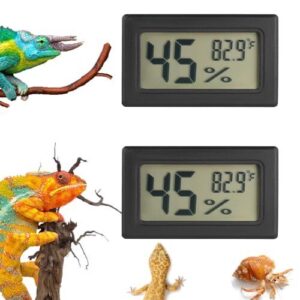
If you’re looking for a compact option, the Serundo Auto HT01 delivers high-precision readings with ±1℉ temperature accuracy and ±5% humidity accuracy within a 10-second response time.
You can mount two units using the included double-sided tape to track different microclimates in bearded dragon or leopard gecko setups. The clear LCD display makes monitoring straightforward, though you’ll want to remove the gauge before misting sessions to maintain accuracy and extend the four-month battery life included with each spare set.
| Best For | Reptile owners who need an affordable, dual-unit monitoring solution for tracking temperature and humidity across different zones in terrariums or enclosures. |
|---|---|
| Display Type | Digital LCD |
| Temperature Accuracy | ±1℉ |
| Humidity Accuracy | ±5% |
| Power Source | Battery |
| Mounting Method | Double-sided tape |
| Weight | 1.44 oz |
| Additional Features |
|
- Fast 10-second response time with solid accuracy (±1℉ for temperature, ±5% for humidity)
- Includes two units so you can monitor multiple spots or enclosures at once
- Easy setup with double-sided tape and comes with spare batteries for extended use
- Needs to be removed before misting to maintain accuracy and avoid damage
- LCD display can be hard to read for some users, especially in certain lighting
- May lag behind during rapid temperature changes and accuracy can be inconsistent according to some reviews
5. QZQ Reptile Thermometer Hygrometer
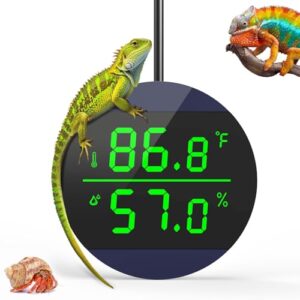
The QZQ USB-powered unit provides a 32°F-140°F temperature range and 5-99% humidity measurement on its LED display, though you should be aware that some users have reported humidity accuracy concerns that fall outside the advertised ±5% tolerance.
You’ll need to purchase a separate power adapter since the 59-inch cable doesn’t include a wall plug, and the included clips may require reinforcement in larger terrariums. The double-sided tape mounting works well for glass enclosures housing bearded dragons, crested geckos, and similar species when positioned away from direct basking zones.
| Best For | Reptile owners who need an affordable, always-on monitoring solution for mid-to-large terrariums and don’t mind dealing with a power cord. |
|---|---|
| Display Type | Digital LED |
| Temperature Accuracy | Not specified |
| Humidity Accuracy | Not specified |
| Power Source | USB |
| Mounting Method | Double-sided tape |
| Weight | 2.89 oz |
| Additional Features |
|
- Wide temperature range (32°F-140°F) and humidity range (5-99%) covers most reptile species’ needs
- Clear LED display makes it easy to check conditions at a glance, even from across the room
- Includes double-sided tape and a long 59-inch cable for flexible placement in various enclosure setups
- Humidity readings can be unreliable, with several users reporting accuracy issues beyond the advertised tolerance
- Requires a separate wall adapter purchase since only the USB cable is included
- Mounting clips feel flimsy and may need reinforcement for secure attachment in larger tanks
6. Fluker’s Digital Thermometer Hygrometer
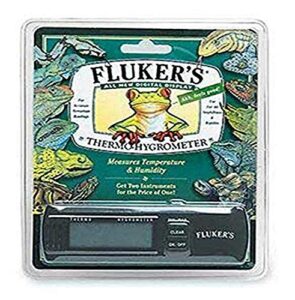
Fluker’s battery-powered unit tracks temperature from 32°F to 122°F and humidity from 10% to 99% using a CR2032 battery, though you should know that some keepers report hygrometer drift that requires periodic recalibration or battery replacement to maintain the advertised precision.
The adhesive backing allows quick mounting on terrarium glass, but reptiles may occasionally contact the sticky surface if you position it within reach. The MAX MIN memory function helps you identify environmental fluctuations between routine checks, making it suitable for basic monitoring in bearded dragon, ball python, and corn snake setups.
| Best For | Reptile and amphibian owners who need an affordable, basic monitoring tool to track temperature and humidity in terrariums, especially for common pets like bearded dragons, ball pythons, and corn snakes. |
|---|---|
| Display Type | Digital LED |
| Temperature Accuracy | 0.9°F |
| Humidity Accuracy | Not specified |
| Power Source | Battery |
| Mounting Method | Double-sided adhesive |
| Weight | 1.44 oz |
| Additional Features |
|
- Wide measurement range (32°F to 122°F and 10% to 99% humidity) covers most reptile habitat requirements
- MAX MIN memory function lets you catch temperature and humidity swings even when you’re not watching
- Easy adhesive mounting sticks directly to glass without tools or complicated installation
- Hygrometer accuracy can drift over time and may need frequent recalibration or battery swaps
- Adhesive backing might not hold firmly in all enclosures and could pose a sticky hazard if pets reach it
- Some users report the device stops working sooner than expected, potentially requiring replacement
7. Zoo Med Dual Thermometer Humidity Gauge
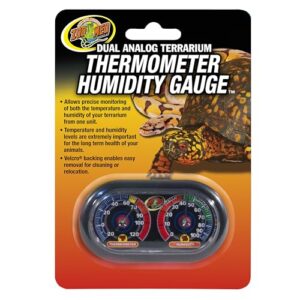
Zoo Med’s analog gauge combines German movement precision with Velcro-backed convenience, letting you monitor temperature from 20°F to 120°F and humidity from 0% to 100% without batteries or calibration hassles. The dual-dial design delivers immediate readings for bearded dragon and ball python enclosures, though you should position it away from direct heat sources to prevent skewed temperature data.
Mechanical indicators eliminate digital drift, but some keepers note analog scales require closer inspection than backlit displays, making it better suited for keepers who prefer simplicity over high-precision monitoring.
| Best For | Reptile and exotic pet owners who want a reliable, battery-free monitoring solution for their terrariums and prefer analog displays over digital readouts. |
|---|---|
| Display Type | Digital LCD |
| Temperature Accuracy | Not specified |
| Humidity Accuracy | Not specified |
| Power Source | Battery |
| Mounting Method | Not specified |
| Weight | 1.44 oz |
| Additional Features |
|
- No batteries or calibration needed—just mount and read with German-engineered mechanical movement
- Velcro backing makes repositioning and cleaning simple without permanent adhesive damage
- Covers wide temperature range (20°F to 120°F) suitable for various reptile species from ball pythons to bearded dragons
- Temperature readings can be off by a few degrees, requiring occasional cross-checking with other thermometers
- Humidity accuracy provides general estimates rather than precise measurements for humidity-sensitive species
- Analog dials require closer visual inspection compared to backlit digital displays, especially in low-light conditions
8. Repti Zoo Digital Thermometer Hygrometer
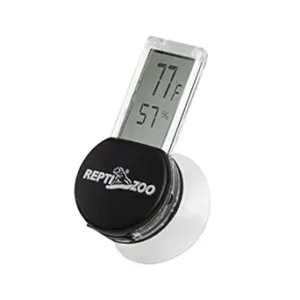
You’ll appreciate Repti Zoo’s SH125B model for its clear LCD display and flexible four-sided mounting system, which lets you position the gauge on any terrarium face using a simple suction cup.
Measuring temperature from -4°F to 176°F (±0.5°C accuracy) and humidity from 10% to 95% RH (±5% RH accuracy), this battery-powered unit updates readings every few seconds, making it suitable for monitoring both arid species and tropical rainforest inhabitants.
However, keep the probe away from direct water spray, since moisture exposure can compromise internal electronics and halt functionality.
| Best For | Reptile owners who need an affordable, easy-to-read gauge for tracking temperature and humidity in terrariums, vivariums, or brooders. |
|---|---|
| Display Type | Analog |
| Temperature Accuracy | Not specified |
| Humidity Accuracy | Not specified |
| Power Source | None required |
| Mounting Method | Velcro |
| Weight | 9.07 g |
| Additional Features |
|
- Clear LCD display that’s easy to read and monitor at a glance
- Flexible mounting options with suction cup that works on any terrarium side
- Accurate readings with updates every few seconds, plus includes backup battery
- Not waterproof—can stop working if exposed to direct water or heavy moisture
- Suction cup installation can be tricky, especially for angled viewing
- Battery life inconsistent, with some units dying after just a few months
9. ThermoPro Digital Hygrometer Thermometer
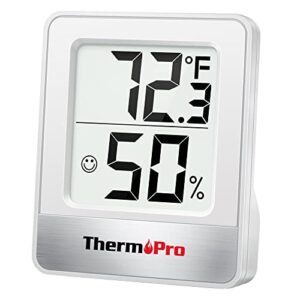
ThermoPro’s TP49 model stands out with its face icon comfort indicator, which visually signals dry, comfortable, or wet conditions at a glance, making interpretation easier for new keepers.
Measuring temperature from 14°F to 122°F (±1°F accuracy) and humidity from 10% to 99% RH (±2% to 3% RH accuracy), this compact white unit refreshes every ten seconds and offers tabletop, magnetic, or hanging placement options.
At $8.99, it lacks a backlight for dark-room viewing, but its large digits and quick response time make it practical for basic terrarium monitoring.
| Best For | Reptile keepers who want an affordable, easy-to-read hygrometer with a visual comfort indicator for quick terrarium checks. |
|---|---|
| Display Type | Digital LCD |
| Temperature Accuracy | Not specified |
| Humidity Accuracy | Not specified |
| Power Source | Battery |
| Mounting Method | Suction cup |
| Weight | Not specified |
| Additional Features |
|
- Face icon comfort indicator makes it simple to assess humidity levels at a glance without interpreting numbers
- Fast 10-second refresh rate and high accuracy (±1°F, ±2-3% RH) provide reliable real-time monitoring
- Multiple mounting options (tabletop, magnetic, hanging) and compact size fit various terrarium setups
- No backlight makes it hard to read in dim or dark environments
- Small, lightweight design may feel flimsy or get lost easily
- Battery life isn’t specified, so you might need replacements more often than expected
Common Mistakes With Reptile Humidity Monitoring
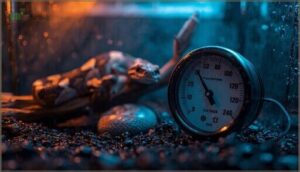
Even experienced keepers make errors that compromise their reptiles’ respiratory health, shed cycles, and overall physiological function.
These missteps often stem from well-intentioned but misguided approaches to monitoring enclosure conditions. Understanding the most common pitfalls will help you avoid preventable health complications in your collection.
Misplacing The Gauge in The Enclosure
Even a perfectly calibrated humidity gauge can mislead you if it sits in the wrong spot. When you mount your sensor near heat sources or water dishes, local humidity variance can skew readings by up to 20 percent, making it impossible to track true enclosure microclimates.
For the most accurate picture of reptile humidity, place your gauge at mid-height in a well-ventilated zone where misting systems won’t saturate the sensor.
Relying on Inaccurate or Outdated Devices
Low-cost hygrometers often drift by five to fifteen percentage points within weeks without device calibration, forcing you to make decisions on faulty data that jeopardize reptile health.
Outdated tech using single-point sensors misses critical microclimate variation, while sensor drift accelerates in high-humidity environments—sometimes reaching double-digit errors over months.
Regular calibration against a trusted external hygrometer helps you catch measurement accuracy problems before humidity errors compromise your animal’s well-being.
Ignoring Seasonal and Environmental Changes
Humidity calibration must account for seasonal humidity shifts as HVAC cycles and outdoor weather patterns alter your terrarium’s baseline readings by ten to twenty percentage points across months.
Environmental factors demand adjustment: during dry winters you’ll need more frequent misting, while humid summers require increased ventilation to prevent microclimate management failures that stress reptiles and trigger shedding problems.
Key seasonal considerations for maintaining reptile habitat humidity:
- Adjust misting schedules when room humidity changes with heating or cooling systems
- Monitor substrate moisture loss during dry months to prevent dehydration
- Recalibrate gauges quarterly as temperature swings affect sensor accuracy
Frequently Asked Questions (FAQs)
What is the best hygrometer for reptiles?
Your best choice depends on your reptile’s needs, but digital models like the Repti Zoo Thermometer Hygrometer Gauge offer reliable sensor technology, hygrometer accuracy within ±3%, and clear displays essential for effective humidity management.
Are cheap digital hygrometers accurate?
Most budget digital hygrometers offer acceptable accuracy within plus or minus three to five percent relative humidity for reptile enclosures, though sensor calibration drift over months and humidity fluctuations demand regular accuracy tests against known standards.
How to measure humidity in a reptile enclosure?
Studies show that ambient conditions are reflected more accurately by gauges placed mid-height than by substrate-level readings.
You’ll measure humidity levels using digital hygrometers positioned away from direct heat, ensuring precise microclimate control throughout your reptile enclosures.
How often should I calibrate my humidity gauge?
You should calibrate your humidity gauge at least once a year for standard use, increasing to every three to six months in variable climates or when monitoring critical hatchling enclosures.
Can I use household hygrometers for reptile enclosures?
You can use household hygrometers to track general reptile humidity, but they often miss microclimates inside terrariums and may require regular calibration to maintain the ±3–5% accuracy needed for proper enclosure monitoring.
What humidity level is best for shedding reptiles?
Most shedding reptiles need 60 to 80 percent humidity, though desert species shed best around 30 to 50 percent.
Tropical snakes often require higher levels, while bearded dragons benefit from localized humidity gradients during shedding cycles.
Do humidity gauges need battery replacement or maintenance?
Yes, digital hygrometers need battery replacement every 6–24 months, and sensor calibration after each change ensures device accuracy.
Regular maintenance schedules prevent humidity gauge drift, preserving reptile health monitoring without high replacement costs.
How do I increase humidity without a misting system?
You don’t need expensive equipment to boost humidity levels—simple evaporation techniques like water bowl placement near warmth, humid hide creation with damp substrate, and live plant benefits all raise moisture naturally while supporting reptile hydration.
Conclusion
The theory that humidity is secondary to temperature collapses when you’re treating your third respiratory infection in six months.
Accurate reptile humidity gauges for beginners eliminate the costly cycle of reactive veterinary visits by detecting problems while they’re still reversible.
Your hygrometer isn’t optional equipment—it’s the diagnostic tool standing between routine husbandry and emergency interventions.
Precision measurement transforms guesswork into prevention, keeping your reptile’s mucosal defenses intact and respiratory passages clear.