This site is supported by our readers. We may earn a commission, at no cost to you, if you purchase through links.
hides, heating, and substrate—then grab whatever ceramic dish sits nearest on the pet store shelf.
That small decision matters more than it seems.
A poorly chosen water dish can leach contaminants, tip over and soak your substrate, grow biofilm within 48 hours, or leave a full-grown corn snake unable to soak comfortably before a shed.
The right reptile water dishes for corn snake habitats balance food-safe materials, the correct depth-to-footprint ratio, and a stable base that survives an active snake’s rearranging instincts.
The five options ahead cover every setup, from a hatchling’s first enclosure to a six-foot adult’s permanent home.
Table Of Contents
- Key Takeaways
- Key Features of Corn Snake Water Dishes
- Proper Placement in Corn Snake Habitats
- Maintenance and Hygiene Best Practices
- Top 5 Reptile Water Dishes for Corn Snakes
- Frequently Asked Questions (FAQs)
- What is the best water bowl for corn snakes?
- Do corn snakes need a water dish?
- Why do people put pennies in reptile water dishes?
- What to put in a corn snake habitat?
- Can corn snakes drink from a drip system?
- How often should water dishes be replaced?
- Do corn snakes soak in their water dish?
- What water temperature is safe for corn snakes?
- Can tap water harm a corn snakes health?
- Conclusion
Key Takeaways
- A non-porous, food-safe material like high-fired ceramic or food-grade resin is the single most important feature in a corn snake water dish, since porous surfaces allow biofilm to take hold within 48 hours.
- Dish placement on the cool side (75–82°F) slows evaporation, limits bacterial growth, and keeps humidity predictable — putting it near heat actively works against all three.
- Daily water changes and weekly disinfection (bleach, chlorhexidine, or F10SC) aren’t optional extras — they’re the minimum routine that keeps a water dish from becoming a health hazard.
- Tap water treated with a reptile-safe conditioner is the safest choice for corn snakes, since untreated chlorine, chloramine, and heavy metals accumulate in their system over time.
Key Features of Corn Snake Water Dishes
Choosing a water dish for your corn snake is less about looks and more about a few key features that keep your snake safe, hydrated, and stress-free.
Ceramic dishes, for example, are a popular pick—their non-porous surface keeps water cleaner longer, which you can read more about when choosing the right corn snake water dish size.
Material, size, stability, and hygiene all play a big role in how well a bowl works in real daily use.
Let’s walk through the specific dish options that meet those needs.
Material and Durability Requirements
Not every bowl on the market deserves a place in your corn snake’s enclosure. The material it’s made from determines how long it lasts — and how safe it stays.
Look for these five material qualities:
- Food-Safe Glazes — ceramic bowls won’t leach lead or heavy metals
- Impact-Resistant Resin — endures drops without cracking
- Corrosion-Proof Stainless — 304-grade steel survives repeated disinfection
- Nonporous surfaces — resist biofilm and stay easy cleaning-friendly
- Thermal Shock Resistance — durable through daily temperature swings
Stable, well-built dishes with smart weight distribution design simply outlast cheap alternatives. Its non‑porous resin design helps limit bacterial buildup.
Size and Depth Considerations
Once materials are sorted, you need the right bowl size, water depth, and Footprint Ratio for your enclosure size and snake.
For hatchlings, a small water dish with Growth Scaling over time keeps reptile water dishes from swallowing the floor plan and moderates Humidity Impact.
Mark a safe Depth Mark Line and Safety Margin for soaking versus sipping when possible.
proper humidity control is essential for maintaining healthy reptile environments.
Stability and Spill Prevention
Once size and depth are set, you need stability so Reptile Water Bowls work and do not flood the enclosure.
A Weighted Base Design with Material Density Benefits, like heavy resin, keeps corn snakes from flipping the dishes.
Pair that with Corner Bracing Techniques, slate for Substrate Platform Stability, Rim Guard Innovations, and you gain Durable, low-spill setups supporting material choice and cleanability.
Non-Porous Surfaces for Hygiene
Once your bowl stays put, you want a surface that stays clean instead of growing slime. In your Reptile Water Dish Selection, prioritize material choice and cleanability that limit biofilm.
Look for:
- Glazed Ceramic Benefits with high-fired, smooth finishes for low Surface Smoothness Impact.
- Stainless Steel Sanitizing that tolerates boiling water.
- Glass Transparency Checks and Resin Chemical Safety from Resin.
Aesthetic and Naturalistic Designs
In your Reptile Water Dish Selection, appearance matters for both you and your snake.
Pairing a dish that complements your enclosure’s aesthetic gets easier when you follow a reptile enclosure maintenance and cleaning routine that keeps everything looking its best.
Rock-inspired textures, Earth-tone finishes, and Matte low-gloss surfaces help a Rock Water Bowl disappear into your Terrarium Design, supporting Naturalistic Design and Integrated habitat blending.
Look for Eco-friendly Products with smooth interiors and Subtle embossing details so the dish looks wild but still cleans quickly afterward.
Proper Placement in Corn Snake Habitats
Now that you know what makes a good water dish, the next question is where it should actually sit in the tank.
Placement affects your corn snake’s humidity, shedding, and safety more than most people realize.
Let’s walk through the key placement rules so you can match the right bowl position to your specific enclosure setup.
Cool Side Vs. Warm Side Placement

Think of placement as plumbing for your habitat’s climate: on the cool side (75–82°F), reptile water dishes offer better temperature stability, slower evaporation rate, and reduced bacterial growth, protecting water quality and simplifying enclosure maintenance.
Warm side temperature near 88–90°F rushes evaporation, undermines spill prevention, and forces extra refills, while also complicating consistent snake access for your corn snake routine.
Impact on Humidity and Shedding
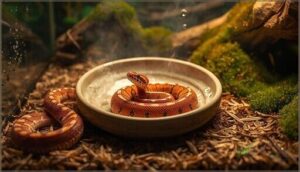
Where you place your water dish quietly shapes your corn snake’s entire shed cycle. Surface area effects and water temperature influence how much humidity climbs — a wide dish near mid‑enclosure creates meaningful microclimate creation, pushing levels toward 60–70% during shed.
- Soaking benefits: A dish large enough for full coiling loosens stubborn eye caps and tail‑tip shed.
- Substrate moisture interaction: Minor spills release humidity gradually — helpful during shed, risky if left saturated.
- Enclosure maintenance: Monitor condensation near the dish; it signals localized humidity rather than even distribution.
Safety From Tipping and Escape Risks
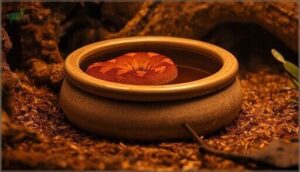
Corn snakes are surprisingly strong for their size — they’ll bulldoze a lightweight dish without hesitation.
Weighted Base Design and Corner Placement Security dramatically cut spill risk; corner-braced bowls face only two push directions instead of four.
Platform Underlay Support adds friction on loose substrates.
Look for Safety Step Features and Shallow Rim Depths to prevent drowning, keeping your stable, durable Water Bowl safe inside the enclosure.
Integration With Terrarium Décor
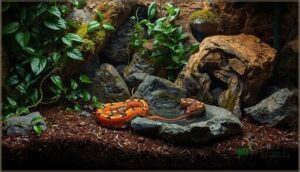
A well-placed Water Bowl pulls the whole Terrarium together.
Rock Finish Harmony works because resin dishes mimic natural stone, blending into desert or tropical setups without visual jarring.
Try Substrate Embedding — partially burying the bowl’s lower edge into coconut fiber — for a grounded, naturalistic look.
Plant Pairing near Pothos adds depth, while Hide Proximity placement 2–4 inches from cool side shelters ties Habitat Decoration and Reptile Care together seamlessly for your Corn Snake.
Maintenance and Hygiene Best Practices
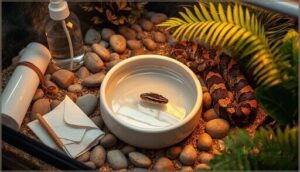
Choosing the right water dish is only half the job; keeping it clean and safe is what actually protects your corn snake. A simple, consistent routine stops bacteria, mold, and waste from turning the bowl into a health risk.
In this next section, you’ll see the key maintenance steps to build into your regular care schedule.
Daily Water Changes and Cleanliness
Daily water changes aren’t optional — they’re the foundation of clean drinking water for your corn snake. Change the water every one to two days at minimum, and immediately if contamination signs appear, like cloudy water, slime, or foul odor.
Daily water changes are non-negotiable: they are the foundation of your corn snake’s health
Use a dedicated scrub brush, rinse thoroughly, and refill with room-temperature, dechlorinated tap water to maintain proper mineral balance.
Weekly Disinfection Methods
Once a week, step beyond the basics. bleach soak — one part bleach to ten parts water for five minutes — kills lingering pathogens that daily wipes miss.
Prefer something gentler? chlorhexidine spray or vinegar rinse works well too.
F10SC application on ceramic or resin dishes needs no rinsing once dry.
Always finish with thorough air drying before refilling.
Preventing Biofilm and Bacterial Growth
Disinfection addresses the big threats, but biofilm — that slippery bacterial film — builds back fast if your Water Change Frequency slips. Swap water every 24 hours, rinse thoroughly, and scrub with a stiff brush using Mechanical Scrubbing Techniques. Surface Texture Selection matters too: smooth dishes resist grip points.
- Use Cleaning Agent Safety-approved, unscented soap
- Practice Bowl Depth Optimization — shallower means less stagnant water
- Choose non-porous materials to protect reptile hydration and snake health
Dish Inspection and Replacement Frequency
Even the cleanest routine won’t save a cracked or etched bowl.
Build a simple Inspection Schedule: run your fingertips around the rim daily during water changes — that’s your Visual Damage Checks right there.
Watch for Water Clarity Indicators like cloudiness or slime between changes.
Material Aging Signs — flaking resin, glaze loss, staining that won’t scrub out — signal Replacement Timing.
Budget a swap every 6–12 months.
Top 5 Reptile Water Dishes for Corn Snakes
Now that you know what makes a safe, practical water dish, it helps to see some concrete options that work well for corn snakes.
The dishes below all meet the basic standards for stability, hygiene, and ease of use, with different shapes and sizes to match your setup. Scan through them and choose the one that best fits your snake and enclosure.
1. Exo Terra Large Reptile Water Dish
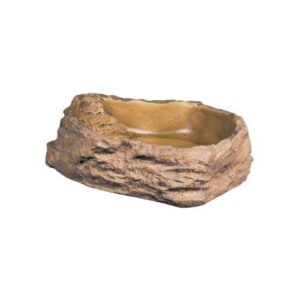
The Exo Terra Large Reptile Water Dish is a solid workhorse for most corn snake setups. At roughly 22 cm long and 5 cm tall, it gives an adult corn snake room to soak without flooding the enclosure floor.
The food-grade resin is non-porous, so bacteria can’t burrow in between cleanings. Built-in safety steps help smaller or juvenile snakes climb out easily.
Weighing close to 1 kg empty, it stays put even when your snake decides to redecorate.
| Best For | Corn snake owners and reptile keepers who want a durable, easy-to-clean water dish that looks natural and stays put in the enclosure. |
|---|---|
| Material | Plastic/Resin |
| Surface Finish | Smooth non-porous |
| Easy Cleaning | Yes |
| Natural Aesthetic | Multi-color natural look |
| Stability | Tip-resistant |
| Pet Suitability | Reptiles and amphibians |
| Additional Features |
|
- Non-porous food-grade resin means bacteria has nowhere to hide between cleanings
- Built-in safety steps make it easy for juvenile or smaller snakes to climb out safely
- Weighs about 1 kg, so it won’t tip or shift when your snake moves it around
- Reported dimension inaccuracies mean it might not be the size you’re expecting
- Could be too big for very small reptiles or too cramped for larger species
- Plastic construction may not hold up as long as ceramic or stone alternatives
2. Exo Terra Extra Large Reptile Water Dish
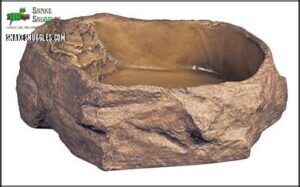
If your corn snake is pushing adult size, step up to the Extra Large.
At 9.7 × 10 × 2.5 inches and 16 ounces of capacity, it gives a full-grown snake room to coil and soak without you constantly refilling it.
The food-grade resin stays chemically inert, so water won’t pick up any off-putting taste or smell.
Safety steps on the inner wall let smaller reptiles climb out safely.
Stable, naturalistic, and genuinely low-maintenance — it fits right into any 75–120 cm terrarium setup.
| Best For | Owners of large reptiles, amphibians, or full-grown corn snakes who need a spacious, easy-to-clean water dish that looks natural in any terrarium setup. |
|---|---|
| Material | Stone-like Resin |
| Surface Finish | Smooth non-porous |
| Easy Cleaning | Yes |
| Natural Aesthetic | Rock-like exterior |
| Stability | Tip-resistant |
| Pet Suitability | Large reptiles and amphibians |
| Additional Features |
|
- Food-grade resin keeps water tasting and smelling clean, no weird chemicals leaching in
- Built-in safety steps mean smaller critters won’t get trapped and drown
- Rock-like exterior blends right into desert or tropical setups without looking out of place
- Pricier than a lot of similar dishes on the market
- The listed dimensions might not be totally accurate, so double-check before buying
- Too big for smaller enclosures — not a great fit if your tank is on the compact side
3. REPTIZOO Reptile Terrarium Water Food Bowl
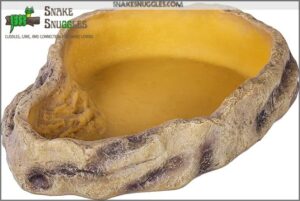
solid mid-list pick
Measuring 11 × 8 × 2.4 inches, it gives your corn snake genuine soaking room without dominating the enclosure floor.
The resin is non‑porous and smooth inside, so bacterial biofilm doesn’t get a foothold — wipe it down daily, run it through a weekly scrub, done.
At 1.52 kg, it won’t shift when your snake climbs the rim. One heads‑up: rinse it thoroughly before first use to clear any initial resin odor.
| Best For | reptile keepers who want a sturdy, natural-looking water dish that gives snakes and other small reptiles real soaking space without taking over the enclosure. |
|---|---|
| Material | Resin |
| Surface Finish | Smooth surface |
| Easy Cleaning | Yes |
| Natural Aesthetic | Soil-like brown |
| Stability | Stable base |
| Pet Suitability | Reptiles and amphibians |
| Additional Features |
|
- Smooth, non-porous resin surface is easy to clean and helps reduce bacteria buildup.
- Natural brown, soil-like color and rock shape blend nicely into bioactive or display enclosures.
- Heavy 1.52 kg build stays put when snakes or lizards climb on the rim.
- Only comes in one color (brown), so it may not match every tank aesthetic.
- Some units may have a chemical or resin smell at first and need several thorough rinses.
- No other sizes or shapes in this model, so it may be too big or too small for some setups.
4. RunXF Large Simulation Rock Reptile Bowl
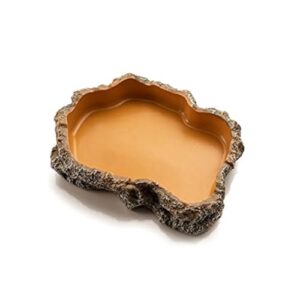
The RunXF Large Simulation Rock Reptile Bowl earns its spot here for one simple reason: it looks like it belongs in your enclosure. The 9 x 6.7 x 2-inch footprint gives an adult corn snake real soaking room, and the smooth interior won’t snag scales.
At roughly 380 grams with a wide base, it stays put when your snake investigates the rim. The resin is non-porous and easy to scrub clean. Rinse it before first use — a little dust from packaging is normal.
| Best For | Reptile owners with medium to large pets like bearded dragons, iguanas, or adult snakes who want a feeding or soaking dish that actually looks good in the tank. |
|---|---|
| Material | Resin |
| Surface Finish | Smooth interior |
| Easy Cleaning | Yes |
| Natural Aesthetic | Simulated rock texture |
| Stability | High density base |
| Pet Suitability | Large and medium reptiles |
| Additional Features |
|
- Big enough for most medium and large reptiles at 9 x 6.7 inches, so your pet has real room to move around
- Smooth interior keeps scales safe during feeding and baths, and the resin cleans up easily
- Heavy enough (380g) with a stable base that it won’t tip when your reptile climbs on the edge
- There’s a color mismatch in the listing — described as brown in one place, yellow in another, so what you see might not be what you get
- No real data on long-term durability, so it’s hard to know how it holds up over time
- Needs a freshwater rinse before first use to clear off packaging dust
5. Penn Plax Reptile Fossil Rock Dish
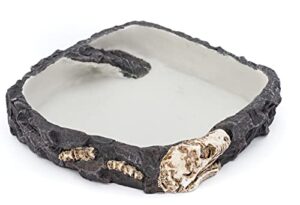
The Penn Plax Fossil Rock Dish brings a prehistoric vibe to your setup without sacrificing function. At 7 x 7 x 1.5 inches, it’s sized well for juvenile and adult corn snakes needing a reliable water source.
The resin construction is non-toxic, crack-resistant, and passes pet safety standards — that matters more than aesthetics.
Rinse it thoroughly before first use.
The shallow 1.5-inch depth works fine for daily hydration, though snakes that love a good long soak may prefer something deeper.
Priced at $21.99, it’s solid value.
| Best For | Reptile owners who want a feeding or water dish that actually looks good in a natural terrarium setup — especially great for bearded dragons, geckos, and corn snakes. |
|---|---|
| Material | Resin |
| Surface Finish | Smooth interior |
| Easy Cleaning | Yes |
| Natural Aesthetic | Rock and fossil texture |
| Stability | Non-tippable |
| Pet Suitability | Reptiles and amphibians |
| Additional Features |
|
- Looks like a real rock — blends right into a natural terrarium without looking out of place
- Made from non-toxic, durable resin that’s built to last and easy to wipe down
- Stable enough that it won’t tip over when your pet climbs on or drinks from it
- At only 1.5 inches deep, it’s not ideal for reptiles that love a long, deep soak
- Needs thorough cleaning to keep residue from building up over time
- The 7×7 inch footprint might feel a bit large for smaller enclosures
Frequently Asked Questions (FAQs)
What is the best water bowl for corn snakes?
To keep your snake drinking confidently, prioritize a heavy, non‑porous bowl—Exo Terra Large is a strong pick, with smooth interior, wide base, and 21‑centimeter length that lets adult corn snakes soak fully when kept properly.
Do corn snakes need a water dish?
Yes, corn snakes need a water dish.
In captivity they lack water sources, so a clean, shallow bowl provides constant drinking water, safe soaking for shedding and mite control, and helps hydration and respiratory health.
Why do people put pennies in reptile water dishes?
Some keepers drop old copper pennies into water dishes believing copper ions slow bacterial growth.
It’s a well-meaning shortcut, but veterinarians warn that dissolved copper and zinc can be toxic to snakes over time.
What to put in a corn snake habitat?
A corn snake habitat needs a hiding spot on both the warm and cool sides, a sturdy water dish, a substrate like aspen shavings, climbing branches, and proper heating with a thermostat.
Can corn snakes drink from a drip system?
Practically magic, your corn snake can drink from a drip system, drawing droplets into the mouth by suction.
Treat it as a supplemental trickle into a shallow bowl, and still offer a clean water dish.
How often should water dishes be replaced?
Replace plastic dishes every 6–12 months, resin rock bowls every 1–2 years, and glazed ceramic every 2–3 years. Stainless steel can last 3–5 years with regular inspection.
Do corn snakes soak in their water dish?
Yes, corn snakes do soak occasionally — usually before a shed or when something’s off in their environment. Healthy adults usually do it only a few times a month, not daily.
What water temperature is safe for corn snakes?
single degree too cold, your corn snake might refuse to drink entirely.
Keep water between 77°F and 82°F (25°C–28°C) — sweet spot matches their natural cool-zone gradient perfectly.
Can tap water harm a corn snakes health?
Tap water can harm your corn snake. Chlorine irritates the digestive tract, chloramine won’t evaporate, and heavy metals accumulate over time.
Use a reptile-safe conditioner or filtered water to stay safe.
Conclusion
The devil is in the details—and for corn snakes, that detail is often sitting in the corner of the enclosure holding fresh water. Choosing the right reptile water dishes for corn snake habitats isn’t glamorous husbandry work, but it’s foundational.
A stable, non-porous, correctly sized dish protects your snake from bacterial exposure, facilitates clean sheds, and keeps humidity predictable. Get this small decision right, and your setup runs smoother than you’d expect.