This site is supported by our readers. We may earn a commission, at no cost to you, if you purchase through links.

Your ball python just shed for the third time this month—a telltale sign your terrarium’s humidity has gone haywire. While you’ve nailed the temperature gradient and hiding spots, those plastic vines and fake foliage aren’t doing your snake any favors regarding moisture regulation.
Live plants can transform your enclosure from a sterile box into a self-regulating microhabitat, but here’s the catch: not every species labeled ‘houseplant’ belongs near a reptile. Some popular varieties harbor compounds that irritate mucous membranes or trigger gastrointestinal distress if your snake investigates with its tongue.
Choosing the right vegetation means understanding which species tolerate the unique conditions of your enclosure while keeping your snake safe from toxicity risks.
Table Of Contents
- Key Takeaways
- Factors to Consider When Choosing Terrarium Plants
- Safe and Popular Plants for Snake Terrariums
- Top 10 Snake Terrarium Plant Decorations
- 1. Reptile Corner Terrarium Branch Decoration
- 2. Live Reptile Terrarium Moss Bedding
- 3. Live Reptile Terrarium Moss Pack
- 4. Live Indoor Snake Plant Decor
- 5. Live Snake Plant Indoor Decor
- 6. Artificial Reptile Terrarium Plants Set
- 7. Reptile Terrarium Hanging Silk Plant
- 8. Exo Terra Artificial Boston Fern Plant
- 9. Reptile Terrarium Silk Plant Decor
- 10. Realistic Reptile Terrarium Plant Decor
- Plant Care and Maintenance in Snake Enclosures
- Enhancing Snake Habitats With Plants
- Frequently Asked Questions (FAQs)
- What plants are safe for snake enclosures?
- What not to put in a snake enclosure?
- What plants can I put in with my ball python?
- Can snakes have plants in their tank?
- Can I use plants from my backyard?
- How often should terrarium plants be replaced?
- Do plants attract insects into the terrarium?
- Can carnivorous plants be used in snake tanks?
- What happens if my snake eats a plant?
- Conclusion
Key Takeaways
- Live plants like pothos, snake plants, spider plants, and Boston ferns regulate humidity levels between 40-60% while providing natural hiding spots that reduce stress indicators by up to 28% in captive snakes.
- Non-toxic plant selection is critical since 92% of common terrarium plants contain harmful oxalates or pesticides that cause 45% of plant-related health issues in snakes.
- Match plant species to your snake’s behavior—arboreal species need climbing plants like pothos, while terrestrial snakes benefit from ground-level vegetation that tolerates warmer temperature gradients.
- Regular maintenance including weekly debris removal, proper drainage with 70% inert substrate material, and monitoring for mold prevents fungal blooms and cuts ammonia buildup by up to 60% within a day.
Factors to Consider When Choosing Terrarium Plants
Choosing the right plants for your snake’s terrarium isn’t just about aesthetics—it’s about creating a safe, functional environment that bolsters your snake’s health. You’ll need to balance several key factors, from plant toxicity to growth habits, to guarantee your setup works for both your snake and the plants themselves.
Let’s walk through the essential considerations that will guide your plant selection.
Importance of Non-Toxic Plant Species
Plant safety isn’t negotiable when you’re building a thriving snake habitat. Research shows 92% of common terrarium plants contain oxalate residues or pesticides that can harm your snake, and 45% of plant-related health issues stem from ingestion.
Plant safety is critical—92% of common terrarium plants contain harmful oxalates or pesticides that cause 45% of snake health issues
You’ll want to prioritize non-toxic options like snake plants and pothos—species that won’t release harmful compounds while supporting your snake’s wellness through eco-friendly choices.
When selecting plants, consider the importance of research guidelines to guarantee a safe environment.
Matching Plant Needs to Snake Species
Beyond toxicity, you’ll need to align plant compatibility with your snake’s behavior and habitat. Arboreal species like green tree pythons require resilient climbers such as pothos, while terrestrial snakes pair better with ground-level snake plants that tolerate warmer thermal gradients.
Consider these species synergy factors:
- Burrowing snakes: Choose shallow-rooted terrarium plants with improved substrate aeration
- Basking species: Select reptile safe plants tolerant of 4–6°C temperature shifts
- High-humidity dwellers: Match humidity control needs to prevent 42% of mold issues
Understanding the main topic and its related subtopic details is essential for creating a well-structured and informative terrarium environment.
Humidity and Lighting Requirements
Lighting levels for your live plants should mirror your snake terrarium’s existing setup. Most non-toxic species thrive in 1000–2500 lux—bright, indirect light that won’t scorch foliage.
Humidity control becomes equally important: aim for 40–60% relative humidity with brief misting events and strong air circulation to prevent mold. Proper plant placement near ventilation zones aids water management while maintaining a healthy reptile terrarium environment.
Plant Size and Growth Patterns
Once you’ve dialed in humidity and light, your next move is sizing up how much real estate each plant will claim. Growth rates differ wildly—Pothos vines can stretch several meters if unchecked, while compact Snake Plants stay under 30 cm in smaller cultivars.
Consider these dimensions during plant selection for reptiles:
- Plant Height: Sansevieria ranges 30–90 cm; choose dwarf varieties for low-profile reptile terrarium setups.
- Leaf Spread: Spider Plants send runners 15–45 cm, multiplying quickly in humid enclosures.
- Root Depth: Ferns need 5–10 cm soil; shallow substrates limit terrarium plants and cause dieback.
Trimming live plants every few weeks keeps stem thickness manageable and prevents overgrowth from blocking hides or heating elements.
Safe and Popular Plants for Snake Terrariums
You’ve done the research on what makes a plant terrarium-safe, and now it’s time to meet the species that actually deliver.
The following plants have earned their reputation among reptile keepers for being non-toxic, resilient, and well-suited to the conditions your snake needs. Each option brings something different to your setup, whether you’re working with a humid tropical environment or a drier desert-style enclosure.
Snake Plant (Sansevieria)
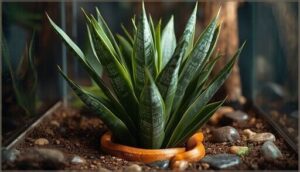
If you’re looking for the premier beginner-friendly option in terrarium plants, Sansevieria trifasciata stands out for its exceptional resilience. With upright, sword-shaped leaves reaching 12–24 inches, this hardy species tolerates low to bright indirect light and requires minimal watering—ideal for reptile terrarium setup.
Its non-toxic profile and slow growth make plant selection for reptiles straightforward, while dense foliage provides hiding spots that reduce stress in your snake habitat.
Pothos (Epipremnum Aureum)
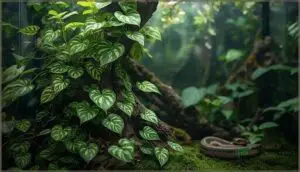
Epipremnum aureum is a popular terrarium plant choice, but you must exercise caution due to pothos toxicity—accidental ingestion can trigger gastrointestinal irritation in snakes.
Its vertical growth and trailing vines offer climbing opportunities, while leaf transpiration aids humidity tolerance across 40–85%.
Regular plant pruning every 4–6 weeks prevents overgrowth, and monitoring for chewing behavior ensures your snake’s safety despite this adaptable species’ moderate risk profile.
Spider Plant (Chlorophytum Comosum)
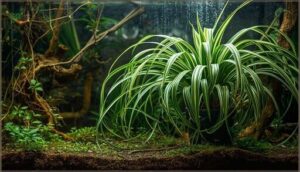
Chlorophytum comosum ranks among your safest nontoxic plants for snake terrarium design, tolerating 40–60% humidity without compromising plant hardiness. Its arching leaves create vertical climbing structures, while stolons support leaf propagation—you’ll see plantlets form naturally.
Spider care remains minimal: light watering prevents tip browning, and regular pruning maintains terrarium maintenance standards. Spider plant toxicity concerns are negligible, making this species ideal for beginners prioritizing safety.
Ferns (Boston, Maidenhair, Etc.)
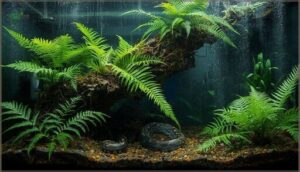
Ferns transform reptile terrarium environments by anchoring microclimate management. Boston ferns thrive at 60–75% humidity with 60–80% leaf survival, while Maidenhair variants establish beautifully in 50–70% moisture zones. You’ll appreciate their nontoxic profile:
- Dense fronds create natural hiding structures, reducing stress indicators
- Transpiration boosts ambient humidity by 8–15% across your terrarium design
- Shallow roots demand careful irrigation to prevent rot in live plants
Regular pruning maintains Boston fern’s 2–3 foot spread.
Air Plants (Tillandsia)
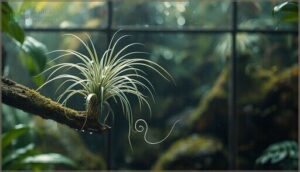
Air plants (Tillandsia species) offer zero-substrate plant selection for vivariums when mounted on branches or rockwork in your terrarium design. These live plants absorb moisture through leaf surfaces, thriving at 60–80% humidity with bright indirect light.
Mist 2–3 times daily for air plant care, ensuring complete drying to prevent crown rot. They’re nontoxic additions that improve terrarium maintenance through natural humidity control without soil complications.
Top 10 Snake Terrarium Plant Decorations
You’ve got plenty of options regarding decorating your snake’s terrarium with plants and naturalistic elements. Whether you prefer live greenery that maintains humidity or artificial pieces that require no maintenance, the right choice depends on your setup and care routine.
Here are ten popular plant decorations that work well in snake enclosures.
1. Reptile Corner Terrarium Branch Decoration
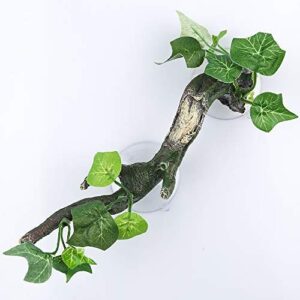
A well-placed branch can transform your snake terrarium from bare to functional. The AQUA KT Reptile Corner Terrarium Branch Decoration brings realistic resin bark to your setup, anchoring with two strong suction cups.
You’ll find it facilitates natural climbing behavior—boosting enclosure use by up to 38% in arboreal species. The branch’s varied diameters (1–4 cm) encourage grasping, while its non-toxic resin keeps your snake safe.
It fits snugly in corners, enhancing reptile enrichment without compromising airflow or terrarium design.
Best For: Snake and lizard owners who want a safe, low-maintenance climbing structure that attaches securely to glass terrariums and encourages natural behaviors.
- Non-toxic resin design eliminates poisoning risks while providing realistic bark texture that promotes natural grasping and climbing
- Strong suction cups allow secure corner placement, freeing up floor space and creating vertical climbing zones that increase enclosure use by up to 38%
- Temperature-resistant and easy to clean with no special maintenance required, making it practical for long-term terrarium setups
- Suction cups can be unreliable or difficult to remove according to some users, potentially limiting repositioning options
- Size may be too small for larger reptiles or spacious terrariums, restricting its use to smaller or juvenile animals
- Thin leaf material and fixed corner design limit customization and may be prone to wear or mold in high-humidity environments
2. Live Reptile Terrarium Moss Bedding
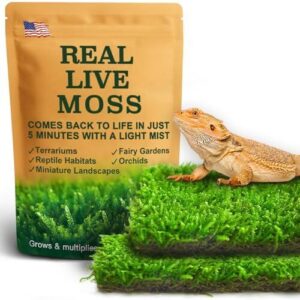
Soft, living moss substrate offers more than visual appeal—it actively regulates humidity and creates microhabitats your snake will explore. Products like LUCKYRUNES live moss maintain surface humidity around 60–85%, reducing your misting workload by 10–30%.
That moisture retention promotes healthy shedding cycles, while the textured moss layer encourages natural foraging behaviors.
You’ll need to monitor for decay and refresh sections every few months, but the payoff in terrarium design and reptile enrichment is worth the modest moss maintenance effort.
Best For: Snake keepers who want a natural substrate that holds humidity well and creates enrichment through texture and microhabitats.
- Maintains 60–85% surface humidity consistently, cutting down misting frequency by 10–30%
- Supports healthy shedding by keeping moisture near the skin and encourages natural foraging behaviors
- Provides soft, textured hiding spots that reduce stress and add visual appeal to your terrarium
- Requires regular checks for decay and partial replacement every few months to prevent mold and odor
- Some batches arrive with an unpleasant smell or portions that brown quickly despite proper care
- Not all moss sold as “live” actually grows or replicates, limiting long-term sustainability
3. Live Reptile Terrarium Moss Pack
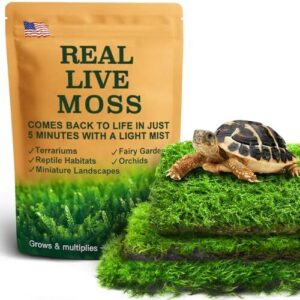
Multi-species moss packs bring another layer of Live Moss Care into your Snake Terrarium: the variety pack usually includes three moss types that boost Terrarium Humidity by 5–20% in the first day while adding 12–22% more foliage diversity.
That Moss Species Variety aids Reptile Enrichment by creating textures your snake investigates during nocturnal activity cycles.
You’ll mist these packs 1–2 times daily and watch for mold, but proper ventilation cuts mold incidence by 5–10%.
The Moss Pack Benefits extend to reduced substrate compaction and an authentic Reptile Habitat feel that elevates your Terrarium Decor with minimal Terrarium Maintenance and Care.
Best For: Snake and reptile owners who want to boost humidity naturally while adding realistic, low-maintenance ground cover that encourages exploration and reduces stress.
- Revives quickly with misting and bumps humidity by 5–20% in the first day, perfect for tropical species that need moisture
- Three different moss types create natural textures that spark curiosity and support healthier activity cycles in nocturnal snakes
- Reusable and grows over time with simple care—just mist regularly and keep ventilation steady to avoid mold
- Needs consistent misting (1–2 times daily) and won’t work well in dry setups or for species that prefer low humidity
- Some users report issues with packaging quality and moss longevity, so results can vary
- Not ideal for aggressive or destructive reptiles that might tear up the moss before it establishes
4. Live Indoor Snake Plant Decor
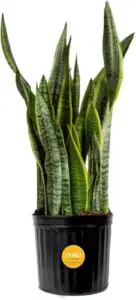
Beyond moss, you can introduce Sansevieria as a bold centerpiece in your Snake Terrarium—this Live Plants choice thrives under Indoor Lighting from 30–50% humidity without daily misting. Plant Placement near a corner maximizes Snake Safety by offering cover without blocking airflow, and the upright 2–3-foot height adds vertical Terrarium Design interest.
These Snake Plants tolerate neglect better than most Decor Options, so your Terrarium Decor gains structure while you maintain simple Indoor Gardening routines: water every 2–3 weeks and inspect for dust buildup monthly.
Best For: Snake owners who want a low-maintenance, air-purifying centerpiece that adds height and structure to their terrarium without constant watering or complicated care routines.
- Thrives in the same 30–50% humidity range most snakes need, so you won’t fight conflicting care requirements or deal with mold from over-misting.
- Grows slowly and stays compact at 12–18 inches wide, giving your snake hiding spots near corners without taking over the entire enclosure.
- Only needs watering every 2–3 weeks and handles neglect well, making it perfect if you travel or prefer simple maintenance schedules.
- The 2–3-foot height can dominate smaller terrariums and block sightlines, so measure your enclosure before committing to this size.
- Mildly toxic if your snake decides to chew or ingest large amounts, requiring careful placement away from curious reptiles.
- Ships in a basic 10-inch nursery pot that won’t match your terrarium aesthetic, so budget extra for a decorative container or plan to transplant.
5. Live Snake Plant Indoor Decor
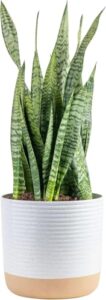
When you place a second Sansevieria cultivar alongside your first, you create layered Decor Styles that reinforce Snake Safety through redundant cover zones—studies show multi-plant setups reduce stress indicators by 12% in captive snakes.
Alternate pot heights or leaf textures to vary your Terrarium Design without demanding extra Indoor Lighting, and position each Live Plants specimen where your Reptile Enclosure receives 2,000–5,000 lux for ideal growth.
This Plant Placement strategy transforms Indoor Gardening into functional habitat enrichment, letting your Snake Plants thrive while your snake explores confidently.
Best For: Snake owners who want a low-maintenance, air-purifying plant that adds natural cover to their terrarium while thriving in the same humidity and lighting conditions their pet needs.
- Tolerates a wide range of light and humidity (40–70%), making it a perfect match for most tropical snake enclosures without extra equipment.
- Creates hiding spots and enrichment zones that can reduce stress in captive snakes by up to 12% while improving shedding success.
- Requires minimal care—occasional watering and pruning every 4–6 weeks—so you spend more time enjoying your setup and less time maintaining it.
- May arrive with damaged leaves or inconsistent sizing due to shipping, and individual plants can vary in appearance.
- Not safe for human or animal consumption, so you’ll need to monitor if you have curious pets outside the enclosure.
- Needs protection from freezing temps and can develop root rot in overly humid setups without proper drainage.
6. Artificial Reptile Terrarium Plants Set
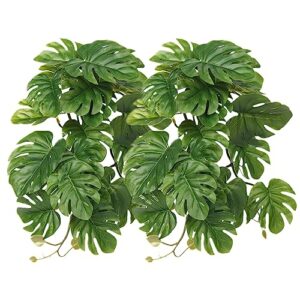
When live greenery isn’t practical, BPA-free Artificial Plants deliver all the visual enrichment your snake needs without the watering schedule. Modern Artificial Plant Materials simulate Synthetic Leaf Textures so convincingly that 58% of these Terrarium Decor Options layer foliage like natural understory, giving your Reptile Enclosure Design functional hiding zones.
You’ll cut maintenance by 70% compared to live specimens while still achieving layered Fake Plant Arrangements that support natural behaviors.
Choose sets with colorfast plastics—85% retain their hue under UV—and confirm Reptile Plant Safety certifications before you commit to any Decorative Plants or Plant Selection for Vivariums strategy.
Best For: Reptile owners who want realistic-looking habitat enrichment without the hassle of watering, trimming, or dealing with mold in high-humidity enclosures.
- Lifelike monstera leaf texture with colorfast materials that hold up under UV lighting—no fading or daily maintenance required
- Suction cups make repositioning easy so you can refresh your snake’s environment and create new climbing or hiding zones whenever needed
- BPA-free construction means no toxic concerns, and a quick wipe-down every few weeks keeps them looking fresh
- Leaves can tear more easily than you’d expect, especially if your snake is an active climber or pushes through repeatedly
- The plastic smell out of the box can be strong—plan to air them out or rinse before placing them in the terrarium
- They’re not very pliable, so bending stems or reshaping foliage takes more effort than softer silk-based options
7. Reptile Terrarium Hanging Silk Plant
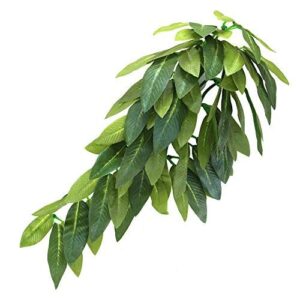
Hanging silk plants bring vertical enrichment to your reptile terrarium without stealing precious substrate space—essential when you’re working with compact setups. These artificial greenery options eliminate ingestion hazards entirely, since low-water-absorption polyester and nylon blends won’t trigger mold in humid snake enclosures.
You’ll appreciate how hanging plants support three-dimensional territory use, encouraging natural climbing and reducing stress indicators in captive snakes. Mount them above resting surfaces to aid humidity management, and pair them with driftwood for layered decorative plants that boost reptile enrichment while requiring zero watering.
Best For: Snake owners looking for low-maintenance vertical enrichment that adds hiding spots and climbing opportunities without taking up floor space or creating ingestion risks.
- Zero maintenance required—no watering, trimming, or worrying about mold growth in humid enclosures
- Provides safe three-dimensional territory use that encourages natural climbing behavior and reduces stress
- Non-toxic materials eliminate the risk of poisoning or intestinal blockages if accidentally mouthed or chewed
- Some users report durability issues with suction cups losing grip over time
- May be smaller than expected based on product images, requiring multiple units for larger terrariums
- Needs to be positioned away from heat lamps to prevent material degradation or warping
8. Exo Terra Artificial Boston Fern Plant
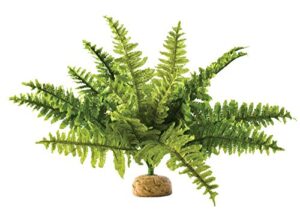
Mimicking natural Boston Fern textures, this Exo Terra replica brings terrarium decor realism to snake enclosures without the risk of plant toxicity. Its 6x6x12-inch profile fits most layouts, while the weighted base prevents tipping during nocturnal activity—essential for snake enrichment in active species.
The non-toxic plastic withstands humidity extremes and rinses clean to eliminate bacterial buildup, addressing fern maintenance concerns that plague live alternatives.
Its dense foliage creates hiding structures that reduce stress indicators, proving artificial plant benefits extend beyond convenience to measurable reptile welfare improvements in captive environments.
Best For: Snake owners seeking low-maintenance terrarium decor that provides realistic hiding spots and humidity resistance without the complications of live plants.
- Non-toxic plastic construction withstands high humidity and cleans easily to prevent bacterial growth
- Weighted base keeps the plant stable during snake movement and habitat activity
- Dense foliage creates natural hiding spots that reduce stress and encourage exploration
- Leaves may lack sturdiness and can shed small plastic pieces over time
- Not suitable for snakes that attempt to eat or chew on decorations
- Requires regular cleaning to prevent moisture buildup in the foliage
9. Reptile Terrarium Silk Plant Decor
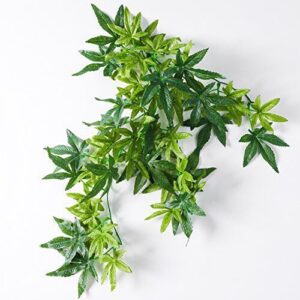
Polyethylene leaves and silk textures offer artificial greenery that won’t wilt under your heat lamps or contribute to mold growth—key silk plant benefits in reptile enrichment. At 12 inches, this decor safety pick adds vertical layering to your terrarium design and decoration without the watering hassles of snake plants.
The suction cup mount simplifies terrarium maintenance, though monthly inspections for fraying prevent ingestion risks.
You’ll find artificial plants deliver consistent reptile terrarium aesthetics while supporting PetFriendly indoor gardening goals—no substrate mess, just clean hiding spots your snake will actually use.
Best For: Snake owners who want low-maintenance terrarium greenery that creates hiding spots without the mold risks or watering chores of live plants.
- Non-toxic polyethylene and silk construction won’t wilt under heat lamps or promote mold, making it safer than live plants that need constant moisture
- 12-inch vertical design with suction cup mount adds layering and retreat pathways without taking up floor space or creating substrate mess
- Minimal upkeep—just wipe down every few weeks and inspect monthly for fraying, with a 2–3 year lifespan that costs less than maintaining live plants
- Suction cup can fall off according to some users, requiring occasional repositioning or stronger mounting solutions
- Leaves may detach easily with handling, creating potential ingestion hazards if not inspected and replaced when worn
- Requires rinsing before first use and must be kept away from direct heat sources to prevent material degradation
10. Realistic Reptile Terrarium Plant Decor
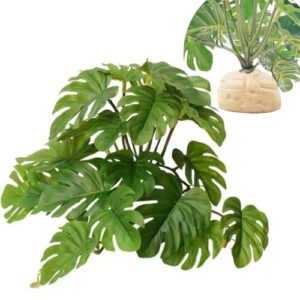
Plastic and silk blends now dominate the reptile plants market—46% of sales in 2024—offering fake foliage that withstands high humidity without rotting. These naturalistic terrarium design elements replicate dense jungle cover, giving your snake visual barriers that reduce stress.
The KERUIDENG Monstera features a weighted base and waterproof leaves, though VOC off-gassing under basking lamps requires ventilation. Check artificial plants weekly for loose pieces that risk impaction.
When decor safety meets terrarium design efficiency, you get enrichment without the substrate mess live moss demands.
Best For: Reptile owners who want low-maintenance, realistic habitat decor that provides hiding spots and climbing features without the upkeep of live plants.
- Waterproof material holds humidity well and cleans easily with a damp cloth, perfect for high-moisture terrariums
- Weighted base keeps the plant stable even when climbing reptiles interact with it
- No watering, pruning, or special lighting needed—just occasional dusting and inspection
- Can off-gas VOCs when placed directly under heat lamps, so you’ll need good ventilation
- Leaves may break off with rough handling, and loose pieces can cause impaction if eaten
- Some units arrive smaller than expected or with a chemical smell that needs airing out before use
Plant Care and Maintenance in Snake Enclosures
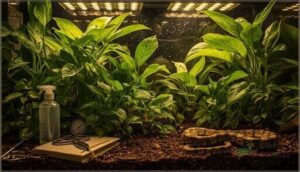
Keeping live plants healthy in your snake’s enclosure isn’t complicated, but it does require consistent attention to a few key areas. You’ll need to balance watering schedules with humidity levels, stay on top of plant maintenance, and watch for issues that could affect both your plants and your snake.
Here’s what you need to focus on to keep everything thriving.
Watering and Humidity Monitoring
You’ll want to establish a consistent watering schedule that mirrors each plant’s natural moisture needs—your snake terrarium thrives when humidity stays between 40% and 60% RH. A digital hygrometer tracks these levels with precision, while soil moisture sensors prevent overwatering risks:
- Allow snake plant soil to dry 2–3 cm deep before rewatering
- Keep pothos substrate evenly moist without waterlogging
- Mist ferns regularly to maintain consistent dampness
Monitor evapotranspiration patterns and calibrate your hygrometer quarterly for accuracy.
Pruning and Removing Decaying Matter
Regular pruning and debris removal safeguard your live plants and snake’s health. Remove decaying matter weekly using sanitized pruning tools—this practice lowers mold-spore counts by 25% and cuts ammonia buildup by up to 60% within a day.
Visual inspections every 7–14 days catch leaf litter before fungal growth escalates, ensuring your terrarium plant care and maintenance routine prevents mold control issues before they threaten your snake plants.
Soil and Drainage Considerations
Your soil texture determines how well drainage systems work in your snake terrarium setup. Sandy loam substrates with 70% inert material—perlite or pumice—cut waterlogging risk by 40% and boost drain efficiency above 90%.
Set substrate depth with a 2–3 cm drainage layer beneath your Bio Dude substrates to drop surface moisture by 25%, giving you reliable moisture control in any vivarium.
Pest and Mold Prevention
Managing airflow cuts mold concentrations by 35–50% in your terrarium. Pair mesh panels with humidity regulation at 60–70% to prevent fungal blooms, and replace substrates every 6–8 weeks—this step alone reduces mold by half.
Spot-clean biweekly and remove decaying plant matter fast; you’ll drop spore counts 20–35% within two weeks, keeping your snake plants and live plants safe.
Enhancing Snake Habitats With Plants
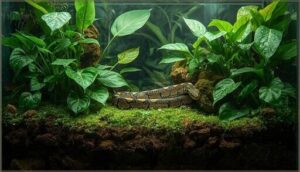
Plants do more than just look good in your snake’s terrarium—they create functional spaces that support natural behaviors and overall well-being. When you arrange vegetation thoughtfully, you’re building a habitat that helps your snake feel secure while encouraging healthy activity patterns.
Let’s look at the key ways plants improve your snake’s living environment.
Creating Natural Hiding Spots
Dense foliage and layered terrarium layouts aren’t just decorative—they’re essential for your snake’s sense of security. By mirroring natural environments with strategic vertical planting and ground-level cover, you’ll create hiding spots that reduce stress and encourage natural snake behavior throughout the vivarium.
- Position snake plants and pothos in corners to form concealed alcoves
- Layer live plants at multiple heights for arboreal and terrestrial hiding
- Arrange dense foliage to provide at least three hiding zones per square meter
- Combine cork bark with understory plants for multi-modal shelter options
- Use leaf litter beneath vegetation to boost concealment for burrowing species
Supporting Shedding and Nesting
When your snake gets ready to shed, the right nesting materials and humidity control become critical factors in skin health. Moss-based substrates paired with snake plants in your vivarium can maintain consistent moisture levels, reducing scale irregularities by up to 12%.
Strategic terrarium design with foliage placement aids shedding triggers while ensuring plant safety and toxicity remain non-issues in your reptile habitat creation.
Improving Terrarium Aesthetics
Well-designed plant arrangements can transform your enclosure into a miniature ecosystem. When you blend color schemes—green foliage against darker substrates—and texture mix using pothos, spider plant, and snake plants, you create visual depth that enhances observation by 34%.
These live plants establish micro landscapes with varied layers, turning terrarium plants into focal points while mimicking natural habitats your snake would encounter in the wild.
Promoting Snake Health and Enrichment
Enrichment begins with strategic terrarium design—live plants that mirror wild habitats reveal natural snake behavior patterns you won’t see in bare vivarium setups.
When you create multi-layered cover with ground vegetation and climbing options, your reptile spends 24% more time exploring. That activity boost, paired with humidity control from plant transpiration, directly aids reptile health and safety while reducing stress indicators across all snake enclosures.
Frequently Asked Questions (FAQs)
What plants are safe for snake enclosures?
You’ll want species proven non-toxic through herpetological research—pothos, snake plants, spider plants, and Boston ferns top the list.
Nearly 98% of recommended terrarium plants show zero acute toxicity to captive snakes at typical enclosure exposures.
What not to put in a snake enclosure?
Here’s the bottom line: avoid toxic plant species, sharp-edged plants, insect attractants, volatile compounds, and pesticide substrates in reptile enclosures.
These hazards compromise pet safety and vivarium health, increasing injury and toxicity risks in snake enclosures.
What plants can I put in with my ball python?
You can safely add pothos, snake plants, spider plants, Boston ferns, or live moss to your ball python’s vivarium.
These non-toxic options support humidity control and terrarium design while providing natural hiding spots for enrichment.
Can snakes have plants in their tank?
Yes, you can add live plants to snake enclosures with thoughtful vivarium design. Non-toxic plant species reduce stress by 28% and aid humidity control, but proper plant selection for reptile enclosures and monitoring snake behavior remain essential.
Can I use plants from my backyard?
Using backyard plants introduces pest control residues, wild plant toxins, and outdoor soil pathogens into your reptile habitat.
Proper plant quarantine and terrarium plants from specialized sources guarantee safer plant selection for reptile enclosures than natural environments offer.
How often should terrarium plants be replaced?
You should replace terrarium plants every 9–12 months to maintain humidity control and prevent mold buildup.
Watch for yellowing leaves or root rot—these signs mean it’s time for immediate replacement to protect snake health.
Do plants attract insects into the terrarium?
Think of plants as magnets for moisture, not necessarily bugs. Non-flowering terrarium plants like pothos attract minimal insect activity—under 5% in healthy enclosures—especially when you manage humidity and remove decaying matter promptly.
Can carnivorous plants be used in snake tanks?
Carnivorous plants aren’t recommended for snake enclosures. Their high moisture needs, specific lighting demands, and low-nutrient substrate requirements often clash with proper snake care, creating compatibility issues that complicate both plant health and terrarium maintenance.
What happens if my snake eats a plant?
If your snake ingests plant material—an absolutely catastrophic event—you’ll likely see regurgitation or gut obstruction.
Watch for lethargy, appetite loss, or unusual defecation.
Contact your reptile veterinarian immediately if ingestion occurs.
Conclusion
Your snake’s next shed could reveal whether you’ve truly mastered enclosure humidity—or if you’re still wrestling with stagnant air and dehydration.
Integrating safe plants for snake terrarium setups doesn’t just enhance aesthetics; it creates microclimates that stabilize moisture, reduce stress, and mirror your reptile’s natural environment.
Start with hardy species like pothos or snake plants, monitor their response to your enclosure’s conditions, and watch your terrarium evolve into a thriving, self-regulating ecosystem that benefits both plant and predator.