
This site is supported by our readers. We may earn a commission, at no cost to you, if you purchase through links.

Your ball python refuses dinner in October, then gorges itself come March—and both behaviors are completely normal. Seasonal snake metabolism changes govern everything from appetite cycles to energy expenditure, yet most keepers misinterpret these shifts as illness or husbandry failure.
A corn snake’s metabolic rate can plummet 70% during winter brumation; meanwhile, tropical pythons maintain near-constant activity year-round, their internal clocks calibrated to rainfall rather than frost. Temperature dictates baseline energy burn, but photoperiod—day length—acts as the master switch for hormonal cascades that either stoke or suppress hunger.
Understanding these physiological rhythms separates panicked vet visits from confident, species-appropriate care that mirrors what evolution spent millennia perfecting.
Table Of Contents
Key Takeaways
- Snake metabolism drops 40–80% during winter brumation as a temperature-independent shutdown—driven by photoperiod and hormonal signals, not just cold—requiring keepers to distinguish normal seasonal fasting from illness by tracking gradual appetite declines tied to shorter days rather than sudden refusal with weight loss.
- Temperature dictates baseline metabolic rate (doubling or halving across just 10°C), but day length acts as the master switch: long photoperiods (≥12 hours light) stimulate feeding and growth, while short days (≤10 hours) trigger reproductive quiescence and suppressed appetite through melatonin-driven neuroendocrine cascades.
- Tropical species like ball pythons maintain near-constant activity year-round with modest fasting tied to rainfall, while temperate snakes like corn snakes enter true metabolic depression for months—meaning husbandry must mirror each species’ native climate by adjusting thermal gradients, humidity, and feeding schedules to match evolutionary rhythms.
- Gut microbiota shifts orchestrate seasonal transitions by converting tryptophan into indole metabolites during active feeding (modulating circadian rhythms and hunger) then contracting to ferment host mucins during brumation, demonstrating that your snake’s internal chemistry—not just external conditions—governs appetite and energy allocation throughout the year.
What Drives Seasonal Snake Metabolism?
Snake metabolism doesn’t shift on a whim—it reacts to precise environmental signals that have shaped reptilian physiology for millions of years. Temperature, light, and humidity work together like a biological control panel, triggering hormonal cascades that ramp feeding up or shut it down entirely.
Understanding these three core drivers helps you anticipate your snake’s seasonal needs before they become problems.
Temperature and Thermoregulation
At the heart of seasonal snake metabolism lies temperature—the invisible conductor orchestrating every physiological shift. As an ectotherm, your snake relies entirely on external heat to power its internal engine, and even a 2 °C drop triggers measurable metabolic shifts that reshape appetite, activity, and energy use.
Temperature is the invisible conductor of snake metabolism—even a 2°C drop reshapes appetite, activity, and energy use
Key thermoregulatory principles that drive seasonal metabolism:
- Thermal regulation dictates baseline metabolic rate—garter snakes maintain field-active body temperatures near 29.9 °C, with metabolic rate doubling or halving across just 10 °C of temperature fluctuations
- Behavioral thermoregulation intensifies under thermal stress—inland rattlesnakes achieve tighter temperature control than coastal populations despite harsher environments, demonstrating adaptive ectothermic responses
- Preferred activity ranges are surprisingly narrow—most temperate species function optimally between 26–32 °C, becoming lethargic below and stressed above these bounds
- Temperature fluctuations directly alter energy budgets—a 1–2 °C warming increases annual maintenance costs in rattlesnakes, forcing higher food intake to meet elevated demand
- Thermoregulatory adaptations vary by habitat—species from thermally stable environments show weaker temperature selection than those facing extreme seasonal swings, reflecting divergent metabolic strategies
Understanding ectothermic animals and their cold weather adaptations is essential for providing proper care and environment.
Daylight Length and Photoperiod
Beyond warmth, day length acts as your snake’s internal calendar—a photoperiod-driven neuroendocrine signal that times appetite, reproduction, and dormancy. In the diamondback water snake Nerodia rhombifera, serum melatonin regulation peaks during dark hours and shifts phase when you reverse light cycles, proving photoperiodic control. Long photoperiods (≥12 hours light) stimulate growth; short days (≤10 hours) suppress feeding, matching seasonal cues to energy availability. The study of photoperiodic effects is vital in understanding these physiological changes.
| Photoperiod Length | Melatonin Pattern | Metabolic Effect | Reproductive State | Immune Response |
|---|---|---|---|---|
| Long (≥12h light) | Reduced nocturnal peak | Elevated metabolic rate, increased appetite | Active vitellogenesis | Moderate immune activity |
| Short (≤10h light) | Elevated winter levels | Suppressed growth, reduced feeding | Reproductive quiescence | Enhanced immune function |
| 12h:12h constant | Stable diel rhythm | Circannual rhythms persist independently | Seasonal cycles maintained | Upregulated activity |
| Reversed 12h:12h | Phase-shifted peak | Normal amplitude, new timing | Adjusted to new “seasons” | Reallocated energy trade-offs |
| Natural ambient | Seasonal amplitude shifts | Aligned with local latitude | Timed to shortest days | Photoperiod-guided allocation |
That’s why temperate pit vipers like Trimeresurus albolabris enter brumation consistently in early December—shortest day length triggers the shift from reproductive investment to energy conservation, regardless of minor temperature fluctuations.
Humidity and Environmental Cues
While photoperiod sets the calendar, humidity and moisture patterns fine-tune your snake’s seasonal transitions—acting as environmental signals that confirm resource availability. Wild snakes integrate water balance cues alongside temperature and light: prairie rattlesnakes harvest rainwater in 72 recorded events, tropical death adders lower field metabolic rate by 40% in dry seasons, and subtropical assemblages synchronize activity pulses with humidity spikes.
As these moisture cues signal upcoming resource shifts, keepers should adjust brumation feeding adjustments for snakes to mirror the natural tapering that precedes dormancy.
Physiological responses to these ecological adaptations include:
- Reduced evaporative water loss during dry periods, conserving plasma osmolality
- Rain-triggered behavioral shifts, moving from refuges to exposed postures
- Barometric pressure detection, cueing brumation entry alongside photoperiod
These environmental cues guarantee thermal regulation aligns with hydration-dependent physiology—your snake won’t ramp up metabolism unless moisture patterns signal safe foraging conditions.
Matching this environmental rhythm to your pet’s natural cycle—whether it’s a temperate kingsnake or a tropical boa—helps you dial in feeding frequency by species without overriding their instincts.
How Metabolism Changes Throughout The Year
Your snake’s metabolism isn’t static—it shifts dramatically as the calendar turns, responding to ancient biological rhythms that govern survival. These changes unfold in predictable phases, from feast-or-famine appetite swings to the near-shutdown of winter dormancy.
Let’s walk through the three major metabolic transitions you’ll observe throughout the year.
Appetite Fluctuations in Different Seasons

Your snake’s appetite cycles follow predictable seasonal feeding patterns driven by environmental triggers. In temperate regions, many species stop eating entirely during winter brumation—some for three months straight—then resume vigorous feeding when spring temperatures rise above 70°F. Temperature drops below 60°F slash metabolic rate and digestive efficiency, making even hungry snakes refuse meals.
Young snakes experiencing growth spurts may also pause feeding temporarily, though healthy growth rates and size milestones help distinguish normal development from concerning appetite loss.
Tropical species show wet-season peaks instead.
Energy Storage Before Dormancy

Pre-dormancy hyperphagia is your snake’s insurance policy for winter survival. As autumn temperatures cool, temperate species ramp up feeding—sometimes doubling meal frequency—to pack on fat reserves and glycogen before brumation shuts down digestion entirely.
Urban sprawl and warming trends are even reshaping where snakes build their nests, pushing them toward shaded, moisture-rich areas that better regulate body temperature during critical reproductive periods.
This surge in lipid metabolism converts prey into stored energy; a 2025 metabolomic study confirmed vigorous fat deposition genes fire during active pre-hibernation phases, fueling energy homeostasis through months of fasting.
Metabolic Depression During Brumation
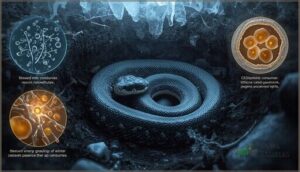
Dormancy flips the metabolic switch entirely. During brumation, your snake’s metabolic rate plunges 40–50% beyond what cold alone explains—an active, temperature-independent shutdown.
Standard metabolic rate in squamate reptiles drops roughly 80% from summer peaks, slashing ATP turnover so profoundly that stored lipids fuel months of fasting without tissue damage, exemplifying seasonal adaptations in reptiles through physiological adaptation and thermal regulation.
Species-Specific Adaptations to Seasons

Not all snakes respond to seasonal shifts the same way—your ball python’s metabolic strategy differs dramatically from a corn snake’s, and both operate under entirely different rules than species evolved for deserts or rainforests.
These adaptations aren’t just interesting biology; they’re the blueprint for understanding why your snake refuses food in October or becomes hyperactive each spring.
Let’s compare how different species have fine-tuned their metabolism to match their native environments.
Ball Python Vs. Corn Snake Metabolic Patterns
Ball pythons and corn snakes illustrate how native climate shapes seasonal appetite changes and brumation physiology. Ball pythons, adapted to stable tropical heat, maintain relatively constant metabolic rates year-round with modest fasting episodes; corn snakes exhibit pronounced seasonal feeding cycles—hyperphagic before winter, then entering true metabolic depression during brumation.
- Ball pythons require stable warmth (28–32 °C) for efficient digestion and linear growth
- Corn snakes accumulate energy reserves in autumn, then cease feeding during months-long brumation
- Thermal acclimation differs: ball pythons struggle with cool periods; corn snakes tolerate broad temperature swings
- Snake feeding habits reflect origin—tropical stability versus temperate seasonal cycling
Tropical Vs. Temperate Snake Strategies
Where your snake evolved determines its seasonal playbook. Tropical species in wet–dry habitats maintain year-round activity while shifting metabolic rate downward during drought—water conservation takes priority over feeding, and energy reserves support intermittent foraging every two to three weeks.
Temperate snakes face temperature drops that trigger prolonged brumation, halting appetite entirely; thermal acclimation and fat storage define their climate adaptation, ensuring survival when thermal regulation becomes impossible and snake habitat freezes solid.
Unique Adaptations in Arid-Environment Snakes
Desert survival demands extreme physiological adaptation—arid-environment snakes reduce metabolic rate up to 90 percent during aestivation, retreating into thermally buffered burrows where water conservation and thermoregulation override feeding.
Specialized ecological adaptation includes:
- Sidewinding locomotion on sand minimizes conductive heat gain while improving thermal regulation
- Uric acid excretion conserves water far more efficiently than urea-based systems
- Cryptic coloration and extended immobility reduce energy expenditure between sparse prey encounters
Your desert species evolved to thrive where others perish.
Hormonal and Biochemical Influences
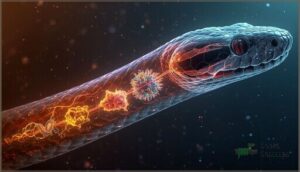
Your snake’s internal chemistry orchestrates every aspect of its seasonal behavior—from the urge to feed to the drive to seek shelter. Hormones, amino acid pathways, and even gut bacteria work together to synchronize metabolic shifts with environmental changes.
Let’s examine three biochemical mechanisms that govern how snakes respond to the seasons.
Tryptophan Metabolism and Circadian Rhythms
Your snake’s internal clock runs on tryptophan—the same amino acid that makes you sleepy after Thanksgiving dinner. In colubrid snakes, tryptophan pathways shift dramatically between seasons: summer feeding activates gut-microbial indole routes, while winter dormancy redirects flux toward host kynurenine metabolism and serotonin regulation.
This seasonal reallocation coordinates melatonin synthesis with day length, entraining circadian rhythms that govern metabolic rate, immune function, and the precise timing of snake behavior throughout the year.
Hormonal Regulation of Hunger and Activity
Beyond the tryptophan pathways, ghrelin response triggers your snake’s hunger before each meal, while leptin signaling from fat stores broadcasts long-term energy status—modulating foraging drive across seasons.
Corticosteroid effects rise during metabolic stress, promoting catabolism when prey is scarce.
Meanwhile, melatonin regulation syncs these hormonal changes to photoperiod, and hypothalamic neuropeptide control (NPY, orexin) fine-tunes appetite intensity and wakefulness, orchestrating energy homeostasis year-round.
Role of Gut Microbiota in Seasonal Changes
The hormones above don’t work alone—gut microbiota shifts orchestrate much of your snake’s seasonal adaptation. During active feeding, microbial diversity peaks, and bacteria like Paeniclostridium convert tryptophan into indole metabolites that modulate circadian rhythms and snake behavior. Come brumation, that community contracts; your snake’s gut health pivots to fermenting host mucins for baseline energy, rebalancing the host–microbe dialogue until spring.
Three key microbial roles in seasonal appetite changes:
- Energy harvest — Microbes extract calories from prey and endogenous substrates year-round.
- Tryptophan metabolism and regulation — Bacterial indole production influences neuroendocrine signaling during activity.
- Barrier maintenance — Simplified winter communities protect the gut lining during fasting, a core physiological adaptation in reptiles.
Implications for Snake Care and Conservation

Understanding how snake metabolism shifts across seasons isn’t just academic—it shapes how you care for captive snakes and how conservationists protect wild populations. Whether you’re adjusting your ball python’s feeding schedule in November or evaluating habitat threats for temperate species, these physiological patterns matter.
Let’s explore three critical applications: adapting husbandry practices to match natural cycles, distinguishing healthy seasonal fasting from medical problems, and addressing the conservation pressures that climate change creates for snakes worldwide.
Adjusting Feeding and Habitat for Seasonal Needs
You’ll often find that adjusting Feeding Strategies and Habitat Enrichment is essential as seasonal appetite changes kick in. Your approach to reptile care and management should mirror physiological responses to temperature and light, ensuring Feeding behavior stays healthy and predictable year-round.
Temperature drops call for tighter Thermal Gradients and Humidity Control—think ceramic heat emitters, humid hides, and careful Seasonal Monitoring.
Recognizing Normal Vs. Abnormal Appetite Loss
When Appetite Monitoring reveals sudden refusal for weeks—especially alongside lethargy or weight loss—you’re likely seeing abnormal appetite changes, not typical Seasonal Acclimation. Healthy Brumation triggers gradual declines tied to cooler temps and shorter days; illness doesn’t wait for environmental Feeding Cues.
Regular Health Checks and Dietary Adjustments help you distinguish normal Physiological responses to temperature and light from red flags demanding veterinary attention.
Conservation Challenges Amid Climate Change
As Climate Change reshapes landscapes, you’ll notice Habitat Fragmentation forcing snakes into isolated pockets—poor Climate Refuge where Extreme Weather disrupts brumation and prey cycles.
Snake Migration corridors vanish, undermining Ecosystem Resilience and Ecological Balance.
Effective Conservation Efforts for Snake Species demand Environmental Science that maps climate-resilient refugia, ensuring Species Conservation keeps pace with warming-driven range shifts and unpredictable precipitation.
Frequently Asked Questions (FAQs)
Do snakes drink more water before winter arrives?
An ounce of prevention is worth a pound of cure”—yet snakes don’t drink more water before winter. Instead, dehydration risks climb as seasonal appetite changes reduce prey-derived moisture, triggering episodic drinking when thirst signals spike during brumation.
Can artificial lighting prevent seasonal appetite changes?
Photoperiod manipulation through artificial lighting regimes can support circadian rhythm control and normal snake feeding behavior, but won’t fully prevent seasonal appetite changes.
Temperature remains the primary driver of metabolic shifts and dormancy triggers.
How do gravid females manage energy demands?
Gravid females face extreme physiological responses—some stop eating entirely while carrying young. Energy allocation shifts dramatically: thermoregulatory tactics like prolonged basking accelerate development, while maternal investment relies heavily on pre-stored energetic reserves rather than current foraging.
Do juvenile snakes experience different metabolic patterns?
Yes—juvenile snakes allocate up to 30 percent of their metabolic rate to rapid growth, exhibiting higher mass-specific metabolism than adults.
These ontogenetic changes reflect energy allocation priorities that shift dramatically as your snake matures.
What blood changes occur during metabolic depression?
During brumation, blood glucose shifts downward as demand drops; ketone body increases signal lipid metabolism changes.
Plasma protein alterations and electrolyte balance shifts reflect reduced metabolic rate and prolonged fasting physiology.
Conclusion
Picture your snake coiled motionless in December—heart rate halved, digestion stalled, survival mechanisms humming beneath stillness. That’s seasonal snake metabolism changes orchestrating a biological masterpiece you’re witnessing in real time.
Temperature gradients, photoperiod cues, and hormonal cascades don’t malfunction when appetite vanishes; they’re executing genetic programming refined across millennia.
Your role isn’t forcing normalcy onto wildness—it’s recognizing when evolutionary rhythms deserve respect over intervention, letting nature’s blueprint guide your hand instead of fear.
- https://wildlifepreservation.ca/blog/how-snakes-overwinter/
- https://bouldercountyopenspace.org/i/science/a-winter-snakes-tale/
- https://housemanservices.com/blog/do-snakes-hibernate-and-what-is-brumation
- https://naturemuseum.org/cas/blog/what-do-snakes-do-in-the-winter
- https://pmc.ncbi.nlm.nih.gov/articles/PMC11262299/