This site is supported by our readers. We may earn a commission, at no cost to you, if you purchase through links.
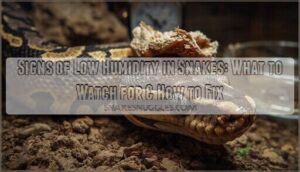
Your ball python’s eyes look cloudy—a sure sign shedding is near—but three days later, the skin comes off in ragged patches instead of one smooth piece. That incomplete shed isn’t just cosmetic. It’s your snake’s body telling you the humidity in its enclosure has dropped too low.
Low humidity affects far more than shedding cycles. It compromises respiratory function, triggers dehydration, and opens the door to secondary infections that can threaten your snake’s long-term health.
Recognizing the early warning signs means you can correct humidity issues before they escalate into veterinary emergencies, and the symptoms are more specific than most keepers realize.
Table Of Contents
Key Takeaways
- Low humidity in snakes triggers a cascade of health problems, including incomplete sheds, dehydrated skin with visible cracks, sunken eyes, and respiratory distress from thickened mucous membranes that obstruct airways.
- Behavioral changes like increased hiding, irritability, food refusal, and compulsive rubbing against objects serve as early warning signs that humidity levels have dropped below your snake’s species-specific requirements (typically 40-70% depending on whether it’s a desert or tropical species).
- Chronic low humidity compromises skin integrity and creates entry points for bacterial infections (Staphylococcus, Pseudomonas) and fungal diseases that require antimicrobial therapy and can threaten your snake’s long-term health.
- Daily hygrometer monitoring combined with immediate corrective action—such as adding moisture-retaining substrate, strategic misting, or using a reptile humidifier—prevents minor humidity issues from escalating into veterinary emergencies requiring professional intervention.
Why Proper Humidity is Essential for Snakes
Your snake’s humidity isn’t just about comfort—it’s a biological necessity that affects multiple body systems simultaneously. When humidity levels drop below what your snake needs, you’ll see the impact show up in their skin, their ability to shed properly, and even how well they can breathe and stay hydrated.
Humidity isn’t a comfort feature for snakes—it’s a biological necessity affecting skin, shedding, breathing, and hydration simultaneously
Let’s look at the three main ways humidity keeps your snake healthy and functioning at their best.
Role of Humidity in Shedding
Successful ecdysis—the shedding process—hinges on proper humidity levels because moisture allows the old skin to separate cleanly from underlying layers. When humidity drops below your snake’s species-specific needs, you’ll notice incomplete sheds, especially around the eyes and tail tip.
Maintaining a stable humidity gradient within your enclosure prevents stuck shed and promotes smooth, complete sloughing cycles that keep your snake healthy and comfortable. Researchers utilize scientific study methods to better understand the importance of environmental factors in animal health.
Impact on Skin and Scale Health
Beyond shedding issues, low humidity directly damages your snake’s skin and scales. You’ll see dull, wrinkled scales and flaky patches when ambient levels fall below 50–70%. Dehydration reduces skin hydration and turgor, compromising epidermal health and creating micro-tears that invite skin infections like scale rot.
If your snake struggles to shed despite correct humidity, check out safe ways to assist during difficult sheds to avoid causing further skin damage.
Humidity gradients protect against these dehydration effects, preserving your snake’s barrier against bacterial and fungal pathogens that exploit compromised reptile health.
If you notice any of these warning signs, check out this guide on how to treat a dehydrated snake to restore your pet’s health quickly.
Understanding dictionary search patterns can help researchers find relevant information on reptile health and environmental factors.
Effects on Hydration and Respiration
When humidity levels drop too far, your snake faces twin threats: dehydration and respiratory distress. Elevated skin dryness increases mucus membrane viscosity, thickening secretions that clog airways and trigger labored breathing.
To prevent this, pair your humidity monitoring with proper temperature gradient zones so your snake can self-regulate its comfort level across the enclosure.
You’ll notice weight loss, reduced activity, and sometimes coughing as airway irritation sets in.
If you spot any of these warning signs, check out this guide on common pet snake health issues to help identify what might be going on.
Proper hydration management and humidity gradients prevent these dehydration effects while supporting respiratory health throughout the shedding process.
Common Signs of Low Humidity in Snakes
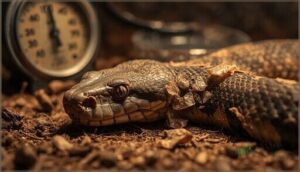
When humidity drops too low, your snake’s body will start showing warning signs that something’s off. These symptoms can appear gradually or suddenly depending on how far the levels have fallen and how long the problem’s been going on.
Here are the most common indicators that your snake needs more moisture in its environment.
Stuck or Incomplete Shed
One of the clearest red flags is incomplete shedding—when your snake’s old skin clings in patches rather than peeling away in one piece.
This happens when humidity levels fall short of what your snake needs, leaving dried-out skin stuck around the eyes, tail tip, or between scales.
Low humidity levels cause the shedding process to stall, leaving stubborn fragments around the eyes, tail tip, or body.
These retained pieces can restrict circulation and lead to serious reptile health complications if you don’t address humidity control promptly.
Dry, Flaky, or Cracked Skin
Your snake’s scales shouldn’t feel rough or look dull—those textures signal trouble. Low humidity levels strip moisture from the dorsal and ventral scales, creating dry, flaky patches that compromise reptile health and set the stage for skin infections.
Watch for these dry-skin warning signs:
- Dull, lackluster scales that’ve lost their natural sheen
- Rough texture when you gently run your finger along the body
- Flaking skin between scales, especially on the back
- Visible fissures or tiny cracks in scale edges
- Increased shedding problems with skin that won’t release properly
Addressing humidity therapy now prevents scale damage and skin lesions that require veterinary intervention. Proper snake care means maintaining species-appropriate moisture before dry shedding becomes a chronic issue.
Sunken Eyes and Wrinkled Appearance
When your snake’s face loses its plumpness, you’re seeing severe dehydration signs that demand immediate humidity control. Sunken eyeballs and wrinkled skin around the head signal compromised facial turgor—a veterinary red flag that threatens reptile health beyond simple shedding problems.
| Dehydration Indicator | What You’ll Observe |
|---|---|
| Eye appearance | Hollow, recessed eyeballs with reduced tissue volume |
| Head and neck skin | Tight, wrinkled texture with visible creases |
| Scale condition | Dull, flaky patches near eyes requiring urgent eye care |
Restoring proper humidity levels and skin hydration usually reverses these wrinkle prevention concerns within days.
Lethargy and Reduced Activity
When your snake spends most of the day lying motionless near the heat lamp instead of exploring its enclosure, low humidity levels might be sapping its energy. Environmental factors like chronic dryness can trigger lethargy that compromises reptile health and normal snake behavior:
- Your snake may remain coiled in one spot for days, barely responding to movement outside the tank
- Activity levels drop noticeably as dehydration drains physical reserves needed for hunting and climbing
- Health consequences escalate when shedding problems and respiratory health issues compound the moisture deficit
Correcting humidity effects often restores your snake’s natural curiosity within 24–48 hours, though persistent inactivity warrants veterinary attention.
Difficulty in Breathing
When your snake breathes with its mouth open or you hear faint clicking sounds during respiration, airway obstruction from dried mucous membranes may be compromising gas exchange.
Respiratory issues tied to low humidity levels create breathing difficulty that progresses from subtle wheezing to visible hypoxia symptoms like rapid, shallow breaths.
Chronic dryness weakens your snake’s defenses against respiratory infections, threatening overall reptile health and respiratory health simultaneously.
Behavioral Changes Linked to Low Humidity
Your snake’s behavior can tell you a lot about whether humidity levels are off. When the air’s too dry, snakes don’t just develop physical symptoms—they act differently, often in ways that signal discomfort or stress.
Watch for these three behavioral red flags that point to low humidity in your snake’s enclosure.
Increased Hiding or Irritability
Ever notice your snake burrowing deeper or snapping more often? Increased Hiding Behavior and Irritability are classic Stress Signals tied to low humidity levels.
Dry conditions disrupt reptile health, often causing shedding problems and respiratory health issues.
Address Irritability Causes with Environmental Enrichment and Humidity Solutions—think misting or moisture-retaining substrates—to restore proper snake humidity and ease your pet’s discomfort.
Reluctance to Eat
Is your snake skipping meals despite a healthy appetite before? Appetite loss often signals environmental stress—especially when humidity levels drop. Feeding behavior changes, like refusing food or eating less, can quickly follow. Watch for these signs of reptile health decline:
- Unexplained fasting
- Delayed response to prey
- Weight loss
- Shedding problems
- Signs of dehydration effects
Frequent Rubbing Against Objects
If your snake’s appetite drops, watch for frequent rubbing behavior along enclosure branches or rocks. This isn’t just restless pacing—it’s often a direct response to skin irritation and shedding issues caused by low humidity levels. Persistent friction can lead to abrasions or scale damage.
Maintaining proper humidity gradients helps prevent these shedding problems and promotes overall reptile health in daily snake care.
Physical Health Issues Caused by Low Humidity
When humidity drops too low, your snake’s body can’t function the way it should. The consequences go beyond surface-level discomfort—you’re looking at real physiological problems that can compromise your pet’s health and longevity.
Here are the most critical physical health issues that develop when your snake doesn’t have adequate moisture in its environment.
Dehydration Symptoms
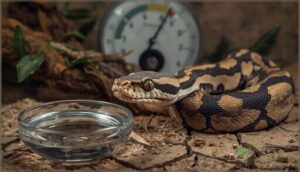
Vigilance is key when tracking dehydration signs in your snake. Watch for dry mouth, thick saliva, sunken eyes, and sluggish movement—classic dehydration symptoms tied to poor snake humidity and water balance.
These skin issues and changes in feeding signal a drop in reptile health and wellness. Addressing humidity levels quickly helps prevent shedding problems and aids proper snake hydration.
Reduced Skin Elasticity
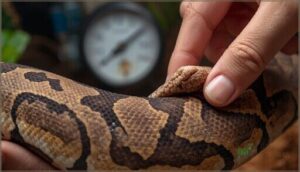
As dehydration progresses, you’ll notice your snake’s skin loses its healthy snap-back quality—what veterinarians call skin turgor. Gently pinch a fold of skin along your snake’s side; if it slowly returns or stays tented, you’re seeing elasticity loss from inadequate humidity levels. This dehydration effect signals compromised reptile husbandry and warrants immediate humidity therapy through rehydration methods to restore proper shedding and skin health.
- Check skin turgor by gently pinching the body skin between heat and cool zones
- Monitor how quickly pinched skin returns to its normal position after release
- Watch for wrinkled, loose skin that doesn’t smooth out when your snake moves
- Track shedding cycles closely, as reduced elasticity often precedes incomplete sheds
- Implement humidity control adjustments immediately when you detect reduced skin pliability
Secondary Infections From Damaged Skin
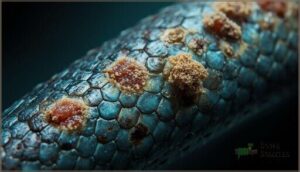
When skin integrity breaks down from chronic dryness, bacterial infections and fungal diseases can take hold rapidly. Staphylococcus and Pseudomonas species commonly colonize skin lesions, while dermatophytes create pustular eruptions that compromise both shedding and skin health. Prompt antimicrobial therapy and diligent wound care are necessary to prevent these secondary complications from spreading systemically and threatening a snake’s respiratory health and infection recovery.
| Pathogen Type | Common Species | Clinical Signs |
|---|---|---|
| Bacterial | Staphylococcus, Pseudomonas | Localized dermatitis, open wounds |
| Fungal | Dermatophytes | Pustules, crusting lesions |
| Mixed | Various opportunistic | Systemic spread, delayed healing |
How to Confirm and Address Low Humidity
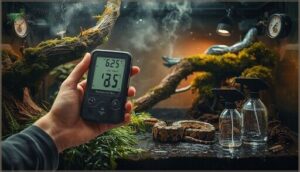
Once you suspect low humidity, your next move should be confirming the problem and taking action before your snake’s health deteriorates further. Accurate measurement tools and careful observation will tell you exactly what’s going on in the enclosure.
From there, you can implement targeted adjustments that tackle the underlying issue rather than just masking symptoms.
Using Hygrometers for Accurate Measurement
You can’t manage what you don’t measure—that’s where digital hygrometers become your most reliable tool. These humidity sensors deliver accurate measurements through digital readings when you place them correctly inside the enclosure, away from heat sources and water dishes.
Regular hygrometer calibration using a salt test ensures precision within 2-5% RH.
For better humidity control, position multiple sensors to capture different microclimates, giving you complete visibility into your humidity levels before problems develop.
Monitoring Shedding Cycles and Skin Condition
Track your snake’s molt cycles in a log—complete versus incomplete sheds reveal humidity gradients at work. Photograph skin before and after shedding to document scale health changes, including lesions or abnormal dryness. Record environmental readings during each cycle, noting substrates and behavioral shifts.
This reptile health and wellness practice connects shedding patterns to humidity levels, helping you spot trends before respiratory or skin problems develop.
Immediate Steps to Increase Humidity
Once you’ve confirmed low humidity with your hygrometer, act quickly. A reptile-specific humidifier can boost humidity levels by 5–20 percentage points depending on your snake’s needs.
Mist the enclosure once or twice daily using proper misting techniques, and seal any gaps that leak moisture. Add moisture-retaining substrate or place the water bowl near your heat source to increase evaporation rates naturally.
Frequently Asked Questions (FAQs)
What humidity level does my snake species need?
Your tropical ball python isn’t a cactus—humidity research shows it needs 50 to 60 percent humidity levels, while desert corn snakes thrive around 40 to 60 percent, demonstrating clear species-specific care requirements.
Can low humidity cause respiratory infections in snakes?
Yes, low humidity can contribute to respiratory infections in snakes. Dry air compromises mucous production and airway defenses, leaving respiratory tissues vulnerable to bacterial overgrowth and chronic inflammation in your snake enclosures.
How often should I mist my snakes enclosure?
Most snakes don’t need daily misting—let your hygrometer guide you. Desert species rarely require it, while tropical snakes may benefit from light misting once daily or several times weekly, especially during shedding cycles.
What substrates help maintain humidity for snakes best?
Coconut coir, cypress mulch, and sphagnum moss excel at moisture retention for snake enclosures. You can mist these substrate materials regularly to maintain humidity levels, creating a proper humidity gradient that aids healthy shedding and respiration without requiring a humidifier.
Does low humidity affect snake feeding behavior?
When environmental stress from inadequate humidity levels disrupts your snake’s comfort, feeding refusal often follows—even with proper hydration levels.
Stabilizing humidity gradients and maintaining species-appropriate humidity control usually restores normal snake appetite within days.
Conclusion
A ball python owner once missed the subtle signs of low humidity in snakes—wrinkled skin, reluctant feeding—until retained eye caps required veterinary intervention. You don’t have to follow that path.
Check your hygrometer daily, observe your snake’s behavior closely, and adjust humidity levels at the first warning sign.
Your vigilance prevents stuck sheds from becoming infected wounds, minor dehydration from escalating into respiratory distress. Small corrections now protect your snake’s health for years ahead.