This site is supported by our readers. We may earn a commission, at no cost to you, if you purchase through links.
Most snake owners misread their animals—constantly. They assume a motionless snake is a content snake, or that any tongue flicking means stress.
The truth cuts the other way: snakes communicate readiness through a specific set of behavioral signals, and once you know what to look for, they’re surprisingly readable. A relaxed body, steady tongue flicks, and a calm approach toward your open hand aren’t random—they’re an invitation.
Learning the signs your snake wants handling takes the guesswork out of every interaction and builds the kind of trust that makes handling sessions genuinely enjoyable for both of you.
Table Of Contents
- Key Takeaways
- Relaxed Body Language in Snakes
- Calm Tongue Flicking Patterns
- Comfortable Exploration Behavior
- Lack of Defensive Postures
- Consistent Feeding and Shedding
- Settled Behavior When Approached
- Positive Response to Gentle Touch
- Absence of Stress Signals
- Gradual Increase in Handling Tolerance
- Environmental Factors Supporting Handling
- Frequently Asked Questions (FAQs)
- Conclusion
Key Takeaways
- A relaxed snake shows its comfort through loose, draped body language—soft S-curves over your hands, even weight distribution, and no tight coiling are your clearest green lights before and during handling.
- Tongue flicking isn’t a stress sign; slow, steady flicks mean your snake is just gathering scent, and paired with fluid movement, they signal genuine curiosity rather than alarm.
- Trust builds session by session—consistent, calm handling over several weeks gradually replaces stiff, defensive reactions with relaxed draping, so patience isn’t optional, it’s the whole strategy.
- A well-set enclosure (proper temps, snug hides, right humidity) does half the behavioral work for you before you ever open the lid, because a snake that feels safe at home is a snake that’s easier to handle.
Relaxed Body Language in Snakes
Your snake’s body is basically a mood ring — if you know what to look for, it tells you everything. Before you ever reach into that enclosure, take a few seconds to read what your snake is actually showing you.
Once you start noticing the patterns, reading defensive snake posture and body language becomes second nature — like learning to read a friend’s face.
Here are the key body language signs that say “yeah, I’m good with this.
Loose, Supported Posture

Posture is your first real handling cue. A snake that’s ready to be picked up feels soft and pliable — its body drapes across your hands with even weight distribution, settling naturally over your forearms without locking up or going completely limp. That balanced muscle relaxation tells you it feels secure.
When body alignment looks loose and unhurried, those posture signals are basically a green light. Handlers can learn more about interpreting relaxed snake body language to make informed decisions when interacting with their pets.
Slow, Fluid Movements

Beyond posture, watch how your snake actually moves. A snake showing relaxed snake behavior glides with uninterrupted gliding — smooth, steady traversal across your hands with balanced weight shifting coil to coil. No sudden darting or frantic loops.
Understanding snake communication means reading that unhurried pace as genuine snake comfort. When interpreting reptile body language, slow and flowing is your clearest sign of ease.
To better recognize these signs, you can review reading snake body language for helpful behavioral cues.
Gentle Curves Over Hands
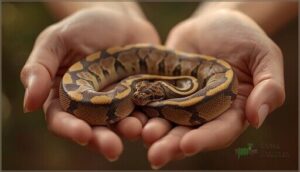
Once that smooth movement settles in, watch where the body goes next. A snake truly okay with handling doesn’t bunch up — it drapes. Think of it like a scarf finding its shape over your hands.
Here’s what curve formation looks like when snake trust is real:
- Soft S-curves flow along your arms, never sharp or coiled tight
- The snake’s belly scales glide smoothly — no gripping or digging into skin
- Body weight distributes evenly across both hands during calm interaction
- Head rests lightly on your palm, using your gentle touch as a steady perch
- Loops stay loose and balanced, a sure sign your handling techniques are working
Those open, relaxed curves are your green light. Snake handling tips don’t get more reliable than this.
Calm Tongue Flicking Patterns

Your snake’s tongue is basically its nose — it’s how they read the world around them.
The speed and rhythm of those flicks actually tell you a lot about how your snake is feeling in the moment. Here’s what calm tongue activity looks like.
Regular, Slow Tongue Flicks
Think of slow, steady tongue flicks as your snake’s way of saying, “I’m just checking things out.” This calm tongue flicking is pure scent gathering — your snake’s split tongue carries chemical signals straight to its Jacobson’s organ to identify you.
Regular, rhythmic tongue flick patterns are a clear relaxation sign, meaning your snake’s body language and snake communication are both signaling trust, not alarm.
Absence of Rapid or Jerky Movements
Watch how your snake moves, not just where. A relaxed snake flows through smooth motion patterns like water — no sudden jolts, no jerky pivots. Calm muscle tone means gentle curve movements and a steady pace handling that feels rhythmic in your hands.
That relaxed body flow signals understanding snake behavior at its clearest. Rapid bursts? Those are defensive behaviors talking. Slow and steady is your green light.
Once you start reading those physical cues consistently, a guide like how snakes communicate stress can sharpen your instincts even further.
Comfortable Exploration Behavior

Sometimes a snake doesn’t wait for you to make the first move — it makes it for you. When your snake starts sniffing your hand or crawling onto your palm without hesitation, that’s a pretty clear signal.
Here are the two key exploration behaviors that tell you your snake is genuinely comfortable with handling.
Sniffing and Investigating Hands
When your snake slowly tongue-flicks around your hand, that’s scent detection at work — not a warning sign. Snake curiosity looks like calm, fluid investigation.
Understanding snake behavior here means recognizing that loose body language paired with steady tongue flicking signals comfort. Good handling techniques start by letting this hand investigation happen naturally, without pushing forward. That patience builds real trust over time.
Moving Onto Open Palms Voluntarily
A voluntary approach is one of the clearest signs of trust you’ll see. When your snake glides toward your open palm instead of retreating, that’s not coincidence — it’s communication.
Watch for these cues during palm placement:
- Weight distribution spreads evenly across both hands
- Movement style stays slow, deliberate, unhurried
- Head stays level, not pulled into a defensive S-curve
- Hand adjustment happens smoothly when you shift position
- The tail rests softly instead of bracing to escape
Lack of Defensive Postures
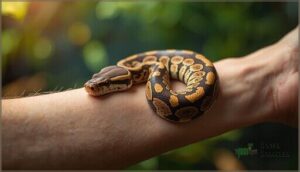
A snake that’s genuinely comfortable with you won’t feel the need to put up its guard.
Defensive postures are basically your snake’s way of saying “back off,” so when they’re missing, that’s a green light.
Here are the two clearest signs that your snake has dropped its defenses.
No Tight Coiling or Balling Up
When your snake doesn’t ball up during handling, that’s a genuine trust signal worth noticing.
Coil relaxation means the body spreads loosely across your hands instead of compressing inward to protect the head. That open body language tells you stress reduction is happening.
Consistent, calm handling techniques build this snake trust over time — think of it as your snake quietly saying, “I’ve got you.
Absence of Hissing or Flattening
No hissing, no flattening — that’s your snake’s version of a green light. When calm snake behavior replaces defensive behaviors, the body stays tubular and rounded rather than spreading wide to look threatening.
That absence of stress signs tells you your gentle handling techniques are working. Reduced stress shows up quietly, through relaxed body language and zero behavioral changes toward aggression. Snake comfort doesn’t announce itself loudly — it just… isn’t loud.
Snake comfort doesn’t announce itself loudly — it just isn’t loud
Consistent Feeding and Shedding

A snake that’s thriving outside of handling sessions is usually easier to work with during them.
Two of the clearest indicators of overall well-being are how consistently your snake eats and how cleanly it sheds. Here’s what normal looks like for both.
Normal Eating Habits
One of the clearest windows into your snake’s well-being is its feeding schedule. A healthy snake eating regularly — whether that’s every week or every two weeks — signals that handling isn’t triggering stress signs.
Watch for consistent eating rhythms, proper meal sizes matched to prey types, and clean digestion patterns. Loss of appetite over several weeks? That’s your cue to reassess your reptile care routine.
Healthy, Complete Shedding
Feeding consistency tells part of the story — shedding tells the rest. A snake shedding successfully follows a predictable shed cycle: going dull, entering the blue-eyed phase, then clearing up before the shed.
Skin quality matters too. Watch for:
- A single, complete tube with intact eye caps
- Bright, even colors right after
- No shedding in pieces, which signals low humidity levels
Healthy shedding patterns confirm your husbandry is working.
Settled Behavior When Approached

How a snake reacts before you even touch it tells you a lot. A ready snake doesn’t bolt for cover or press into the back corner the moment your hand appears near the enclosure.
Watch for these two telling signs that your snake is settled and open to interaction.
Remaining Visible in Enclosure
A snake that lounges near the front glass is basically waving hello. That visible comfort is one of the clearest Calm Visibility Signs you’ll spot.
| Visible Resting Patterns | What It Means |
|---|---|
| Resting near front glass | Feels secure with your presence |
| Using Open Hide Preferences | Balancing safety with curiosity |
| Enclosure Exploration at dusk | Healthy, natural activity cycle |
| Stable visibility routine | Secure Environment Design working |
Not Retreating Quickly From Handler
That visible comfort near the glass naturally leads to what happens next — when you actually reach in.
A snake showing Snake Trust won’t bolt.
Instead, it pauses, tongue flicking slowly, weighing your Slow Approach with calm curiosity.
That unhurried stillness signals real signs of snake comfort.
No defensive behaviors, no panic.
Just a snake comfortable with your Gentle Handling and Handler Patience.
Positive Response to Gentle Touch
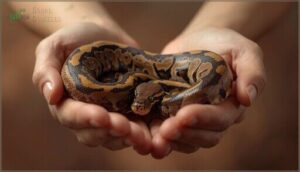
Touch tells you a lot more than you might think. When a snake is genuinely comfortable, its body gives clear, honest feedback the moment your hands make contact.
Here’s what to look for.
Muscles Not Tensing or Locking
Touch tells the whole story. A snake with Relaxed Muscle Tone won’t feel like a rope pulled tight — its body shows Calm Posture and Fluid Movement across your hands. These Reduced Stress signals confirm comfort through snake behavior and body language.
The following signs are indicative of a comfortable snake:
- Muscles stay soft, not board-stiff
- Gentle Weight drapes naturally across your palms
- No rigid bracing against your fingers
- Body bends smoothly when you shift hands
- Zero defensive behaviors or stress signs present
No Sudden Pulling Away
Willingness says everything. When your snake stays in steady contact with your hands instead of retreating, that’s relaxed snake behavior in real time. Stable settling — landing on your arm and actually staying — is one of the clearest signs of snake comfort. Gentle draping follows naturally.
| Body Language Signal | What It Means | What To Do |
|---|---|---|
| No sudden pulling away | Tolerating handling well | Continue calmly |
| Steady contact maintained | Understanding your snake’s body language | Keep sessions short |
| Gentle draping over hands | Relaxed snake behavior | Reward with stillness |
Absence of Stress Signals

Sometimes the clearest sign your snake is ready to be handled isn’t what it does — it’s what it doesn’t do. A relaxed snake simply won’t bother with certain behaviors that show up when something feels off.
Watch for the absence of signals and the absence of these two telling signals.
No Rubbing Nose or Cage Surfing
Two quiet signs your snake feels at home: no nose rubbing and no cage surfing. When you’re not seeing those stress signs, the enclosure design is doing its job.
Your snake isn’t pressing against glass searching for an exit — it’s settled. That’s a genuine handling readiness signal, confirming a stress-free environment where safe snake handling techniques can actually work.
No Tail Rattling or Vibrating
A quiet tail speaks volumes. When your snake doesn’t rattle or vibrate during your calm approach, that’s tail behavior telling you it doesn’t feel threatened. It’s one of the clearest low stress signals you’ll spot.
Watch for these signs during gentle handling:
- Tail lies loosely, not buzzing against the substrate
- No defensive behaviors like sudden tail shaking
- Snake comfort stays steady as you reposition it
- Stress signs stay absent from start to finish
- Handling techniques feel smoother and more predictable
Gradual Increase in Handling Tolerance
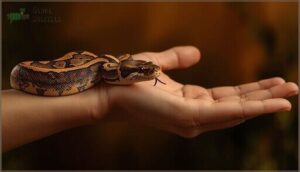
Handling tolerance doesn’t happen overnight — it builds slowly, session by session.
The good news is that snakes actually show you when they’re getting more comfortable, if you know what to look for. Here are the clearest signs that your snake is becoming easier to handle over time.
Becoming Calmer Over Time
Trust isn’t built overnight — it grows through calm, consistent Handling Routines. With patient Gentle Interaction and smart Calming Techniques, Snake Trust builds gradually. You’ll notice real Stress Reduction over weeks.
| Week | Snake Behavior | What It Means |
|---|---|---|
| 1–2 | Stiff, quick movements | Still adjusting |
| 3–5 | Slower, fluid motion | Gaining comfort |
| 6+ | Loose, relaxed draping | Trust established |
Less Defensive Reactions During Handling
As defensive behavior fades, you’re seeing real progress. Fewer hisses, no S-curve rearing, no frantic escaping — that’s your snake’s body language saying it trusts you.
Gentle Support and consistent Handling Techniques create Calm Environments where Reduced Stress becomes the norm. Snake Comfort doesn’t appear overnight, but when stress signals disappear and handling safety becomes second nature, both of you finally relax together.
Environmental Factors Supporting Handling

Before your snake even leaves its enclosure, the space it lives in sets the tone for everything. A comfortable, well-set-up habitat makes a snake far more likely to be calm and receptive when you reach in.
Here’s what to get right on the environmental side.
Proper Temperature and Humidity
Your snake’s mood starts long before you open the lid. A proper temperature gradient — warm side around 88–92°F, cool side near 78–80°F — keeps metabolism steady and stress low.
Pair that with humidity targets matching your species needs (65–75% for corn snakes, 60–70% for ball pythons), and use digital monitoring tools to catch any environmental stress before it affects your handling sessions.
Secure Hides and Spacious Enclosure
Beyond temperature and humidity, your enclosure design itself shapes how your snake feels about you. Give it at least two snug hides — one on each end — so it can thermoregulate without feeling exposed.
Make sure hide fit is tight enough that it touches the walls. Match enclosure length to your snake’s body, add vertical space for climbing, and watch the defensive behavior fade.
Frequently Asked Questions (FAQs)
How often should I handle my pet snake?
Most healthy pet snakes thrive with handling frequency of one to three times per week. That balance fosters snake socialization while giving your animal proper rest — a core part of responsible, gentle interaction and stress reduction.
What age is best to start handling snakes?
Most keepers begin snake socialization after a hatchling completes two or three successful meals. Age considerations matter less than readiness — calm feeding habits and settled behavior signal it’s time.
Can snakes recognize their owners over time?
Sort of — but not the way your dog does. Pet snakes rely on Snake Scent Recognition and Repeated Exposure to build Owner Familiarity over time, developing Handling Trust through scent, not social bonding.
Should I handle my snake before or after feeding?
Think of snake digestion like a slow cooker — don’t lift the lid. Always handle your pet snake before feeding or wait 48 hours after, to avoid regurgitation risk and food stress.
How do I handle an aggressive snake safely?
Use a snake hook first, stay calm, and approach from the side. Recognize defensive postures early — an S-coil or tail buzzing means pause.
Short sessions and slow movements are your safest stressed snake handling techniques.
Conclusion
Snakes don’t beg for attention—but they do ask for it, quietly. Once you recognize the signs your snake wants handling, every session stops being a guessing game and becomes a conversation you actually understand.
A tense, retreating snake is telling you something. So is a loose, curious one moving toward your hand. Trust what you’re seeing. When you read your snake clearly, you stop managing an animal and start connecting with one.
- https://www.allanglescreatures.com/blogs/news/how-to-handle-and-tame-your-corn-snake-safely
- https://reptifiles.com/corn-snake-care-guide/corn-snake-handling-body-language
- https://www.youtube.com/playlist?list=PLNbZzsRecQ2YLFGFvQlEiEtHvwdhA2vX-
- https://www.wilbanksreptiles.com/blogs/ball-python/ball-python-body-language-and-mood-guide
- https://www.beginnersnakes.com/how-to-tell-if-a-snake-is-stressed/