This site is supported by our readers. We may earn a commission, at no cost to you, if you purchase through links.

corn snake strike moves faster than most students can blink—and bare fingers are no match for that reflex.
Classroom reptiles offer powerful learning opportunities, but feeding time carries real risks that even experienced handlers respect.
The right tool changes everything.
Snake feeding tongs for classroom reptile care keep students at a safe distance, reduce reptile stress, and eliminate the guesswork of hand‑feeding.
Six inches of stainless steel between a hungry ball python and a student’s fingers isn’t just smart—it’s standard.
Knowing which tongs actually perform under daily classroom conditions separates a smooth feeding routine from a chaotic one.
Table Of Contents
Key Takeaways
- Tong length should match your snake’s size — 8–10 inches for small snakes, up to 24 inches for larger or fast‑striking ones — because that gap between hand and jaw is your first line of defense.
- Stainless steel beats bamboo in classroom settings: it resists moisture, cleans faster, and outlasts multiple bamboo replacements without weakening at the tips.
- Rubber tips protect the snake’s mouth during aggressive strikes and make first feeding demos less intimidating for younger students, but metal tips resist bacteria buildup better over time.
- Safe feeding goes beyond the right tool — dedicated tongs per enclosure, a hot rinse after every use, and a 48‑hour no‑handle window post‑feeding are non‑negotiables for student and reptile safety.
Key Features of Classroom Snake Feeding Tongs
Not all feeding tongs are built the same, and in a classroom setting, the difference really matters.
Knowing what separates a good pair from a frustrating one is easier when you have a solid beginner’s guide to feeding tongs to reference before you buy.
The right pair does more than just hold a mouse — it keeps students safe, keeps your snake calm, and holds up after dozens of uses. Here’s what to look for before you buy.
Serrated Grip and Rubber Tips for Safety

Serrated jaws on quality snake feeding tongs do two jobs at once — they lock onto prey with real traction control and keep your hands a safe distance from the strike zone. Rubber tip covers mouth protection, cushioning each hit so teeth stay intact.
Together, they nail pressure distribution and prey stability, making reptile feeding safety equipment that actually earns its place in any classroom. The rubber‑coated ends protect the snake’s mouth during aggressive strikes.
Curved Vs. Straight Jaw Designs
Once you’ve nailed grip, jaw shape becomes your next call.
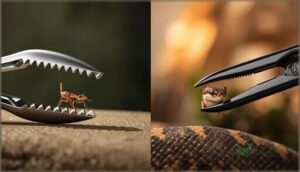
Curved jaws cradle prey naturally — great wrist mechanics mean small rolls keep slippery feeders aligned.
Straight jaws point exactly where your grasp aims, making visual demonstration simple for students.
For pressure distribution and prey compatibility, curved wins with insects; straight holds firm rodents cleanly.
Both use serrated tips or rubber tip covers depending on your ergonomic design preference.
Stainless Steel Durability and Corrosion Resistance

Jaw shape sorted — now think about what those jaws are made of. Most quality snake feeding tongs use 304 stainless steel, the same high durability materials found in aircraft grade applications. Its passive film self-repair mechanism means light scratches don’t turn into rust.
Stay within the chloride pitting threshold — rinse tongs after use — and fatigue life cycles stretch into the billions. Metal durability, handled right.
Non-slip and Ergonomic Handles

Steel sorted — now think about what’s holding it. Ribbed Grip Textures molded into the handle keep your fingers anchored even with damp gloves on. A silicone sleeve benefits setup adds tactile feedback without bulk. Angled Handle Design reduces wrist strain during longer sessions.
- Pressure-Responsive Triggers for smooth, controlled jaw movement
- Thumb Lock Mechanism to hold prey without constant squeezing
- Nonslip handle ergonomics that support lighter grips for smaller hands
Consider the durability of stainless steel feeding tongs for reliable classroom use.
Benefits for Student Safety and Reptile Comfort
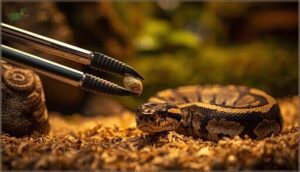
Every feature here pulls double duty — protecting students and keeping your snake calm. Tongs hold prey at a safe distance, so heat‑sensing strikes never find fingers. Rubber tips cushion impact. Consistent routines reduce reptile anxiety over time.
| Student Safety | Reptile Comfort |
|---|---|
| Bite prevention via 15-inch reach | Rubber tips protect oral tissue |
| Hygiene protocols limit pathogen transfer | Stress reduction through distance feeding |
| Ergonomic comfort reduces fatigue | Precise prey placement triggers instincts |
| Safe distance from strike zone | Animal comfort preserved during feeds |
| Ergonomic design facilitates control | Minimal handling trauma overall |
Choosing The Right Feeding Tongs
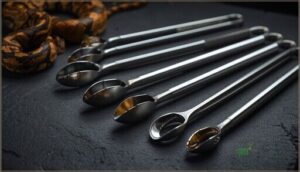
Not every pair of tongs works for every snake, and using the wrong one can make feeding time harder than it needs to be.
A few key factors — length, jaw type, material, and grip — make a real difference in how safe and smooth the process goes.
Here’s what to look for before you pick up a pair.
Matching Tong Length to Snake Size
Tong length isn’t a minor detail — it’s your first line of defense. Match it to your snake’s size and you’ve already solved half the safety equation.
A longer tong paired with a calm, handleable species — like those listed among snake morphs suitable for children — makes the whole experience far less intimidating from the start.
- 8–10 inches for small snakes under 2 feet
- 12–16 inches for classroom snakes between 2–4 feet
- 18–24 inches for larger or fast‑striking individuals
Longer reptile feeding tongs create a reliable strike zone buffer, keeping students’ hand reach safely outside the enclosure while still delivering feeding accuracy.
Selecting Jaw Type for Various Prey
The jaw type you choose shapes everything — prey placement, feeding accuracy, and how well your snake actually strikes.
Wide flat jaws handle thawed mice without crushing them. Narrow precision jaws nail prey size matching for small feeders like pinkies or crickets. Rubber tip covers improve texture compatibility on slick, thawed prey. Curved jaws naturally support species‑specific preferences, especially for fast‑striking or reluctant feeders.
Material Considerations: Stainless Steel Vs. Bamboo
Stainless steel wins on durability, hygiene, and recycling potential — one pair can outlast several bamboo alternatives. Bamboo sustainability is real, but moisture absorption weakens the tips over time. Sensory comfort slightly favors bamboo since its lower thermal conductivity keeps it warmer in cool labs.
Either way, prioritize material safety and ergonomic design. For busy classrooms, stainless steel’s smaller long-term manufacturing footprint makes it the smarter investment.
Rubber Tips Vs. Metal Tips
Rubber or metal? It’s a real trade-off worth thinking through.
- Bite Impact & Student Perception — Rubber tips cushion hard strikes and look less intimidating, making first feeding demos smoother for younger students.
- Grip Friction — Rubber grips thawed rodents better; serrated tips on stainless steel release prey more cleanly once the snake latches on.
- Safety and Hygiene — Metal tips resist bacteria buildup better; rubber surfaces trap fur and fluids in textured seams.
- Cost Longevity & Noise Levels — Stainless steel outlasts rubber coatings considerably and produces less clinking against glass.
Ergonomic Design for Frequent Classroom Use
Ergonomic design isn’t a luxury — it’s what keeps feeding sessions from turning into a wrist workout. Angled grips deliver real wrist relief by matching your hand’s natural posture, while non-slip rubber grips lock in grip comfort even on sweaty hands.
Balanced weight distribution prevents arm fatigue across long demos. Add thumb lock safety and spring tension that auto-opens jaws, and these snake feeding tongs practically do the work for you.
Top 6 Snake Feeding Tongs for Classrooms
Not all feeding tongs are built the same, and in a classroom setting, that difference really matters.
The six options below were chosen for their grip, durability, and ease of use — qualities that hold up through daily handling by students.
Here’s what made the cut.
1. Vodolo 15 Inch Snake Feeding Tongs
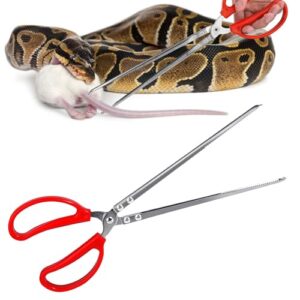
The Vodolo 15 Inch Snake Feeding Tongs are a solid pick for classroom settings. At 15.51 inches, they keep your hands well outside strike range for corn snakes and ball pythons.
The stainless steel construction resists rust and wipes clean fast between classes — no excuses for skipping sanitation.
The silicone handle feels secure even during longer feeding demos.
One heads-up: the handle runs a bit thick, so smaller hands may need a few sessions to get comfortable.
| Best For | Teachers, reptile hobbyists, and first-time snake owners who want a safe, comfortable way to hand-feed without getting too close. |
|---|---|
| Material | Stainless Steel & Silicone |
| Serrated Tips | Yes |
| Length | 15 inches |
| Reptile Compatible | Yes |
| Non-slip Handle | Yes |
| Aquarium Use | Yes |
| Additional Features |
|
- At 15 inches, your hands stay well out of strike range — great for nervous feeders
- Stainless steel won’t rust and cleans up fast, which matters if you’re doing this regularly
- The silicone handle gives you a solid, secure grip even mid-feeding
- The serrated ridges are pretty deep, which can feel awkward until you get used to them
- The handle is on the thicker side, so smaller hands may find it uncomfortable at first
- Not safe for handling snakes directly — the toothed tips are for food only
2. Fri4Free Long Aquarium Tweezers
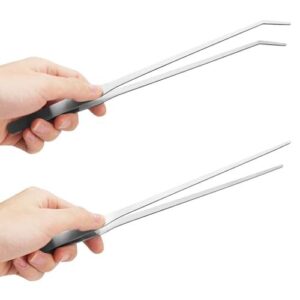
If 15 inches feels like more reach than you need, the Fri4Free Long Aquarium Tweezers offer a 10.6‑inch alternative that still keeps your hand clear of strike range.
The stainless steel build supports both saltwater and freshwater tanks, so it doubles for aquarium maintenance between feeding sessions.
You get straight and curved options in the set.
The serrated tips grip worms and small prey firmly.
Just note — users report the shaft can bend under pressure with heavier feeders.
| Best For | Hobbyists who want a versatile, mid-sized tweezer for feeding fish, reptiles, or amphibians and keeping up with aquascaping in smaller tanks. |
|---|---|
| Material | Stainless Steel |
| Serrated Tips | Yes |
| Length | 10.6 inches |
| Reptile Compatible | Yes |
| Non-slip Handle | No |
| Aquarium Use | Yes |
| Additional Features |
|
- Comes with both straight and curved options, so you’ve got the right angle for any spot in your tank
- Serrated tips hold worms and small prey without slipping
- Stainless steel works in both saltwater and freshwater setups
- The shaft can bend under pressure, so it’s not great for heavier feeders
- May struggle to grip certain items, like frozen rat pinkies
- Not built for heavy-duty tasks that need real force or precision
3. EvaGO Black Curved Aquarium Tweezers
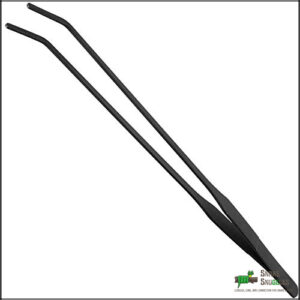
When you need a little more reach, the EvaGO Black Curved Aquarium Tweezers deliver — all 15 inches of forged stainless steel with a black rust-resistant coating that holds up in humid terrariums.
The curved tip lets you angle prey toward a shy snake’s mouth from above or the side, and the serrated grip keeps feeder insects or pinkie mice from slipping mid‑strike.
The anti‑skid handle works for both right‑ and left‑handed students without strain.
| Best For | Anyone feeding or handling shy, small, or tricky pets like snakes, bearded dragons, or tarantulas who needs extra reach and a secure grip. |
|---|---|
| Material | Stainless Steel |
| Serrated Tips | Yes |
| Length | 14.96 inches |
| Reptile Compatible | Yes |
| Non-slip Handle | Yes |
| Aquarium Use | Yes |
| Additional Features |
|
- At nearly 15 inches, you get plenty of distance between your hand and whatever’s on the menu
- The curved, serrated tip keeps feeders from slipping — no fumbling mid-strike
- Forged stainless steel with a rust-resistant coating holds up well in wet or humid setups
- Some users found them stiff or hard to close smoothly right out of the box
- The angle can be awkward for certain insects like moths or arachnids
- Takes a bit of practice to get comfortable with the feel and weight
4. Heavy Duty Stainless Steel Snake Feeding Tongs
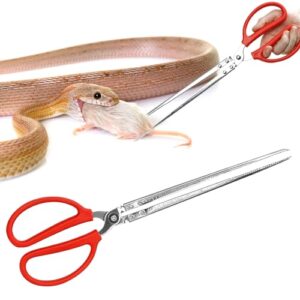
If grip strength and jaw stability matter to your classroom setup, heavy duty stainless steel feeding tongs are worth serious consideration. The thicker gauge metal means the jaws won’t flex when holding jumbo mice or small rats — no awkward mid‑feed fumble.
At 15 inches, students keep a safe distance without losing control. Serrated tips hold slippery thawed prey securely, and the non‑slip grips stay steady even with nervous hands. Just dry them thoroughly after each wash to prevent rust spots.
| Best For | Teachers and reptile keepers who need safe, reliable feeding tools for snakes, lizards, or other reptiles — especially in classroom or multi-handler settings. |
|---|---|
| Material | Stainless Steel |
| Serrated Tips | Yes |
| Length | 15 inches |
| Reptile Compatible | Yes |
| Non-slip Handle | Yes |
| Aquarium Use | Yes |
| Additional Features |
|
- At 15 inches, you stay at a comfortable distance while keeping full control during feeding
- Serrated tips grip slippery thawed prey without dropping it mid-feed
- Heavy-duty stainless steel holds its shape even with larger feeders like jumbo mice or small rats
- Can rust if you don’t dry them thoroughly after washing
- Some units arrive bent or with uneven tips, which makes gripping food a real hassle
- The length takes some getting used to — grip strength and hand positioning matter more than you’d expect
5. OLIISS Stainless Steel Reptile Feeding Tongs
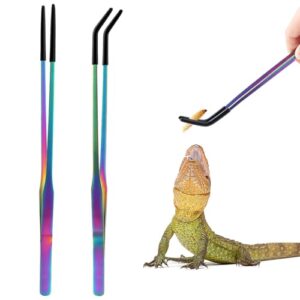
The OLIISS set gives you two tools in one purchase — a straight tweezer and a curved one, both 10.6 inches long.
That’s enough reach to keep student hands outside a typical classroom snake tank while still placing food precisely.
The stainless steel body resists rust in humid terrariums, and the rubber tips grip thawed pinkies or mealworms without harsh metal contact on a reptile’s mouth.
You can also use these to move plants or pull shed skin.
Practical and easy to clean.
| Best For | Reptile owners, classroom pet keepers, and aquarium hobbyists who want a safe, hygienic way to feed and handle animals without getting too close. |
|---|---|
| Material | Stainless Steel |
| Serrated Tips | No (rubber tips) |
| Length | 10.6 inches |
| Reptile Compatible | Yes |
| Non-slip Handle | No |
| Aquarium Use | Yes |
| Additional Features |
|
- Two tweezers in one pack — straight and curved — so you’ve got the right tool for different angles and tank setups
- At 10.6 inches, there’s plenty of reach to keep your hand away from a nervous or hungry reptile
- Stainless steel holds up well in humid environments and cleans up easily
- The rubber tips can wear down over time and may need replacing
- On the heavier side, so not ideal if you want something lightweight for extended use
- Some users find the grip a bit slippery, though the silicone tips do help
6. WORFACE 15 Inch Reptile Feeding Tongs
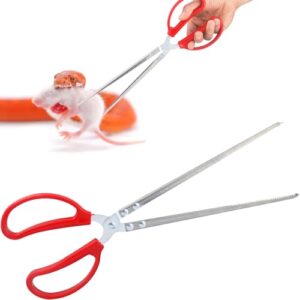
WORFACE 15-inch tongs give you the most reach on this list — enough to keep hands well outside a ball python’s strike zone without losing control of the prey.
The smooth serrated jaws grip thawed mice firmly without crushing them, and the rubber tips protect both the reptile’s mouth and your glass tank walls.
Available in straight or curved, so you can match the jaw shape to your enclosure setup.
Stainless steel means easy disinfection between classes.
Simple, durable, and classroom-ready.
| Best For | Teachers, reptile hobbyists, and new snake owners who want a safe, no-fuss way to feed their reptiles without risking a bite. |
|---|---|
| Material | Stainless Steel |
| Serrated Tips | Yes |
| Length | 15 inches |
| Reptile Compatible | Yes |
| Non-slip Handle | Yes |
| Aquarium Use | Yes |
| Additional Features |
|
- Stainless steel build makes it easy to clean and disinfect between uses
- Smooth serrated jaws hold prey firmly without crushing or damaging it
- Available in straight and curved styles to fit different tank setups
- 15 inches may still feel too short for owners of larger, more aggressive snakes
- Not ideal for feeding very large or heavy prey items
- Only comes in one size, so there’s no option to size up if needed
Safe and Hygienic Feeding Practices
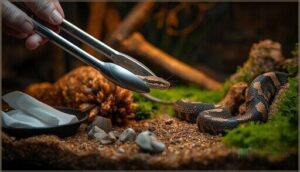
Feeding time in a classroom comes with real responsibility — for the snake and for the students watching. The right tongs are only half the equation; how you use and maintain them matters just as much.
Here’s what every teacher and student handler should know before the next feeding session.
Preventing Bites and Scratches During Feeding
Bites rarely happen by accident — they happen because someone got too close at the wrong moment. Operator Positioning matters more than most people realize. Keep a safe distance of 30–45 cm from the strike zone, angle prey slightly downward, and train students before they ever touch the tongs.
- Distance Management: Stay outside typical strike range
- Prey Angle: Tilt tips down to guide bites onto soft tissue
- Student Training: Only trained handlers should operate tongs near the enclosure
Reducing Cross-contamination and Germ Spread
Reptiles can carry Salmonella even when they look perfectly healthy — that’s not scare talk, it’s just biology.
Use dedicated tongs per enclosure and follow labeling protocols so tools never cross between animals.
Storage practices matter too: keep used and clean tongs separated.
Hand hygiene after every feeding session stops contamination cold.
Prey sanitization and consistent disinfection close the loop on germ spread.
Proper Cleaning and Maintenance of Tongs
Clean tongs are non-negotiable. Start with a hot rinse — 160°F loosens blood and tissue fast.
Use Dawn dish soap for soap selection, scrubbing for 20–30 seconds with a soft sponge.
For disinfection timing, soak in 70% isopropyl alcohol for one minute post-wash. Then air dry completely before storage.
Check rubber tips weekly — that’s your inspection frequency baseline for long-term hygiene and maintenance.
Safe Handling Protocols for Students and Staff
Safe handling isn’t just about technique — it’s about building habits that protect everyone in the room.
- Student Training Modules should cover grip placement, pressure monitoring, and strike zone awareness before any live feeding.
- Follow supervision guidelines: staff observe every session, no exceptions.
- Keep safe distance — 15‑inch tongs maintain 1–1.5 meters from the head.
- Practice distance management and handling techniques with rubber snakes first.
- Know your emergency response plan if a bite occurs.
Enhancing Classroom Reptile Care With Feeding Tongs

The right feeding tongs don’t just make mealtimes safer — they shape how students interact with reptiles every single day.
Consistent routines, calmer animals, and more confident handlers all start with having the proper tools in hand.
Here’s how feeding tongs can genuinely improve your classroom reptile program.
Reducing Stress for Reptiles and Handlers
Feeding goes smoother when both the snake and the handler feel secure. Tongs keep your hands 12–24 inches away — well outside the strike zone — while black matte finishes act as Calming Visual Cues that prevent defensive reactions.
Wide polymer jaws support Low-Noise Handling and Gradual Desensitization over time.
| Stressor | Tong Solution |
|---|---|
| Handler anxiety | Safe distance via longer tongs |
| Reptile startle response | Reflection-free, quiet feeding environment |
Promoting Consistent Feeding Routines
snake care is what makes snake care work in a classroom. Post Feeding Schedule Visuals on the enclosure — juveniles eat every 5–7 days, adults every 10–14 days. Use Standardized Tong Technique and Environment Cue Consistency to signal feeding time reliably.
- Student Role Rotation for tong handling, recordkeeping, and observation
- Log prey placement, strike response, and handling techniques each session
- Use Recordkeeping Automation via shared spreadsheets to maintain feeding routines
Improving Educational Experiences With Safe Tools
Good recordkeeping sets the stage, but the right tools take learning further. Feeding tongs turn routine care into interactive demonstrations where students actually see strike mechanics, constriction, and swallow times up close.
That hands-on skill development sticks far better than any textbook diagram. With proper snake feeding tongs selection, curriculum integration feels natural — and student confidence building happens almost automatically.
Encouraging Responsible Reptile Care Habits
Tongs don’t just make feeding safer — they teach students that animal welfare starts with every small decision.
Feeding tongs teach students that animal welfare begins with every small decision
Assign Feeding Schedule Tracking and Observation Journaling as weekly tasks to build Student Accountability.
Use Peer Training Programs so experienced students coach newcomers on snake feeding tongs use, proper tool usage and hygiene, and feeding tongs maintenance and care.
Add Habitat Enrichment checks to round out real-world reptile care.
Frequently Asked Questions (FAQs)
How often should classroom snakes be fed?
Think of a snake’s feeding schedule as its internal clock — miss it too often, and things go sideways.
Most classroom snakes eat every 7 to 14 days, depending on age, species, and metabolism.
What prey sizes are safe for juvenile snakes?
Aim for prey that’s roughly 10% of your juvenile’s body weight and no wider than the snake’s thickest mid-body point. Staying within that width guideline protects digestion and keeps feeding stress-free.
Can students handle snakes after feeding sessions?
Wait at least 48 hours after feeding before letting students handle snakes.
Digestion timing matters — rushing it risks regurgitation and stress.
Watch for hissing or rapid tongue flicking as clear stress indicators.
How should uneaten prey items be disposed of?
Remove uneaten thawed prey within 15 minutes.
Spray with disinfectant, double‑bag using leak‑proof containers, and follow your classroom waste protocol.
This prevents salmonella spread and keeps your bio‑bag disposal hygienic and infection control standards intact.
Which snake species are best suited for classrooms?
Corn snakes and ball pythons top the list.
Both have Gentle Temperament, compact Adult Size, simple Enclosure Needs, reliable Feeding Habits, and strong Lifespan Expectations — making snake care low‑stress for any classroom.
Conclusion
Funny how the smallest tool in your classroom cabinet carries the most weight. A simple pair of snake feeding tongs for classroom reptile care quietly does what no safety lecture fully can—it removes the moment where instinct beats training.
Students learn faster when fear isn’t in the room.
Tongs keep the snake calm, the fingers safe, and the lesson on track.
Respect the animal. Use the right tool. Everything else follows.
- https://talis-us.com/blogs/news/reptile-feeding-tongs-essential-tools-for-proper-reptile-nutrition
- https://www.deerhuntingtool.com/blogs/news/safety-precautions-before-using-a-snake-tong
- https://www.anapsid.org/handlingreptiles.html
- https://www.acornnaturalists.com/products/animal-worlds/amphibians-reptiles/reptile-snake-hooks-handling-equipment.html
- https://www.petsmart.com/reptile/feeders-and-food-storage/feeding-accessories