This site is supported by our readers. We may earn a commission, at no cost to you, if you purchase through links.

Your ball python spent millions of years evolving in the warm grasslands of West Africa, where ground temperatures stay reliably toasty and nighttime lows rarely dip below 75°F. Now it’s living in a glass box in your home, counting on you to recreate those conditions with the right heating setup. Get it wrong, and you’re looking at respiratory infections, digestion problems, and a stressed snake that won’t eat.
The good news? Snake heating pads for ball pythons have come a long way from the unreliable hot rocks of decades past. Today’s under-tank heaters deliver steady, controllable warmth when paired with proper thermostats and placement strategies.
Whether you’re setting up your first enclosure or upgrading an existing setup, understanding how these heating systems work—and which products actually deliver safe, consistent heat—makes the difference between a thriving python and costly vet visits.
Table Of Contents
Key Takeaways
- Ball pythons need a precise thermal gradient of 88-92°F on the warm side and 75-80°F on the cool end, which requires under-tank heating pads covering 25-40% of the enclosure floor paired with a reliable thermostat to prevent burns and maintain proper digestion.
- A thermostat isn’t optional equipment—it’s your snake’s life insurance policy that automatically cycles heat to prevent dangerous temperature spikes that can cause burns or metabolic problems within hours.
- You’ll need at least two digital thermometers positioned at snake-body level (one warm side, one cool side) plus monthly calibration checks to catch temperature drift before it compromises your python’s health.
- Heating pads should be replaced every 12-24 months and inspected monthly for cracks or adhesive failure, because even small malfunctions can create life-threatening hot spots or temperature drops overnight.
Top 5 Snake Heating Pads for Ball Pythons
You need the right heating setup to keep your ball python healthy, but sorting through all the options can feel overwhelming. I’ve spent years working with reptiles in clinical practice, and I know which products actually deliver safe, consistent heat.
Let me walk you through five solid choices that’ll help you create the perfect warm environment for your snake.
1. Reptile Thermometer And Humidity Gauge
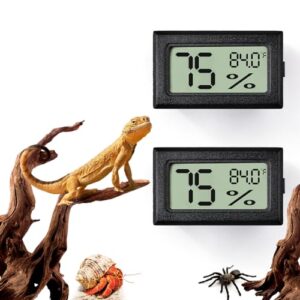
Accurate temperature sensors make all the difference when you’re setting up a proper thermal gradient for your ball python. A reliable reptile thermometer tracks both heat and humidity in real time, so you’ll know exactly what your snake experiences on the warm side versus the cool side.
Look for digital displays with fast response times and probe placement away from direct heat sources. Calibration methods help you verify readings stay within that essential 88-92°F range, preventing guesswork and keeping temperature regulation spot-on for healthy reptile care.
| Best For | Reptile owners who need an affordable, easy-to-read digital solution for monitoring temperature and humidity in small to medium enclosures. |
|---|---|
| Primary Use | Reptile environment monitoring |
| Material | Resin |
| Power Source | Battery (1.5V) |
| Quantity | 2 pieces |
| Color | Black |
| Target Species | Multiple reptiles |
| Additional Features |
|
- Fast 5-second response time with clear digital display makes it easy to check conditions at a glance
- Compact size with sticky pad lets you place monitors in multiple spots to track thermal gradients
- Comes in a 2-pack so you can monitor both warm and cool zones without buying extras
- Some users report humidity readings can be off by more than the stated ±5% accuracy
- Fragile construction means you need to handle it carefully during cleaning or enclosure maintenance
- No batteries included and limited to Fahrenheit only, which might require extra prep or conversion for some users
2. Leoterra Ball Python Hide
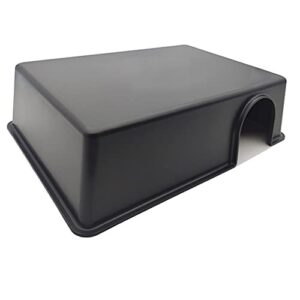
While precise monitoring sets the stage, your ball python also needs a warm retreat where it can curl up and feel secure. The Leoterra hide combines shelter with localized heating, giving your reptile a cozy spot that aids thermal regulation without complicated installation.
Measuring 16.5″×10.6″×4.3″, it fits adult snakes comfortably and promotes natural hide behavior. The smooth plastic design improves humidity retention inside while staying easy to clean.
Just remember—heat distribution depends on your substrate choice and overall enclosure design, so pair this hide with a thermostat to keep temperatures safely within your snake’s comfort zone.
| Best For | Ball python owners who want a hide that doubles as a warm retreat and improves humidity retention in their enclosure. |
|---|---|
| Primary Use | Snake hiding spot |
| Material | Plastic |
| Power Source | None required |
| Quantity | 1 piece |
| Color | Black |
| Target Species | Ball pythons and snakes |
| Additional Features |
|
- Combines shelter with localized heating to create a cozy, thermo-regulating hideout
- Smooth plastic design with a top seal improves humidity while staying easy to clean
- XL size (16.5″×10.6″×4.3″) fits adult ball pythons comfortably and encourages natural curling behavior
- Heat distribution varies by substrate and setup, so you’ll need a separate thermostat for safe temperature control
- Some owners find it pricey for what amounts to a plastic hide with basic heating
- Too large for smaller snakes under 150g—you’ll need a different size for juveniles
3. Digiten Reptile Temperature Controller Thermostat
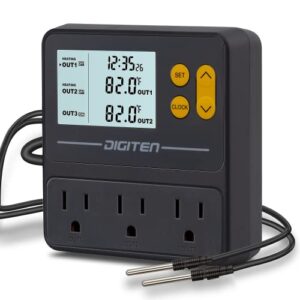
Once you’ve got your hide settled, you’ll need reliable temperature control—and that’s where the Digiten thermostat steps in. This plug-and-play controller pairs with undertank heaters or heat tape to maintain your ball python’s thermal gradient precisely.
You’ll set day and night temperature probes within 14–248°F, and the LCD confirms sensor accuracy at a glance. Two outlets handle heat sources, while a third controls lighting schedules. Calibration is straightforward, though reports on durability vary.
Pair it with your heat source for consistent, worry-free reptile thermostat performance.
| Best For | Ball python owners who want precise day/night temperature control for their heat mats without dealing with complicated programming. |
|---|---|
| Primary Use | Temperature control system |
| Material | Plastic housing |
| Power Source | AC plug-in |
| Quantity | 1 unit |
| Color | Black |
| Target Species | Multiple reptiles |
| Additional Features |
|
- Three outlets let you manage heating and lighting separately, so you can set different temps for day and night cycles
- Wide temperature range (14–248°F) with dual probes gives you flexibility for various reptile setups beyond just ball pythons
- Plug-and-play design means you can get it running quickly without needing advanced technical skills
- Reliability is hit-or-miss—some units stop working after a few weeks while others last years
- Temperature outlets don’t have day/night programming, only the timer outlet does, which limits your automation options
- Probes aren’t waterproof, so you need to keep them away from water dishes and high-humidity spots
4. Reptile Red Heat Lamp Bulbs
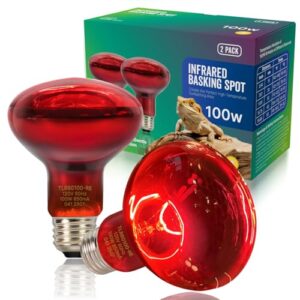
Red heat lamp bulbs offer a different approach to reptile heating than your thermostat-controlled heat pad alone. These bulbs emit long-wave infrared heating that warms your ball python’s basking spot without disrupting sleep cycles—the red light is barely visible to your snake.
You’ll want 50–100W depending on enclosure size, mounted above one end to create proper heat distribution. Always pair them with a thermostat for temperature control, and inspect regularly for cracks.
They’re excellent supplements to under-tank heating pads, ensuring your reptile can thermoregulate comfortably day and night. Heat lamp safety means checking bulb replacement schedules too.
| Best For | Ball python owners who need supplemental nighttime heating that won’t disrupt their snake’s day-night cycle or stress them with bright lights. |
|---|---|
| Primary Use | Reptile heating lamp |
| Material | Glass |
| Power Source | Electric bulb |
| Quantity | 2 pack |
| Color | Infrared |
| Target Species | Multiple reptiles |
| Additional Features |
|
- Emit long-wave infrared heat that’s barely visible to reptiles, making them perfect for 24/7 use without disturbing sleep patterns
- Create focused basking spots with proper temperature gradients when mounted above one end of the enclosure
- Work great alongside heat pads to give your snake multiple ways to thermoregulate throughout the day and night
- Bulbs may need replacement within a year depending on how often you use them, so keep spares on hand
- Require careful placement and a thermostat to prevent overheating or accidental burns to your reptile
- Can dry out substrate faster than other heating methods, which means you’ll need to monitor humidity levels more closely
5. Infrared Heat Lamp Bulb For Reptiles
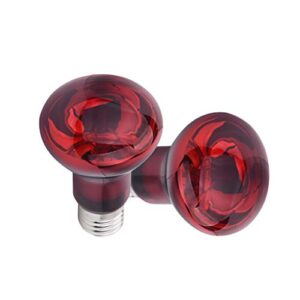
Infrared bulbs deliver wavelike warmth your ball python feels deeply without flooding the enclosure with harsh light. These 60–100W reptile lighting options work beautifully for night heating, letting your snake bask comfortably while you observe without disturbing its rest.
Mount them above the warm end to achieve proper thermal gradients and heat distribution, always using a thermostat for temperature control.
Pair infrared heat lamp fixtures with your heat pad for well-rounded reptile heating—you’ll create the stable environment ball pythons need to digest, move, and thrive year-round.
| Best For | Ball python owners who need reliable nighttime heating that won’t disrupt their snake’s natural dark cycle while maintaining proper basking temperatures. |
|---|---|
| Primary Use | Reptile heating lamp |
| Material | Glass |
| Power Source | 110V-130V AC |
| Quantity | 2 bulbs |
| Color | Red |
| Target Species | Multiple reptiles |
| Additional Features |
|
- Provides infrared warmth without bright light, perfect for observing and heating nocturnal reptiles without disturbing their rest
- Long 25,000-hour lifespan means fewer replacements and better value over time compared to standard heat bulbs
- Standard E26 base fits most reptile fixtures easily, and the 100W output creates effective basking spots for proper temperature gradients
- Some users report bulbs burning out much faster than the advertised lifespan, suggesting inconsistent quality control
- May not generate enough heat for larger enclosures or very cold rooms without supplemental heating sources
- Requires a separate thermostat purchase to prevent overheating, adding to the overall setup cost
Choosing The Best Heating Pad Type
Not all heating pads are created equal, and picking the wrong type can leave your ball python too cold or, worse, at risk of burns. You’ll want to think about factors like installation method, durability, and whether the design actually meets a snake’s unique needs.
Let’s break down the main types so you can choose what works best for your setup.
Adhesive Heat Pads Vs. Heat Tape
You’ll find adhesive heat pads stick directly to your tank’s exterior, offering simple installation with minimal fuss. Heat tape, however, needs mounting hardware and precise placement for proper heat distribution.
While adhesive pads can lose their grip over time—especially in humid setups—tape installation gives you flexibility to customize coverage. Both require a thermostat for safe temperature control, but adhesive longevity varies depending on your enclosure’s conditions.
For best results, consider following proper scientific writing guidelines to document your findings.
Under-Tank Heaters and Heat Mats
Under-tank heaters sit beneath your enclosure, converting electrical energy into steady warmth that mimics a ball python’s natural basking behavior. Heat mat materials deliver consistent bottom heat—perfect for creating a thermal gradient your reptile needs to thrive. Here’s what makes them work:
- Glass or acrylic mounting guarantees even contact
- Enclosure insulation prevents heat loss
- Thermostat pairing guarantees temperature control
- Safety features protect against dangerous hotspots
To guarantee the accuracy of temperature control systems, researchers rely on scientific study audits to validate their findings.
Waterproof and Chew-Resistant Features
Your ball python’s heating pad faces a tough job—humidity spills and curious nibbles can ruin unprotected units fast. Look for IPX4-rated water resistance to handle cleaning splashes, plus silicone-coated cords that resist chewing.
Check cable entry points for solid seal integrity, since that’s where moisture protection fails first. Reinforced housings with polycarbonate casings pass durability testing better than standard models.
Reptile-Specific Design Requirements
Generic heat pads won’t cut it—reptile-specific designs deliver uniform warmth without dangerous hot spots. Your heat mat needs proper thermostat compatibility and mounting hardware that won’t warp glass or PVC enclosures.
These enclosure compatibility features separate reliable undertank heater models from risky alternatives.
- Moisture resistance prevents corrosion in humid ball python setups
- Predictable heat distribution maintains your thermal gradient systems
- Non-porous surfaces simplify cleaning with reptile-safe products
- Corrosion-resistant components withstand typical enclosure conditions
Proper Sizing and Placement Strategies
Getting the size and placement right makes all the difference between a healthy snake and an expensive vet visit. You can’t just slap a heating pad anywhere and hope for the best—your ball python needs specific temperature zones to digest food properly and stay comfortable.
Let’s walk through exactly how to set up your heating system so your snake can thrive.
Coverage Area and Enclosure Size

Your heat mat should cover about 25–40% of your enclosure’s floor space—think of it as creating a cozy warm corner rather than heating the whole room.
Smaller tanks (under 20 gallons) need less coverage, while larger setups (40+ gallons) require proportionally bigger heat mats for effective space allocation.
This setup gives your ball python control over its body temperature through proper thermal gradients.
Creating a Temperature Gradient

Once your heat mat is in place, you’re building thermal zones that let your snake thermoregulate naturally. Aim for 88–92°F on the warm side and 75–80°F on the cool end—this 10–15°F temperature gradient mimics the natural habitat and aids proper digestion.
Gradient stability depends on even heat distribution, so monitor multiple spots with a reliable thermometer to catch any temperature fluctuation early.
Mounting and Installation Tips
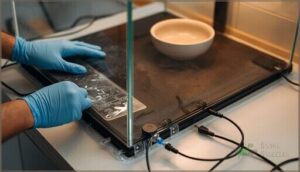
With your gradient dialed in, secure mounting keeps everything stable. Here’s how to install your heating pad safely:
- Affix the heat mat to the exterior using reptile-safe adhesive to prevent substrate moisture from loosening the bond.
- Route cords away from water bowls with cable channels to avoid chewing or electrical exposure.
- Check adhesive integrity weekly, especially after cleaning, so heat transfer stays consistent and your enclosure remains safe.
Substrate Selection for Optimal Heat Transfer

Once your heating pad is mounted, layer your substrate wisely. Ceramic tiles deliver excellent thermal conductivity and wipe clean easily, while coco chips retain moisture that can slow heat transfer.
Aim for thin, non-porous layers—thick bedding acts like insulation and blocks warmth. A stable setup gives your ball python reliable temperature control without hotspots or cold zones.
Temperature Control and Safety Essentials

Getting the temperature right is non-negotiable—your ball python’s health literally depends on it. Without proper controls in place, even the best heating pad can overheat and cause serious burns or fail completely when your snake needs it most.
Let’s walk through the essential safety gear and habits that’ll keep your python comfortable and protected.
Importance of Thermostats and Controllers
Think of a reptile thermostat as your snake’s life insurance policy—it cycles power to maintain temperature ranges within safe setpoints, protecting your python from dangerous overheating.
A reptile thermostat is your snake’s life insurance, automatically cycling heat to shield your python from dangerous temperature spikes
Modern controllers offer three key upgrades you’ll appreciate:
- Programmable profiles that mirror natural day-night temperature shifts
- Fault detection that shuts down malfunctioning heating elements automatically
- Multiple sensor inputs for precise heat distribution across the gradient
These safety features make temperature control foolproof, giving you peace of mind while your ball python thermoregulates comfortably.
Monitoring With Digital Thermometers
You’ll want at least two digital thermometers—one near the warm end and another on the cool side—to confirm your temperature gradient stays between 78–88°F.
Position probes at snake-body level, away from direct heat sources, for accurate sensor readings.
Log temperatures daily to spot trends, and recalibrate your devices quarterly to maintain reliable temperature control for your python’s thermoregulation needs.
Preventing Overheating and Burns
Temperature control isn’t just about comfort—it’s your python’s shield against heat stress prevention. Follow these burn prevention steps to safeguard your snake:
- Use a reptile thermostat with every heat source to guard against runaway temperatures
- Check for hot spots twice daily—heat source risks escalate fast
- Keep surfaces below 95°F through thermal monitoring with validated thermometers
- Maintain safe distance between your python and direct heat elements
- Install temperature guards or barriers to prevent accidental contact burns
Thermal management protects your temperature gradient and your snake.
Routine Maintenance and Troubleshooting
Every two weeks, inspect your heating pad for wear or edge lifting—small issues turn into safety hazards fast.
Calibrate your thermostat monthly against a digital thermometer to verify accurate temperature control for proper thermoregulation.
Clean enclosures with reptile-safe products every four weeks, and keep a maintenance log tracking your heat pad inspection dates and observations for reliable troubleshooting tips.
Frequently Asked Questions (FAQs)
Can ball pythons survive without a heating pad?
Ball pythons can survive without a heating pad if alternative heat sources maintain proper thermal gradients and ambient temperatures.
Studies show inadequate heat regulation disrupts digestion and compromises species survival through impaired thermoregulation.
How often should heating pads be replaced?
Most heating pads need replacement every 12–24 months, depending on wear indicators like cracking, inconsistent temperature control, or adhesive failure.
Inspect your heat mat monthly and swap it immediately if ball python thermoregulation suffers.
Do heating pads increase electricity bills significantly?
Most reptile heating pads draw just 5–40 watts, so your electricity bills won’t spike.
With a thermostat managing temperature control, monthly energy costs usually run under five dollars—minimal power consumption for reliable heat efficiency.
Are used or secondhand heating pads safe?
I don’t recommend reusing heating pads. Safety Risks from Insulation Degradation and Electrical Issues create Thermal Inconsistencies that threaten your ball python.
Invest in new reptile heating systems with reliable temperature control and a quality thermostat instead.
What happens if the thermostat fails overnight?
When your thermostat fails overnight, your ball python’s enclosure can plummet below safe temperatures within hours, risking hypothermia and metabolic slowdown—that’s why backup heating and emergency protocols matter so much.
Conclusion
Your ball python’s next shed, meal, and year of healthy growth all hinge on one decision: will you trust guesswork, or will you dial in the heat?
The right snake heating pads for ball pythons—paired with a reliable thermostat and smart placement—turn your enclosure into the warm haven your snake instinctively craves.
No respiratory infections. No regurgitated meals. Just a python that thrives because you got the basics bulletproof from day one.
- https://www.aussiepythons.com/threads/can-you-heat-a-tank-through-substrate.230123/
- https://academichelpexpress.blog/2024/08/please-use-the-bulleted-points-and-the-rubric-below-to-guide-your-work-your-pa/
- https://x.com/godofprompt/status/1990526288063324577
- https://www.writingclearscience.com.au/category/writing-guides/writing-research-papers/page/2/
- https://www.sciencedirect.com/science/article/pii/S0749208123000268