This site is supported by our readers. We may earn a commission, at no cost to you, if you purchase through links.

Most snake keepers obsess over temperature and feeding schedules, then throw down a bag of reptile bark and call it done.
That works—until it doesn’t.
A poorly chosen substrate collapses burrow attempts, grows mold within weeks, or starves out the cleanup crew before it ever gets established.
The floor of your vivarium does more work than any other component.
It regulates moisture, anchors plant roots, houses microfauna, and gives your snake the sensory environment it instinctively needs.
Choosing the right snake substrates for naturalistic vivariums means understanding how each layer functions—and how they work together to build something that actually sustains itself.
Table Of Contents
- Key Takeaways
- What Makes a Good Snake Substrate?
- Top Substrate Options for Bioactive Terrariums
- Layering Substrates for Optimal Performance
- Matching Substrates to Snake Species
- Substrate Maintenance and Monitoring Tips
- Frequently Asked Questions (FAQs)
- What is the best substrate for a snake enclosure?
- How to make your own snake substrate?
- What substrate is bad for snakes?
- How deep should substrate be for burrowing snakes?
- Can substrate choices affect snake respiratory health?
- How often should bioactive substrate be fully replaced?
- Are certain substrates toxic to juvenile snakes?
- Can substrate impact a snakes feeding response?
- Conclusion
Key Takeaways
- properly layered vivarium floor — drainage base, bioactive mix, and leaf litter top — does more to keep your snake healthy than any hide or heat mat ever will.
- Match your substrate mix to your species: ball pythons need deep, moisture-holding coco fiber, while corn snakes and boas each call for different ratios of sand, topsoil, and bark.
- Mold and compaction are the two biggest substrate killers — short, frequent misting beats heavy soaks, and orchid bark mixed in keeps things loose enough for your cleanup crew to work.
- Avoid cedar, pine, silica sand — they damage lungs, eyes, and digestive tracts, and no naturalistic setup can fix the harm they cause.
What Makes a Good Snake Substrate?
Not all substrates are created equal — especially when you’re building a vivarium meant to actually function like nature.
Choosing the right mix matters more than most people realize, and a closer look at substrate and decoration options for snake tanks shows how each layer shapes the animal’s daily experience.
right mix needs to hold moisture without drowning roots, support live plants, and give your cleanup crew something to work with. Here’s look for before you start layering.
Key Qualities for Naturalistic Vivariums
The foundation of a thriving naturalistic terrarium design comes down to one thing: the right bioactive substrate. It needs to provide Microhabitat Diversity, allow a proper Thermal Gradient, and hold up under daily snake activity.
A quality reptile substrate option delivers three essentials:
- Structure — stays loose enough for burrowing without collapsing
- Balance — aids cleanup crews and live plant roots equally
- Stability — maintains consistent substrate moisture without becoming compacted
coconut fiber substrate offers excellent moisture retention for snakes.
Moisture Retention and Drainage
Moisture management is where most bioactive substrate setups succeed or fail.
Your drainage layer — built from LECA or clay pebbles — creates a LECA Water Table beneath the main substrate. It catches excess water so the upper layers stay workable, not soggy. It also supports live plant growth, as described in the LECA water table benefits.
| Layer | Function |
|---|---|
| LECA base (2–5 cm) | Stores overflow water |
| Coconut Husk Capacity layer | Absorbs and wicks moisture evenly |
| Mid substrate | Maintains Moisture Gradient Design |
| Surface ventilation | Controls humidity via Ventilation Impact |
Microfauna Moisture Balance depends on this structure staying intact.
Support for Live Plants and Cleanup Crews
A good bioactive substrate does two jobs at once: it feeds your live plants and keeps your cleanup crew alive.
- Root aeration improves when you add orchid bark to prevent compaction
- Microfauna nutrition comes from leaf litter depth — aim for several centimeters of dried leaves
- Moss microhabitats give springtails refuge; isopods benefit from calcium enrichment, like crushed eggshell mixed in
Both thrive when your drainage layer stays functional.
Top Substrate Options for Bioactive Terrariums

Not all substrates are created equal — especially when you’re building something alive.
Choosing the right substrate—and keeping it clean—is half the battle, so a solid reptile terrarium hygiene and substrate guide can save you a lot of headaches down the road.
The right mix does more than fill space; it anchors your plants, helps your cleanup crew, and keeps your snake’s environment stable long-term. Here are the top options worth building around.
Organic Soil Mixes
Organic soil is the backbone of any bioactive substrate worth building. Start with 60% sanitized topsoil — bake it at 200°F for 30 minutes for proper Substrate Sterilization — then blend in 40% play sand for arid setups or swap in sphagnum moss for tropical builds.
| Mix Type | Ratio |
|---|---|
| Arid Setup | 60% topsoil, 40% play sand |
| Tropical Build | 50% topsoil, 30% moss, 20% bark |
| General Bioactive | 40% topsoil, 40% ReptiSoil, 20% sand |
These Layering Techniques support pH Optimization between 6.0–7.0, create a reliable Microfauna Habitat, and lock in Nutrient Balance so your cleanup crew actually thrives.
Coconut Husk and Fiber
Coconut husk is a workhorse in any bioactive substrate mix. The Expansion Process is simple — drop a compressed brick into 1–2 gallons of water and watch it expand 6–7 times its size.
The Fiber Texture mimics a forest floor, facilitates Odor Absorption without chemicals, and holds 60–80% humidity. It’s excellent for Species Compatibility across ball pythons, boas, and corn snakes.
Orchid Bark and Leaf Litter
Orchid bark and leaf litter are a classic pairing in any bioactive substrate build. Bark size selection matters — medium-grade chunks (¼ to ½ inch) balance drainage and burrowing space nicely. The hygroscopic bark benefits kick in fast, cutting your misting needs roughly in half.
Layer leaf litter on top for microhabitat diversity, decomposition timeline support, and steady leaf litter nutrients feeding your cleanup crew.
Sand-Soil Blends
Sand-soil blends hit the sweet spot for snakes that love to dig. A 70/30 topsoil-to-play-sand ratio facilitates burrowing dynamics while keeping substrate moisture balanced — firm enough to hold tunnels, loose enough to drain.
Sand’s thermal conductivity helps maintain temperature gradients naturally.
Keep sand under 30% for dust management and safe nutrient cycling.
Your bioactive substrate and drainage layer will thank you.
Commercial Bioactive Substrate Brands
Some brands have already done the mixing math for you. These pre‑blended reptile substrate options save setup time and deliver consistent results:
- Bio Dude Terra Firma – no drainage layer needed, $13.95 for 6 quarts
- NEHERP Original – trusted by zoos since 2009, $11.99 for 4 quarts
- Josh’s Frogs BioBedding – jumpstarts bioactive terrarium benefits, fast
- BioActive Supply Mixes – 11–17 hand‑blended ingredients, rainforest‑ready
Layering Substrates for Optimal Performance
Getting the layers right is what separates a vivarium that struggles from one that practically runs itself.
Think of it like building a house — the foundation has to come first, and every layer on top fulfills a specific purpose.
Here’s how to stack them for the best results.
Creating a Drainage Layer (LECA, Clay Pebbles)
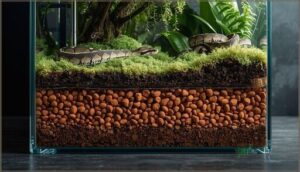
Think of your drainage layer as the foundation everything else depends on. Start with 2–3 inches of LECA or clay pebbles across the entire enclosure floor — no thin spots.
For an 18×18 inch terrarium, that’s roughly 9 liters. Their porous structure manages temperature buffering and weight management better than gravel.
Lay mesh barriers on top to separate bioactive substrate from the LECA.
Add a siphon tube at the back corner for easy terrarium drainage and substrate layer maintenance.
Adding Substrate Mixes for Root Health
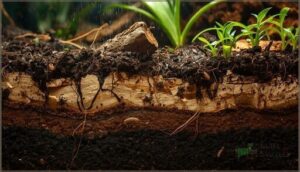
Your bioactive substrate layer does the real work once the drainage layer is set. Aim for 40% coco coir, 30% organic topsoil, 20% orchid bark, and 10% worm castings — that ratio nails substrate moisture, aeration techniques, and nutrient boosters in one mix.
- Mycorrhizal Integration: Dust roots with mycorrhizal powder before planting for stronger nutrient uptake.
- pH Balancing: Add a pinch of crushed coral to stabilize substrate pH around 6.5.
- Microfauna Synergy: Loose, airy substrate lets isopods and springtails move freely, accelerating decomposition.
Using Leaf Litter and Moss for Aesthetics and Function

Leaf litter and moss aren’t just decoration — they’re your humidity regulation system working silently around the clock. Scatter a few centimeters of oak or magnolia leaves over your bioactive substrate for leaf litter scent cues, microhabitat camouflage, and visual texture contrast that brings naturalistic terrarium design to life.
Leaf litter and moss work silently as your vivarium’s humidity regulation system, not mere decoration
| Element | Function |
|---|---|
| Leaf litter | Color gradient dynamics, cleanup crew food source |
| Live moss | Moss moisture buffering, humidity regulation |
| Combined layer | Plant maintenance support, snake stress reduction |
Matching Substrates to Snake Species
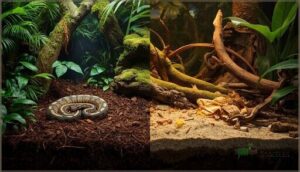
Not every snake thrives on the same ground.
A ball python’s needs look nothing like a corn snake’s, and getting that wrong can stress your animal fast.
Here’s how to match your substrate to the species you’re keeping.
Ball Pythons: Preferred Substrate Types
Ball pythons thrive in a substrate that mimics their native forest floor. Start with a 4-6 inch deep bioactive substrate — coconut fiber is your best base, holding 70% more moisture than aspen.
It maintains humidity microclimate stability and lets cleanup crews work efficiently. Add a drainage layer beneath, and you’ve got a naturalistic terrarium design that actively prevents impaction while regulating humidity around the clock.
Corn Snakes: Best Substrate Choices
Corn snakes come from loose woodland soils, so forest floor mimicry isn’t optional — it’s the foundation. A solid bioactive substrate hits 3–4 inches minimum for proper burrowing depth and tunnel support. Keep substrate moisture balanced with a clear humidity gradient: drier on top, slightly damp below.
Build your mix with safe ingredients:
- 40% organic topsoil
- 30–40% coconut fiber
- 20% play sand
- 10% clay for tunnel support
- Leaf litter top layer
Boa Constrictors: Substrate Needs
Boas are a different challenge than corn snakes — bigger, heavier, and surprisingly particular about their substrate.
Adults need a minimum of 3–4 inches of substrate layer minimum. That weight requires a firm but yielding base to prevent compaction and help microfauna balance.
| Factor | Requirement | Why It Matters |
|---|---|---|
| Burrowing Depth | 3–4 inches | Reduces stress, helps coiling |
| Humidity Levels | 55–75% ambient | Prevents respiratory issues |
| Substrate Mix | 40% topsoil, 40% coco fiber, 20% sand | Drainage without sogginess |
Adjusting for Species-Specific Humidity and Digging Behaviors
Every species draws its own map. Matching your bioactive substrate to species-specific requirements means hitting precise humidity levels and burrow depth optimization without guesswork:
- Ball pythons: 50–60% humidity, 2–4 inch substrate depth
- Corn snakes: 40–70%, drier aspen-style base
- Hognoses: 30–50%, 4–6 inches of clay-rich substrate for burrow stability
- Sand boas: layered humidity gradient design, damp base beneath drier surface
Substrate Maintenance and Monitoring Tips
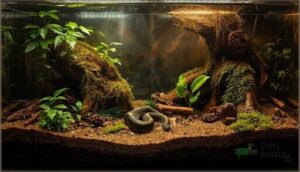
Even the best substrate won’t perform well without some basic upkeep.
The good news is that a bioactive setup does most of the heavy lifting — you just need to know what to watch for.
Here’s what to keep in mind to keep things running smoothly.
Maintaining Moisture and Preventing Mold
Moisture kills more bioactive builds than bad substrate choices ever will. Keep your misting schedule short and frequent — 2–3‑hour bursts beat heavy daily soakings every time.
Aim for a humidity gradient, not uniform saturation. Your LECA drainage layer manages overflow, but ventilation airflow seals the deal against mold detection problems.
| Warning Sign | Fix |
|---|---|
| Fuzzy white substrate coating | Improve ventilation airflow immediately |
| Persistent glass condensation | Reduce misting schedule frequency |
| Musty anaerobic odor | Check drainage layer for blockage |
| Soggy top layer | Allow partial dry-down between cycles |
Supporting Cleanup Crews Effectively
Think of your cleanup crews as livestock — they need the right conditions to thrive.
Start with springtail introduction timing: add them first, then wait a week before introducing isopods.
Match isopod humidity preference to your species setup, keeping powder orange varieties at 50–70%.
Tuck microhabitat hides under cork bark, follow population density guidelines of 10 per 3 gallons, and use feeding supplement strategies like fish flakes monthly.
Signs Your Substrate Needs Refreshing
Your bioactive substrate quietly tells you when it’s failing — you just have to know what to listen for.
Foul odor detection is your first alert: rotten egg or sour ammonia smells signal anaerobic breakdown.
Watch for compaction signs, drainage failure, plant health decline, and moisture imbalance cues like soggy bottoms with dry tops.
These are your substrate’s way of saying it’s time.
Troubleshooting Common Substrate Issues
Most substrate problems share a root cause — too much moisture, too little airflow, or both.
For mold prevention, cut misting frequency and let the top layer dry slightly between sessions.
Fix drainage failure by adding LECA beneath your bioactive substrate.
Combat compaction remedies by folding in orchid bark.
Spot-clean waste daily for odor control, and boost cleanup crew decline with fresh isopod cultures and extra leaf litter.
Frequently Asked Questions (FAQs)
What is the best substrate for a snake enclosure?
There’s no single perfect answer — it depends on your snake’s species, humidity needs, and whether you’re building a bioactive substrate system or keeping things simple.
Match the substrate layer to your setup first.
How to make your own snake substrate?
Mix 40% organic topsoil, 40% coconut coir, and 20% sphagnum moss. Always verify ingredient sourcing — no fertilizers or pesticides. This DIY approach cuts costs substantially while meeting your snake’s specific needs.
What substrate is bad for snakes?
Some materials look harmless but act like slow poison. Cedar toxicity, pine oils, silica sand, clumping litter, and walnut shells all harm snakes — damaging lungs, eyes, and digestive tracts.
How deep should substrate be for burrowing snakes?
Most burrowing snakes need at least 3 to 6 inches of bioactive substrate. Ball pythons do well at 4 inches. Larger species may need up to 12 inches for stable tunnels.
Can substrate choices affect snake respiratory health?
Yes, absolutely. The wrong bioactive substrate raises Dust Particle Inhalation risks, introduces Aromatic Wood Irritants, causes Chemical Off‑gassing, disrupts Humidity Balance, and increases Microbial Load — all directly stressing your snake’s respiratory tract.
How often should bioactive substrate be fully replaced?
A thriving bioactive substrate rarely needs full replacement. With active cleanup crews and proper terrarium maintenance, most setups last years. Watch for foul odors — that’s your clearest signal.
Are certain substrates toxic to juvenile snakes?
cedar aromatics, loose sand, and chemical residues all pose real risks. Dust inhalation and mold gas emissions worsen snake health fast.
safe bioactive substrate mixes to protect juveniles.
Can substrate impact a snakes feeding response?
Absolutely. Substrate affects visibility cues, stress reduction, and ingestion risk all at once.
A bioactive substrate that’s too loose can hide prey or get swallowed during strikes, quietly disrupting your snake’s feeding response.
Conclusion
Think of your vivarium floor as the foundation of a house. Build it wrong, and everything above it shifts and cracks over time. Get it right, and the whole structure holds itself up.
Choosing the best snake substrates for naturalistic vivariums isn’t just a setup decision—it’s an ongoing commitment to balance.
Nail your layers, match your species, and monitor consistently.
The result isn’t just a thriving enclosure. It’s a system that largely takes care of itself.
- https://www.thebiodude.com/blogs/snake-caresheets/care-guidelines-for-corn-snakes
- https://www.zenhabitats.com/blogs/reptile-care-sheets-resources/corn-snake-complete-substrate-guide
- https://talis-us.com/blogs/news/optimizing-reptile-habitat-achieving-ideal-humidity
- https://www.anapsid.org/substrates2.html
- https://exoticdirect.co.uk/news/ball-pythons-as-pets-and-what-setup-you-need/