This site is supported by our readers. We may earn a commission, at no cost to you, if you purchase through links.

You don’t get a second chance at substrate selection—choose the wrong foundation for your tropical setup, and you’re looking at respiratory infections, scale rot, or a terrarium that smells like a neglected gym bag within two weeks. The problem isn’t that hobbyists lack dedication; it’s that most substrate options for tropical species come wrapped in vague marketing claims about ‘moisture retention’ without addressing the real-world balance between holding humidity at 70-85% and creating anaerobic bacterial soup.
Your emerald tree boa, poison dart frog, or humidity-loving invertebrate didn’t evolve on shredded newspaper or sand—they need a medium that mimics the forest floor’s moisture gradient, facilitates their natural behaviors (whether that’s burrowing, biofilm grazing, or thermoregulation), and resists the microbial chaos that comes with constant dampness.
The right substrate becomes invisible infrastructure; the wrong one announces itself through mold blooms, impaction emergencies, or animals that refuse to behave naturally.
Table Of Contents
- Key Takeaways
- Key Features of Tropical Substrates
- Factors to Consider When Choosing Substrate
- Top 8 Substrate Products for Tropical Species
- Coconut-Based Substrates for Tropical Habitats
- Moss and Mulch Options for Humidity Control
- Soil and Peat-Based Substrates
- Substrate Safety and Health Considerations
- Maintenance and Replacement Tips
- Matching Substrate to Tropical Species
- Frequently Asked Questions (FAQs)
- What is the best substrate for tropical fish?
- What is the best substrate for tropical reptiles?
- Do tropical fish prefer sand or gravel?
- How to make tropical bioactive substrate?
- Can I mix different substrate types together?
- How deep should tropical substrate layers be?
- What temperature range affects substrate moisture retention?
- Do tropical substrates need live plants to work?
- How do I sterilize used substrate safely?
- Conclusion
Key Takeaways
- Substrate selection determines whether your tropical setup succeeds or fails—wrong choices lead to respiratory infections, scale rot, and bacterial growth, while the right foundation holds 70-85% humidity without creating anaerobic conditions that breed pathogens.
- Coconut-based substrates (coir, husk chips) and moss options excel at moisture retention without waterlogging, typically lasting 6-12 months with proper spot cleaning, while materials like aspen shavings fail in high-humidity environments despite working well for dry-climate species.
- Bioactive setups combining 4-6 inches of substrate depth with cleanup crews (isopods, springtails) create self-regulating systems that break down waste and maintain microbial balance, extending replacement intervals to 4-6 months compared to 1-3 months for non-bioactive enclosures.
- Species-specific requirements override general guidelines—burrowing snakes need 4-6 inches of cohesive substrate for stable tunnels, amphibians demand 70-90% humidity with fine particles that prevent skin irritation, and invertebrates require materials that support both their nutrition and plant root development in shared habitats.
Key Features of Tropical Substrates
You can’t just toss any substrate into a tropical enclosure and hope for the best—your species needs something that works with their biology, not against it. The right foundation holds moisture without turning into a swamp, resists the funk that comes with high humidity, and accommodates whatever natural behaviors your animal’s hardwired to perform.
Check out substrate options for humid environments to see which materials actually deliver on drainage, odor control, and natural function without the guesswork.
The right substrate holds moisture without swamping your enclosure, resists mold, and supports your animal’s hardwired behaviors
Let’s break down the four features that separate mediocre substrates from the ones that actually deliver.
Moisture Retention Capabilities
Moisture retention separates mediocre substrates from setups that actually work. You’re looking for materials that hold water without turning into a swamp—critical for tropical environments where humidity control and evaporation control make or break your enclosure. Here’s what drives effective moisture management and control in humid substrate selection:
- Coconut coir absorbs 8–10 times its weight, stabilizing moisture during dry spells
- Layering benefits include 20% better water absorption and 15–25% slower evaporation
- Sphagnum moss releases stored water gradually over 5–7 days
- Bioactive soil mixes retain moisture 12–18% longer than sterile options, with pH influence affecting microbial activity
For a deeper understanding of how, consider the role of circular systems in sustaining ideal substrate conditions.
Support for Digging and Burrowing
If you’re keeping burrowing species, substrate cohesion determines whether your animal builds stable tunnels or struggles with constant collapses. Digging mechanics depend on particle size—fine to medium blends (1–5 mm) let claws grip without clumping, while moderate moisture (30–40%) maintains tunnel architecture without waterlogging.
Reptile substrate for humid environments needs 4–6 inches of depth, balancing burrowing behavior with bioactive potential.
Compatibility With Bioactive Setups
When you pair digging-friendly substrate with a cleanup crew—isopods, springtails, millipedes—you achieve bioactive balance, where waste vanishes and microbial loops hum along without you scrubbing every corner.
Bioactive setups demand substrate depth (4–6 inches), microbe support through organic layers, and moisture retention that sustains detritivore health, transforming humidity control into a self-regulating system that benefits both eco-friendly substrates and bioactive terrariums.
For more insight on the role of, consider reviewing in-depth resources.
Odor and Mold Resistance
Beyond cleanup crews, you need substrate safety built on odor control and mold inhibitors—antimicrobial additives that target bacteria during moisture retention cycles without disrupting humidity regulation in bioactive and eco-friendly substrates.
Smart reptile substrate choices deliver five advantages:
- Activated carbon traps volatile compounds before musty smells develop
- Hydrophobic coatings repel surface moisture where mold thrives
- Breathable structures prevent stagnant zones through air exchange
- Anti-microbial concentrates remain active across multiple moisture management cycles
- Micro-porous layers reduce odor molecule accumulation in humid tropical environments
Factors to Consider When Choosing Substrate
You can’t just grab any substrate and hope it works—tropical species need specific conditions to thrive, and choosing the wrong material can lead to dehydration, respiratory issues, or bacterial buildup.
The substrate you pick affects everything from humidity retention to how well waste breaks down, so you need to understand what you’re working with before you commit.
Here are the key factors that’ll help you make the right call for your specific setup.
Habitat Moisture Needs
You’ll want to match substrate choice to species-specific humidity levels, because a ball python thriving at 60% won’t tolerate the 85% your dart frogs demand—and ignoring that mismatch leads to respiratory stress or dehydration. Moisture gradients let your animal self-regulate by moving between damp and drier zones, while proper water cycling and evaporation rates keep humid environments stable without creating anaerobic pockets that breed mold.
| Species Type | Target Humidity Range | Moisture Management Techniques |
|---|---|---|
| Burrowing snakes | 60–70% | Light misting, drier basking zones |
| Rainforest frogs | 75–90% | Deep moist substrate, daily misting |
| Arboreal geckos | 65–80% | Layered gradients, hydration management |
Particle Size and Texture
Particle size shapes moisture dynamics and burrowing mechanics in ways most keepers overlook—fine particles under 1 mm boost moisture retention and substrate porosity for delicate amphibians, while medium textures (2–5 mm) balance airflow with stability for reptile substrate applications.
Texture analysis reveals that coarse chips over 8 mm drain fast but risk injury, so substrate depth and ecofriendly substrates demand careful particle screening for substrate safety.
Drainage and Aeration
Without adequate pore space management, your tropical enclosure becomes a swamp—water infiltration stalls, air channel formation breaks down, and you’re left with substrate permeability issues that suffocate roots and stress animals.
Moisture balance depends on a drainage layer beneath humid environments, where substrate depth and bioactive, eco-friendly substrates work together to preserve moisture retention while channeling excess water away from burrowing zones.
Biological Compatibility
Your reptile substrate choice either cultivates a thriving microbe balance or torpedoes immune response—there’s no middle ground when biofilm support and species tolerance hang in the balance. Toxin-free bioactive setups preserve animal health and welfare through:
- Substrates that nurture beneficial bacteria without triggering stress responses in sensitive amphibians
- Moisture retention systems that prevent pathogen blooms in bioactive and eco-friendly substrates
- Materials free from residues that disrupt gut flora or irritate mucous membranes
Maintenance and Longevity
You’re choosing a substrate that either stays functional for months or crumbles into a muddy mess in weeks—substrate durability hinges on moisture retention engineering, replacement strategies, and maintenance schedules you actually follow.
Bioactive setups extend longevity through microbial balance, while substrate depth (ideally 2–4 inches for burrowers) slows compaction and preserves humidity control, cutting full replacement down to every 6–12 months with consistent spot cleaning.
Top 8 Substrate Products for Tropical Species
You’ve narrowed down the key factors—now it’s time to match them to actual products that won’t let you down.
The substrates below span coconut-based options, vermiculite blends, and specialized tropical soils, each chosen for moisture retention, safety, and real-world performance in humid setups.
These eight options represent the most reliable picks for keepers who refuse to gamble with their animals’ health.
1. Exo Terra Plantation Soil
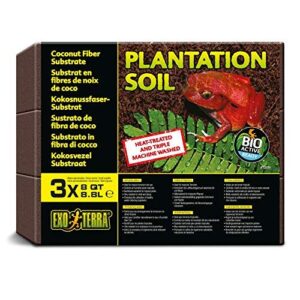
You need a substrate that actually performs when your humidity-loving frogs, salamanders, or burrowing inverts demand consistency—and Exo Terra Plantation Soil delivers.
Triple-washed coconut husk fiber from tropical Asia expands from a compact brick into a moisture-retentive, well-draining base that won’t waterlog your enclosure or suffocate roots.
Heat-treated to knock down bacteria, it’s safe, biodegradable, and nourishes the microfauna that keep bioactive setups humming.
Layer 2 to 4 inches, mist as needed, and you’ve got a reliable foundation for digging, planting, or incubation.
| Best For | Keepers of tropical frogs, salamanders, burrowing reptiles, or anyone running a bioactive or planted terrarium who needs consistent humidity without the swamp. |
|---|---|
| Material | Coconut husk fiber |
| Humidity Control | Increases humidity |
| Burrowing Support | Stimulates digging and burrowing |
| Plant Compatible | Yes, nutritional planting soil |
| Organic/Natural | 100% natural |
| Volume | 24 quarts (3x8qt) |
| Additional Features |
|
- Expands from a compact brick into 8 quarts of lightweight, moisture-retentive substrate that won’t compact or rot
- Heat-treated and triple-washed so it’s safe out of the box—no pest eggs, mold spores, or nasty surprises
- Works as both a functional substrate and a planting medium, supporting live plants and microfauna in bioactive setups
- You’ll need to soak, break apart, and wait for it to hydrate before it’s usable—no instant setup
- Holds moisture well, which means it can take a while to dry out if you overdo the misting
- Has a strong earthy smell when wet that some people find off-putting
2. Zoo Med Creature Soil
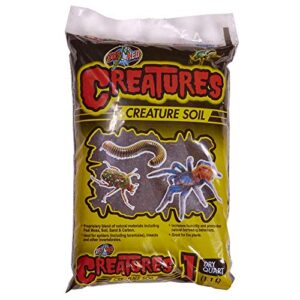
Zoo Med’s proprietary blend—peat moss, soil, sand, and carbon—pulls double duty when you’re setting up for tarantulas, millipedes, or salamanders that dig like their lives depend on it (because, well, they do).
It holds humidity without turning into a swamp, nurtures live plants beautifully, and encourages the kind of burrowing behavior that keeps invertebrates happy.
The one-quart bag won’t fill a massive vivarium, and you might fish out the occasional twig, but it’s a solid choice for bioactive setups.
| Best For | Hobbyists setting up bioactive terrariums for burrowing invertebrates like tarantulas, millipedes, and salamanders who want a substrate that holds humidity and supports live plants. |
|---|---|
| Material | Peat moss blend |
| Humidity Control | Increases humidity |
| Burrowing Support | Promotes natural burrowing |
| Plant Compatible | Yes, suitable for live plants |
| Organic/Natural | Natural material blend |
| Volume | 1 quart |
| Additional Features |
|
- Holds moisture well without getting waterlogged, perfect for species that need higher humidity
- Encourages natural digging and burrowing behaviors that keep invertebrates active and healthy
- Works great in bioactive setups and supports live plant growth
- The one-quart size is pretty small and won’t go far in larger enclosures
- You might find random twigs, wood chips, or debris mixed in that you’ll need to pick out
- Some users feel the price is steep for what you actually get in the bag
3. Hamiledyi Reptile Vermiculite Bedding
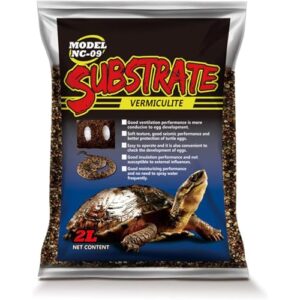
Vermiculite behaves like a sponge that actually knows when to quit—it absorbs hundreds of times its weight in water, then releases moisture slowly to keep your tropical setup stable without drowning your animals.
The 2.1-quart Hamiledyi option gives you lightweight, fungus-resistant granules that stay breathable even when damp, making it ideal for egg incubation or mixing with coconut fiber to dial in exactly the humidity your dart frogs or geckos need (without the mud).
| Best For | Reptile keepers who need precise humidity control for egg incubation or species like dart frogs, geckos, and tortoises that require stable moisture levels without soggy substrate. |
|---|---|
| Material | Vermiculite |
| Humidity Control | Controls water loss |
| Burrowing Support | Imitates natural environment |
| Plant Compatible | No |
| Organic/Natural | Natural vermiculite |
| Volume | 2.1 quarts |
| Additional Features |
|
- Absorbs and releases water gradually, preventing both dehydration and over-saturation in your terrarium
- Lightweight and fungus-resistant even when wet, so it won’t compact or grow mold like soil-based substrates
- Mixes well with other bedding like coconut fiber, letting you customize humidity levels for different species
- Overpriced for the 2-liter volume you actually get—some bags arrive half full
- Granules look more like tiny pebbles than traditional vermiculite, which surprises buyers expecting flakier texture
- Can’t be returned easily if it doesn’t work for your setup, based on customer experiences
4. Zoo Med Reptile Soil
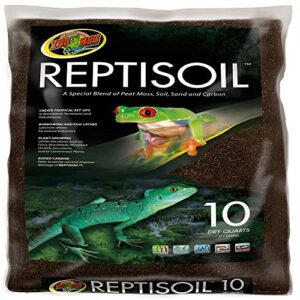
ReptiSoil delivers what vermiculite can’t—a full substrate ecosystem that lets your animals dig, burrow, and nest the way they would under a rainforest canopy.
Zoo Med blends peat moss, organic topsoil, sand, and coconut carbon into a 10-quart bag that stays moist without becoming a swamp, nourishes live tropical plants (ferns, bromeliads, mosses), and hosts the beneficial bacteria your bioactive setup depends on.
You’ll want 2 to 4 inches deep for most tropical lizards, amphibians, box turtles, hermit crabs, and invertebrates that actually use the ground.
| Best For | Tropical reptile and amphibian keepers who want a bioactive substrate that holds humidity, supports live plants, and lets their animals dig and burrow naturally. |
|---|---|
| Material | Coconut carbon blend |
| Humidity Control | Maintains humidity |
| Burrowing Support | Allows burrowing and egg laying |
| Plant Compatible | Yes, bioactive terrarium plants |
| Organic/Natural | Natural coconut carbon blend |
| Volume | Not specified |
| Additional Features |
|
- Maintains consistent humidity without getting waterlogged, perfect for tropical setups and live plants
- Encourages natural behaviors like burrowing, nesting, and egg-laying in species that need substrate depth
- Contains coconut carbon that helps beneficial bacteria thrive and keeps odors under control
- Some batches contain wood chips, splinters, or sharp debris that can injure animals
- Creates dust when dry, so you’ll want to mist it or mix it with other substrates
- Costs more than basic options like coconut fiber or topsoil alone
5. Zoo Med Aspen Snake Bedding
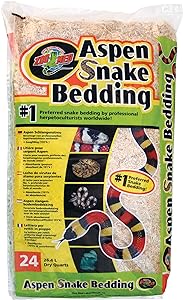
Aspen shavings work beautifully for snakes that prefer drier microclimates—corn snakes, king snakes, milk snakes—but they’re a poor match for most tropical species that need sustained humidity above 60 percent. The 24-quart Zoo Med bag gives you fine to medium particles, 99.9 percent dust-free performance, and zero toxic oils (no cedar, no pine), yet aspen dries out fast and molds quickly when you mist for humidity.
If you’re housing a ball python or boa that demands moisture retention, skip this one and reach for coconut fiber or a bioactive soil blend instead.
| Best For | Snake keepers with corn snakes, king snakes, or milk snakes that thrive in dry environments and enjoy burrowing. |
|---|---|
| Material | Aspen wood |
| Humidity Control | Moisture absorption |
| Burrowing Support | Allows burrow formation |
| Plant Compatible | Yes, soil amendment use |
| Organic/Natural | Natural aspen wood |
| Volume | 24 quarts |
| Additional Features |
|
- 99.9% dust-free and odorless with no toxic oils, making it safe for respiratory health
- Allows snakes to burrow and nest naturally, mimicking their wild behavior
- Easy to spot-clean and replace when needed
- Dries out quickly and doesn’t hold humidity well for tropical species like ball pythons
- Gets moldy fast when misted, requiring frequent removal of wet spots
- Not suitable for high-humidity reptiles that need moisture retention
6. ReptiChip Coconut Reptile Substrate Bedding
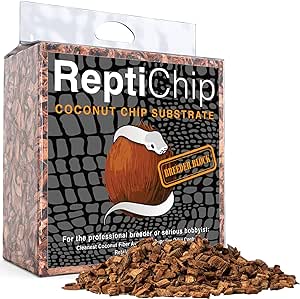
Compressed coconut husk expands to ten pounds of bedding when hydrated—ReptiChip’s 72-quart brick—and delivers the moisture retention your ball pythons, boas, and tropical geckos need without the dust you’ll find in cheaper options.
You’re getting 100 percent organic coconut fiber with zero synthetic fillers, odor-absorbing properties that keep enclosures fresh between cleanings, and a porous structure that fosters bioactive microfauna when you pair it with leaf litter or beneficial fungi.
Just watch for slow water absorption if you skip a proper watering hose.
| Best For | Reptile keepers maintaining tropical species like ball pythons, boas, and geckos who need reliable humidity retention and a natural, bioactive substrate. |
|---|---|
| Material | Coconut husk chips |
| Humidity Control | High humidity retention |
| Burrowing Support | Versatile bioactive substrate |
| Plant Compatible | Yes, bioactive substrate |
| Organic/Natural | 100% organic |
| Volume | 72 quarts expanded |
| Additional Features |
|
- Expands to 10 pounds of bedding from a compact brick, making storage and shipping convenient
- 100% organic coconut fiber with strong odor-absorbing properties keeps enclosures fresher between cleanings
- Supports bioactive setups when combined with leaf litter or beneficial microorganisms
- Higher price point compared to standard substrates
- Absorbs water slowly without using a watering hose for proper hydration
- Some users report dust when breaking apart the compressed block
7. Kritter’s Natural Coconut Husk Bedding
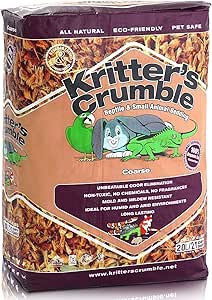
You’ll get 21 quarts of 100 percent organic coconut coir—no oils, no fragrances, no chemical additives—that absorbs moisture up to four times its own weight, making it ideal for your dart frogs, tropical pythons, and humid-loving invertebrates.
The soft, crumbly texture facilitates natural digging and burrowing behaviors, odor control holds up through spot cleanings (though you’ll still need full replacements every six to twelve months), and the biodegradable fibers break down cleanly in compost bins when you’re done with them.
| Best For | Reptile and amphibian keepers who need a natural, high-absorbency substrate for humid enclosures and want an eco-friendly option that doubles as compost when it’s time to replace it. |
|---|---|
| Material | Coconut husk coir |
| Humidity Control | Promotes healthy humidity |
| Burrowing Support | Naturalistic enclosure look |
| Plant Compatible | Yes, soil conditioner use |
| Organic/Natural | 100% organic and biodegradable |
| Volume | 21 quarts |
| Additional Features |
|
- Absorbs over four times its weight in liquid and controls odors effectively between cleanings
- 100% organic and biodegradable with no chemicals, making it safe for sensitive species and compostable after use
- Soft texture encourages natural burrowing behavior in dart frogs, invertebrates, and other digging species
- Can arrive dusty, which may irritate respiratory systems during setup
- May contain springtail pods that some keepers find unexpected or unwanted
- Pricier than synthetic alternatives like paper-based bedding
8. Coconut Husk Growing Media
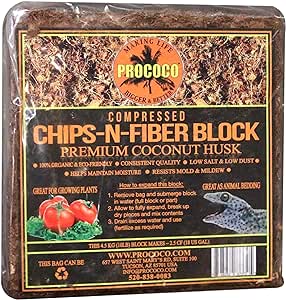
This nine-pound brick expands into seventy-five quarts of organic coconut coir chips and fiber—a volume that’ll fill multiple vivaria but demands serious storage space once you’ve hydrated it.
You’ll find the mix holds moisture beautifully for snakes, lizards, and tortoises, the fibrous matrix resists compaction better than peat, and the pH-neutral profile (slightly acidic in some batches) adapts easily to most tropical species.
Just rinse thoroughly before use to cut dust, monitor for dry spots in coarse blends, and plan drying time if you’re prepping bulk quantities.
| Best For | Reptile owners seeking an organic, moisture-retentive substrate for tropical species like snakes, lizards, and tortoises that need humidity control and digging opportunities. |
|---|---|
| Material | Coconut coir chips |
| Humidity Control | Helps with humidity control |
| Burrowing Support | Allows digging and burrowing |
| Plant Compatible | Yes, garden and raised beds |
| Organic/Natural | Organic coconut coir |
| Volume | 75 quarts expanded |
| Additional Features |
|
- Expands to 75 quarts from a compact 9.9-pound brick, giving you excellent value and enough material for multiple setups
- Holds moisture exceptionally well while resisting compaction, maintaining a breathable structure that supports burrowing and humidity needs
- PH-neutral and organic composition works safely across different species and can be mixed with other substrates like cypress mulch for custom blends
- Requires significant storage space once expanded, and the material arrives damp enough that you’ll need drying time before long-term storage
- Dries out fairly quickly in low-humidity environments, meaning you’ll need to monitor and mist regularly to maintain proper moisture levels
- Needs thorough rinsing before use to remove dust and fine particles that can irritate respiratory systems
Coconut-Based Substrates for Tropical Habitats
Coconut-based substrates have become the backbone of tropical setups, and for good reason—they hold moisture without turning into a swamp, resist compaction even when your critters dig like excavators, and break down slowly enough that you won’t be replacing them every other week.
You’ll find these substrates in two primary forms: shredded fiber and chunky husk chips, each offering different textures and moisture dynamics that suit various species.
Here’s what you need to know about the coconut options that’ll keep your tropical habitat thriving.
Coconut Fiber and Coco Husk Chips
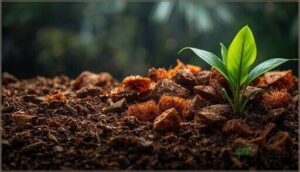
Coconut Fiber and Coco Husk Chips form the backbone of most successful Reptile Substrate strategies for tropical enclosures. Their unbeatable Moisture Retention—chips hold several times their weight in water—and fibrous, chunky Chip Sizes support Bioactive Setups without suffocating roots or burrowing animals.
The Fiber Structure resists compression for months, with Fiber Durability outlasting finer substrates. Meanwhile, Coco Husk’s gradual moisture release keeps Humidity Control steady between mistings.
Coconut Coir Blends
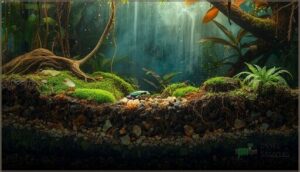
You’ll find that blending coconut coir with husk chips or perlite—at typical Blend Ratios of 60–70 percent coir to 30–40 percent fiber—creates a Reptile Substrate that balances Moisture Retention with aeration in any Tropical Vivarium Design.
- Coir Composition maintains Moisture Balance without waterlogging roots or burrows
- Fiber Structure resists compaction, preserving airflow for six to twelve months
- Coconut Fiber releases humidity gradually between mistings
- Coir Durability fosters Bioactive and EcoFriendly Substrates with live microfauna
- The blend rehydrates easily, cutting maintenance effort in half
Moss and Mulch Options for Humidity Control
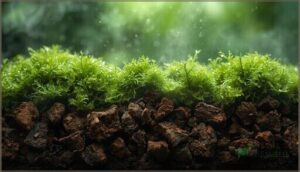
You’ve got coconut fiber down, but now it’s time to talk about the real moisture masters—moss and mulch substrates that regulate humidity like they were engineered for it.
These options excel at creating stable microclimates without turning your enclosure into a swamp, which is exactly what demanding tropical species need.
Let’s break down the heavy hitters that’ll keep your humidity game tight.
Sphagnum Moss and Long-Fibered Moss
When you’re chasing perfect humidity control in bioactive setups, sphagnum moss and long-fibered moss deliver superior moisture retention—sphagnum holds up to twenty times its weight in water, creating stable humid environments while its fibrous structure prevents compaction.
Both moss types excel as reptile substrate in tropical habitats, fostering microclimate creation that aids beneficial microfauna, and their bioactive support makes them indispensable for species demanding consistent surface humidity.
Cypress Mulch
While moss types handle surface-level humidity brilliantly, cypress mulch brings a different set of strengths to tropical enclosures—shredded cypress wood offers moderate moisture retention without the waterlogging risks of peat, and its natural resinous compounds provide termite resistance that makes it a safer choice around wood-framed vivaria.
- Cypress mulch composition is free of dyes or recycled hardwood fibers
- Mulch application at 2–3 inches suppresses weeds and conserves irrigation water
- Cypress benefits include slower color fade and natural pest deterrence
- Environmental impact varies by supplier, so verify sustainable sourcing claims
Fir Bark and Bark Chips
If cypress excels at pest resistance, fir bark and bark chips win on substrate aeration—those porous 1/2- to 2-inch chunks from Douglas Fir create airflow pockets that prevent anaerobic soil zones, making them ideal for bioactive setups where microfauna thrive.
Mulch layering at 2–3 inches balances moisture retention with humidity control, and the lightweight structure accommodates burrowing without compaction risks that plague denser reptile bedding.
Soil and Peat-Based Substrates
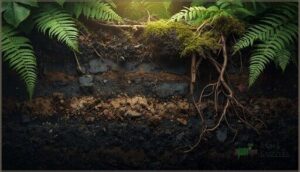
Soil and peat substrates offer something coconut fiber can’t quite match—a living, nutrient-rich foundation that mimics the acidic forest floors most tropical species evolved on. These blends hold moisture with impressive tenacity while supporting the microbial activity that keeps bioactive enclosures thriving, though you’ll need to balance that retention against the risk of anaerobic pockets and pH swings.
Here’s what you need to know about peat-based options, bioactive mixes, and the chemistry that makes them work.
Peat Moss Blends
You’ll love how peat moss blends hold 10 to 20 times their weight in water—a reptile substrate that delivers serious moisture retention for tropical terrariums.
These terrarium substrates maintain an acidic pH between 4.0 and 6.0, perfect for many species in bioactive setups.
Blending components like vermiculite or coir improves aeration without sacrificing humidity, and with proper enclosure applications and spot cleaning, longevity stretches six to twelve months.
Bioactive Soil Mixes
Bioactive soil mixes transform your terrarium into a self-sustaining ecosystem. Combining coco fiber, bark, and charcoal with live microfauna like springtails and isopods, these mixes handle waste breakdown, nutrient cycling, and mold control.
This biological diversity maintains microbial balance and soil structure while reducing your maintenance burden to occasional spot cleaning. When ecosystem stability kicks in, you’re looking at years between full replacements instead of months.
Nutrient Content and PH Balance
Your substrate’s pH determines whether nutrients reach your animals’ food sources—and most tropical species thrive when pH hovers between 6.0 and 6.5, the sweet spot for macronutrient availability and microbial balance.
Buffering capacity keeps pH stable through moisture management cycles, supporting nutrient cycling in bioactive and eco-friendly substrates while preventing the deficiencies that force premature terrarium substrate replacement.
Substrate Safety and Health Considerations
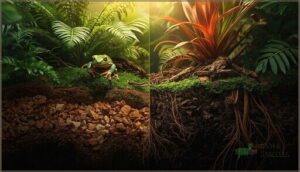
You can’t afford to get substrate safety wrong—it’s the difference between a thriving animal and a trip to the vet for impaction, respiratory distress, or worse. The wrong material introduces toxins, mold spores, and choking hazards that undermine even the most carefully calibrated humidity and temperature.
Here’s what you need to watch for to keep your tropical species healthy and your setup trouble-free.
Avoiding Toxic or Unsafe Materials
You wouldn’t pour motor oil into your animal’s water dish—so why risk substrates laced with formaldehyde, phthalates, or heavy metals? Toxic material risks lurk in treated wood products, dyed mulches, and chemically processed fibers that off-gas VOCs and threaten reptile and amphibian care.
Safe substrate options mean choosing chemical-free alternatives: untreated coconut coir, natural sphagnum moss, and certified non-toxic products that prioritize animal welfare over convenience, ensuring hazardous waste prevention and species-specific health in bioactive and eco-friendly substrates.
Minimizing Impaction and Dust Risks
Fine particulates choke lungs and block digestive tracts—two nightmares you’ll sidestep with proper substrate safety and humidity control.
Keep moisture management around 60 percent to bind dust, choose medium-grained blends for burrowing species, and refresh layers every six months to safeguard respiratory health and impaction prevention.
Smart substrate replacement and cleaning protect reptile and amphibian care, ensuring animal welfare without compromise.
Monitoring for Mold and Bacteria
You can’t wait until fuzzy colonies appear—mold detection and fungal prevention demand proactive humidity control and moisture management from day one. Bacterial growth thrives silently under damp layers, so pair terrarium substrate sanitization with routine spot checks to protect bioactive and eco-friendly substrates while supporting beneficial bacteria.
- Visual scans for discoloration or white fuzz flag early contamination
- Odor shifts from earthy to sour signal harmful bacterial overgrowth
- Portable air-quality devices track spore concentrations in high-moisture setups
- Keep relative humidity between 30–50 percent to suppress fungal blooms
- Replace saturated zones within 24–48 hours to prevent mold establishment
Species-Specific Substrate Needs
You wouldn’t feed pythons the same diet as dart frogs—so why treat Reptile Substrate and Amphibian Substrate as one-size-fits-all? Species Research drives SpeciesSpecific choices: burrowing geckos demand 4–6 inches Substrate Depth for tunneling Animal Behavior, while red-eyed tree frogs thrive on moist coco coir with 70–80 percent Humidity Control.
Tropical Vivarium success hinges on matching Substrate Selection and Maintenance protocols to each inhabitant’s Reptile and Amphibian Habitat origins.
Maintenance and Replacement Tips
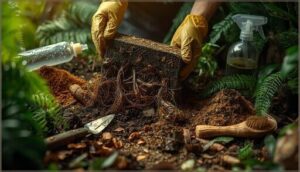
You can’t just set up the perfect tropical substrate and walk away—maintaining it requires consistent effort, sharp observation, and knowing when to intervene before problems escalate.
Regular cleaning protocols, paired with strategic full replacements, keep your substrate functional and your animals healthy without creating unnecessary stress or expense.
Here’s how to balance daily upkeep with long-term substrate management.
Spot Cleaning and Waste Removal
You can’t let waste linger—spot cleaning daily prevents that slow slide into odor control nightmares and microbial imbalance. Here’s your waste management protocol for terrarium and enclosure maintenance:
- Target fecal matter and uneaten feeders within 24 hours to halt bacterial blooms
- Use soft bristles or tweezers for debris removal without disturbing bioactive layers
- Blot—never rub—fresh spills to avoid embedding particles deeper into substrate
- Dry treated zones within 15 minutes to maintain moisture management and prevent mold
Full Substrate Replacement Frequency
Beyond daily spot checks, you’ll need to strip everything down every one to three months—though humidity impact and waste management push that timeline in either direction.
Enclosures hovering at 75 to 85 percent humidity demand replacement schedules closer to four to eight weeks, while bioactive setups with thriving microfauna can stretch substrate lifespan to four to six months if you’re careful about maintenance cycles and moisture retention balance.
Preventing Mold and Odor Buildup
Fresh substrate won’t last long if you’re ignoring airflow optimization and humidity management. Mold prevention hinges on keeping indoor moisture below 60 percent, layering in sphagnum moss for odor control, and checking damp zones weekly with a moisture meter.
Bioactive and eco-friendly substrates benefit from spot cleaning waste immediately, while moisture retention balance and substrate sanitization through routine turnover stop smells before they spread.
Matching Substrate to Tropical Species

You can’t just throw any substrate into an enclosure and call it a day—different tropical species have wildly different needs, and matching the right material to your animal’s natural behavior is half the battle. Snakes, amphibians, and invertebrates each demand their own moisture levels, textures, and structural features, so what works brilliantly for a burrowing frog might spell disaster for an arboreal python.
Let’s break down the substrate requirements by species group so you can stop guessing and start building habitats that actually work.
Snake Habitat Requirements
Your tropical snake thrives when temperature gradients run 75–90°F with a basking spot near 95°F, humidity levels hover between 60–80%, and terrarium substrate facilitates natural snake behavior—burrowing, thermoregulation, shedding.
Coconut fiber, cypress mulch, or bioactive terrariums mimic tropical environments beautifully, but enclosure security matters just as much; even the best reptile bedding won’t help if your animal escapes through shoddy ventilation gaps.
Amphibian Substrate Needs
While snakes tolerate a broader range of terrarium substrate, amphibian enclosures demand moisture retention without waterlogging—your frog’s skin health depends on humidity control between 70–90%, shallow burrowing depth for thermoregulation, and bioactive and eco-friendly substrates that support beneficial microbes. Poor reptile bedding or incorrect moisture levels invite skin infections, so monitor water quality daily and prioritize:
- Coco coir or sphagnum moss blends for consistent moisture retention
- Fine organic particles that allow stable, shallow burrows
- Bioactive layers supporting detritivores and clean waste cycling
- Low-dust options to minimize respiratory and skin irritation
- Regular spot cleaning to prevent mold without disrupting microhabitats
Invertebrate and Plant Considerations
Your cleanup crew—isopods, springtails, and earthworms—shapes the entire bioactive and eco-friendly substrate system through foraging impact and nutrient cycling. Therefore, substrate selection must balance invertebrate nutrition with plant root depth, soil microbes supporting mycorrhizal networks, and humidity control to prevent anaerobic pockets. Ecosystem balance hinges on matching particle size to both burrowing invertebrates and plant growth requirements.
| Substrate Component | Invertebrate Substrate Benefit |
|---|---|
| Coconut coir blends | Facilitates burrowing, reduces impaction risk |
| Hardwood charcoal | Prevents mold, improves air exchange |
| Sphagnum moss layers | Regulates surface moisture for detritivores |
| Bark or pumice | Enhances drainage, stabilizes root zones |
Eco-friendly substrate options like ABG mixes deliver the aeration invertebrates need while anchoring tropical plant roots. Without this synergy, your vivarium crashes.
Frequently Asked Questions (FAQs)
What is the best substrate for tropical fish?
Picture fine grains sifting between translucent fins—aquarium substrate selection for planted aquariums shapes water quality, fish behavior, and aquatic ecosystem balance.
Nutrient-rich materials supporting aquatic plants while maintaining substrate depth guarantee tank stability for your tropical fish.
What is the best substrate for tropical reptiles?
You’ll want coconut coir or bioactive soil mixes—both excel at humidity control while supporting digging behavior and maintaining reptile health in tropical environments without triggering impaction, mold, or odor when you stay on top of substrate replacement.
Do tropical fish prefer sand or gravel?
Most tropical fish adapt to either substrate, but corydoras and loaches thrive on soft sand that lets them sift naturally.
Gravel size matters—rounded edges prevent mouth injuries while maintaining water clarity and beneficial bacteria in freshwater aquarium setups.
How to make tropical bioactive substrate?
A dart frog breeder once showed me her layered approach—drainage gravel, charcoal for microbe balance, tropical soil with coco coir, then leaf litter—creating humidity control and bioactive terrarium design that fosters substrate layering, reptile bedding ecosystems, and ecofriendly substrates requiring minimal substrate replacement.
Can I mix different substrate types together?
You can blend substrates—pairing coarse with organic components balances moisture retention and drainage—but test small batches first to catch compaction, mold, or dust issues before committing to a full bioactive setup.
How deep should tropical substrate layers be?
Most tropical setups thrive with a substrate depth of 2 to 4 inches—shallow enough for easy maintenance, yet deep enough to buffer humidity levels and support natural burrowing needs in bioactive aquarium setups.
What temperature range affects substrate moisture retention?
Between 20 and 25 C, your substrate holds moisture beautifully—evaporation rates slow, microbial activity hums along, and humidity management becomes almost automatic, because thermal balance keeps everything from drying out or stagnating in your tropical aquarium.
Do tropical substrates need live plants to work?
No—you can run a perfectly functional setup without them. Plant-free options maintain substrate stability, support bioactive ecosystems, and control humidity just fine, leaving microhabitat creation to hardscape and fauna instead.
How do I sterilize used substrate safely?
Like scrubbing a wound without reopening it, heat sterilization at 121°C for sixty minutes in a pressure cooker kills all microbes—but honestly, you’re better off just replacing substrate entirely to dodge recontamination risks.
Conclusion
The irony? After spending hundreds on UV arrays, thermostats, and misting systems, most tropical setups fail because of what sits on the bottom—the cheapest component you’ll install. Your substrate options for tropical species determine whether you’re maintaining a thriving microhabitat or just housing animals in expensive tupperware.
Get the foundation right (moisture gradient, burrowing depth, microbial balance), and everything else becomes easier. Skimp here, and no amount of tech fixes structural neglect.