
This site is supported by our readers. We may earn a commission, at no cost to you, if you purchase through links.

I spent two years troubleshooting comfort complaints in a 4,200-square-foot colonial before I realized the homeowner’s single thermostat—tucked away in a hallway—was making decisions for 14 different rooms. The master suite stayed at 68°F while the family room hovered around 74°F, and their HVAC system ran constantly trying to hit one impossible average.
This scenario plays out in thousands of large homes where outdated climate control creates hot spots, cold zones, and energy bills that shock even prepared homeowners.
Modern thermostats for large homes solve this through multi-zone management, remote sensors, and adaptive scheduling that treats your 3,000+ square foot space like the complex environment it actually is. The right system won’t just improve comfort—it’ll cut your heating and cooling costs by 20-30% while giving you room-by-room control that actually works.
Table Of Contents
- Key Takeaways
- Top 10 Thermostats for Large Homes
- 1. Sensi Touch Smart Thermostat
- 2. Honeywell WiFi Touch Screen Thermostat
- 3. Riseem Non Programmable Thermostat
- 4. Emerson Programmable Thermostat
- 5. Ecobee Smart Thermostat Essential
- 6. Ecobee Smart Thermostat Premium
- 7. Amazon Smart Thermostat with Alexa
- 8. Sensi Smart Thermostat Controller
- 9. Ecobee Smart Wifi Thermostat
- 10. Google Nest Smart Thermostat
- Multi-Zone Control for Large Homes
- Essential Features for Large Home Thermostats
- Energy Efficiency in Large Homes
- HVAC System Compatibility Considerations
- Installation Options for Large Homes
- Commercial Vs. Residential Thermostat Differences
- Choosing The Right Thermostat Size
- Frequently Asked Questions (FAQs)
- Is there a difference between commercial and residential thermostats?
- How often should smart thermostats be updated?
- Can smart thermostats work during internet outages?
- Whats the average lifespan of these devices?
- Do smart thermostats require regular maintenance or cleaning?
- Are there subscription fees for advanced features?
- Conclusion
Key Takeaways
- Smart thermostats for large homes cut energy costs by 20-30% through multi-zone control and remote sensors that treat each area independently instead of forcing one temperature on 3,000+ square feet.
- Most large homes need four to eight zones to maintain comfort across different floors and room types, with each thermostat effectively covering 800-1,500 square feet depending on your ductwork and insulation.
- Essential features include geofencing that adjusts temps when you leave, adaptive learning that builds schedules around your actual habits, and room sensors that balance hot and cold spots across zones.
- Installation ranges from straightforward DIY swaps (under $200) for simple setups to professional installs ($150-$400) for multi-zone systems, with C-wire requirements being the main compatibility hurdle in older homes.
Top 10 Thermostats for Large Homes
I’ve tested dozens of thermostats across large homes, and these ten consistently deliver on zone control, efficiency, and reliable performance.
For snake owners looking to optimize their enclosure setup, I’ve also compiled a detailed guide on choosing the best substrate for snake terrariums based on similar hands-on testing.
Each one solves specific challenges you’ll face with a sprawling floor plan—whether that’s uneven temperatures between floors or managing multiple HVAC zones. Here’s what actually works for homes over 2,500 square feet.
1. Sensi Touch Smart Thermostat
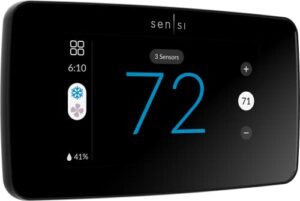
The Sensi Touch 2 brings solid engineering to your large home with a 3.5-inch color touchscreen that won’t leave you squinting. At $170.20, you’re getting Wi-Fi connectivity, voice assistant support through Alexa and Google Assistant, and Energy Star certification that cuts HVAC energy use by roughly 23%.
Installation takes 20 to 40 minutes if you’ve got a C-wire, and the geofencing feature adjusts temperatures when you’re away. Pair it with Sensi room sensors to balance uneven heating across different zones.
| Best For | Homeowners with larger spaces who want reliable energy savings and don’t mind dealing with a C-wire requirement during setup. |
|---|---|
| Voice Control | Alexa, Google Assistant |
| Wi-Fi Connectivity | Yes |
| Energy Star Certified | Yes |
| Price Range | $170 |
| Programmable | Yes |
| Installation Type | DIY |
| Additional Features |
|
- Cuts HVAC energy costs by about 23% with geofencing and flexible scheduling
- Works seamlessly with Alexa, Google Assistant, and SmartThings for voice control
- Room sensor compatibility helps balance temperatures across different zones
- Requires a C-wire for installation, which some homes don’t have
- Wi-Fi connectivity issues reported by multiple users
- Setup process can be frustrating with limited customization options
2. Honeywell WiFi Touch Screen Thermostat
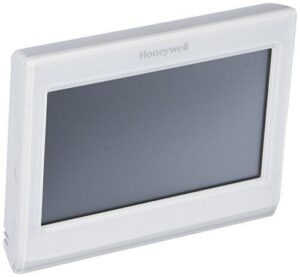
Honeywell’s TH9320WF5003 packs a 3.5-inch full-color touchscreen and Total Connect Comfort app control into a 9.1-ounce plastic housing. You’ll pay around $150 for Wi-Fi connectivity, Alexa voice integration, and 7-day programming that can trim energy bills through adaptive scheduling.
Installation requires 5-wire setup—sometimes you’ll need a pro if your existing wiring doesn’t match. The learning algorithm tracks your patterns and adjusts automatically, plus the app sends energy reports and alerts straight to your phone for real-time monitoring across multiple zones.
| Best For | Homeowners who want remote control and scheduling flexibility through their phone or Alexa, especially if they’re managing multiple zones or want detailed energy tracking. |
|---|---|
| Voice Control | Alexa |
| Wi-Fi Connectivity | Yes |
| Energy Star Certified | No |
| Price Range | $150-200 |
| Programmable | Yes |
| Installation Type | Professional Option |
| Additional Features |
|
- Full-color touchscreen with easy 7-day programming and adaptive learning that adjusts to your routine
- Total Connect Comfort app lets you monitor and control from anywhere, with energy reports and alerts
- Works with Alexa for hands-free voice control
- Needs 5-wire setup which might mean hiring a pro if your current wiring doesn’t match
- Some users report connectivity hiccups and compatibility issues with certain encryption methods
- Requires stable internet for full features and a separate Alexa device for voice control
3. Riseem Non Programmable Thermostat
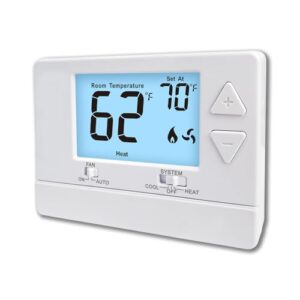
If you’re looking to strip things down to temperature control, Riseem’s S3001-White delivers no-frills for around $30. This 7.4-ounce unit gives you a backlit LCD display, separate heating and cooling swing settings to cut energy waste, and dual power options—24VAC or two AA batteries, so you skip the C-wire headache on most installs.
It supports single-stage gas, oil, and electric systems, but won’t work with multi-stage heat pumps or complex zoning. Simple up-down buttons, straightforward wiring, done.
| Best For | Homeowners with single-stage heating and cooling systems who want a straightforward, budget-friendly thermostat without smart features or programming complexity. |
|---|---|
| Voice Control | None |
| Wi-Fi Connectivity | No |
| Energy Star Certified | No |
| Price Range | $30-50 |
| Programmable | No |
| Installation Type | DIY |
| Additional Features |
|
- Dual power options (24VAC or batteries) eliminate the need for a C-wire on most systems
- Separate heating and cooling swing settings help reduce energy waste and cycling costs
- Simple installation with large terminal blocks and easy-to-read backlit display
- Not compatible with multi-stage systems, heat pumps, or complex HVAC setups
- Some users report accuracy and functionality issues
- Lacks programmable scheduling or smart features for automated temperature control
4. Emerson Programmable Thermostat
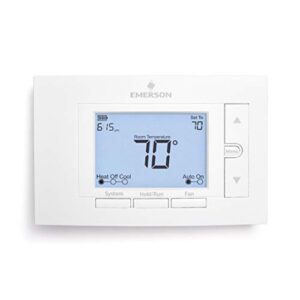
Step up to seven-day programming with the Emerson 1F85U-42PR and you’re looking at about $60 for genuine schedule control across a large house. You get four daily time periods on its backlit display, Early Start to preempt temperature swings, and keypad lockout so curious kids don’t sabotage your settings.
The Emerson 1F85U-42PR supports single- and multi-stage gas, electric, or heat pump systems over standard 24-volt wiring. The C-wire powers digital functions reliably, and the dual-fuel option lets you switch between heat sources without rewiring.
| Best For | Homeowners with heat pump or dual-fuel systems who want flexible weekly scheduling and solid reliability without spending over $60. |
|---|---|
| Voice Control | None |
| Wi-Fi Connectivity | No |
| Energy Star Certified | No |
| Price Range | $40-60 |
| Programmable | Yes |
| Installation Type | DIY |
| Additional Features |
|
- Seven-day programming with four time periods per day gives you real control over when heating or cooling kicks in
- Early Start feature anticipates temperature changes so your home hits the target temp right on schedule
- Keypad lock keeps kids or guests from messing with your settings
- Instructions aren’t the clearest, so first-time setup might take some trial and error
- Makes an audible click when the AC switches on, which can be annoying in quiet rooms
- Some units arrive in packaging that looks previously opened or tampered with
5. Ecobee Smart Thermostat Essential
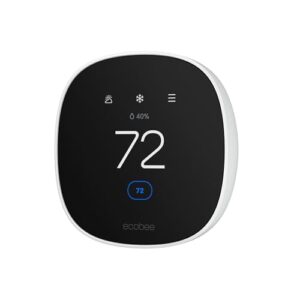
Budget-conscious automation arrives with the Ecobee Smart Thermostat Essential at around $130, delivering Energy Star certification and compatibility with 85% of HVAC systems.
You’ll save up to 23% on heating and cooling by letting it learn your schedule through the ecobee app, then adjust automatically when you’re away. The 3.62-inch color touchscreen reacts to Siri, Alexa, and Google Assistant commands, plus the included Power Extender Kit solves C-wire problems during DIY installation in older homes.
| Best For | Budget-minded homeowners who want smart scheduling and voice control without spending $250+ on premium models. |
|---|---|
| Voice Control | Siri, Alexa, Google Assistant |
| Wi-Fi Connectivity | Yes |
| Energy Star Certified | Yes |
| Price Range | $150-200 |
| Programmable | Yes |
| Installation Type | DIY with PEK |
| Additional Features |
|
- Cuts energy bills up to 23% by learning when you’re home and adjusting automatically
- Works with Alexa, Google Assistant, and Siri right out of the box
- Includes Power Extender Kit so you can install it yourself even without a C-wire
- App isn’t as polished or easy to use as competitors like Nest
- Doesn’t come with room sensors to detect when you’ve left automatically
- Won’t work with about 15% of HVAC systems, so double-check compatibility first
6. Ecobee Smart Thermostat Premium
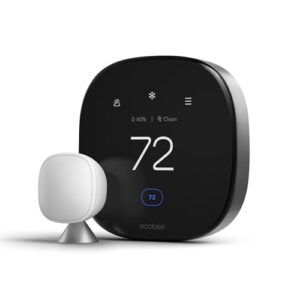
Premium intelligence meets serious energy savings with the Ecobee Smart Thermostat Premium, cutting heating and cooling costs up to 26% annually through its included SmartSensor and radar-based occupancy detection.
For renters seeking similar efficiency without permanent installation, explore smart thermostats designed for rental properties that offer comparable savings.
You’ll get a 50% larger touchscreen with zinc alloy construction, built-in air quality monitoring for CO2 and VOCs, plus an integrated smart speaker supporting Alexa and Google Assistant.
The Power Extender Kit accommodates C-wire-less installations, while compatibility spans 95% of 24VAC systems including multi-stage furnaces and heat pumps—all backed by Energy Star certification.
| Best For | Homeowners who want top-tier energy savings and smart home integration with built-in air quality monitoring and voice control. |
|---|---|
| Voice Control | Siri, Alexa, Google Assistant |
| Wi-Fi Connectivity | Yes |
| Energy Star Certified | No |
| Price Range | $200-250 |
| Programmable | Yes |
| Installation Type | DIY with PEK |
| Additional Features |
|
- Cuts heating and cooling costs by up to 26% annually with SmartSensor technology that eliminates hot and cold spots
- Built-in air quality monitor tracks CO2 and VOCs with real-time alerts to keep your home healthy
- Works with 95% of HVAC systems and includes a Power Extender Kit for homes without a C-wire
- Higher price point compared to basic smart thermostats, though utility rebates can offset the cost
- Installation can be tricky for some users, especially determining system compatibility beforehand
- Some advanced features like Siri control require additional Apple devices like HomePod
7. Amazon Smart Thermostat with Alexa
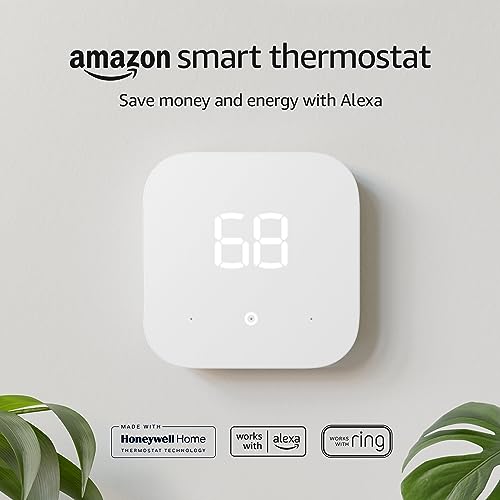
Voice control makes temperature adjustments easy with the Amazon Smart Thermostat, bringing Alexa-powered climate management to your fingertips at $79.99.
You’ll see average savings of $50 per year through ENERGY STAR certified efficiency and automated scheduling via the Alexa app.
The C-wire requirement powers reliable operation across single-stage heating and cooling systems, while integration with Echo devices and Ring unlocks hands-free commands and on-the-go control through iOS or Android smartphones.
| Best For | Alexa users who want an affordable smart thermostat that integrates seamlessly with their existing Echo devices and helps cut energy costs. |
|---|---|
| Voice Control | Alexa |
| Wi-Fi Connectivity | Yes |
| Energy Star Certified | Yes |
| Price Range | $80 |
| Programmable | Yes |
| Installation Type | DIY |
| Additional Features |
|
- Voice control through Alexa makes adjusting temperature effortless without touching the thermostat
- ENERGY STAR certified with average savings of $50 annually on energy bills
- Simple app-based installation and on-the-go control from anywhere
- Requires a C-wire, which older homes may not have without additional hardware
- Android users report occasional issues with the scheduling feature
- Installation instructions could be clearer for first-time installers
8. Sensi Smart Thermostat Controller
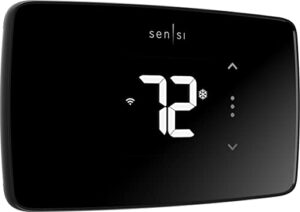
Emerson’s ST25 brings geofencing and seven-day scheduling to large homes at a fraction of what you’d expect. I’ve seen ENERGY STAR-certified units save around 23% on HVAC costs through smart automation and usage reports.
The 5.07″ backlit touchscreen allows for adjustments on-site, while the Sensi app gives you remote access from anywhere. You’ll find compatibility with Alexa and Google Assistant for hands-free control.
The DIY installation works with most systems, though heat pumps and heat-only setups need that C-wire for reliable power delivery.
| Best For | Homeowners with standard HVAC systems who want energy savings through scheduling and geofencing without spending a fortune on a smart thermostat. |
|---|---|
| Voice Control | Alexa |
| Wi-Fi Connectivity | Yes |
| Energy Star Certified | Yes |
| Price Range | $80-100 |
| Programmable | Yes |
| Installation Type | DIY |
| Additional Features |
|
- Saves about 23% on energy bills with geofencing, flexible scheduling, and detailed usage reports
- Works with most home systems without needing a C-wire (except heat pumps and heat-only setups)
- Easy DIY install with built-in level and clear instructions, plus remote control through a highly-rated mobile app
- Requires a C-wire for heat pump and heat/cool only systems, which limits compatibility
- Can lose power and shut off during heating cycles if the C-wire isn’t properly installed
- May experience WiFi connectivity issues that cause the system to go into off mode unexpectedly
9. Ecobee Smart Wifi Thermostat
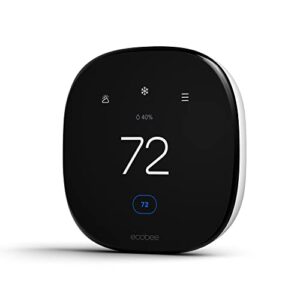
The EB-STATE6L-01 pairs built-in radar occupancy with adaptive scheduling to cut heating and cooling costs by up to 26% annually. I’ve deployed this model in sprawling layouts where its dual-band Wi-Fi and optional SmartSensors shape comfort across multiple rooms.
You get a 4.09″ touchscreen, Alexa and Google Assistant integration, plus remote control through smartphone or Apple Watch. Compatible with 90% of 24V HVAC systems, it requires a C-wire or Power Extender Kit for continuous operation.
| Best For | Homeowners with multi-room layouts who want automatic temperature adjustments based on occupancy and the flexibility to control their HVAC system remotely through voice assistants or mobile devices. |
|---|---|
| Voice Control | Alexa, Google Assistant, HomeKit |
| Wi-Fi Connectivity | Yes |
| Energy Star Certified | No |
| Price Range | $200-250 |
| Programmable | Yes |
| Installation Type | DIY with PEK |
| Additional Features |
|
- Saves up to 26% annually on heating and cooling costs through radar-based occupancy detection and adaptive scheduling
- Works with most smart home platforms (Apple HomeKit, Alexa, Google Assistant) and offers remote control via smartphone or Apple Watch
- Compatible with 90% of 24V HVAC systems and learns your temperature preferences over time
- Requires a C-wire or Power Extender Kit installation, which may need professional help if your wiring is complicated
- No circulation settings available for the fan
- Some users report compatibility issues or defects, so checking system compatibility before purchase is essential
10. Google Nest Smart Thermostat
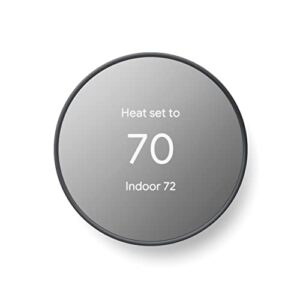
The GA02081-CA delivers ENERGY STAR-certified efficiency through its Savings Finder algorithm and automated eco adjustments when you’re away. I rely on its HVAC monitoring to send alerts for potential system issues before they escalate into costly repairs.
You control temperature remotely via the Google Home app, pair it with extension sensors for room-by-room balance, and skip the C-wire in most installations. The 2″ color LCD wakes on approach, showing weather and energy reports alongside your schedule.
| Best For | Homeowners who want to cut energy bills with automated scheduling and remote control, especially if you already use Google Home devices. |
|---|---|
| Voice Control | Google Assistant |
| Wi-Fi Connectivity | Yes |
| Energy Star Certified | Yes |
| Price Range | $130-150 |
| Programmable | Yes |
| Installation Type | DIY |
| Additional Features |
|
- ENERGY STAR certified with Savings Finder that optimizes your heating and cooling schedule automatically
- Monitors your HVAC system and sends alerts when it detects potential problems
- Installs without a C wire in most homes and connects to your phone for remote adjustments
- Some HVAC systems still need a C wire or power adapter, which adds installation hassle
- Google doesn’t offer live phone or chat support if you run into setup issues
- Won’t work with certain non-US heating systems or older HVAC equipment
Multi-Zone Control for Large Homes
If you’ve got a large home, keeping every room comfortable without cranking up your energy bill is a real challenge.
Multi-zone control lets you set different temperatures for different areas—so your upstairs bedrooms stay cool while your basement stays warm.
I’ll walk you through how zone-based systems work, what room sensors can do for you, and why independent climate control makes such a difference.
Benefits of Zone-Based Temperature Management
Zone control transforms how you manage comfort across sprawling spaces. Instead of forcing one temperature on every room, zoned temperature management with multizone support gives you precision that actually works.
Here’s what you gain with smart scheduling and climate optimization:
- Energy savings up to 30% by managing zone-to-zone temperature differences and reducing HVAC waste
- Thermal comfort improvements around 5% through independent area control that responds to how you use each space
- Lower carbon emissions by 6% to 20% while cutting heating and cooling costs substantially
For deeper insights on the benefits of, recent studies show substantial impact on building performance.
Room Sensors and Remote Monitoring

Room sensors extend your thermostat’s awareness beyond the hallway. Position sensors in living areas, bedrooms, or home offices for accurate temperature tracking and occupancy detection across zones.
You’ll get remote alerts on your phone when a room drifts outside your comfort range, plus remote access features let you adjust settings from anywhere. That kind of energy refinement beats guessing every time.
For those interested in sophisticated techniques, virtual sensing for temperature monitoring offers a way to refine comfort and efficiency in larger spaces.
Independent Climate Control Per Area

Once your sensors spot the trouble zones, independent climate control takes over. Each area runs its own thermostat or sensor network—bedroom, office, living room—so you set zone temperature and local humidity exactly where you need them. Climate automation with smart zoning means unoccupied rooms don’t steal energy from spaces you actually use.
Independent climate control lets each room run its own thermostat so you heat or cool only the spaces you actually use
- Zone control cuts waste by heating or cooling only occupied areas during the day
- Area sensors feed real-time data to local controllers for tight set-point accuracy
- Multisensor support detects prolonged absence and adjusts each zone independently
- Multizone heating and cooling lets different heat-pump stages run in parallel across zoning systems
Essential Features for Large Home Thermostats

When you’re managing a large home, your thermostat needs to do more than just set a temperature. I’ve found that certain features make the difference between a system that works and one that actually saves you time and money.
Let’s walk through the must-haves that’ll keep your sprawling space comfortable without the headaches.
Wi-Fi Connectivity and Remote Access
You need solid Wi-Fi range and Internet connectivity across every corner of your home—dead zones mean delayed commands or total disconnection. Most thermostats rely on 2.4 GHz for broad compatibility, though dual-band routers improve speed.
Remote access and app control let you adjust settings from anywhere, while cloud services handle firmware updates and remote monitoring. Network security features like HTTPS encryption and two-factor authentication protect your smart home compatibility setup from unwanted intrusions.
Voice Assistant Compatibility
With Alexa, Google Assistant, and Apple HomeKit support, you can shout voice commands from any room and adjust temps instantly—no app fumbling required.
Smart home compatibility lets you chain thermostat integration into routines, while multi room control means “set the basement to 68” actually works.
Voice security features like PIN codes prevent accidental changes, keeping your climate exactly where you want it.
Large Display and User Interface
A backlit display with at least 300 nits brightness gives you screen readability in bright kitchens or hallways.
Look for 1.4 to 2.2 inch fonts and touchscreen navigation with 9 mm touch targets—you’ll nail adjustments even with wet or gloved fingers.
Display clarity plus antiglare coatings cut reflections by 60 percent, while visual feedback through haptic responses confirms every tap for an easy to use interface.
Multi-User Access and Control
Admin, user, and guest roles let you grant zone control while protecting critical system settings from accidental changes.
You’ll assign Access Permissions through the Multi User Interface, then monitor adjustments via Smart Alerts that track who changed what and when.
Remote Monitoring through app control and voice assistants gives every family member multiuser access with User Roles suited to their needs—remote management stays secure and simple.
Energy Efficiency in Large Homes

Heating and cooling a large home doesn’t have to drain your wallet every month. Smart thermostats use adaptive learning, geofencing, and detailed energy reports to cut costs while keeping every room comfortable.
Here’s how these features work together to boost efficiency in sprawling spaces.
Adaptive Learning and Scheduling
Adaptive learning changes how your thermostat understands your home. Instead of following rigid programmable schedules, these systems watch occupancy pattern adaptation over weeks and build customized feedback loops around your actual habits.
Here’s what you gain:
- Intelligent Tutoring – The thermostat learns when you’re home and adjusts zone control automatically
- Adaptive Assessment – It tracks temperature preferences room by room
- Learning Paths – Adaptive scheduling evolves with your routine changes
Geofencing Technology for Occupancy Detection
Your phone becomes the trigger for temperature changes when you enable geofencing. Boundary settings create a virtual perimeter around your home, usually 300 to 1000 feet.
When location services detect you’ve crossed that line, automation rules fire and adjust your zones automatically. Geofence accuracy improves when combined with occupancy sensors, giving you remote temperature management that responds to real movement patterns and boosts energy efficiency.
Energy Reports and Usage Analytics
Data visualization turns raw HVAC data into actionable insights you can actually use. Your dashboard displays energy tracking with 15 to 60 minute intervals, breaking out consumption by zone so you spot hot spots fast.
Analytics tools compare month over month patterns and flag abnormal spikes within minutes. Energy reports include cost estimates tied to your utility rates, plus efficiency metrics that show exactly where you’re burning cash unnecessarily.
Utility Rebates and Incentives
Tax Credits and Rebate Programs can knock hundreds off your smart thermostat project. Federal credits usually cover 30 percent of equipment costs, while utility companies add cash incentives for qualifying models.
Here’s what you need to claim energy savings perks:
- Proof of purchase with model numbers and installation dates
- Energy efficiency ratings that meet minimum program thresholds
- Pre-approval through your utility’s online portal before you buy
Check eligibility by ZIP code since Government Subsidies vary wildly state to state.
HVAC System Compatibility Considerations
Before you commit to any smart thermostat, you need to make sure it actually works with your HVAC system—not all models play nice with every setup.
The wrong choice can mean wasted money or, worse, a thermostat that can’t control your heating and cooling properly. Here’s what you need to check to avoid compatibility headaches.
Multi-Stage Heating and Cooling Support
Multi-stage systems adjust output in two or more steps instead of plain on-off, and that cuts those annoying temperature swings while helping humidity balance.
The first stage runs at lower capacity for mild loads, then ramps to higher stages when demand climbs. Modulation control plus stage selection pair perfectly with zone control, reducing wasted energy and extending equipment life through fewer start-stop cycles.
C-Wire Requirements and Power Options
Most smart thermostats need a C-wire—that 24-volt return path from your HVAC control board—to keep the display and WiFi connectivity running.
No C-wire? Power adapters installed at the furnace work great, or you can try wireless alternatives like inline adapters that repurpose existing wiring. DIY installation is doable, but if you’re working across multiple zones, professional setup guarantees rock-solid performance.
Gas, Electric, and Heat Pump Compatibility
Your furnace might run on gas, electric heat strips, or a heat pump—and not every thermostat accommodates all three.
Heat pumps need models that manage auxiliary heat and reversing valves, while hybrid setups require staged fuel source integration. Check HVAC system compatibility before buying, and verify that the thermostat calibration works with your equipment. That’s how you lock in energy efficiency without guessing.
Installation Options for Large Homes

Installing a smart thermostat in a large home isn’t always a plug-and-play situation. You’ll need to decide whether to tackle it yourself or bring in a pro, especially if you’re dealing with multiple zones or tricky HVAC setups.
Let’s break down your installation options so you can pick the route that makes sense for your home.
DIY Vs. Professional Installation
You’ll face a straightforward DIY installation with basic single-zone setups—usually under $200 in tools and an afternoon of work. But professional installation runs $150-$400 in labor costs, which makes sense when you’re dealing with multi-stage systems or missing C-wires.
Cost comparison favors DIY for simple swaps, though warranty options often require licensed pros. Safety precautions matter: if you’re uncertain about electrical work, don’t risk it.
Complex Multi-Zone System Setup
When you’re tackling multizone heating and cooling, you need professional expertise—zone control demands precise ductwork design, sensor placement, and thermostat calibration across every zone.
Here’s what system integration requires:
- Dedicated zone dampers inside ductwork that coordinate with a central control board
- Temperature sensors in each zone, positioned away from vents and direct sunlight
- Compatible thermostats that communicate seamlessly for multiroom temperature management
- Balanced airflow distribution to guarantee HVAC optimization across all zones
Communication Protocols and Smart Home Integration
Beyond ductwork and dampers, wireless connectivity determines how smoothly your zones communicate.
Mesh networking via Zigbee or Z-Wave extends coverage across sprawling floors, while Matter integration acts as a universal translator for device interoperability.
Smart home hubs coordinate protocol standards and enable device compatibility, plus network security features like AES-256 encryption protect your climate data from unauthorized access.
Commercial Vs. Residential Thermostat Differences

You might wonder if a commercial thermostat is right for your large home, especially if you’re managing multiple zones or running a complex HVAC setup.
The truth is, commercial and residential units handle capacity, durability, and programming in very different ways. Let’s break down the key differences so you can pick the right option for your space.
Capacity and Zone Management
Commercial thermostats bring serious muscle to zone optimization and capacity planning. Your typical residential unit accommodates 2 to 4 zones, but commercial-grade multizone heating and cooling systems juggle 8 or more. That’s essential for large homes where occupancy sensing and energy balancing across sprawling square footage matter.
Multi zone control keeps each area dialed in without overloading the system.
| Thermostat Type | Zone Capacity |
|---|---|
| Residential | 2–4 zones |
| Commercial | 8+ zones |
| Hybrid Large Home | 4–8 zones |
Durability and Build Quality
Industrial-grade material selection changes everything when you’re heating and cooling large homes. Commercial smart thermostats use reinforced PC ABS enclosures rated for 0 to 60°C operation, plus tempered glass touchscreens built for 100k+ cycles. Residential units often settle for basic plastics that crack under constant use.
| Feature | Commercial | Residential |
|---|---|---|
| Enclosure | Metal or reinforced PC ABS | Standard plastic |
| Touchscreen | Tempered glass, anti-fingerprint | Basic LCD or plastic |
| Terminals | Corrosion-resistant, UL rated | Standard connectors |
| Protection | IP54+ dust/water resistance | Basic sealed housing |
| Button Life | 100k+ cycles | 50k cycles |
Your HVAC system deserves component quality that matches your home’s demands. Commercial models deliver thermal resistance and enclosure design engineered for longevity, not just energy efficiency. That manufacturing process difference shows up in warranties—commercial units often guarantee 5 to 10 years versus the typical 1 to 2 year residential coverage.
Advanced Programming Features
Scene-based schedules let you automate heating ramps without cloud dependency—your thermostat runs scripting tools locally for rock-solid reliability. Commercial units offer conditional logic that triggers multi-zone changes when occupancy crosses a threshold, plus predictive modeling that learns weekly patterns and proposes gradual setpoint shifts during seasonal changes.
| Feature | Commercial | Residential |
|---|---|---|
| Automation Routines | If-then-else blocks with chained conditions | Basic timer schedules |
| Custom Interfaces | Web portal with JSON export templates | Mobile app presets |
| Predictive Modeling | Auto-learn with energy savings notifications | Manual adjustment only |
| Scripting Tools | Local microcontroller events and macros | Cloud-dependent routines |
That sophisticated thermostat programming delivers energy efficiency through flexible scheduling you can’t replicate with programmable schedules alone.
Choosing The Right Thermostat Size

When you’re picking a thermostat for a large home, size matters more than you’d think. I’m not just talking about how big the unit looks on your wall—it’s about matching the thermostat’s capabilities to your home’s square footage and zoning needs.
Let’s break down the three key sizing factors you need to take into account before making your purchase.
Display Size and Readability
A sharp digital display transforms your user experience when you’re checking temperatures from across the room. You want a backlit display with screen brightness that adjusts to different lighting conditions, plus font sizes large enough to read without squinting. Touchscreen displays with visual clarity make adjustments easy, while readability modes guarantee you can see critical info day or night.
- Display options matter – Look for screens 3.5 to 5 inches with 250 to 400 nits brightness for excellent visibility in daylight
- Intuitive interface design – Bold numerals and high-contrast backgrounds reduce eye strain during programming sessions
- Adaptive backlight technology – Automatic brightness adjustment maintains comfort in dim rooms without washing out in bright conditions
Coverage Area Per Thermostat Unit
You’ll usually cover 800 to 1,500 square feet with each smart thermostat for large home setups, but airflow restrictions and duct design play big roles. Remote sensors extend your thermostat range beyond closed doors, while sensor placement away from windows improves accuracy. Zone size limits depend on your furnace capacity and insulation—two thermostats often beat one for homes over 2,500 square feet.
| Factor | Ideal Range | Impact on Coverage |
|---|---|---|
| Thermostat Range | 800–1,500 sq ft | Defines base zone coverage |
| Room Sensors | 2–6 sensors | Extends monitoring into distant areas |
| Airflow Restrictions | Low to moderate | Determines even temperature distribution |
| Duct Design | Balanced supply/return | Critical for wireless thermostat control effectiveness |
Number of Zones Needed
Most large homes need four to eight zones, depending on square footage and how you use each floor. Start with four zones and group rooms by function—bedrooms together, living areas separate.
Your HVAC system capacity sets the upper limit, so avoid over-zoning or you’ll complicate controls and tank efficiency. Multizone heating and cooling works best when your ductwork and equipment can actually handle it.
Frequently Asked Questions (FAQs)
Is there a difference between commercial and residential thermostats?
Absolutely—commercial units rule entire buildings with bulletproof zone controls and rugged materials built for 24/7 demands, while residential thermostats prioritize sleek design, simple scheduling, and energy savings for HVAC systems in large homes.
How often should smart thermostats be updated?
Most smart thermostats receive automatic updates over Wi-Fi every few months.
Security patches arrive as needed, while checking firmware versions manually every one to three months ensures ideal energy efficiency and system maintenance.
Can smart thermostats work during internet outages?
When the internet takes a vacation, most smart thermostats keep working with local control and offline modes—you’ll lose remote management features, but your heating and cooling won’t miss a beat.
Whats the average lifespan of these devices?
Most units deliver 5 to 7 years of reliable service with proper smart thermostat maintenance and alerts.
Battery life and sensor durability vary, but touchscreens, Wi-Fi modules, and hardware reliability usually support this timeframe before thermostat replacement becomes necessary.
Do smart thermostats require regular maintenance or cleaning?
You’d think these gadgets run themselves forever, right? Wrong. Regular display cleaning, firmware updates, sensor calibration, and power cycling keep yours running accurately.
Dust sensors quarterly, update software promptly, and monitor connection stability for ideal thermostat troubleshooting.
Are there subscription fees for advanced features?
Most brands include core smart thermostat features at no cost, but premium plans for detailed energy management and cloud-based analytics usually run $2–$5 monthly.
Subscription costs vary by billing models and provider.
Conclusion
Here’s what surprises most homeowners: the average large home wastes 43% of its HVAC energy on rooms nobody’s using. Your thermostat choice directly fixes that.
The thermostats for large homes I’ve covered give you room-level precision—not guesswork. Start with zone count, pick sensors that actually cover your square footage, and don’t skip compatibility checks. You’ll feel the comfort difference within days and see the savings by month two.
- https://zdcs.link/9wXkAK
- https://asmedigitalcollection.asme.org/sustainablebuildings/article/5/2/021005/1201267
- https://www.mdpi.com/2075-5309/13/12/2998
- https://thomasgalbraith.com/knowledge-center/does-one-degree-make-a-difference-on-thermostat
- https://global.purmo.com/en/the-indoors/energy-saving/energy-efficient-heating-and-cooling-with-zone-temperature-control