This site is supported by our readers. We may earn a commission, at no cost to you, if you purchase through links.
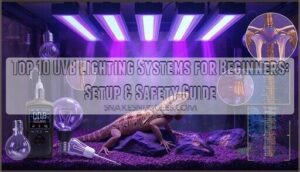
Most reptile keepers learn about UVB the hard way—watching their bearded dragon develop metabolic bone disease or their tortoise’s shell soften despite perfect temperatures and premium food.
The invisible spectrum between 280 and 315 nanometers isn’t optional lighting; it’s the biochemical switch that turns dietary calcium into usable bone material. Without it, your reptile slowly starves at the cellular level no matter how well you feed it.
Choosing UVB lighting systems for beginners means traversing T5 versus T8 debates, decoding cryptic UVB percentages, and understanding why that compact bulb everyone recommends might create dangerous hotspots in your specific enclosure. The difference between adequate and excellent UVB setup often separates thriving reptiles from veterinary emergencies.
Table Of Contents
- Key Takeaways
- What is UVB Lighting and Why It Matters
- Choosing The Right UVB System for Beginners
- Top 10 UVB Lighting Systems for Beginners
- 1. Reptile UVB Light Fixture
- 2. Reptile UVB Light Fixture Combo Kit
- 3. Reptile UVB Light Fixture Kit
- 4. Reptispa T5 UVB Lighting Kit
- 5. Repti Home T5 Reptile Light Combo
- 6. Zoo Med Turtle Lighting Kit
- 7. Hypool Reptile UVB Lighting Fixture
- 8. Zoo Med Desert UVB Lighting Kit
- 9. Oiibo Reptile UVB Lighting Combo Kit
- 10. Zoo Med Turtle UVB Lighting Kit
- Setting Up and Maintaining Your UVB Lighting
- Safety Tips and Common UVB Lighting Mistakes
- Frequently Asked Questions (FAQs)
- How big of an UVB light do I need?
- What is the difference between an UV light and an UVB light?
- How many watts should an UVB light be for a bearded dragon?
- Can you get vitamin D from an UVB light?
- Can UVB bulbs be used with timers?
- How to measure UVB output accurately at home?
- Are there energy-efficient alternatives to traditional UVB bulbs?
- What temperature range works best with UVB lighting?
- Conclusion
Key Takeaways
- UVB radiation between 280-315 nanometers triggers vitamin D synthesis in reptile skin, making it essential for calcium absorption and preventing metabolic bone disease regardless of diet quality.
- T5 fixtures deliver more powerful UVB output at greater distances (12-18 inches) than T8 tubes (6-10 inches), while compact and coil bulbs create concentrated hotspots that require careful placement to avoid burns.
- UVB bulbs lose effectiveness long before they stop producing visible light—compact and T8 types need replacement every six months, while T5 linear bulbs typically last twelve months based on measured output rather than brightness.
- Glass and acrylic barriers block nearly all UVB wavelengths, and mesh screens can reduce UVB output by 30-40%, so fixtures must be positioned with direct line-of-sight to basking zones and measured with a UVB meter for accuracy.
What is UVB Lighting and Why It Matters
Understanding UVB lighting starts with knowing what makes it different from other types of ultraviolet light—and why your reptile or plants can’t thrive without it.
Different snake species have vastly different snake lighting needs explained based on whether they climb trees or burrow underground in the wild.
UVB sits in a specific wavelength range between 280 and 315 nanometers, distinct from UVA’s longer waves and UVC’s germicidal properties. Before you invest in any system, you need to grasp how UVB functions, what it does for living organisms, and where beginners usually go wrong.
Proper ventilation for snake enclosure setups becomes critical when introducing UVB, since airflow affects both heat distribution and how effectively the light penetrates your habitat.
UVB Vs. UVA and UVC Explained
You’ll encounter three ultraviolet types when working with reptile lighting—UVA, UVB, and UVC—each occupying distinct wavelength ranges and producing different biological effects.
Understanding how each UV type affects your reptile’s health becomes especially important when selecting bulbs for specific species, as outlined in our guide on ball python morph lighting needs.
UVA spans 315 to 400 nanometers and penetrates deeper into skin, while UVB falls between 280 and 315 nanometers and drives vitamin D synthesis. UVC radiation below 280 nanometers poses serious radiation safety concerns, so quality systems exclude it entirely.
Understanding these UV wavelengths helps reptile keepers choose safe lighting, which is why many consult a boa species care guide to balance UVB benefits with proper exposure limits.
For a thorough overview of the UV spectrum and wavelengths, you can reference scientific resources on UV technology.
The Role of UVB in Reptile and Plant Health
UVB radiation drives vitamin D synthesis in reptile skin, which increases intestinal calcium uptake and prevents metabolic bone disease—your animal’s bone density depends on it.
UVB radiation triggers vitamin D synthesis in reptile skin, boosting calcium absorption and preventing metabolic bone disease
Beyond reptile health, UVB grow light systems trigger photosynthetic stimulation and plant growth enhancement by boosting secondary metabolites like flavonoids.
Proper UVB intensity and UVB dosage control support both reptile skin health and plant growth without risking overexposure burns. For more on the effects of UVB light on reptile health, see current research and best practices.
Common Misconceptions About UVB Lighting
Despite understanding how UVB radiation works, many beginners fall for persistent UVB myths that compromise reptile health and lighting safety. Here’s what you need to know:
- Glass blocks UVB light—your enclosure needs direct exposure
- Higher UVB intensity isn’t always better and can cause burns
- UVB bulbs lose effectiveness long before they stop glowing
- UVB exposure alone won’t fix poor diet or temperature
Recognizing these errors protects your animals from metabolic disease and overexposure injuries.
Choosing The Right UVB System for Beginners
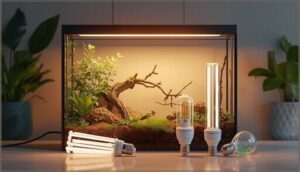
Selecting your first UVB system doesn’t have to feel like traversing a minefield—once you understand the fundamental differences between bulb types, output strengths, and how they match up with your specific enclosure.
The right choice depends on three critical factors: the bulb format that fits your setup, the UVB percentage your species requires, and whether your fixture can accommodate the distance and screening involved. Let’s break down each consideration so you can make an informed decision without second-guessing yourself at the pet store.
Types of UVB Bulbs: T5, T8, Compact, and Coil
When shopping for your first UVB lighting setup, you’ll face four main bulb types—each with distinct UVB outputs and form factors.
T5 bulbs deliver powerful UVB radiation in slim 16 mm tubes, while T8 grow lights spread gentler UVB across wider areas.
Both types need regular replacement to maintain effective UVB output, so check our UVB lighting systems for ball pythons guide to track bulb lifespan and replacement schedules.
Compact and coil designs fit tight enclosures but create concentrated hotspots, demanding careful placement to prevent burns and guarantee safe UVB exposure.
Selecting The Correct UVB Strength and Size
You need a bulb match that matches your animal’s biology and enclosure dimensions—desert species demand higher UVB intensity at closer basking spots, while forest dwellers thrive under gentler UVB exposure.
Measure your tank length to choose bulb size that ensures full lighting coverage, then verify UVB levels with a UVB metering device at the basking spot before adding your reptile to prevent dangerous UVB exposure.
Compatibility With Different Enclosures and Setups
Your enclosure materials—glass tanks, plastic, wood, or metal—dictate which mounting options and heat management strategies will work.
Glass tanks need ventilation systems that prevent UVB lighting fixtures from overheating, while wooden setups demand closed-back mounts with safety features.
Magnetic or clamp-on hardware offers flexible positioning without drilling, essential when you’re matching a grow light system to non-standard cage dimensions.
Top 10 UVB Lighting Systems for Beginners
You’ve covered the basics—now it’s time to look at specific systems that work well for beginners. The following ten UVB lighting options represent reliable, beginner-friendly setups that won’t overwhelm you with complexity while still meeting your reptile’s needs.
Each system offers different features, so you’ll find options for various enclosure types, budgets, and species requirements.
1. Reptile UVB Light Fixture
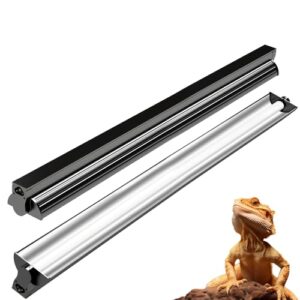
The REPTIDLDB T5 fixture brings together solid fixture design and reliable UVB output in one beginner-friendly package. You get a 10% UVB, 30% UVA bulb that promotes reptile health through proper vitamin D3 synthesis—no guesswork required.
The built-in reflector layer maximizes UVB lighting across your enclosure, while the detachable cable and on/off switch give you simple lighting controls. Available in four sizes from 12 to 46 inches, this fixture accommodates desert and tropical setups equally well, making it a practical first choice for new keepers.
| Best For | Beginners looking for a straightforward UVB setup that covers the essentials without overwhelming options or complicated installation. |
|---|---|
| UVB Output | 10% UVB |
| Power | 8W-54W |
| Material | Alloy |
| Light Type | T5 Fluorescent |
| Target Species | Desert Reptiles |
| Reflector | Alloy Reflective |
| Additional Features |
|
- Comes with a replaceable UVB 10.0 bulb right out of the box, so you can start using it immediately
- Built-in reflector maximizes UVB output across your terrarium, giving your reptile better coverage
- Available in four different sizes to fit various enclosure types, from small to large setups
- Some customers have reported receiving damaged or defective units upon delivery
- The bulb will need periodic replacement to maintain proper UVB levels over time
- May not provide adequate UVB for all reptile species or specific habitat requirements
2. Reptile UVB Light Fixture Combo Kit
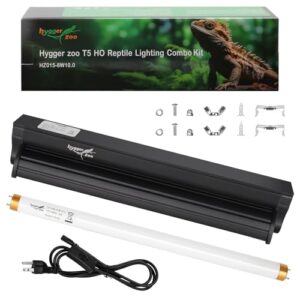
Combo kits eliminate the trial-and-error phase by pairing a T5 or T8 fixture with a matched UVB bulb, integrated ballast, and mounting hardware in one box. You’ll usually find a 10.0 desert lamp pre-installed, delivering around 10% UVB and 30% UVA to meet most beginner reptile lighting needs without separate bulb shopping.
The polished curved reflector design concentrates UVB output downward, often doubling effective rays at the basking spot compared to bare tubes. Clear instructions guide fixture installation tips, helping you avoid common placement mistakes that compromise reptile care and health.
| Best For | Beginner reptile owners who want an all-in-one solution that takes the guesswork out of UVB lighting setup for desert species like bearded dragons and tortoises. |
|---|---|
| UVB Output | High UVB |
| Power | 8W |
| Material | Aluminum |
| Light Type | T5 |
| Target Species | Desert Reptiles |
| Reflector | Curved Reflector |
| Additional Features |
|
- Comes complete with fixture, pre-installed 10.0 UVB bulb, and mounting hardware so you don’t need to buy components separately
- Curved reflector design doubles UVB output at the basking spot compared to standard tube fixtures
- Works both on top of mesh screens or mounted inside the tank for flexible placement
- Won’t work well for larger enclosures over 75-90 gallons
- Some users have reported durability issues with the fixture over time
- May need extra clips or support to keep it securely positioned on certain tank lids
3. Reptile UVB Light Fixture Kit
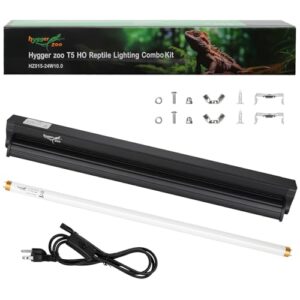
This kit arrives with a T5 fixture, pre-selected UVB bulb matched to forest or desert reptiles, and removable reflector materials that redirect stray rays toward your basking zone.
Fixture design uses lightweight aluminum construction for long lighting durability, while the curved reflector boosts UVB intensity without increasing wattage.
Built-in on/off switches, detachable power cords, and mounting clips simplify reptile care and health routines. Some kits include UV test cards so you can verify your UVB grow light is producing the spectrum your reptiles need.
| Best For | Reptile owners with desert or forest species who want a complete UVB lighting solution that’s ready to use right out of the box. |
|---|---|
| UVB Output | High UVB |
| Power | 24W |
| Material | Aluminum |
| Light Type | T5 |
| Target Species | Desert Reptiles |
| Reflector | Curved Reflector |
| Additional Features |
|
- Comes with everything you need—fixture, bulb, and reflector—so you don’t have to hunt down compatible parts separately
- Curved aluminum reflector design concentrates UVB rays where your reptiles actually bask, giving you more efficiency without cranking up the wattage
- Installation is straightforward with multiple mounting options and built-in switches, plus some kits include UV test cards to confirm you’re getting the right spectrum
- Might not provide enough coverage for larger tanks like 120-gallon setups
- Some users have run into quality control issues with durability and how stable the fixture stays once mounted
- Only works well for specific reptile types, so if you keep a mixed collection, this might not cover all your needs
4. Reptispa T5 UVB Lighting Kit
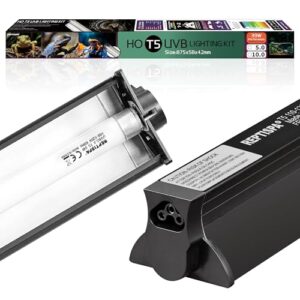
The Reptispa kit delivers 5.0 UVB output through a T5 fixture with an integrated curved UVB reflector that spreads rays evenly across 18-inch enclosures—critical for reptile health when your bearded dragon or chameleon needs consistent calcium metabolism support.
You’ll appreciate the plug-and-play ballast design, lightweight aluminum housing, and mounting brackets that secure to glass or mesh tops without sagging. Replace UVB bulbs every 12 to 18 months, wipe the reflector monthly, and verify output with a UVB meter to maintain proper lighting for your reptiles.
| Best For | Desert-dwelling reptile owners who need a reliable all-in-one UVB solution for medium-sized enclosures without dealing with separate fixtures and bulbs. |
|---|---|
| UVB Output | 10% UVB |
| Power | 39W |
| Material | Aluminum |
| Light Type | T5 |
| Target Species | Desert Reptiles |
| Reflector | Alloy Reflective |
| Additional Features |
|
- Combines T5 fixture and 10.0 UVB bulb in one package with built-in ballast and reflector for easier setup
- Aluminum housing with reflective layer boosts UVB output to help reptiles synthesize vitamin D3 and absorb calcium
- Includes mounting accessories and detachable power cable with on/off switch for flexible installation
- Bulb replacement needed every 6-12 months, and some users report difficulty accessing or replacing the integrated bulb
- May run hot during use and might not provide enough coverage for larger terrariums or species with higher UVB needs
- Quality and durability questions compared to established brands in the reptile lighting market
5. Repti Home T5 Reptile Light Combo
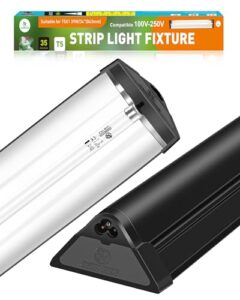
Repti Home offers a high-output T5 fixture paired with a Desert 10.0 UVB bulb—ideal for bearded dragons, uromastyx, and other desert species that demand intense UVB lighting.
The curved reflector concentrates rays over a broader basking zone, boosting UVB output at distances up to 18 inches while the electronic ballast ensures rapid start and minimal flicker.
Mount it under mesh lids or inside canopies using the low-profile design, replace UVB bulbs every 12 months, and clean the heat-resistant reflector regularly to maintain consistent reptile lighting performance.
| Best For | Keepers of desert reptiles like bearded dragons and uromastyx who need intense, concentrated UVB coverage over larger basking areas. |
|---|---|
| UVB Output | 10% UVB |
| Power | 39W |
| Material | Aluminum Alloy |
| Light Type | T5 |
| Target Species | Bearded Dragons |
| Reflector | Alloy Reflective |
| Additional Features |
|
- High-output Desert 10.0 UVB bulb delivers strong rays up to 18 inches, perfect for species that need intense lighting
- Curved reflector design spreads UVB across a wider basking zone instead of a narrow strip
- Electronic ballast starts quickly with minimal flicker, and the low-profile mount fits easily under mesh lids
- Bulbs can be finicky during installation and may require careful handling to avoid startup issues
- Not suited for damp environments—moisture can interfere with performance
- Requires bulb replacement every 12 months, adding to ongoing maintenance costs
6. Zoo Med Turtle Lighting Kit
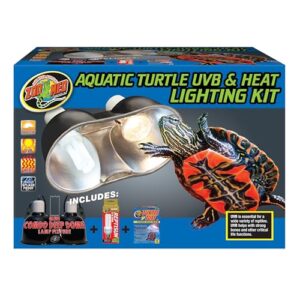
Zoo Med’s dual-socket Mini Deep Dome delivers both UVB lighting and focused heat—making it a practical choice for aquatic turtles and water-dwelling amphibians that need balanced UVB rays and thermal gradients.
The polished aluminum dome reflects up to 30% more UVB output from the included ReptiSun 5.0 Mini bulb, supporting turtle health through improved calcium metabolism, while the 50-watt splash-proof halogen lamp creates measurable basking temperatures.
Mount it over aquarium lighting setups, replace UVB bulbs every six to twelve months, and clean the reflector regularly to maintain consistent reptile care performance.
| Best For | Aquatic turtle owners who need a simple, ready-to-use lighting solution that provides both UVB and heat in one fixture. |
|---|---|
| UVB Output | 5.0 UVB |
| Power | 13W + 50W |
| Material | Aluminum |
| Light Type | Dual Socket |
| Target Species | Aquatic Turtles |
| Reflector | Polished Dome |
| Additional Features |
|
- Comes with both a ReptiSun 5.0 UVB bulb and a 50W halogen heat lamp, so you get everything needed right out of the box
- The polished aluminum dome boosts UVB output by up to 30%, helping your turtle absorb calcium and stay healthy
- Dual sockets let you control heat and UVB separately, making it easier to adjust temperatures without losing UVB coverage
- Each socket maxes out at 100 watts, which might not provide enough heat for larger tanks or cooler rooms
- UVB bulbs need replacing every 6–12 months even if they still light up, adding to ongoing costs
- The fixture is only 11 inches wide, so it may not cover basking areas well in tanks longer than 20–30 gallons
7. Hypool Reptile UVB Lighting Fixture
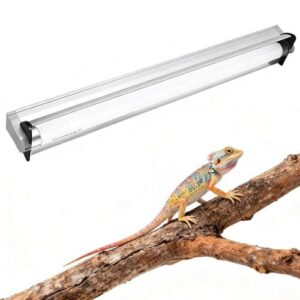
If your setup calls for a no-frills approach, the Hypool Reptile UVB Lighting Fixture offers dual-bulb capability—one socket for UVB bulbs and one for heat—in a compact dome that reptiles and even UVB grow light applications can benefit from.
The T8-compatible design radiates 10.0 UVB emission across basking zones, supporting reptile health through improved calcium uptake, while independent lighting controls let you manage day-night cycles without adjusting multiple fixtures. Replace bulbs every six months, secure the mounting hardware properly, and check fixture durability regularly to avoid loose connections.
| Best For | Reptile owners looking for an affordable, straightforward UVB lighting solution with dual-bulb capability for managing both UVB exposure and heat in one compact fixture. |
|---|---|
| UVB Output | 10.0 UVB |
| Power | 15W |
| Material | Fluorescent |
| Light Type | T8 Fluorescent |
| Target Species | Desert/Rainforest |
| Reflector | Standard |
| Additional Features |
|
- Dual-bulb design lets you run UVB and heat from the same fixture, simplifying your setup
- T8-compatible with 10.0 UVB output that supports calcium absorption for desert and rainforest species
- Independent controls for each bulb make it easy to adjust day-night cycles without swapping fixtures
- Build quality feels cheap to some users, with reports of scratched arrivals and loose bulb connections
- Durability is hit-or-miss—some units quit working or turn off randomly after short use
- Requires careful installation and regular checks to prevent loose connections and ensure proper function
8. Zoo Med Desert UVB Lighting Kit
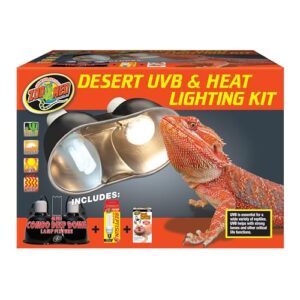
For desert dwellers like bearded dragons, the Zoo Med Desert UVB Lighting Kit delivers 10.0 UVB output through a 13 W compact fluorescent alongside a 75 W basking spot lamp—both housed in a mini deep dome that focuses heat and UVB into a concentrated thermoregulation zone.
This dual-bulb setup promotes reptile health by promoting calcium absorption and natural basking behavior, though you’ll need to replace UVB bulbs every six to twelve months and monitor heat gradients closely to prevent localized overexposure or burns, which fosters reptile health.
| Best For | Bearded dragons, desert-dwelling reptiles, and anyone who wants a ready-to-go lighting solution that handles both heat and UVB in one fixture. |
|---|---|
| UVB Output | 10.0 UVB |
| Power | 13W + 75W |
| Material | Metal |
| Light Type | Dual Socket |
| Target Species | Desert Reptiles |
| Reflector | Dual Dome |
| Additional Features |
|
- Comes with everything you need—heat lamp, UVB bulb, and a dual-dome fixture with separate switches for easy control
- Delivers strong 10.0 UVB output specifically designed for desert species that need higher UV levels
- Compact design with focused light coverage makes it easy to create a proper basking zone
- Bulbs tend to burn out faster than expected, so plan on replacing them more often than the standard six-month mark
- Some users report the heat socket shorting out or failing to turn on after a few months of use
- Can run too hot for certain setups or species like geckos, requiring careful placement and temperature monitoring
9. Oiibo Reptile UVB Lighting Combo Kit
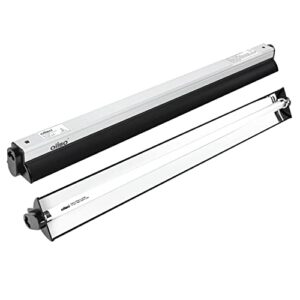
Beginners looking for a plug-and-play solution will appreciate the Oiibo Reptile UVB Lighting Combo Kit—a 24 W T5 high output fluorescent tube paired with a reflective fixture that spreads UVB lighting across larger basking zones for bearded dragons, tortoises, and other desert species.
However, UVB output testing by hobbyists suggests the included UVB bulbs deliver closer to 4–6 percent rather than the advertised 12.0, so you may need to mount the UVB grow light closer than premium brands or swap in a higher-quality UVB tube for ideal reptile health benefits and reliable UVB tube replacement cycles.
| Best For | Beginners who want an affordable, ready-to-use UVB setup for desert reptiles like bearded dragons and tortoises without dealing with separate components. |
|---|---|
| UVB Output | 12.0 UVB |
| Power | 24W |
| Material | Plastic |
| Light Type | T5 |
| Target Species | Desert Reptiles |
| Reflector | Curved Reflector |
| Additional Features |
|
- Plug-and-play kit includes both the fixture and UVB bulb, so you can set it up right out of the box
- Built-in reflector boosts light spread across larger basking areas
- Lightweight and easy to install in most terrariums
- Actual UVB output may be lower than advertised (closer to 4-6% instead of 12%), requiring closer mounting or bulb upgrades
- Bulbs typically need replacing every 6 months, and finding the right replacements can be tricky
- May not provide enough coverage for larger enclosures without upgrading to a higher wattage
10. Zoo Med Turtle UVB Lighting Kit
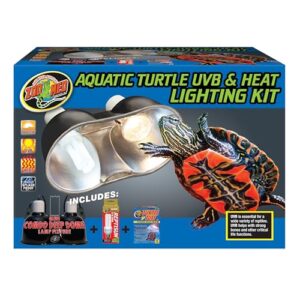
For aquatic turtle care, the Zoo Med Turtle UVB Lighting Kit delivers both heat and UVB benefits in one dual-dome fixture—pairing a 50 W splashproof halogen with a ReptiSun 5.0 compact UVB bulb that provides essential UVB rays for shell and bone health.
You’ll position this lighting kit roughly 12 inches above the basking platform, though mesh screens can block 30–40 percent of UVB output, requiring closer placement. Replace the UVB bulbs annually even when they still glow, since UVB lighting effectiveness fades long before visible dimming occurs.
| Best For | Aquatic turtle owners who need a complete lighting solution that provides both essential UVB for shell health and a dedicated basking heat source in one convenient dual-dome fixture. |
|---|---|
| UVB Output | UVB Included |
| Power | 50W |
| Material | Metal |
| Light Type | Dual Socket |
| Target Species | Aquatic Turtles |
| Reflector | Deep Dome |
| Additional Features |
|
- Includes both a splashproof halogen basking lamp and a ReptiSun 5.0 UVB bulb right out of the box, so you’re ready to set up immediately
- Dual fixture with individual switches lets you control basking heat and UVB independently based on your turtle’s needs
- Deep dome design keeps the bulbs recessed and protected, reducing the risk of water damage in humid turtle environments
- Durability concerns reported by some users, with components potentially failing sooner than expected
- UVB bulbs require annual replacement even when they appear to be working, adding to ongoing costs
- Needs two separate outlets to run both lamps simultaneously, which can be inconvenient depending on your setup
Setting Up and Maintaining Your UVB Lighting
Installing your UVB system correctly makes the difference between a thriving animal and one that develops metabolic bone disease or thermal burns. You’ll need to take into account fixture height, mesh interference, and the specific UVB requirements of your species—factors that directly impact how much beneficial radiation actually reaches your reptile or plants.
Here’s how to set up your system properly and maintain it over time.
Proper Placement and Installation Tips
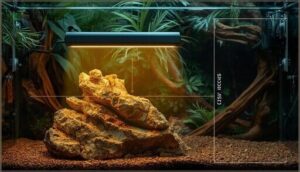
Mounting your UVB fixture directly above the basking zone ensures your reptile receives even exposure at the ideal angle. Position T5 desert-strength UVB grow lights around 16 inches from the basking spot, while forest-strength tubes work best at 10 to 12 inches.
Safety precautions and fixture placement tips:
- Secure the fixture so it can’t shift—small angle changes redirect the UVB beam away from your basking platform
- Never mount UVB lighting above glass or acrylic barriers, since these materials block nearly all UVB wavelengths
- Install fixtures where climbing animals can’t contact bulbs or wiring to prevent burns and electric shock
How Often to Replace UVB Bulbs
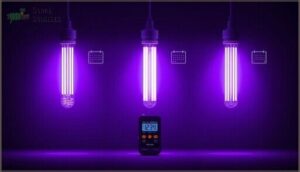
Most UVB bulbs lose significant output long before they burn out—compact and T8 types need replacement every six months, while T5 linear bulbs usually last twelve months. Track your install date and use a UVB meter to measure actual output rather than guessing by visible brightness.
| Bulb Type | Replacement Schedule |
|---|---|
| Compact/Coil | 6–8 months |
| T8 Linear | 9–12 months |
| T5 Linear | 12 months |
Safety Tips and Common UVB Lighting Mistakes
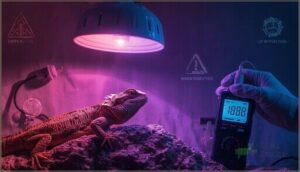
Even with the right setup, UVB lighting carries real risks if you don’t handle it correctly—overexposure can burn your reptile’s skin and eyes, while improper installation puts you at risk too.
Most beginners make predictable mistakes that compromise both safety and effectiveness, from placing bulbs too close to ignoring the warning signs of a failing system. Here’s what you need to watch for to keep both yourself and your animals safe.
Preventing Overexposure and Burns
Preventing sunburn in your reptile starts with measuring UVB intensity at the basking zone—Ferguson Zones tell you whether your species needs a UV Index of 1 or 4.
Safe distancing matters more than you’d think; T5 tubes work best at 12 to 18 inches, while T8s sit closer at 6 to 10 inches.
Watch for reddened patches during skin monitoring, provide shaded retreats, and never skip eye protection by avoiding direct beam exposure.
Ensuring Safe Handling During Installation
Installing UVB lighting isn’t just about screwing in a bulb—electrical safety and personal protection prevent painful mistakes.
Five installation precautions that keep you and your animals safe:
- Switch off all circuits before touching fixtures to avoid electric shock from live housings
- Wear UV-rated safety glasses during test runs to shield your eyes from stray UV radiation
- Handle bulbs by ceramic ends to prevent skin oils from creating hot spots on glass
- Secure fixtures to solid surfaces so vibration can’t dislodge your UVB grow light
- Remove animals temporarily before safe mounting begins
Troubleshooting Dimming or Malfunctioning UVB Systems
Even fresh bulbs can fail when hidden faults sabotage your UVB lighting systems. Ballast failure shows up as flickering or half-lit tubes, while corrosion prevention demands regular socket inspection in humid setups. Use UVB metering every few months to catch output drops before your animals suffer—voltage monitoring helps spot weak power supplies that dim LED grow lights.
When your UVB grow light strobes constantly, flicker analysis points to worn starters or incompatible dimmers that stress reptiles.
| Symptom | Most Likely Cause |
|---|---|
| Tube glows at ends only | Failing starter in magnetic ballast |
| Lamp dims after six months | UVB output loss despite visible light |
| Fixture trips breaker | Internal short or ballast overload |
| Slow ignition with flicker | Socket corrosion or poor contact pressure |
Frequently Asked Questions (FAQs)
How big of an UVB light do I need?
Your terrarium’s footprint—not the bulb’s wattage—determines which fixture you need, since UVB intensity weakens with distance and enclosure dimensions dictate effective coverage across basking zones.
What is the difference between an UV light and an UVB light?
UV light covers the entire ultraviolet spectrum from 100 to 400 nanometers, while UVB light specifically targets the 280–315 nanometer range—the critical wavelength for vitamin D synthesis and calcium metabolism.
How many watts should an UVB light be for a bearded dragon?
Bearded dragon UVB lighting needs depend on bulb type and basking distance—most keepers use 24 to 39 watts in T5 tubes, adjusting placement to maintain a UVI of 4 to
Can you get vitamin D from an UVB light?
Yes, UVB lamps can stimulate vitamin D production in human skin—the same photochemical reaction that occurs under natural sunlight.
However, you’ll need proper exposure timing and safety precautions to avoid burns or eye damage.
Can UVB bulbs be used with timers?
You can automate UVB exposure with mechanical or digital timers—just verify your fixture’s wattage matches the timer’s capacity and aim for stable 12-hour cycles to avoid stressing your UVB lamps or disrupting consistent UVB rays delivery.
How to measure UVB output accurately at home?
You’ll need a handheld UVB meter like the Solarmeter 5R to check readings at basking height, measuring both above and below mesh barriers to account for distance, angle, and bulb degradation over time.
Are there energy-efficient alternatives to traditional UVB bulbs?
Smart lighting choices save both money and energy—LED UVB fixtures, ceramic emitters with integrated modules, and adjustable arrays deliver targeted exposure while consuming fewer watts than mercury vapor bulbs or older fluorescent tubes.
What temperature range works best with UVB lighting?
UVB lighting doesn’t generate heat sources—you’ll need separate heat sources to reach basking zones of 85–95°F for most reptiles.
Maintain thermal gradients and ambient temperatures independently while UVB lamps deliver essential UVB exposure for health.
Conclusion
Your reptile’s skeletal future hinges on the telegraph-simple truth that UVB isn’t negotiable—it’s the invisible architecture holding their bones together. Implementing proper UVB lighting systems for beginners transforms guesswork into measurable outcomes: correct bulb placement, scheduled replacements every six to twelve months, and species-appropriate UVB percentages.
The ten systems outlined here eliminate dangerous trial-and-error approaches. Install them correctly once, maintain them consistently, and metabolic bone disease becomes a condition you’ll only read about—never witness.
- https://www.zillarules.com/articles/understanding-uva-uvb-uvc-reptile-lighting
- https://arcadiareptile.com/lighting/guide/
- https://www.hvreptilerescue.org/resources/heating-and-lighting-guide
- https://chameleonacademy.com/basics-uvb-for-chameleons/
- https://www.reptileacademy.co.uk/post/the-science-of-reptile-husbandry-uvb-ferguson-s-zones