This site is supported by our readers. We may earn a commission, at no cost to you, if you purchase through links.
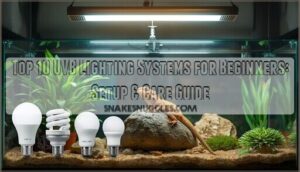
If you’ve ever watched a bearded dragon bask under a lamp, you’ve seen firsthand how UVB lighting transforms their world. It’s not just about warmth—UVB is the secret ingredient behind strong bones, healthy appetite, and vibrant behavior. Without the right setup, even the most attentive keepers can stumble into pitfalls that leave pets sluggish or plants stunted.
Managing UVB lighting systems for beginners can feel overwhelming, but getting it right unlocks a thriving environment. From bulb types to placement tricks, the essentials are easier than you think—and your animals and plants will thank you for it.
Table Of Contents
- Key Takeaways
- What is UVB Lighting for Beginners
- Key Benefits of UVB Lighting Systems
- Types of UVB Bulbs and Fixtures
- Choosing The Right UVB System for Your Needs
- Top 10 UVB Lighting Systems for Beginners
- 1. Reptile UVB Light Fixture
- 2. Reptile UVB Light Fixture Combo Kit
- 3. Reptile UVB Light Fixture Kit
- 4. Reptispa T5 UVB Lighting Kit
- 5. Repti Home T5 Reptile Light Combo
- 6. Zoo Med Turtle Lighting Kit
- 7. Hypool Reptile UVB Lighting Fixture
- 8. Zoo Med Desert UVB Lighting Kit
- 9. Oiibo Reptile UVB Lighting Combo Kit
- 10. Zoo Med Turtle UVB Lighting Kit
- Step-by-Step UVB Lighting Setup Guide
- Maintenance and Safety for UVB Lighting
- Frequently Asked Questions (FAQs)
- Do UVB lights actually work?
- Can you get vitamin D from an UVB lamp?
- Do UVB lamps use a lot of electricity?
- How long to use UVB light for psoriasis?
- How big of an UVB light do I need?
- What is the difference between an UV light and an UVB light?
- How many watts should an UVB light be for a bearded dragon?
- Can you get vitamin D from an UVB light?
- Can UVB bulbs be used with timers?
- How to measure UVB output accurately at home?
- Conclusion
Key Takeaways
- UVB light isn’t optional for reptiles — it drives vitamin D3 production, calcium absorption, and natural behaviors like basking, and skipping it leads to real health problems over time.
- Matching your bulb to your setup matters more than picking the most powerful option — T5 tubes suit taller enclosures and last up to 12 months, while T8s work best close-range and need swapping every 6 months.
- A glowing bulb doesn’t mean active UVB output, so replace tubes on schedule and use a UV index meter to catch silent decay before it harms your animals.
- Mesh screens can block 30–50% of UVB, so adjust fixture height accordingly and always give your reptile both a well-lit basking zone and a shaded retreat to move between.
What is UVB Lighting for Beginners
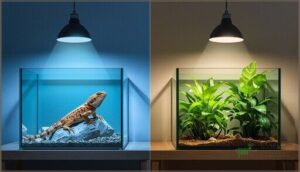
UVB lighting might sound technical at first, but it’s simpler than you think once you understand the basics.
Before jumping into product recommendations, it helps to know what UVB actually is, how it differs from other UV types, and why it matters for your reptiles or plants.
If you’re curious about the science behind UVB and UVA, this in-depth guide on the differences between UVB and UVA lighting breaks it down in plain English.
Here’s what every beginner should know going in.
Definition and Purpose of UVB Lighting
A UVB lamp is defined by UVB Spectrum Range 290–320 nm. In this band, the Photochemical Mechanism powers Vitamin D3 Synthesis, Plant Photoreceptor Activation, and UVB light therapy when you follow Safety Dosage Guidelines.
- UVB lighting for plants extends sunlike cues indoors.
- UVB Grow Light designs concentrate output into UVB narrowband peaks.
- Used correctly, strengthens resilience, color, and bones.
The T8 UVB Grow Light provides a full 400‑800 nm range for extensive plant illumination.
Difference Between UVB, UVA, and UVC
Not all UV light is the same, and knowing the difference matters more than you’d think.
UVA lamps sit at 315–400 nm, with the lowest energy levels and deepest penetration depth, reaching through skin and even glass.
UVB light covers 280–315 nm — medium energy, big biological impact. UVC? Atmospheric absorption blocks nearly all of it before it ever reaches you.
UVB rays are a major driver of skin cell mutations, a key factor in skin cancer risk.
Why UVB is Essential for Reptiles and Plants
Once you understand how these wavelengths behave, it’s easier to see why your reptiles and plants depend on a UVB lamp or UVB light at all.
Reptiles get Vitamin D3 synthesis and Hormone regulation that support health, while UVB grow light and UVB lighting for plants boost Photomorphogenesis control, Flavonoid production, Soil microbiome reduction, and UVB Light Therapy Benefits indoors.
Key Benefits of UVB Lighting Systems
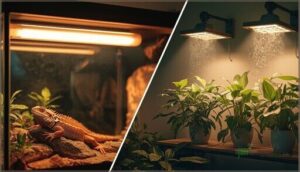
Before you pick a UVB setup, it helps to know what it’s actually doing for your animals and plants.
UVB lighting provides healthy reptile growth, boosts indoor plant performance, and keeps natural rhythms closer to what they’d experience outdoors.
As you look through the different enclosure-friendly systems below, keep these core benefits in mind so you can match each option to your goals.
Promoting Healthy Reptile Development
Think of proper UVB Light as your reptile’s multivitamin, driving bone density, muscle strength, and an immune boost.
With quality UVB lamps and safe dosage, you support bones, movement, and clear eyes, while Behavior Enrichment appears as basking and exploring.
Choose reptile fixtures over UVB grow light or UVB light therapy gear for humans, despite UVB light therapy benefits claims.
Enhancing Indoor Plant Growth
Plants respond to UVB lamps much like reptiles do — as a biological cue that triggers real chemical change.
With proper Light Spectrum Tuning and Automated Timing, UV light for plants boosts flavonoids, thickens leaves, and deepens aroma in herbs.
Smart Microclimate Optimization and Nutrient Synergy through horticultural lighting make indoor plant growth noticeably richer, while Hormone Regulation keeps development compact and stress‑resilient.
Supporting Natural Behaviors and Metabolism
Once you dial in UVB Light correctly, you’ll see confident Basking Behavior, stronger Appetite Stimulation, and clear Activity Rhythms instead of restless pacing.
That same UVB lamp drives Calcium Metabolism, enhances Reproductive Hormones, and, when paired with a UVB Grow Light over edible greens, boosts photomorphogenesis and plant health optimization for safe, nutritious foraging that your reptiles truly thrive under.
Types of UVB Bulbs and Fixtures
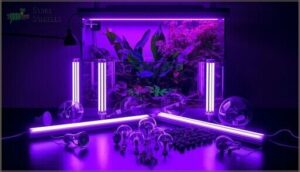
Before you settle on a UVB lighting kit, you need a quick sense of the different bulb types and fixture styles on the market.
In the next options, you’ll see T5 and T8 bulbs, compact and coil designs, and various fixtures built for specific enclosure shapes and sizes.
Use this section as a simple reference point so, as you look at each recommended setup, you know what kind of hardware you’re choosing.
T5 Vs. T8 Bulbs
Picking between a T5 and T8 UVB lamp isn’t just a spec debate — it shapes your whole setup. Here’s what actually matters:
- Output Efficiency — T5 bulbs push more UVB per watt, making them ideal for plant UV lighting and taller enclosures.
- Safe Distance — T5 needs 12–24 inches; T8 works best at 6–12 inches.
- Enclosure Height — Match bulb strength to your setup’s height, not just floor space.
- Replacement Cycle — T5 lasts 12 months; T8 needs swapping every 6.
- Energy Consumption — T8 draws less power but delivers less UVB reach.
Compact and Coil Bulbs
Compact and coil bulbs are “precision tools” of UVB, ideal when you want UVB hotspot control in setups. Their Phosphor coating shapes output, while Reflective dome use and Heat management keep the UVB lamp effective.
Enclosure size matching is key, so treat this UVB Light like a targeted UVB Grow Light, not LED UV grow lights claiming UV lighting benefits.
Fixture Compatibility and Enclosure Types
Not every UVB lamp works in every fixture — and that mismatch can silently undermine your setup. Ballast matching matters most: T8 Grow Light fixtures need T8 bulbs, full stop.
Reflector integration boosts output substantially, while mesh transmission loss can cut UVB by nearly half. Solid lid transmission preserves far more.
Dome mounting options give compact UVB Light setups flexibility across enclosure styles.
Choosing The Right UVB System for Your Needs
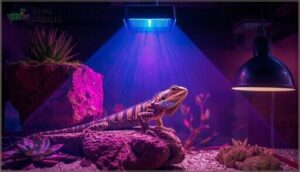
Now that you know the basic bulb types, the next step is choosing a UVB setup that actually fits your enclosure and the species or plants you’re caring for. You’ll want the right size, strength, and layout so the light reaches the spots where your reptile basks or your plants do the most growing.
Up next, you’ll see specific beginner-friendly systems and how they line up with different enclosure sizes and needs.
Sizing UVB Systems for Enclosures
Think of your UVB lamp as the sun on rails: you size it, then set the stage.
Use Enclosure Length Ratio and Species Zone Requirements to decide coverage, then fine‑tune with:
- Bulb Height Guidelines for safe UVI.
- Mesh Transmission Impact on UVB light.
- Reflector Efficiency, PPFD, light spectrum, and grow light selection, using T5 T8 fixture distances.
Matching Bulbs to Species and Plant Types
Once you’ve sized your system, the next step is matching the UVB light to who is actually living under it.
Desert reptile needs are worlds apart from shade plant UVB requirements.
Bearded dragons want high-output 10.0 tubes, while arboreal reptile lighting for chameleons suits a 5.0–6.0 range.
For succulent UVB tolerance and medicinal plant dosing, short, low‑dose bursts through a UVB grow light keep growth regulation balanced without scorching.
Top 10 UVB Lighting Systems for Beginners
Now that you know what to look for, let’s put that knowledge to work.
The options below are beginner-friendly, reliable, and cover a range of setups and budgets. Here are ten UVB lighting systems worth considering.
1. Reptile UVB Light Fixture
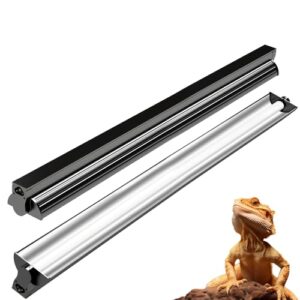
The REPTIDLDB T5 Reptile Light Fixture delivers 10% UVB and 30% UVA output in a slim 34‑inch aluminum housing — enough coverage for most standard desert setups.
At just 39 watts, it runs cool while still driving Vitamin D3 synthesis and calcium absorption for bearded dragons and tortoises.
The built‑in T5 HO electronic ballast and alloy reflective layer boost UVB delivery, and the detachable cable makes installation straightforward.
A few users noted bulb holder wear over time, so monitor that as it ages.
| Best For | Bearded dragon and tortoise owners who need solid UVB coverage for a standard desert enclosure without a lot of fuss. |
|---|---|
| UVB Output | 10% UVB |
| Fixture Type | T5 HO bar |
| Mounting Options | Detachable cable |
| Suitable Species | Bearded dragons, tortoises |
| Wattage Range | 39W |
| Beginner Friendly | Yes |
| Additional Features |
|
- Puts out 10% UVB and 30% UVA, which is exactly what desert reptiles need for healthy bones and digestion
- Runs at only 39 watts, so it stays cool and won’t spike your energy bill
- The alloy reflective layer and T5 HO ballast work together to actually push UVB down into the enclosure instead of wasting it
- Some users have noticed the bulb holder starting to peel or crinkle over time, so you’ll want to keep an eye on it
- Doesn’t put out much heat, meaning you’ll likely need a separate basking lamp depending on your setup
- Not a one-size-fits-all solution — if you keep tropical species, you’d need the UVB 5.0 version instead
2. Reptile UVB Light Fixture Combo Kit
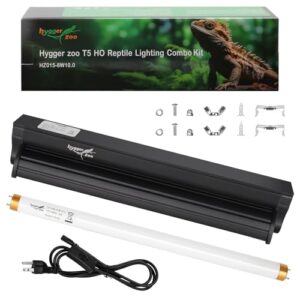
If you want something even more beginner-friendly, the Hygger Zoo HZ015-T5-8W combo kit is worth a look. At just 8 watts and 13 inches long, it’s compact enough for smaller vivariums and terrariums without overwhelming your setup.
The highly polished curved reflector pushes UVB output where it matters most — straight toward your basking spot. It’s designed for desert reptiles like bearded dragons and turtles, with two mounting options: over mesh or inside the tank.
Lightweight, energy-efficient, and straightforward to install.
| Best For | Beginners with smaller vivariums housing desert reptiles like bearded dragons or turtles who want an easy, no-fuss UVB setup. |
|---|---|
| UVB Output | UVB for desert reptiles |
| Fixture Type | T5 bar combo |
| Mounting Options | Mesh or tank |
| Suitable Species | Bearded dragons, turtles |
| Wattage Range | 8W |
| Beginner Friendly | Yes |
| Additional Features |
|
- Polished curved reflector directs UVB right where your reptile needs it most
- Two mounting options (mesh or inside tank) give you flexibility without extra gear
- Compact and energy-efficient at just 8W — won’t spike your electric bill
- Too small for larger enclosures like 120-gallon tanks
- Some users had concerns about long-term durability and build quality
- Can shift around inside the tank and be tricky to keep in place
3. Reptile UVB Light Fixture Kit
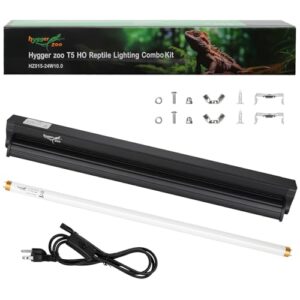
standard reptile UVB light fixture kit like the Hygger Zoo HZ015‑T5‑24W suits medium desert setups.
You get a slim 24‑inch, 24‑watt bar with a highly polished curved reflector that pushes stronger UVB and bright light straight into the basking zone.
It’s light enough to sit on a mesh lid, or you can mount it inside the tank.
Aluminum construction helps with heat dissipation, so output stays consistent and service life is longer for most beginners.
| Best For | Beginner to intermediate reptile keepers with small to medium desert setups (like bearded dragons, small tortoises, or similar species) who want an easy, slim UVB bar they can place on a mesh lid or mount inside the tank. |
|---|---|
| UVB Output | UVB for desert setups |
| Fixture Type | T5 bar |
| Mounting Options | Mesh or tank |
| Suitable Species | Bearded dragons, tortoises |
| Wattage Range | 24W |
| Beginner Friendly | Yes |
| Additional Features |
|
- Higher UVB output with a polished curved reflector, so more effective vitamin D3 and calcium support in the basking area.
- Lightweight, slim 24-inch bar that’s easy to position on a mesh lid or mount inside most medium enclosures.
- Aluminum construction helps with heat dissipation, giving more stable output and generally longer service life for the bulb and fixture.
- May be underpowered or too short for larger tanks and big display enclosures, like 120-gallon setups.
- Some users report durability and quality issues, so long-term reliability can be hit or miss.
- Can shift or not stay perfectly in place if the enclosure gets bumped or animals push around inside.
4. Reptispa T5 UVB Lighting Kit
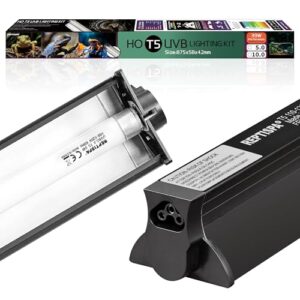
Reptispa T5 UVB Lighting Kit as your plug‑and‑play starter bar for serious husbandry.
It’s a T5 HO fixture with a polished curved reflector, pushing both visible light and either 5.0 or 10.0 UVB across your tank.
You can pick 8W, 24W, or 39W versions to match enclosure length and species needs.
It suits desert reptiles needing stronger UVB, yet can be toned down for tropical setups, keeping things bright, safe, and predictable, even for complete beginners today.
| Best For | reptile keepers who want an easy plug-and-play T5 UVB bar to boost appetite, bone health, and lighting in small to medium desert or tropical enclosures. |
|---|---|
| UVB Output | 5.0 or 10.0 UVB |
| Fixture Type | T5 HO bar |
| Mounting Options | Plug-and-play |
| Suitable Species | Desert, tropical reptiles |
| Wattage Range | 8W/24W/39W |
| Beginner Friendly | Yes |
| Additional Features |
|
- Strong 10.0 UVB output with a reflective alloy layer for better UV coverage and bright visible light.
- Helps support calcium absorption, bone strength, appetite, and overall comfort for many reptile and amphibian species.
- Simple plug-and-play design with electronic ballast, detachable cable, and on/off switch that’s friendly for beginners.
- Fixture surface can get quite hot during use, so it needs careful placement and clearance.
- UVB bulb must be replaced every 6–12 months, and swapping it can be tricky or may push you to buy a whole new fixture.
- Not ideal for larger tanks, and some users report strobing or faulty units that may require returns or replacements.
5. Repti Home T5 Reptile Light Combo
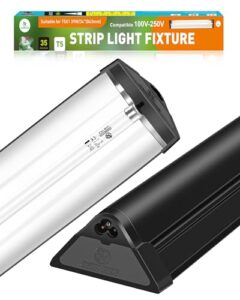
Reliability is the name of the game with the Repti Home T5 Reptile Light Combo. You get a sturdy aluminum fixture, a high-output 10.0 UVB bulb, and mounting hardware that fits most enclosures—perfect for desert reptiles like bearded dragons and tortoises.
The wide voltage range (100–250V) means stable performance, and the plastic protector keeps things safe. Just remember: bulb placement and careful handling matter; vibrations or assembly missteps can cause issues, so take your time and follow the instructions closely.
| Best For | Reptile owners who need reliable UVA and UVB lighting for desert species like bearded dragons and tortoises. |
|---|---|
| UVB Output | 10.0 UVB |
| Fixture Type | T5 HO bar |
| Mounting Options | Mounting hardware |
| Suitable Species | Bearded dragons, tortoises |
| Wattage Range | Varies |
| Beginner Friendly | Yes |
| Additional Features |
|
- Wide voltage range for steady power and performance
- Durable aluminum build resists UV aging and wear
- Easy to install with clear instructions and safe bulb cover
- Bulb may need adjustment or careful placement to turn on
- Vibrations can cause the bulb to shut off unexpectedly
- Not suitable for damp or humid environments
6. Zoo Med Turtle Lighting Kit
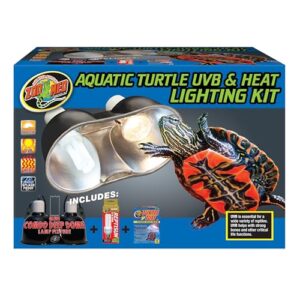
Versatility is what sets the Zoo Med Turtle Lighting Kit apart. You get a deep-dome fixture with dual ceramic sockets, a splashproof halogen heat lamp, and a compact UVB bulb—all bundled for aquatic turtles.
The dome keeps bulbs safely recessed, while independent switches let you fine-tune basking and UVB cycles. For beginners, this kit removes the guesswork: it’s designed for standard tanks, delivers reliable heat and UVB, and helps prevent shell and bone issues right from day one.
| Best For | Aquatic turtle owners who want a simple, all-in-one lighting solution that covers both heat and UVB needs. |
|---|---|
| UVB Output | UVB bulb included |
| Fixture Type | Dual dome fixture |
| Mounting Options | Independent switches |
| Suitable Species | Aquatic turtles |
| Wattage Range | Varies |
| Beginner Friendly | Yes |
| Additional Features |
|
- Includes both heat and UVB bulbs for healthy turtle care
- Deep dome design keeps bulbs secure and prevents sticking out
- Easy setup with separate switches for flexible lighting control
- Costs more than basic lighting kits
- Can be heavy and needs a sturdy base
- Bulky cables may be tricky to organize
7. Hypool Reptile UVB Lighting Fixture
Ever wish your basking reptiles received sunlight as evenly as a summer morning?
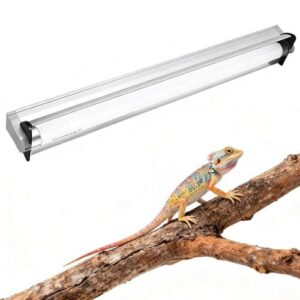
The Hypool Reptile UVB Lighting Fixture makes that possible for small to mid‑sized tanks, spreading 10.0 UVB along its 18‑inch T8 tube—ideal for desert species like bearded dragons and tortoises.
It’s lightweight, easy to install right over mesh, and comes with everything you need in the box.
Just remember, T8 bulbs lose UVB output over time, so swap them out every 6–12 months to keep your reptiles thriving.
| Best For | Reptile owners with small to mid-sized terrariums housing desert or rainforest species like bearded dragons, turtles, snakes, or frogs who want an affordable UVB setup without a complicated install. |
|---|---|
| UVB Output | 10.0 UVB |
| Fixture Type | T8 tube fixture |
| Mounting Options | Mesh mounting |
| Suitable Species | Desert, rainforest reptiles |
| Wattage Range | Varies |
| Beginner Friendly | Yes |
| Additional Features |
|
- Puts out solid 10.0 UVB coverage across an 18-inch tube, great for calcium absorption in desert reptiles
- Comes with everything in the box — brackets, wires, and accessories — so setup is quick and painless
- Lightweight aluminum build makes it easy to reposition on different enclosures
- Build quality feels a bit cheap to some users, with reports of scratches right out of the box
- Bulb burnout can happen as early as 2–3 months in, which is shorter than you’d hope
- Not a name-brand fixture, so if you prefer the peace of mind of a trusted label, this might fall short
8. Zoo Med Desert UVB Lighting Kit
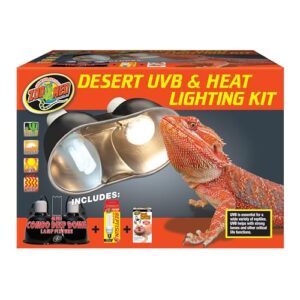
The Desert UVB Lighting Kit gives you everything you need right out of the box — no guesswork, no missing pieces.
It pairs a 75-watt Repti Basking Spot Lamp with a ReptiSun 10.0 UVB bulb, delivering both heat and UVB in one dual-dome fixture.
For breeding setups, see this guide to UVB lighting systems for reptile breeding for proper UVI targets and replacement schedules.
That combo is perfect for desert reptiles like bearded dragons and leopard geckos, supporting calcium absorption and preventing metabolic bone disease.
Each socket supports up to 160 watts, and the independent on/off switches make managing your day-night cycle genuinely simple.
| Best For | desert-dwelling, basking reptiles like bearded dragons and leopard geckos whose owners want an all-in-one heat and UVB lighting setup that’s easy to manage. |
|---|---|
| UVB Output | ReptiSun 10.0 UVB |
| Fixture Type | Dual dome fixture |
| Mounting Options | Independent switches |
| Suitable Species | Bearded dragons, geckos |
| Wattage Range | 75W + UVB |
| Beginner Friendly | Yes |
| Additional Features |
|
- All-in-one kit with fixture, basking bulb, and UVB bulb, so there’s no guesswork or extra shopping.
- Provides heat, UVB, UVA, and visible light to support calcium absorption, activity, and healthy shell/bone growth.
- Dual dome with independent switches and high-wattage ceramic sockets makes it simple to fine-tune day/night cycles and temperatures.
- Included bulbs may have a shorter lifespan and need replacing sooner than expected.
- Basking lamp can run quite hot and may be too intense for some smaller or more sensitive species.
- Fixture and bulbs can be prone to flickering or damage if not packed, handled, and installed carefully.
9. Oiibo Reptile UVB Lighting Combo Kit
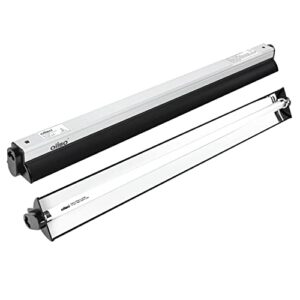
Think of the Oiibo Reptile UVB Lighting Combo Kit as a beginner‑friendly “plug it in and you’re covered” bar light.
You get a slim 24W T5 HO fixture, a Desert 12.0 UVB bulb, curved reflector, and removable power cable, all sized for typical 24‑inch enclosures.
It’s ideal for desert species like bearded dragons and uromastyx, though I’d still treat the included tube as “starter grade” and upgrade to a proven UVB brand when long‑term health really matters for your reptiles.
| Best For | New or casual desert reptile owners with 24" enclosures who want an easy, plug‑and‑play T5 UVB bar light for species like bearded dragons and similar lizards. |
|---|---|
| UVB Output | Desert 12.0 UVB |
| Fixture Type | T5 HO bar |
| Mounting Options | Removable power cable |
| Suitable Species | Bearded dragons, uromastyx |
| Wattage Range | 24W |
| Beginner Friendly | Yes |
| Additional Features |
|
- Slim 24W T5 HO fixture with built‑in curved reflector gives strong, efficient UVB output in a compact bar.
- Very beginner‑friendly: comes with UVB bulb, reflector, and removable power cable with on/off switch, so setup is simple.
- Sized well for standard 24" desert setups and works nicely over mesh for species that need strong UVB and UVA.
- Included bulb is more “starter grade,” with a typical lifespan of about 6 months before UVB output drops.
- Not ideal for larger or taller enclosures, where UVB spread and intensity may be insufficient.
- Some users report issues with incorrect replacement bulbs and a modest bump in power usage over time.
10. Zoo Med Turtle UVB Lighting Kit
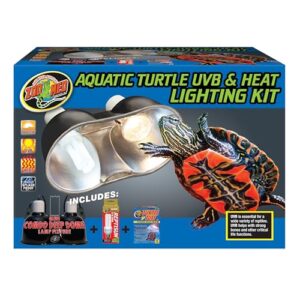
Where the Oiibo kit suits general reptile setups, this Zoo Med Turtle UVB Lighting Kit is designed for aquatic turtles from day one.
You get the Mini Combo Deep Dome fixture, a 50‑watt Repti Tuff splashproof halogen for basking heat, and a 13‑watt ReptiSun 5.0 compact UVB bulb in one tidy package.
The UVB facilitates vitamin D3 synthesis and shell health, while the halogen creates a bright, warm basking zone that encourages natural, frequent out‑of‑water behavior throughout their daily cycle.
| Best For | Aquatic turtle owners who need a reliable combo setup that handles both UVB and basking heat right out of the box. |
|---|---|
| UVB Output | UVB and heat bulbs |
| Fixture Type | Dual dome fixture |
| Mounting Options | Dual sockets |
| Suitable Species | Turtles, tortoises |
| Wattage Range | 50W |
| Beginner Friendly | Yes |
| Additional Features |
|
- Dual deep dome fixture keeps everything tidy — one spot for heat, one for UVB, each with its own switch
- Splashproof halogen bulb is built for water-based setups, so you’re not worried about moisture damage
- Supports shell health and natural basking behavior, which matters a lot for long-term turtle wellness
- Needs two outlets if you’re running both bulbs at the same time, which can be annoying depending on your setup
- Some users report bulbs burning out in under six months, so replacement costs can add up
- Packaging complaints are common, and the design makes it tricky to repair if something shorts out
Step-by-Step UVB Lighting Setup Guide
UVB lighting set up right makes all the difference for your animals and plants.
Let’s walk through the basics so you can feel confident from the start.
Here’s how each enclosure option stacks up for easy installation and safe results.
Proper Placement and Installation Tips
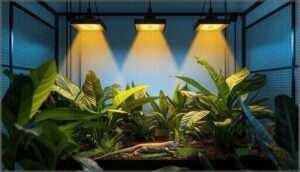
While setting up your UVB Light or UVB Grow Light, ceiling mounting is key—fixtures should sit above, not beside, your animals or plants.
For indoor gardening, keep mesh positioning in mind, since screens can block rays.
Aim for light zone zoning: provide both sun and shade.
Always make sure there is a barrier-free path and secure wiring routing for a safe, effective grow light installation.
Adjusting Fixture Height and Angle
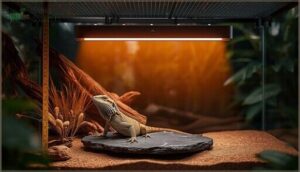
Once placement is sorted, height calibration makes all the difference.
Most T5 fixtures hit safe UVI levels around 12 to 18 inches above your basking spot — but mesh compensation matters. Fine metal mesh blocks 30 to 50 percent of UVB, so drop your fixture a few inches closer. Angle tilting toward the basking zone creates a natural gradient, giving your animal a real UV gradient to move through.
Safety margins: never let reptiles get within 6 to 8 inches of powerful bulbs.
Integrating UVB With Existing Lighting Systems
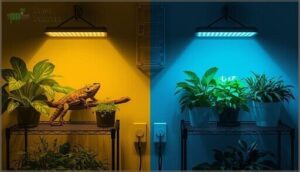
Once fixture’s height is dialed in, blending UVB with grow lights and supplemental lighting for plants takes a bit of orchestration.
Timing synchronization matters. A dual timer setup keeps UVB and LEDs on the same schedule, while heat-UVB coordination ensures reptiles bask under both.
Smart wiring management and spectral balancing make your plant lighting systems efficient, safe, and easy to maintain.
Maintenance and Safety for UVB Lighting
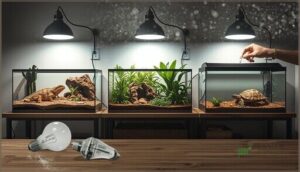
Keeping your UVB lighting in top shape is key for healthy plants and reptiles.
A few simple steps can make all the difference in safety and performance.
Let’s walk through what you’ll need to know for each enclosure option.
How Often to Replace UVB Bulbs
Don’t let a glowing bulb fool you — UV decay rate is silent. Most T8 UVB light tubes need replacing every 6–8 months, while T5s last closer to 10–12 months, depending on daily usage hours.
A glowing UVB bulb isn’t proof of UVB output — replace T8 tubes every 6–8 months before silent decay harms your animals
Species needs vary too; desert reptiles burn through bulb lifespan faster.
Use monitoring tools like a UV index meter to catch drops before they cause harm.
Preventing Overexposure and Burns
UVB light can scorch or stress if you miss a detail. You’ll want to dial in Lamp Distance, use Mesh Screens to soften rays, and embrace Gradual Acclimation for new setups. UVI Monitoring ensures safe exposure, while Eye Protection—like overhead lamps and shade zones—keeps your reptiles and plants thriving, whether you’re tackling UV therapy or phototherapy.
- Measure UVI at basking spot monthly
- Adjust lamp height for safe exposure
- Provide shaded retreats for eye protection
Troubleshooting Common UVB Lighting Issues
When your UVB light flickers, dims, or stops working, check for loose bulbs, worn sockets, or ballast issues—these are classic flicker causes.
UVB Decay sneaks up fast; visible brightness isn’t enough, so monitor output with a meter.
Distance Problems and obstruction effects, like mesh screens, cut UVB lighting for plants and UVB light therapy efficiency, so adjust placement regularly.
Frequently Asked Questions (FAQs)
Do UVB lights actually work?
Yes, they absolutely do.
UVB light triggers vitamin D3 synthesis in reptiles, directly supporting metabolic bone health, while UVB lighting for plants boosts secondary metabolites.
efficacy evidence is clear and well-documented.
Can you get vitamin D from an UVB lamp?
You absolutely can get vitamin D from a UVB lamp—when lamp calibration, dose timing, and skin type are carefully managed.
Clinical efficacy depends on safety guidelines, making home phototherapy a practical option for skin treatment and ultraviolet therapy.
Do UVB lamps use a lot of electricity?
Funny how people worry about power bills, but most UVB lamps sip electricity compared to heaters or LED UV grow lights.
Wattage Comparison shows typical UVB bulbs run under 40 watts, making Energy Cost Breakdown surprisingly gentle on your wallet.
How long to use UVB light for psoriasis?
For psoriasis, light therapy sessions usually start at 30–60 seconds, two to three times weekly.
Treatment course length runs six to twelve weeks, adjusting dose titration as skin response monitoring guides, then shifting to maintenance phase for ongoing skin condition management.
How big of an UVB light do I need?
If you want UVB coverage that could light up a football field, you’re overdoing it!
For most enclosures, match your UVB light to about half the Enclosure Length, focus on Intensity Percentage, Fixture Height, and Species Size Guidelines.
What is the difference between an UV light and an UVB light?
UV light covers a broad Wavelength Range and Energy Levels, while UVB light is a narrowband with higher Biological Impact.
UVB is essential for reptiles and plants, used in UVB light therapy, and demands strict Safety Guidelines in Application Areas.
How many watts should an UVB light be for a bearded dragon?
For a bearded dragon, a 24 to 39 watt T5 HO tube suits most enclosures. Match wattage to enclosure length, and prioritize UV index target of 0 to 5 over wattage alone.
Can you get vitamin D from an UVB light?
Yes — your skin actually makes vitamin D3 when UVB hits it. Dose timing, skin type, and safety limits all matter.
Think of it as a supplement comparison: device efficacy varies, so treat it like dermatology, not decoration.
Can UVB bulbs be used with timers?
UVB bulbs pair easily with timers—whether analog, digital, or smart Wi‑Fi—for reliable cycle programming and power rating safety.
This ensures consistent UVB light therapy, facilitates home-use UVB devices, and keeps your phototherapy system running smoothly.
How to measure UVB output accurately at home?
Grab a Solarmeter 2R or 5R — both offer NIST-traceable accuracy. Hold the sensor directly at the lamp, tilt slowly, and note the highest reading for consistent, reliable results.
Conclusion
Imagine a bearded dragon basking so contentedly, it could write a thank-you note—now that’s the power of a well-chosen UVB lighting system. For beginners, this isn’t just a checklist; it’s the difference between a thriving world and a shadowy guesswork.
With the right setup, you’re not just lighting a tank—you’re unlocking natural behaviors, vibrant health, and peace of mind. Master UVB lighting systems for beginners, and your reptiles and plants will flourish like never before.