This site is supported by our readers. We may earn a commission, at no cost to you, if you purchase through links.

Most people buying their first boa don’t realize they’re choosing between two distinct species—and that choice shapes everything from enclosure size to feeding schedule for the next 20 to 30 years.
Boa imperator, common in Central America, stays manageable at 6 to 8 feet. Boa constrictor, the South American heavyweight, can push 12 feet and requires considerably more space, prey, and handling confidence.
Getting this decision right from the start determines whether you build a setup that works or spend years correcting expensive mistakes.
This guide walks through species selection, enclosure design, climate control, feeding, and health monitoring—everything you need to care for a boa correctly.
Table Of Contents
- Key Takeaways
- Choose Your Boa Species
- Build a Secure Enclosure
- Control Heat, Light, and Humidity
- Feed Your Boa Correctly
- Handle and Monitor Health
- Frequently Asked Questions (FAQs)
- Can boa constrictors be housed together safely?
- How do you breed boa constrictors successfully?
- What permits or licenses are required legally?
- How do you transport a boa safely?
- Can boas recognize or bond with owners?
- Can boas cohabitate with other snake species?
- How does breeding season affect boa behavior?
- Do boas require routine calcium supplementation?
- What permits are needed for boa ownership?
- How do you handle a boa during transport?
- Conclusion
Key Takeaways
- Choosing between Boa imperator (6–8 ft) and Boa constrictor (up to 12 ft) before you buy determines your enclosure size, feeding demands, and budget for the next 20–30 years—getting this wrong is expensive to fix.
- A secure, appropriately sized enclosure with a stable thermal gradient (high 80s–low 90s °F warm side, low 80s cool side) and 50–70% humidity isn’t optional—it’s the foundation your boa’s health depends on.
- Feeding frozen-thawed prey matched to your boa’s mid-body girth on a schedule that stretches from every 5–7 days for hatchlings to every 3–6 weeks for adults, prevents the two most common keeper mistakes: obesity and regurgitation.
- Knowing what a healthy boa looks like—quiet breathing, clean sheds, consistent appetite, natural thermoregulation—lets you catch problems early, before they become vet emergencies.
Choose Your Boa Species
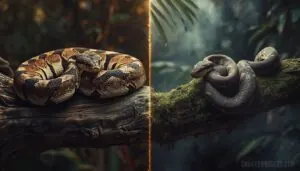
Before you buy a boa, the species you choose shapes everything — space, budget, and how you’ll spend the next few decades. The genus Boa includes several taxa, but most keepers choose between two: Boa constrictor and Boa imperator.
That choice gets even more nuanced when you factor in whether you’re buying captive-bred or wild-caught — a decision worth thinking through carefully before you commit, and one covered in depth in this complete guide to keeping boa constrictors as pets.
Here’s what you need to know about each before committing.
Boa Constrictor Vs. Boa Imperator
Most keepers use "boa constrictor" as a catch-all, but there are real differences worth knowing. Here’s how the two most common species compare:
- Build and markings — Boa constrictor is stockier with smoother saddle pattern differences, while Boa imperator is leaner with crescent-shaped, irregular saddles and vivid tail color variation.
- Range — Geographic distribution splits them: imperator across Central America and Mexico, constrictor through South America.
- Reproduction — Parthenogenesis occurrence is documented in imperator only.
Boa constrictor generally grows larger, requiring a more spacious enclosure, as noted in the larger enclosure requirements.
Adult Size and Growth Expectations
Size matters when choosing a species. Boa imperator stays medium to large — usually 6 to 8 feet — while Boa constrictor genetics set a higher ceiling, with giants topping out at 10–12 feet (3.0–3.7 m).
Growth rate variability is real: females outpace males noticeably due to sexual dimorphism.
Track prey size influence and maturity milestones early — growth monitoring helps you catch problems before they compound.
Lifespan and Long-term Commitment
Growth patterns only tell part of the story. captive boa commonly lives 20 to 30 years — sometimes into the mid-30s. That’s a long-term commitment that pet snake owners often underestimate.
Captive boas routinely live 20 to 30 years — a decades-long commitment most new owners genuinely underestimate
Budget planning should cover equipment longevity, veterinary checkups, and consistent weight monitoring across decades. Succession planning matters too; rehoming an adult boa is genuinely harder than finding a home for a juvenile.
Temperament and Beginner Suitability
Beyond lifespan, temperament shapes your daily experience more than almost anything else. Most captive boas have placid temperaments and tame down easily with regular handling — a key pet boa constrictor ownership consideration.
Stable Activity Levels and reliable Gentle Cue Response make Temperament Assessment straightforward:
- Minimal striking during routine weigh-ins
- Relaxed muscle tone and steady breathing
- Quick acclimation after initial handling sessions
Stress Signal Identification and Heart Rate Monitoring confirm readiness for longer interaction.
Legal and Ethical Ownership
Before you bring a boa home, check your local permit requirements and CITES compliance obligations — some subspecies trigger import paperwork even for private owners.
Maintain a clear documentation chain from breeder to your door: invoices, breeder records, and transfer receipts.
Transport regulations vary by region, so verify rules before relocating.
Welfare standards aren’t optional; ethical breeding practices and responsible pet ownership mean this is a genuine long-term commitment.
Build a Secure Enclosure
Getting boa’s enclosure right isn’t just about comfort — it’s about keeping a powerful, surprisingly clever escape artist safely contained.
A secure, well-designed setup also makes handling less stressful for both of you — and if you’re newer to large constrictors, checking out non-aggressive snake breeds that are easier to manage can help you build confidence before working with a boa.
Before you buy a single piece of equipment, it helps to know exactly what your setup needs to cover.
Here are the key elements to get right from the start.
Minimum Enclosure Size
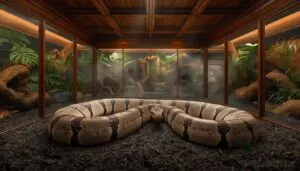
Think of the enclosure as real estate that your boa will grow into quickly. For juveniles, a 20-gallon tank works briefly, but adults need at minimum an 8 × 3 × 3 ft space — and that’s the floor.
Factor in Growth Spurts, planning early, using a 2:1 Length-to-Height Ratio for proper zoning. Floor Space Calculation matters more than volume here — your boa needs room to move, not just exist.
Escape-proof Lid and Locks
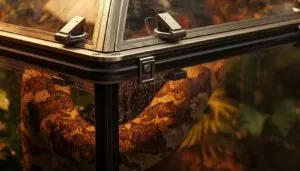
Even the best enclosure fails if the lid isn’t secure. Boas are surprisingly strong, and a poorly latched screened lid is basically an open invitation.
Look for Locking Cam Design hardware that rotates 90 degrees into the frame, Gasket Seal Integrity along the perimeter, and a Magnetic Catch System for backup.
Corrosion Resistant Materials handle humidity without degrading, and Visual Lock Indicators let you confirm the enclosure is secured at a glance.
Substrate and Bioactive Options
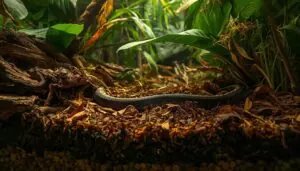
What’s underfoot matters more than most keepers realize. A Coconut Coir Mix blended with orchid bark and leaf litter creates a solid bioactive substrate foundation.
Add a Drainage Layer Design beneath to prevent waterlogging.
Introduce isopods and springtails as your cleanup crew — Microfauna Balance keeps the enclosure fresh naturally.
Leaf Litter Enrichment adds hiding opportunities while Mold Prevention Strategies depend heavily on your substrate composition and ventilation.
Hides, Branches, and Climbing Space

Boas aren’t purely ground-dwellers — they’re semi-arboreal by nature, so your enclosure design for semi-arboreal snakes needs to reflect that.
Build in Branch Height Variety using sturdy branches from 1 to 4 inches wide, secured with Secure Anchor Points that won’t shift under a heavy body.
Maintain Climbing Path Continuity between hides and perches, and use an Enrichment Rotation Schedule quarterly to keep your boa exploring its climbing decor.
Hide Microclimate Zones on both sides, complete the setup.
Water Dish Placement and Cleanup Access
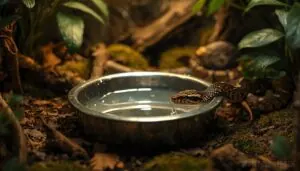
Place the dish on stable, level ground where your boa can reach it from multiple angles — that’s your Reachable Water Position. Choose a Humidity‑Balanced Location away from basking heat to limit evaporation and algae.
Non‑porous Dish Material like stainless steel or ceramic helps water bowl hygiene through easy scrubbing. Spill‑Control Placement and Easy Removal Design keep enclosure cleaning fast and disruption‑free.
Control Heat, Light, and Humidity
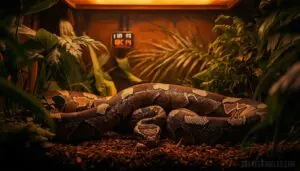
Getting the climate right inside your boa’s enclosure is one of the most important things you’ll do as an owner.
Temperature, humidity, and light all work together to keep your snake healthy, active, and stress‑free. Here’s what you need to know to dial in each one correctly.
Warm Side and Cool Side Temperatures
Getting your thermal gradient right isn’t guesswork — it’s precision. Aim for high 80s to low 90s °F on the warm side, with the cool side sitting in the low-to-mid 80s.
Temperature Gradient Calibration depends heavily on Sensor Positioning: place sensors at surface level, where your boa actually contacts.
Watch for Thermal Drift across the day, and make Seasonal Adjustment when room temps shift.
Safe Heat Sources and Thermostats
Once your thermal gradient is dialed in, keeping it stable comes down to choosing the right equipment. Here’s a reliable setup:
- Use a ceramic heater for ambient warmth without disrupting nocturnal cycles.
- Apply Thermal Guard Shields over any hot surface to prevent direct contact burns.
- Run Heat Pad Placement under a non-conductive barrier, never bare substrate.
- Use the Exo Terra DimmingPulse Proportional Thermostat for precise temperature regulation.
Thermostat Redundancy — running a backup unit — prevents catastrophic failure. Pair that with monthly Probe Calibration Frequency checks, and your heat source placement stays accurate season after season.
Humidity Targets for Daily Care
With your heat sources locked in, humidity becomes the next variable to manage carefully.
Aim for 50–70% relative humidity during daily care, measured with a digital hygrometer placed at your boa’s resting height — not buried in substrate.
Microclimate zones matter here: the humid hide runs higher than the open enclosure.
Adjust for seasonal humidity shifts, and keep substrate damp but never soggy.
Shedding Support and Misting
When your boa’s skin turns dull and its eyes go blue, the shedding cycle has begun — and that’s your cue to act.
- Damp Hide Placement — Set the humid hide on the warm side so your boa gets shedding assistance with heat.
- Humidity Spike Timing — Boost moisture when eyes cloud over, then ease off once the shed completes.
- Misting Frequency — Light spot misting beats soaking; check that no puddles form.
- Stuck Shed Prevention — Consistent microclimate monitoring catches dryness before tail tips or face scales retain skin.
- Microclimate Monitoring — Your humidity gauge usage matters here — read at resting height, not substrate level.
Lighting, UVB, and Monitoring Tools
Light often gets overlooked, but it’s one of the more environmental controls you can dial in.
| Tool | Purpose |
|---|---|
| UVB Fixture Types | Match output to basking zone |
| UVB Meter Placement | Verify intensity at the boa’s level |
| Lamp Aging Schedule | Replace bulbs before output drops silently |
| Remote Light Sensors | Monitor photoperiod timing automatically |
| Digital thermometers + humidity gauge usage | Track temperature gradient and moisture together |
Feed Your Boa Correctly
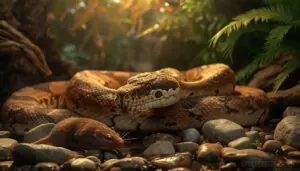
Feeding a boa sounds simple — but get it wrong and you’re looking at a sick, stressed snake.
The details matter more than most new keepers expect, from prey size to prep method to how often you offer a meal. Here’s what you need to know to do it right.
Appropriate Prey Types and Sizes
Getting prey size selection right is the foundation of safe feeding. Frozen prekilled prey — rats, mice, or appropriately sized rabbits — eliminates the injury risk that live prey creates. Match prey girth to your boa’s widest point; this is called Prey Girth Matching, and it prevents regurgitation.
Stick to these guidelines:
- Rodents from reputable suppliers for nutritional balance considerations
- No wild-caught prey — parasite risk is real
- Gradual prey size increases as your boa grows
- Skip live prey; frozen prekilled prey is safer
Feeding Schedule by Age
As your boa grows, its feeding schedule for boas shifts considerably.
Hatchling Frequency starts at every 5–7 days, then Juvenile Interval stretches to every 7–14 days, as the growth rate during the first six years gradually slows.
Subadult Spacing generally lands around every 14–21 days, while Adult Maintenance settles at every 3–6 weeks.
Seasonal Adjustments matter too — cooler months often mean extending intervals rather than pushing meals.
Frozen-thawed Prey Preparation
Proper prep separates a clean feeding response from a flat refusal. Follow this five-step process:
- Cold-water Thawing — Submerge sealed frozen prey in cold water, changing it every 10–15 minutes for consistent moisture retention.
- Core Temperature Check — Squeeze the abdomen; no cool spots mean fully defrosted prey.
- Bag Sealing Method — Keep prey bagged throughout.
- Warm-water Heating — Move sealed prey into 110–115°F water until surface hits 100–105°F.
- Verify before offering — Confirm even warmth throughout before using feeding tongs.
Feeding With Tongs and Separate Space
Two tools make every feeding session safer: feeding tongs and a dedicated feeding area.
| Practice | Why It Matters |
|---|---|
| Tong Length Selection | Match tong length to enclosure size — 18"+ for deep setups |
| Rubber‑Tip Grip | Prevents prey slipping and reduces strike-on-implement risk |
| Prey Positioning Strategies | Offer prey near, not on, the boa for voluntary approach |
| Feeding‑Maintenance Separation | Dedicated feeding tongs prevent confusing routine care with mealtime |
Always use a separate enclosure for feeding. Safe Feeding Practices mean your boa never associates your hands — or maintenance tongs — with food.
Preventing Obesity and Regurgitation
Overfeeding is the silent threat most boa keepers miss until the damage is done. Keep these five habits in place:
- Apply Body Condition Scoring monthly to catch gradual weight gain early.
- Follow Portion Size Guidelines — prey girth should match mid-body width, never exceed it.
- Enforce Post-Feed Rest for 48 hours minimum.
- Maintain Hydration Management through consistent humidity.
- Practice Stress Reduction by minimizing post-meal disturbances.
Handle and Monitor Health
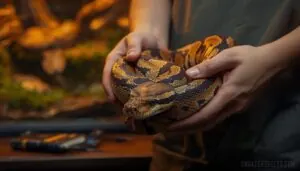
Knowing how to handle your boa safely — and spot trouble early — is just as important as getting the enclosure right. A confident keeper pays attention to both their snake’s behavior and the cleanliness of its space.
Here’s what you need to know across five key areas.
Safe Handling Techniques
Handling a boa well starts with support points — multiple hands along the body, not just the midsection. Use a gentle lift from below, keeping the snake close to your body for drop prevention.
Move slowly, stay balanced, and follow basic hygiene protocols: wash your hands before and after every session.
Good handling techniques reduce stress for both of you.
Handling After Meals and During Shedding
Even with solid technique, timing matters just as much as method. Post-Feed Observation is your first rule: wait at least 48 hours after a meal before handling. Regurgitation Risk Management is real — movement disrupts digestion.
During the shedding cycle, Skin Shedding Sensitivity increases noticeably. Respect the Shedding Phase Rest:
- Skip handling when eyes turn cloudy
- Never peel stuck shed manually
- Raise humidity for Seasonal Shedding Support
- Resume only after full, clean shed completion
Spot Cleaning and Deep Cleaning
Beyond handling timing, how you maintain the enclosure directly affects your boa’s health.
Spot Waste Removal should happen the moment you see feces, urates, or vomit — don’t let waste sit.
For your Deep Clean Process and Substrate Turnover, move your boa to a secure temporary setup monthly, scrub hides and corners thoroughly, apply a reptile-safe Disinfectant Application, and dry everything completely before reassembly.
Healthy Signs to Watch For
A clean enclosure sets the stage — but knowing what a thriving boa actually looks like keeps you ahead of problems. Watch for these five healthy signs:
- Body Condition — Muscle tone is even, with no sharp thinning toward the tail.
- Respiratory Ease — Breathing stays quiet, with no clicking or wheezing.
- Consistent Appetite — Regular feeding interest, with no unexplained refusal cycles.
- Temperature Preference — Moving between warm and cool sides naturally.
- Shedding Progress — Skin releases cleanly, with no stuck patches signaling dysecdysis.
When to Call a Reptile Vet
Some signs don’t wait — and neither should you.
| Emergency (Call Now) | Monitor Closely |
|---|---|
| Respiratory Distress, open-mouth breathing | Mild dysecdysis or stuck shed |
| Cloacal Prolapse or vent tissue visible | Brief appetite loss |
| Neurologic Seizures or tremors | Single abnormal dropping |
Toxic Exposure, Digestive Issues with blood or mucus, stomatitis, scale rot, inclusion body disease, and respiratory infections all need a reptile vet — not a wait-and-see approach.
Frequently Asked Questions (FAQs)
Can boa constrictors be housed together safely?
Solitary by nature, boas rarely tolerate cohabitation. Dominance hierarchies emerge quickly, causing stress indicators like refusal to eat.
Separate enclosures are safest unless managing a breeding pair with careful size matching and feeding separation.
How do you breed boa constrictors successfully?
Successful boa breeding starts with genetic diversity, seasonal timing, and ultrasound monitoring to confirm ovulation.
Understand their viviparous reproduction and watch for mating behaviors—males actively court receptive females during the dry-season breeding window.
What permits or licenses are required legally?
Before you bring a boa home, check your local zoning restrictions, state licensing rules, and CITES documentation requirements.
Import permits and breeding permits may also apply depending on your location and intentions.
How do you transport a boa safely?
Use a solid-sided plastic container with ventilation holes and a secured lid. Skip feeding 48 hours before travel, insulate against temperature swings, and keep the ride smooth and quiet.
Can boas recognize or bond with owners?
Boas don’t bond like dogs do, but they recognize you through scent familiarity and routine consistency.
Over time, regular tactile interaction reduces stress signals — that calm stillness in your hands is their version of trust.
Can boas cohabitate with other snake species?
Keeping boas with other snake species isn’t recommended. Species compatibility breaks down fast — aggression risks, disease transmission, and territorial behavior make cohabitation dangerous for all occupants.
Separate enclosures are always the safer choice.
How does breeding season affect boa behavior?
During breeding season, your boa’s behavior shifts noticeably. Expect increased activity, courtship displays, male aggression, female swelling, and reduced feeding as reproductive biology of boas redirects energy toward mating.
Do boas require routine calcium supplementation?
Yes — but modestly.
Whole prey covers most needs, though gaps in calcium-phosphorus ratio and prey mineral content make light dusting with Repashy Calcium Plus worthwhile to guard against metabolic bone disease.
What permits are needed for boa ownership?
Before you bring a boa home, paperwork may matter more than the enclosure.
Depending on your location, you may need a CITES Certificate, Proof of Origin, Local Conservation Permit, or State Dangerous Permit with Microchip Identification.
How do you handle a boa during transport?
Use an escape-proof container with ventilation holes, thermal gradient control, and a towel lining. Fast your boa beforehand, minimize handling time, and run an arrival health assessment once home.
Conclusion
The irony of this boa species care guide is that the hardest part isn’t the feeding schedule, the thermostat calibration, or even sourcing frozen prey—it’s the decision you make before any of that begins.
Choose the wrong species, and every enclosure you build is solving the wrong problem. Choose correctly, and the next 25 years become genuinely manageable.
Your boa won’t demand excellence. It’ll demand consistency—and that’s something you can actually deliver.