This site is supported by our readers. We may earn a commission, at no cost to you, if you purchase through links.
Your bearded dragon’s skeletal system requires ultraviolet radiation between 280 and 315 nanometers to synthesize vitamin D3. Yet, most commercial lighting fixtures deliver insufficient spectral output at basking distances, creating a metabolic deficit. This manifests gradually as weakened bone density, tremors, and irreversible skeletal deformities.
This physiological dependency on UVB wavelengths isn’t merely a husbandry preference but rather a non-negotiable requirement. It’s rooted in the evolutionary adaptations of species inhabiting high-elevation deserts and sun-exposed rocky outcrops, where ambient UV indices routinely exceed 7.0 during peak daylight hours.
Modern UVB lighting systems for desert species have evolved considerably beyond early compact fluorescent technologies. They now incorporate high-output T5 configurations that maintain therapeutic irradiance levels across broader distances while providing the spectral consistency these animals require for calcium homeostasis and normal physiological function.
Table Of Contents
- Key Takeaways
- Why UVB Lighting is Essential for Desert Species
- Key Features of UVB Lighting Systems
- How to Set Up UVB Lighting for Desert Habitats
- Top 10 UVB Lighting Systems for Desert Species
- 1. Zoo Med Desert UVB Lighting Kit
- 2. Reptile Systems T5 Desert UVB Lamp
- 3. Repti Zoo T5 UVB Lighting Kit
- 4. Zilla Reptile UVB Light Bulb
- 5. T5 Ho Uvb Reptile Light Fixture
- 6. Lucky Herp Reptile Uvb Light Bulb
- 7. Repti Zoo UVB Desert Reptile Lamp
- 8. Reptile UVB Light Fixture
- 9. Haceryc Reptile UVB Light Fixture
- 10. Reptile UVB Light Bulb
- Choosing The Right UVB System for Your Reptile
- Frequently Asked Questions (FAQs)
- What is the difference between tropical and desert UVB bulbs?
- Is a basking light the same as an UVB light?
- Is too much UVB bad for reptiles?
- Can I use UVB lighting through glass or mesh?
- How do I measure actual UVB output at home?
- Do nocturnal desert species need UVB lighting too?
- Whats the difference between UVB and UVA lighting?
- Can UVB bulbs cause eye damage in reptiles?
- Conclusion
Key Takeaways
- Desert reptiles require UVB wavelengths between 280-315 nanometers to synthesize vitamin D3, making proper UVB lighting a non-negotiable physiological requirement rather than an optional husbandry preference.
- High-output T5 fluorescent systems significantly outperform compact fluorescent bulbs by delivering approximately 5,000 lumens with lower heat emission, longer lifespan (12-18 months), and more consistent therapeutic irradiance across broader distances.
- Proper UVB setup demands precise positioning 12-18 inches above basking zones with UV Index readings between 3.0-5.0, combined with seasonal photoperiod adjustments and mandatory bulb replacement every 6-12 months as UVB output degrades faster than visible light.
- Without adequate UVB exposure replicating desert sunlight conditions, captive reptiles will develop metabolic bone disease through disrupted calcium metabolism, leading to skeletal deformities, tremors, and eventual systemic collapse regardless of dietary calcium supplementation.
Why UVB Lighting is Essential for Desert Species
When you’re keeping desert reptiles like bearded dragons (Pogona vitticeps) or blue-tongued skinks (Tiliqua scincoides), you’ll quickly discover that ultraviolet-B radiation between 280-315 nanometers isn’t just beneficial—it’s absolutely critical for preventing catastrophic health failures, particularly metabolic bone disease. This condition develops when calcium metabolism breaks down due to insufficient cholecalciferol (Vitamin D3) synthesis in the skin.
For species that can’t efficiently synthesize D3 through skin exposure alone, like many snake species, proper vitamin and mineral supplementation becomes essential to prevent similar deficiencies.
Without proper UVB exposure replicating the intense solar conditions of their native arid habitats, your animals won’t exhibit natural thermoregulatory behaviors, won’t process dietary calcium efficiently regardless of supplementation levels, and will inevitably develop skeletal deformities, tremors, and eventually complete systemic collapse.
Understanding the full spectrum of common health problems in pet snakes helps you recognize early warning signs before minor issues progress into life-threatening conditions.
Without adequate UVB replicating desert sunlight, your reptiles cannot regulate temperature, absorb calcium, or avoid skeletal collapse
Understanding precisely why UVB matters, how photobiological processes drive essential physiological functions, and what happens when you get the wavelength delivery wrong will transform your approach to lighting design and help you recognize the warning signs before problems become irreversible.
Role of UVB in Calcium Metabolism
UVB lighting drives your desert reptile’s calcium regulation by initiating vitamin D3 synthesis in the epidermis. Wavelengths between 280-315 nanometers convert 7-dehydrocholesterol to cholecalciferol, which hepatic and renal hydroxylation transforms into calcitriol.
Proper bulb selection and placement directly impact these metabolic processes, which is why understanding your boa constrictor’s specific lighting needs helps prevent metabolic bone disease.
Calcitriol, the hormonal form, upregulates intestinal calcium absorption through enhanced expression of calcium transport proteins in enterocytes. This process establishes metabolic balance, which is essential for bone health and skeletal integrity.
Preventing Metabolic Bone Disease
Without proper UVB therapy, your desert reptile can’t maintain calcium balance, which leads directly to metabolic bone disease. You’ll see skeletal deformities, limb bowing, and jaw distortions when mineral metabolism fails. Disease prevention depends on providing appropriate UVB requirements that enable vitamin D3 activation and support bone health.
- Lethargy and reduced appetite signal early mineral disorders
- Soft or irregular skeletal structures indicate severe calcium deficiency
- Movement difficulties reflect progressive skeletal fragility
- Regular monitoring prevents irreversible reptile health complications
Importance for Vitamin D3 Synthesis
Beyond preventing bone disease, UVB exposure triggers a cascade you can’t replicate with diet alone—your desert reptile’s skin converts 7-dehydrocholesterol into vitamin D3 under wavelengths between 290 and 315 nanometers, initiating liver and kidney transformations that regulate calcium absorption, bone health, and skeletal mineralization.
Without adequate UVB lighting matched to species-specific UVB requirements, D3 synthesis halts, compromising reptile health despite proper nutrition. Understanding the essential process of helps explain why proper UVB lighting is essential for reptile well-being.
Natural Behaviors Linked to UVB Exposure
Your animal’s response to UVB lighting extends far beyond skeletal health—UVB induced behavior influences thermoregulation patterns, foraging strategies, and basking preferences through skin-mediated hormonal pathways that coordinate activity cycles with solar conditions.
Desert reptiles exhibit heightened social hierarchy displays, altered reproductive signaling, and strategic microhabitat selection when UVB requirements align with photobiology, demonstrating that proper UVB lighting fundamentally shapes natural reptile behavior in captive environments.
It’s important to recognize that UVB effects on physiology can be influenced by environmental factors like temperature, which has significant implications for animal health and husbandry.
Key Features of UVB Lighting Systems
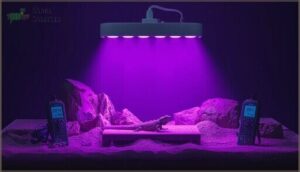
When you’re evaluating UVB lighting systems for desert reptiles, understanding the technical specifications that drive photobiological effectiveness becomes essential for maintaining peak health in captive populations. The wavelength output, bulb configuration, spectral quality, and operational longevity all interact to determine whether your lighting system adequately replicates the solar radiation profile that species like Pogona vitticeps and Uromastyx aegyptia evolved to utilize in their native habitats.
Regular testing with a solarmeter helps you track whether your desert reptile cage lighting still delivers adequate UVB irradiance as bulbs age and phosphor coatings degrade.
Let’s examine the critical features you’ll need to assess when selecting appropriate UVB provisioning technology for your desert-adapted herpetofauna.
UVB Wavelength Requirements for Desert Reptiles
Desert reptiles thrive when you deliver UVB radiation in the 280 to 315 nanometer range, enabling efficient vitamin D3 synthesis and calcium metabolism essential for skeletal integrity. UVB spectrum analysis and intensity mapping help you match wavelength output to species-specific requirements, while reptile skin response studies confirm that peak photobiological activity occurs near 305 to 312 nanometers for most desert-adapted lizards.
- Target wavelengths: 280–315 nm for desert reptile vision and D3 production
- Peak efficiency: Mid-range UVB around 305–312 nm optimizes calcium turnover
- Gradient optimization: Create zones from intense basking to shaded retreats
- Species-specific needs: Match UVB requirements to individual desert reptile physiology
High-output T5 Fluorescent Vs. Compact Bulbs
Selecting between T5 HO systems and compact UVB fluorescent lamps requires careful evaluation of lumen output, heat emission, and bulb longevity. High-output T5 bulbs deliver approximately 5,000 lumens at 54 watts, while compact variants produce only 800 to 1,600 lumens at lower wattage. This difference significantly influences fixture design, energy savings, and overall UVB lighting performance in desert reptile habitats.
| Feature | T5 High Output | Compact Fluorescent |
|---|---|---|
| Lumen Output | ~5,000 lumens per bulb | 800–1,600 lumens per bulb |
| Heat Emission | Lower heat per lumen | Higher relative heat |
| Bulb Longevity | 12–18 months steady output | 8–12 months before degradation |
| Energy Efficiency | Higher lumens per watt | Lower lumens per watt |
Importance of Full-spectrum and UV Index Ratings
Full spectrum lighting replicates natural daylight across visible and ultraviolet bands, supporting behavioral cues such as basking and thermoregulation in desert reptiles.
Choosing the right reptile lighting solutions ensures your setup delivers proper UVB levels without overwhelming smaller habitats.
UV Index ratings quantify the potential for harm from UVB radiation, guiding you to match species-specific photobiology needs with appropriate exposure durations.
Balancing full spectrum output with accurate UV Index values ensures your UVB lighting system delivers safe, biologically effective UVB radiation without overexposure.
Lifespan and Replacement Schedules
You’ll see UVB radiation decline even when visible light remains bright, since phosphor coatings degrade faster than filaments in reptile lighting systems. Compact fluorescent bulbs typically lose approximately 40 percent of UVB output after six months of daily use, necessitating replacement cycles every six to twelve months to prevent calcium metabolism deficiencies.
UVB metering with a hand-held UV Index meter confirms bulb degradation patterns, ensuring proper lighting maintenance and bulb longevity for ideal reptile care.
How to Set Up UVB Lighting for Desert Habitats
You’ve selected the right UVB system for your desert reptile, but proper installation determines whether that equipment actually delivers the photobiologically active wavelengths your animal needs for calcium metabolism and skeletal health.
The positioning of your bulbs relative to basking surfaces, the integration with thermal gradients, and the seasonal adjustment of photoperiods all influence whether your captive specimens receive UVB exposure comparable to what their wild counterparts experience in arid ecosystems.
Let’s examine the four critical setup parameters that transform a quality lighting product into an effective captive husbandry tool.
Positioning Bulbs for Optimal Exposure
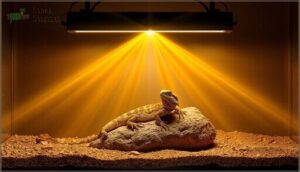
You’ll want to mount your UVB lighting for reptiles directly above the basking zone, aligning the bulb center with the hotspot where your animal spends most of its time—this bulb placement ensures peak UV intensity exactly where it’s needed.
Maintain manufacturer-recommended distances to achieve species-appropriate UVI measurements, positioning the fixture parallel to the enclosure floor to create controlled exposure gradients while enabling proper lighting angles and beam control throughout the habitat.
Creating UV Gradients in The Enclosure
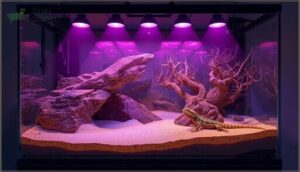
Think of gradient design as layering sunlight across the habitat—you’ll position your UVB lighting for reptiles at varying heights to generate controlled UV intensity zones spanning from peak exposure at basking sites to minimal UVB radiation in retreat areas, mimicking natural desert conditions.
Reflective surfaces redistribute photons without heat penalties, while strategic lighting placement and enclosure optimization create functional UV gradients that support thermoregulation, behavior expression, and physiological wellness in desert reptile care applications.
Integration With Heat Sources
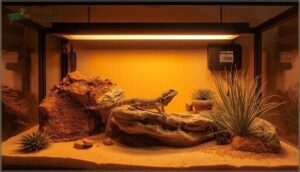
You’ll coordinate UVB lighting with heat lamps by separating basking spots from UVB fixtures to prevent scorching while ensuring desert reptiles receive simultaneous warmth and UV exposure across distinct thermal gradients.
Position ceramic heat emitters at measured distances from T5 fluorescent systems, aligning photoperiod cycles (10–12 hours) with heat source timing, and calibrate basking zone temperatures using dimmable controllers to maintain stable microclimates without compromising UVB distribution or bulb longevity.
Monitoring and Adjusting Seasonal Light Cycles
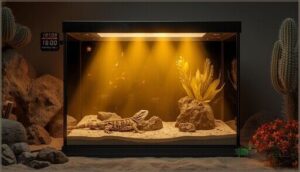
You’ll track seasonal shifts in photoperiod adjustments using programmable timers to shift desert reptiles from 12–14 hours of UVB lighting during spring and summer to 10–12 hours in fall and winter.
Incrementally shifting light cycles by 0.5 to 1 hour over change weeks while maintaining thermal balancing between UV light exposure and ambient temperatures to support photobiology without disrupting thermoregulation.
Top 10 UVB Lighting Systems for Desert Species
You’ll find that selecting the appropriate UVB lighting system for your desert-dwelling reptiles requires careful consideration of spectral output characteristics, enclosure dimensions, and species-specific photoperiod requirements, as inadequate or excessive ultraviolet radiation can compromise calcium metabolism and overall physiological health.
The following compilation presents ten commercially available UVB lighting solutions that have demonstrated reliable performance in maintaining ideal UV Index values between 3.0 and 5.0 units for taxa such as Pogona vitticeps, Tiliqua scincoides, and Eublepharis macularius when positioned at manufacturer-specified distances.
Each system has been evaluated based on its capacity to deliver wavelengths within the critical 280-315 nanometer range, operational longevity, and compatibility with standard enclosure configurations.
1. Zoo Med Desert UVB Lighting Kit
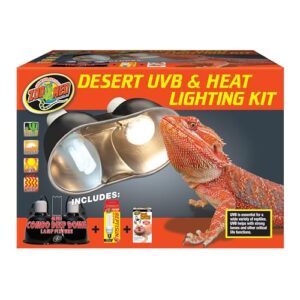
You’ll find the Zoo Med Desert UVB Lighting Kit (model LF-31) combining both ultraviolet-B and thermal regulation in a single, dual-socket fixture engineered for arid-climate species such as Pogona vitticeps (bearded dragon) and similar desert inhabitants.
This compact system, measuring approximately 7.5 by 6.1 inches and weighing one pound, delivers a ReptiSun 10.0 Mini Compact Fluorescent (13 watts) alongside a 75-watt Repti Basking Spot Lamp, with each ceramic socket rated to handle up to 160 watts per socket.
It ensures adequate photon flux density and focused thermal gradients, necessary for ideal calcium metabolism and thermoregulatory behavior.
| Best For | Reptile owners keeping desert species like bearded dragons or turtles who need both UVB light for calcium absorption and a focused heat source for basking in one convenient fixture. |
|---|---|
| UVB Output | 10.0 UVB |
| Wattage | 75w + 13w |
| Light Type | Incandescent + CFL |
| Target Species | Desert reptiles |
| Brand | Zoo Med |
| Replacement Interval | Varies |
| Additional Features |
|
- Dual-socket design lets you run both UVB and heat lamps independently with separate switches, giving you full control over lighting and temperature
- Comes complete with both a 75w basking bulb and a ReptiSun 10.0 UVB compact fluorescent, so you can start using it right away
- Compact size (7.5″ x 6.1″) and lightweight build make it easy to position over smaller enclosures without taking up much space
- Replacement bulbs may burn out faster than expected, requiring more frequent purchases
- Some users report the heat lamp socket can short out or fail to turn on after extended use
- May run too hot for certain species like geckos, and can require modifications to fit properly on some tank lids
2. Reptile Systems T5 Desert UVB Lamp
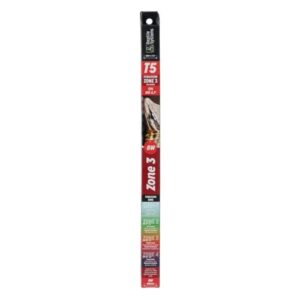
For enclosures exceeding twenty-four inches in height, you’ll want the Reptile Systems T5 Desert UVB Lamp, which delivers higher UVB percentages (approximately ten to twelve percent at the lamp surface) than legacy T8 tubes while maintaining safer exposure distances for diurnal baskers like Uromastyx species and Pogona vitticeps.
This high-output T5 format, with its five-eighths-inch diameter and enhanced phosphor technology, achieves UV Index readings comparable to intense natural sunlight at distances of twelve to eighteen inches when paired with a reflector, ensuring ideal vitamin D3 photobiosynthesis without overexposure risks.
| Best For | Owners of desert-dwelling reptiles like bearded dragons and uromastyx that need high UVB exposure in taller enclosures over 24 inches. |
|---|---|
| UVB Output | Zone 3 High UVB |
| Wattage | 24 watts |
| Light Type | Fluorescent T5 |
| Target Species | Desert baskers |
| Brand | Aquarium Systems |
| Replacement Interval | Not specified |
| Additional Features |
|
- Delivers strong UVB output (10-12%) at safe distances, supporting proper vitamin D3 synthesis and calcium absorption
- T5 design with enhanced phosphor technology provides more consistent, long-lasting performance than older T8 bulbs
- Works well at 12-18 inch distances when used with a reflector, making it ideal for larger setups
- Only suitable for species requiring high UVB levels—not appropriate for reptiles needing low or moderate exposure
- Requires careful installation and positioning to avoid overexposure or underexposure
- Higher output means you’ll need to monitor and replace it on schedule to maintain stable UVB levels
3. Repti Zoo T5 UVB Lighting Kit
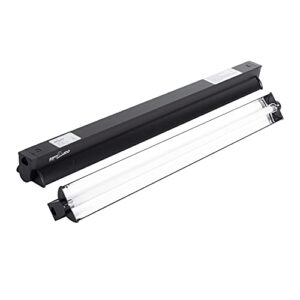
If you’re prioritizing both efficiency and affordability, the Repti Zoo T5 UVB Lighting Kit combines a sleek, low-profile design with a highly polished curved reflector that redirects UVB radiation downward, concentrating photon flux at your animal’s basking site instead of scattering it wastefully above the enclosure.
Available in twenty-four-watt, thirty-nine-watt, and fifty-four-watt configurations, this system accommodates enclosures ranging from twenty-four to forty-eight inches. It includes a Desert 10.0 T5 lamp, delivering sufficient UVB for Pogona species, Uromastyx, and other heliothermic taxa requiring intense overhead radiation for ideal vitamin D3 photobiosynthesis.
| Best For | Reptile owners looking for an affordable, efficient UVB lighting solution for desert species like bearded dragons and uromastyx in medium to large enclosures. |
|---|---|
| UVB Output | 10.0 UVB |
| Wattage | 24 watts |
| Light Type | Fluorescent T5 |
| Target Species | Desert reptiles |
| Brand | REPTI ZOO |
| Replacement Interval | 12 months |
| Additional Features |
|
- Curved reflector design maximizes UVB output by directing light downward where your reptile actually needs it
- Includes everything you need to get started, with a Desert 10.0 UVB bulb already in the box
- Available in three different wattages to match your tank size without overpaying for excess power
- Replacement bulbs can get expensive over time, eating into the initial cost savings
- Some users report the bulbs burning out faster than expected, requiring more frequent replacements
- Only works with 100-120V power, so you’ll need a transformer if you’re outside North America
4. Zilla Reptile UVB Light Bulb
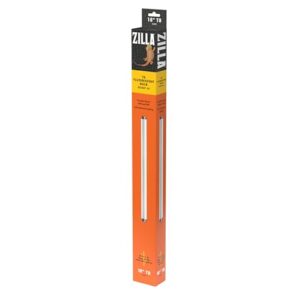
For keepers seeking simplicity without sacrificing spectral accuracy, the Zilla Reptile UVB Light Bulb offers both compact fluorescent coil and linear T8 formats, each engineered to deliver approximately fifty microwatts per square centimeter of UVB radiation at recommended mounting distances, ensuring vigorous calcium metabolism in Pogona vitticeps, Uromastyx aegyptia, and similarly heliothermic taxa.
Available in thirteen-watt and twenty-watt compact versions or fifteen-watt T8 tubes, these full-spectrum lamps integrate seamlessly into standard dome fixtures or Zilla’s matching strip housings, providing energy-efficient UVB provision while enhancing natural coloration under daylight-spectrum illumination.
| Best For | Desert reptile owners looking for a reliable, affordable UVB bulb that supports calcium absorption and bone health in species like bearded dragons and uromastyx. |
|---|---|
| UVB Output | Desert T8 |
| Wattage | 15 watts |
| Light Type | Fluorescent T8 |
| Target Species | Desert reptiles |
| Brand | Zilla |
| Replacement Interval | 6-12 months |
| Additional Features |
|
- Full spectrum lighting promotes proper calcium metabolism and vitamin D3 synthesis while enhancing your reptile’s natural colors
- Available in multiple formats (compact fluorescent and T8 tube) to fit different fixture types and tank sizes
- Easy to install in standard fixtures and energy-efficient at 13-20 watts
- UVB output weakens over time and requires replacement every 6-12 months to maintain effectiveness
- Some users have reported bulbs burning out prematurely after only a few months
- May need multiple bulbs or supplemental lighting to adequately cover larger enclosures
5. T5 Ho Uvb Reptile Light Fixture
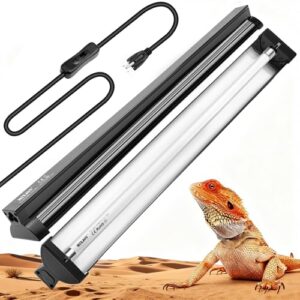
Engineered to replicate the intense midday irradiance encountered by Pogona henrylawsoni and Phrynosoma platyrhinos in their native xerophytic habitats, the T5 HO UVB reptile light fixture combines a twenty-four-watt high-output linear tube delivering ten percent UVB output with a precision-curved aluminum reflector that concentrates photon flux downward.
This setup establishes UV Index values between 3.0 and 4.5 when mounted twelve to eighteen inches above your basking platform, thereby optimizing provitamin D3 photoisomerization while you maintain thermal gradients essential for diurnal thermoregulation in obligate heliophiles.
| Best For | Owners of desert reptiles like bearded dragons, leopard geckos, and tortoises who need a reliable high-output UVB light to support healthy calcium absorption and prevent metabolic bone disease. |
|---|---|
| UVB Output | 10% UVB |
| Wattage | 24 watts |
| Light Type | Fluorescent T5 HO |
| Target Species | Desert reptiles |
| Brand | MIXJOY |
| Replacement Interval | Not specified |
| Additional Features |
|
- Delivers 10% UVB output with a polished aluminum reflector that focuses light where your reptile needs it, improving efficiency and creating a proper basking zone
- Supports essential vitamin D3 production to prevent bone disease while encouraging natural behaviors and healthy appetite in desert species
- Durable aluminum housing dissipates heat quickly and includes flame-retardant materials for safer long-term use
- Won’t work properly if placed behind glass or acrylic barriers, which block the UVB rays your reptile needs
- Not ideal for species that need warmer light fixtures or different UVB percentages than the 10% this provides
- Requires careful mounting at the right distance (12-18 inches) to deliver the proper UVB levels without over or under-exposing your pet
6. Lucky Herp Reptile Uvb Light Bulb
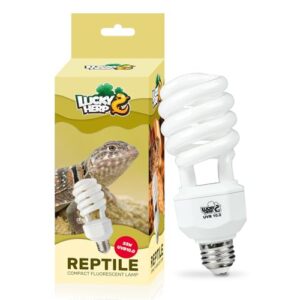
Compact spiral fluorescents offer an economical entry point for smaller desert vivariums housing Eublepharis macularius or juvenile Uromastyx acanthinura. The Lucky Herp twenty-three-watt compact UVB bulb, rated at ten percent UVB output with a color rendering index of ninety, delivers wavelengths spanning 290 to 320 nanometers through a standard E26 socket that integrates seamlessly into low-profile fixtures.
You’ll achieve UV Index readings between 2.5 and 4.0 at eight to twelve inches, supporting adequate cholecalciferol synthesis when you replace the bulb annually to counteract phosphor degradation.
| Best For | Small to medium desert reptile owners seeking an affordable UVB solution for bearded dragons, leopard geckos, and tortoises in low-profile enclosures. |
|---|---|
| UVB Output | 10% UVB |
| Wattage | 23 watts |
| Light Type | CFL E26 |
| Target Species | Desert reptiles |
| Brand | Generic |
| Replacement Interval | 6-12 months |
| Additional Features |
|
- Delivers 10% UVB and 30% UVA with a high CRI of 90%, creating natural lighting conditions that support vitamin D3 production and healthy reptile behavior
- Standard E26 base fits most common fixtures and works with 120V systems right out of the box
- Budget-friendly option for desert species that need moderate UVB levels at 8-12 inch basking distances
- Actual lifespan often falls short of the advertised 1-year rating, with many users reporting effectiveness dropping after just a few months
- Quality control issues lead to some bulbs arriving defective or failing prematurely
- Heat from nearby basking lamps can damage the bulb, requiring careful fixture planning and potential replacement every 6-12 months
7. Repti Zoo UVB Desert Reptile Lamp
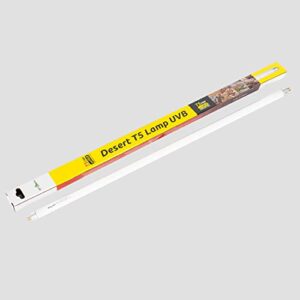
When your budget dictates compact fluorescent solutions but UVB performance can’t be compromised, this twenty-four-watt T5 HO alternative manufactured by Repti Zoo bridges both requirements through glass-encapsulated phosphor technology that maintains spectral output between 295 and 310 nanometers.
Measuring twenty-one point six inches, you’ll position this 10.0 UVB-rated bulb within compatible AT28 fixtures to generate UV Index values from 3.8 to 6.2 at distances of ten to fourteen inches, adequately supporting calcium homeostasis in Pogona vitticeps and Tiliqua scincoides.
| Best For | Desert-dwelling reptile owners looking for an affordable UVB solution for 24″ enclosures who need to support their pet’s calcium absorption and natural behaviors. |
|---|---|
| UVB Output | 10.0 UVB |
| Wattage | 24 watts |
| Light Type | Fluorescent T5 HO |
| Target Species | Desert reptiles |
| Brand | REPTI ZOO |
| Replacement Interval | 8 months |
| Additional Features |
|
- Delivers strong 10.0 UVB output that effectively prevents metabolic bone disease and stimulates appetite and activity in desert species
- Compatible with standard T5 HO fixtures and fits perfectly in 24″ enclosures
- Lightweight design at under 10 ounces makes installation straightforward with the right hood
- Durability concerns with some users reporting bulb failure after just 3 months instead of the expected 8-month lifespan
- Requires replacement every 8 months even under normal use, adding to long-term costs
- Installation can be tricky for first-time users unfamiliar with T5 HO fixture systems
8. Reptile UVB Light Fixture
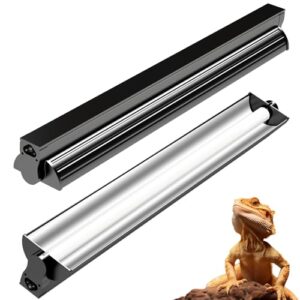
You’ll encounter scenarios where aluminum-bodied T5 fixtures deliver reflector efficiency exceeding 100 percent while accommodating tubes spanning twelve to forty-six inches, ensuring your Uromastyx ornata or Pogona vitticeps receives longitudinal UVB coverage across two-thirds of vivarium length without compromising basking gradients.
Equipped with ETL-listed E26 or T5 sockets rated to one hundred watts, these housings integrate ventilation apertures preventing ballast overheating, parabolic reflectors directing wavelengths through mesh that attenuates output by thirty to fifty percent, and suspension hardware enabling twelve-to-eighteen-inch mounting distances essential for maintaining UV Index targets between 3.0 and 6.5 units.
| Best For | Reptile owners looking for an affordable UVB lighting solution that covers different tank sizes and helps their pets stay healthy through proper vitamin D3 synthesis and calcium absorption. |
|---|---|
| UVB Output | 10.0 UVB |
| Wattage | 8 watts |
| Light Type | Fluorescent T5 |
| Target Species | Multiple reptiles |
| Brand | REPTIDLDB |
| Replacement Interval | Not specified |
| Additional Features |
|
- Comes with everything you need right out of the box, including a replaceable UVB 10.0 bulb that’s ready to go
- The reflective layer boosts UVB output so your reptile gets more of the light it needs without cranking up the wattage
- Available in four different sizes (12 to 46 inches) so you can match it to your specific tank setup
- Several customers have reported receiving units that arrived broken or stopped working shortly after setup
- The UVB bulb will need replacing eventually, which adds to the ongoing cost of ownership
- May not work well for every reptile species or habitat type, so you’ll want to double-check compatibility first
9. Haceryc Reptile UVB Light Fixture
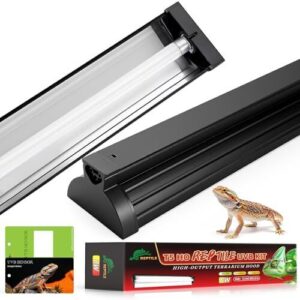
Mounting a twelve-inch T5 HO bar fixture equipped with a 10.0 UVB tube and integrated parabolic reflector, the Haceryc unit delivers ten percent UVB and thirty percent UVA through flame-retardant housing measuring 13.19 inches by 3.9 inches.
This allows you to position it atop mesh lids twelve to eighteen inches above basking platforms where Pogona vitticeps or Uromastyx aegyptia achieve UV Index readings within 3.0 to 6.0 units.
Despite continued visible output, you’ll need to replace the eight-watt tube annually.
| Best For | Reptile owners with standard 12-inch enclosures who need reliable UVB output for species like bearded dragons or uromastyx that require moderate to high UV exposure. |
|---|---|
| UVB Output | 10% UVB |
| Wattage | 8 watts |
| Light Type | Fluorescent T5 |
| Target Species | Reptiles & amphibians |
| Brand | Generic |
| Replacement Interval | Not specified |
| Additional Features |
|
- Curved reflector design maximizes UVB intensity and coverage, getting more from the same bulb
- Comes with a UVB test card so you can actually monitor when the bulb starts losing effectiveness
- Flame-retardant housing and detachable cord make installation safer and more flexible
- Only available in 12-inch and 22-inch sizes, limiting options for custom or odd-sized enclosures
- Bulb needs annual replacement even when it still looks bright, adding ongoing costs
- Long-term durability is unproven since many users haven’t tested it beyond a few months
10. Reptile UVB Light Bulb
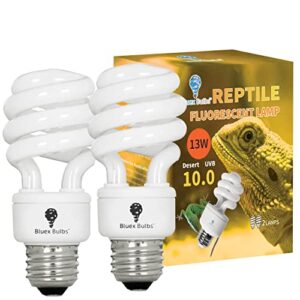
Screwing a thirteen-watt compact fluorescent lamp featuring E26 threading and ten percent UVB emission into any standard dome, you provide Pogona vitticeps, Testudo hermanni, and other heliophilic taxa with 280–315 nanometer wavelengths that drive endogenous cholecalciferol synthesis when positioned fifteen to eighteen centimeters above basking zones.
Though the manufacturer advertises 10,000-hour longevity, empirical evidence from keeper reports suggests photobiological output degrades within six months under continuous twelve-hour photoperiods, necessitating replacement before visible dimming confirms spectral decay and compromised calcium homeostasis.
| Best For | Reptile owners with desert species like bearded dragons, tortoises, and lizards who need reliable UVA and UVB lighting to support their pet’s health and natural behaviors. |
|---|---|
| UVB Output | UVB Compact |
| Wattage | 13 watts |
| Light Type | CFL E26 |
| Target Species | Desert reptiles |
| Brand | Bluex Bulbs |
| Replacement Interval | 10,000 hours |
| Additional Features |
|
- Provides essential UVA and UVB light that helps reptiles produce vitamin D3 and absorb calcium properly
- Easy to install with a standard E26 base that fits most dome fixtures
- Comes in a convenient 2-pack, giving you a backup bulb or coverage for multiple terrariums
- Many users report the bulbs burn out much faster than the advertised 10,000-hour lifespan
- UV output may degrade after about six months, requiring replacement even if the bulb still lights up
- Needs to be positioned carefully (at least 15 cm away) to avoid harming your reptile
Choosing The Right UVB System for Your Reptile
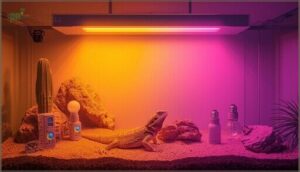
Selecting the appropriate UVB system for your desert reptile requires careful consideration of several interrelated variables, including species-specific photobiological requirements, enclosure dimensions, and long-term operational costs.
While bearded dragons (Pogona vitticeps) and uromastyx species demand high-output fixtures delivering 3.0-5.0 UV Index readings at basking distances of 30-45 centimeters, leopard geckos (Eublepharis macularius) and similar crepuscular species require substantially lower UVB provision.
You’ll need to evaluate bulb compatibility with your habitat’s physical parameters, monitor your animal’s behavioral responses to lighting intensity, and recognize the clinical manifestations of either UVB deficiency or overexposure to guarantee ideal husbandry outcomes.
Matching Bulb Type to Species Needs
You’ll want to select UVB lighting that mirrors the photobiological requirements of your specific desert reptile species, considering that organisms such as Pogona vitticeps (bearded dragons) necessitate higher UVB intensity—usually 10 to 12 percentage output with a UV index ranging from 3 to 5 at basking sites—while species like Eublepharis macularius (leopard geckos) thrive under comparatively modest UVB provision within the 290 to 320 nanometer wavelength spectrum.
- Desert reptiles require UVB bulbs emitting wavelengths between 290 and 320 nanometers for adequate D3 synthesis and calcium metabolism
- Higher basking zone species need UVB intensities labeled as 10 to 12 percent with UV index measurements of 3 to 5 at basking locations
- Algae and insect eating species benefit from broader bulb spectrum combined with full spectrum visible light in their lighting design
- UVB fluorescent lamps should be replaced every 6 to 12 months due to UV output decline affecting reptile health regardless of perceived brightness
- Species research determines appropriate UVB intensity, with flame rate and surface temperature influencing stability in desert reptile lighting systems
Enclosure Size and Lighting Coverage
Your enclosure dimensions directly determine the tube length and UVB fluorescent lamps you’ll need to establish proper lighting coverage. A 22-inch T5 fixture generally illuminates half of a four-foot desert reptile habitat, creating usable UVB gradients that permit self-regulation between intense basking zones and shaded retreats.
Larger vivariums of six feet often require 34-inch tubes paired with strategic fixture placement to prevent dark corners that compromise reptile habitat design entirely.
Energy Efficiency and Cost Considerations
Although T5 high-output UVB tubes draw between 22 and 39 watts—far less than 100-to-160-watt mercury vapor options—you’ll find that genuine energy savings accumulate through careful cost analysis of replacement cycles, fixture efficiency metrics, and runtime schedules.
Budgeting for annual UVB lamp changes prevents hidden veterinary expenses from chronic underexposure, ensuring your reptile lighting systems deliver peak UVB output while controlling long-term lighting costs across multiple desert enclosures.
Recognizing Signs of Insufficient or Excessive UVB
Vigilance through UV metering and behavioral observation safeguards your reptile’s health and longevity against both UVB deficiency and excessive UVB exposure, since inadequate UV radiation triggers metabolic collapse while overexposure accelerates tissue degradation in UVB lighting for reptiles.
Monitor these critical indicators through systematic UVB monitoring of your reptile lighting systems:
- Dull shell texture, sunken eyes, or bowed limbs signaling severe calcium deficiency
- Reddened oral mucosa or corneal cloudiness indicating UV tissue damage
- Prolonged basking or complete avoidance of UVB lighting zones
- Appetite suppression coupled with reduced locomotive activity
- Incomplete ecdysis or retained spectacle scales
Frequently Asked Questions (FAQs)
What is the difference between tropical and desert UVB bulbs?
Desert UVB lighting delivers roughly 10 to 12 percent output with stronger penetration depth exceeding 20 inches, while tropical bulbs provide about 5 percent UVB for species experiencing filtered canopy light at closer basking distances.
Is a basking light the same as an UVB light?
No, basking lights primarily generate heat for thermoregulation, while UVB lamps emit ultraviolet wavelengths enabling vitamin D3 synthesis; you’ll generally need both distinct lighting types to meet your desert reptile’s physiological requirements effectively.
Is too much UVB bad for reptiles?
Yes, excessive UVB can trigger photokeratitis risks, reptile burn, and vitamin D overload in sensitive species, particularly when UVB dosage exceeds natural tolerance thresholds or when inadequate shaded retreats prevent behavioral thermoregulation and exposure modulation.
Can I use UVB lighting through glass or mesh?
You shouldn’t place UVB lamps over glass, which blocks nearly all wavelengths below 320 nanometers that desert reptiles need for vitamin D3 synthesis.
Though mesh screening permits adequate UV light exposure with proper distance adjustments.
How do I measure actual UVB output at home?
You’ll want a handheld Solarmeter 5R to read UV Index directly at your basking platform, confirming whether UVI falls within the target Ferguson Zone for your desert species rather than relying on manufacturer distance claims alone.
Do nocturnal desert species need UVB lighting too?
It’s ironic that creatures hiding from the desert sun still need UVB lighting. Most nocturnal desert reptiles benefit from low-level UVB exposure during dawn and dusk periods, supporting natural vitamin D3 synthesis and preventing metabolic bone disease through carefully designed gradient creation.
Whats the difference between UVB and UVA lighting?
UVB lighting drives vitamin D3 synthesis in reptile skin through shorter wavelengths (280–315 nanometers), enabling calcium absorption.
UVA lighting (315–400 nanometers) influences behavior, color perception, and daily activity patterns without direct metabolic effects.
Can UVB bulbs cause eye damage in reptiles?
Poorly designed or improperly positioned UV light can indeed trigger photokeratoconjunctivitis, causing corneal inflammation and severe squinting when reptile vision meets bulb intensity exceeding safe exposure thresholds for desert reptiles’ delicate ocular tissues.
Conclusion
Your bearded dragon’s skeleton doesn’t negotiate with inadequate lighting—it simply deteriorates, molecule by molecule, until the damage becomes irreversible. Selecting appropriate uvb lighting systems for desert species represents the single most consequential decision you’ll make for your animal’s long-term skeletal integrity and metabolic function.
The systems outlined here deliver therapeutic irradiance levels that replicate their evolutionary requirements, ensuring calcium homeostasis remains within physiologically normal parameters throughout your reptile’s lifespan.
- https://allpetsonline.co.za/blogs/news/essential-guide-to-reptile-uvb-lighting-benefits-and-best-practices
- https://www.thebiodude.com/blogs/reptile-and-amphibian-lighting-faqs-and-help/introduction-to-uvb-part-2
- http://links.zoomed.com/lf-19
- https://pmc.ncbi.nlm.nih.gov/articles/PMC12463476/
- https://pubmed.ncbi.nlm.nih.gov/10333767/