This site is supported by our readers. We may earn a commission, at no cost to you, if you purchase through links.
Your snake’s cloudy eyes signal a shed, but when those opaque eye caps don’t lift, when skin clings in papery fragments around the tail tip, you’re seeing the price of incorrect humidity. What happens when snake humidity is wrong isn’t subtle: ecdysis (the shedding process) stalls, respiratory mucosa dries and cracks, and keratinocyte turnover—the cellular engine that renews your snake’s skin—grinds to a halt.
I’ve treated ball pythons with retained spectacles that led to corneal damage, corn snakes with bacterial dermatitis from humidity above 80%, and dozens of cases where dehydration masqueraded as lethargy. The damage compounds quickly because your snake can’t sweat, can’t pant, and relies entirely on environmental moisture to regulate fluid balance.
Getting humidity right isn’t about hitting a single number—it’s about understanding the gradient your species needs and recognizing the early warning signs before they become veterinary emergencies.
Table Of Contents
Key Takeaways
- Wrong humidity directly causes incomplete sheds, respiratory distress, and skin infections in snakes because they can’t regulate moisture internally like mammals—your snake relies entirely on environmental humidity for cellular skin turnover, fluid balance, and airway function.
- Low humidity creates dehydration, retained eye caps, and cracked scales that invite bacterial infections, while excessive humidity above 80% promotes scale rot and fungal colonization, making species-appropriate humidity gradients essential rather than aiming for a single fixed percentage.
- Early warning signs include incomplete sheds (especially around tail tips and eyes), wrinkled or dull scales, lethargy paired with feeding refusal, and respiratory sounds like wheezing or open-mouth breathing—all of which demand immediate environmental correction before they escalate into veterinary emergencies.
- Fix humidity problems by using calibrated digital hygrometers, switching to moisture-retaining substrates like cypress mulch, creating deliberate humidity gradients across your enclosure, and performing weekly sensor checks alongside monthly substrate replacement to prevent mold while maintaining proper shedding conditions.
Why Correct Humidity is Vital for Snakes
You might think humidity is just about comfort, but for your snake, it’s a matter of survival. Without the right moisture levels, your pet’s body can’t perform essential functions like shedding, breathing, or maintaining healthy skin.
Let’s break down exactly why humidity matters so much and what happens when it’s off.
Role of Humidity in Shedding
Humidity levels directly control skin permeability during ecdysis—the shed cycle—allowing moisture to penetrate and loosen the outer layer. When you maintain proper humidity gradients, your snake reacts to natural shedding cues, shortening the shed duration.
If humidity drops too low, you’ll notice signs your snake enclosure is too cold, including retained eye caps and incomplete sheds that can lead to infection.
Too-low moisture levels cause incomplete sheds, while excessive humidity won’t compensate for missing environmental triggers and may invite fungal problems, compromising reptile health despite your best humidity control efforts.
Recognizing early warning signs like dull scales, rough texture, or flaking skin helps you identify low humidity symptoms in snakes before they escalate into serious shedding complications.
Understanding language patterns is essential for effective communication about these complex topics.
Effects on Skin and Scale Health
Beyond shed timing, skin hydration directly influences scale health and tissue integrity. When humidity levels remain stable, you support epidermal shedding and keratinocyte turnover, maintaining flexible, resilient scales. Chronic dehydration compromises mucous membranes and creates fissures vulnerable to infection.
Proper moisture also protects oral tissues, preventing conditions like mouth rot in snakes, which thrives when dehydration weakens mucous membranes.
To enhance skin health in your snake care routine, focus on:
Seasonal shifts can amplify stress and directly impact shedding quality, so watch for signs of snake stress and anxiety like dull skin or incomplete sheds.
- Monitoring for wrinkled, dull scales
- Checking turgor and skin pliability
- Preventing microtrauma from desiccation
- Balancing moisture without fungal risk.
Ensuring proper scientific study methods using audit trails is essential for understanding the impact of humidity on snake health.
Impact on Hydration and Respiration
Moisture management doesn’t stop at shedding—your snake’s respiratory function depends on humidity control too. When humidity levels drop, water loss accelerates through skin and mucous membranes, triggering dehydration that disrupts gas exchange.
Low humidity thickens airway secretions, forcing labored breathing, while excessive moisture invites microbial colonization that compromises upper respiratory integrity.
Signs Your Snake’s Humidity is Wrong
Your snake won’t text you when something’s wrong, but its body will tell you everything you need to know. Humidity problems show up in predictable, observable ways—and catching them early can prevent serious health complications down the line.
When humidity drops too low or stays too high for extended periods, you’ll often see common pet snake health issues like respiratory infections or stubborn sheds that refuse to come off cleanly.
Here’s what to watch for in your snake’s appearance, behavior, and overall condition.
Incomplete or Stuck Shed
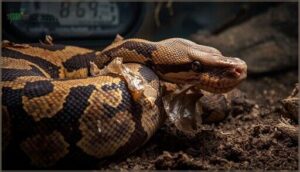
When your snake’s shed comes off in patches rather than one complete piece, you’re witnessing dysecdysis—a direct signal that humidity levels have dropped below the critical threshold.
This retained skin, particularly around the tail tip and spectacles (eye caps), doesn’t just look unsightly; it creates genuine health risks including constriction injuries and vision impairment that demand immediate humidity control and dysecdysis treatment to restore proper snake hydration and shedding cycles.
Dry, Cracked, or Wrinkled Skin
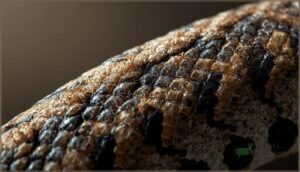
Persistent dryness reveals itself through wrinkled, loose-looking dorsal scales—your snake’s skin literally losing its structural tension from chronic dehydration. You’ll notice cracked areas and dull texture that signal compromised skin hydration and scale damage, conditions that make dry shedding almost inevitable.
Chronic dehydration makes your snake’s scales wrinkle and crack, revealing structural damage that guarantees incomplete sheds
Low humidity creates these skin lesions systematically, demanding immediate wrinkle prevention measures to restore proper skin health before dehydration progresses to retained eye caps or tail-tip necrosis.
Lethargy and Behavioral Changes
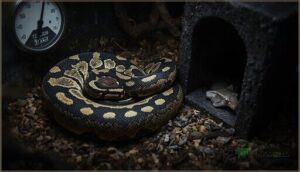
Stress signals emerge as your snake’s first defense mechanism when humidity levels miss their mark—you’ll spot behavioral shifts long before physical symptoms become obvious. Incorrect environmental conditions disrupt normal activity levels and snake temperament, creating a cascade of changes that demand immediate attention.
- Unusual hiding patterns: Your normally curious snake refuses to leave its hide, even during typical basking or feeding windows
- Reduced exploratory behavior: A once-active climber now remains motionless in one corner, ignoring environmental enrichment
- Feeding refusal: Previously reliable eaters skip multiple meals despite proper temperatures and prey presentation
- Irritability or withdrawal: Handling tolerance drops sharply, or your snake becomes uncharacteristically defensive when approached
Watch for lethargy paired with these behavioral changes—dehydration from low humidity decreases digestive motility and appetite in reptiles, while chronic stress from incorrect humidity levels pushes your snake to prioritize security over normal thermoregulation.
These shifts in snake care requirements signal that humidity levels need correction before dehydration progresses to more serious reptile health complications.
Respiratory Distress and Breathing Issues
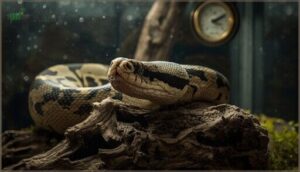
Hypoxia threatens when inappropriate humidity levels compromise your snake’s airway function. You’ll recognize respiratory distress through audible wheezing, open-mouth breathing, and mucus bubbles at the nares. Low humidity thickens respiratory secretions, creating airway obstruction that progresses from mild clicking sounds to severe breathing difficulty.
| Clinical Sign | Cause | Urgency Level |
|---|---|---|
| Wheezing, gurgling sounds | Mucus accumulation from dehydration | Moderate—monitor closely |
| Open-mouth breathing | Tracheal disease, airway obstruction | High—veterinary consultation needed |
| Nasal discharge, bubbles | Respiratory infections from humidity extremes | High—immediate intervention required |
| Elevated head posture | Compensatory breathing effort | Moderate to high—assess environment |
Respiratory failure develops when chronic humidity control failures allow bacterial colonization of compromised airways. Correct your enclosure’s humidity levels immediately—proper shedding depends on adequate moisture, and respiratory infections demand concurrent environmental correction alongside antimicrobial therapy to prevent mortality.
Health Problems Caused by Incorrect Humidity
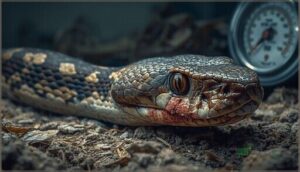
When humidity stays wrong for too long, your snake doesn’t just look uncomfortable—it faces real medical consequences that can escalate quickly. These aren’t minor inconveniences you can ignore; they’re conditions that compromise immune function, damage tissue, and create cascading health failures.
Let’s break down the three most serious complications you need to recognize and prevent.
Skin Infections and Scale Rot
When excessive humidity combines with poor sanitation, you’re creating an ideal breeding ground for bacterial dermatitis—commonly called scale rot. This ulcerative skin condition begins as discolored, blistered ventral scales but can rapidly progress to necrotic lesions with foul-smelling discharge.
Untreated infections may enter your snake’s bloodstream, causing septicemia and potentially death. Scale rot treatment requires immediate veterinary intervention, systemic antibiotics, and strict humidity control methods alongside thorough infection prevention strategies including substrate replacement and enclosure disinfection.
Dehydration and Electrolyte Imbalance
Low humidity doesn’t just disrupt shedding—it triggers systemic dehydration through respiratory water loss and transcutaneous evaporation. Your snake loses circulating blood volume, impairing renal function and causing electrolyte shifts that manifest as sunken eyes, tacky mucous membranes, and lethargy.
Dehydration signs you’ll observe:
- Packed cell volume exceeding 50% on bloodwork
- Elevated uric acid indicating compromised kidney clearance
- Reduced skin turgor and decreased heart rate
- Abnormal sodium and potassium concentrations
Fluid therapy under veterinary supervision—often 40 ml/kg/day via subcutaneous or intracoelomic routes—restores hydration and corrects these dangerous imbalances.
Secondary Infections and Long-Term Health Risks
Damaged skin from improper humidity control and management becomes a gateway—bacteria and fungi colonize open wounds, triggering chronic infections that tax your snake’s immune system.
You’ll see respiratory infections, scale rot, and shedding problems compound into life-threatening septicemia.
Mortality rates climb sharply when respiratory issues meet persistent dehydration, because compromised reptile health can’t mount effective defenses against opportunistic pathogens demanding intensive veterinary intervention.
How to Check and Monitor Humidity Levels
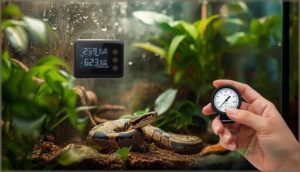
You can’t fix humidity problems if you don’t know they exist in the first place. Monitoring your snake’s environment requires both precision tools and careful observation of your animal’s physical condition and behavior.
Here’s how to stay on top of humidity levels and catch problems before they escalate into health crises.
Using Hygrometers for Accurate Measurement
You can’t manage what you can’t measure. Digital hygrometers with ±5% sensor accuracy give you real-time humidity levels, but only after proper hygrometer calibration using the salt test method.
Place humidity probes mid-enclosure, away from water bowls, to capture true ambient readings. Multiple probes reveal your humidity gradient—critical for humidity control and management, especially when adjusting misting schedules.
Observing Shedding and Skin Condition
Your snake’s skin tells you everything numbers can’t. Watch ecdysis cycles closely: healthy snakes shed one continuous piece, eye caps included, when humidity gradients are correct.
Retained patches—especially on tails or eyes—signal dryness. Run your fingers along the body: wrinkled, tented skin that doesn’t spring back flags dehydration, while raised ventral scales suggest chronic dampness.
These shedding patterns and skin texture changes are your frontline indicators for humidity control.
Monitoring Snake Behavior and Appetite
Behavioral cues and appetite trends reveal humidity stress before crises develop. Track feeding patterns in a written log: refusal of two consecutive meals warrants humidity verification alongside temperature checks.
Watch for restless roaming, excessive soaking, or prolonged hiding—these signal environmental discomfort.
When appetite loss coincides with incomplete sheds or labored breathing, humidity correction becomes urgent for reptile health and animal wellness.
Solutions for Fixing Humidity Problems
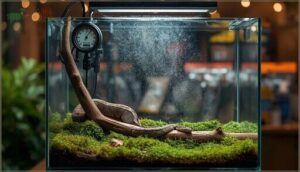
Once you’ve identified humidity problems, you need to act fast—your snake’s health depends on it.
The good news is that most humidity issues can be fixed with straightforward adjustments to your enclosure setup, equipment, and maintenance routine.
Here’s how to correct low or high humidity and keep it stable long-term.
Adjusting Enclosure Setup and Substrate
Your enclosure design is your first line of defense against humidity problems. Switch to moisture-retaining substrates like coconut husk or cypress mulch for tropical species—these hold water without becoming waterlogged.
Create humidity gradients by concentrating heat on one side, allowing your snake to self-regulate. Partially cover screen lids to slow evaporation, and position ventilation strategically to prevent stagnant, overly damp zones while maintaining airflow.
Using Humidifiers, Misting, and Moisture Boxes
You’ll need active humidity control when substrate alone won’t cut it. Reptile-specific humidifiers with timers prevent continuous saturation—cycle them to maintain your target range rather than maxing out at 90%.
Misting schedules should aim for walls and décor, not the snake directly, to avoid skin irritation. Moisture boxes filled with damp sphagnum moss create localized high-humidity retreats during shedding without soaking the entire enclosure.
Clean foggers weekly to prevent bacterial buildup.
Creating Species-Appropriate Humidity Gradients
A single fixed humidity level across your reptile enclosure design won’t serve most species well. Instead, build deliberate humidity gradients by pairing substrate moisture variation with strategic placement of humid refuges and water dishes:
- Position deeper, moist substrate layers on the cool end to sustain 70–85% humidity levels
- Use dry bedding under the basking zone to create a 60% warm-end gradient
- Install humidity hides with saturated sphagnum for microclimate control during ecdysis
- Monitor vertical zones with multiple hygrometers to verify your gradient design
Regular Maintenance and Troubleshooting
Weekly, you must verify your humidity sensors against a second device—digital units drift, and 10–20 percentage-point errors derail even careful misting schedules. Replace substrate monthly if mold appears, adjust ventilation tips when readings stay stuck, and improve troubleshooting techniques as your snake’s shedding cycles reveal what truly works.
Consistent snake enclosure maintenance beats reactive fixes every time.
Frequently Asked Questions (FAQs)
Can high humidity cause mold in snake tanks?
Yes, high humidity creates ideal conditions for mold in your snake’s tank. When moisture sits on surfaces without proper ventilation, fungal spores germinate rapidly on substrate and decorations, threatening snake health.
How often should I replace moisture-retaining substrate?
Although bioactive systems with clean-up crews can last years, non-bioactive moisture-retaining substrate requires full replacement every one to three months depending on humidity levels, spot-cleaning frequency, odor, visible mold, and your snake’s shedding quality.
Do baby snakes need different humidity than adults?
Most species don’t need different baseline humidity levels for neonates versus adults.
Baby snakes shed more frequently, so you’ll manage shedding cycles and microclimate access more actively rather than raising ambient humidity permanently.
Whats the ideal humidity during snake brumation periods?
Most temperate colubrids (corn snakes, kingsnakes) brumate safely at 30–60% humidity—their natural winter refugia range. Tropical species like boa constrictors maintain 55–75%.
Use a hygrometer and moist substrate to prevent dehydration without saturating the microclimate.
Can incorrect humidity affect snake breeding success?
Absolutely—getting moisture wrong during breeding is like asking your snake to build a house on quicksand. Egg incubation depends on precise humidity control; too dry causes embryo development failure, while excessive moisture invites fungal death and poor breeding success.
Conclusion
Don’t let humidity slip through the cracks—your snake’s health depends on vigilance you can measure and adjust daily. What happens when snake humidity is wrong isn’t reversible overnight: retained eye caps, scale rot, and respiratory compromise demand weeks of correction and veterinary intervention.
Check your hygrometer tomorrow morning, adjust substrate depth by Wednesday, and watch your next shed like you’re grading an exam. Prevention beats treatment every single time.
- https://companion-animals.extension.org/shedding-management-for-companion-reptiles/
- https://www.dialavet.com/ask-a-vet/my-snake-hasn-t-shed-its-skin-completely-6927
- https://parker-vet.com/shedding-success-your-guide-to-healthy-snake-molting/
- https://reptilesmagazine.com/retained-eyecaps-in-reptiles-causes-and-solutions/
- https://academichelpexpress.blog/2024/08/please-use-the-bulleted-points-and-the-rubric-below-to-guide-your-work-your-pa/