This site is supported by our readers. We may earn a commission, at no cost to you, if you purchase through links.

You open the enclosure to feed your snake and find it coiled in the water dish—again. Most keepers assume it’s quirky behavior and move on, but a snake sitting in its water dish is rarely random.
It’s a response, and it’s telling you something specific about its environment or health. Brief soaking is normal; a snake that lives in the bowl is not.
The difference between the two comes down to temperature gradients, humidity, shedding cycles, and sometimes parasites or infection. Understanding what’s driving the behavior gets you to the right fix faster.
Table Of Contents
Key Takeaways
- A snake sitting in its water dish most often signals one of three fixable issues: enclosure temps are too high, humidity is too low, or a shed is coming.
- Prolonged or daily soaking—especially paired with wheezing, open-mouth breathing, or tiny dark specks near the eyes—means you need a vet, not a thermostat tweak.
- Your enclosure setup is usually the root cause: check that your warm side hits 85–88°F, your cool side stays around 75°F, humidity stays above 50%, and at least two hides are in place.
- If the environment checks out, clean the water dish daily, add a humid hide on the warm side, and watch for behavioral shifts like feeding refusal or aggression—those clusters point to illness.
Is Water-Dish Sitting Ever Normal?
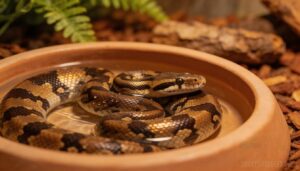
Yes, sometimes snake sitting in its water dish is completely normal. The behavior becomes a concern only when it’s frequent, prolonged, or paired with other warning signs.
If you’re noticing a pattern, common reasons snakes soak excessively can help you figure out whether it’s stress, mites, or a husbandry issue worth fixing.
A few key factors help you tell the difference.
Brief Soaking Versus Prolonged Soaking
Not all water-bowl time signals trouble. Here’s how to read the difference:
- Brief soaking — a few minutes, then back to basking — reflects normal hydration strategy or scale moisture dynamics.
- Occasional soaking near shed time offers microclimate benefits and behavioral comfort.
- Persistent immersion lasting hours suggests failed thermoregulation timing or humidity control gaps.
- Repeated daily soaking means your temperature gradients need immediate review.
Species Differences and Individual Habits
Your snake’s habits don’t exist in a vacuum — species wiring matters enormously.
King snake preference leans toward post-feeding soaks, while corn snake and colubrid submersion stay minimal under stable conditions.
Python’s hydration needs run higher, especially in humid-origin breeds like ball pythons, making ball python water bowl soaking common. Desert species dryness tolerance keeps them out of water longer. Sea snake preference and aquatic behavior of water-loving snake species aside, individual personality shapes behavioral thermoregulation and snake’s hydration preferences just as much as species does.
Research shows that genetic mechanisms in behavior can underlie individual variations in snake water preferences.
Why Timing and Frequency Matter
Timing tells you as much as the behavior itself. A snake following a circadian rhythm — soaking briefly at the same time each day — is showing a behavioral schedule, not a red flag.
Watch for temporal trends over several days:
- Frequency thresholds crossing multiple soaks daily
- Peak activity shifting toward the water dish
- Hydration needs spiking during dry lighting cycles
- Behavioral thermoregulation attempts near the cool zone
- Stress-induced behavior tied to water bowl placement or shedding assistance through water immersion
Usually It Means Shedding, Heat, or Stress
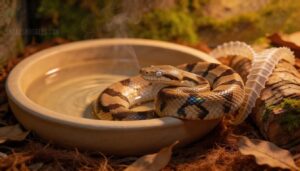
Most of the time, your snake’s water-dish habit comes down to one of three things: an upcoming shed, a too-warm enclosure, or stress.
None of these are random — each one has a clear trigger you can usually spot and fix. Here’s what’s likely driving the behavior.
Pre-shed Soaking to Loosen Old Skin
Shedding triggers one of the most instinctive soaking behaviors you’ll observe. As ecdysis approaches — signaled by dull coloration and opaque, blue-tinged eyes — your snake seeks moisture to support moisture penetration beneath the old skin layer.
A lukewarm soak, around 78–80°F for 15–20 minutes, improves skin circulation and softens keratinized scales without overheating.
| Shed Stage | Recommended Action | Duration |
|---|---|---|
| Pre-shed (eyes clouding) | Increase humidity to 60% | Ongoing |
| Active blue phase | Offer lukewarm soak | 15–20 min |
| Clearing phase | Monitor for full shed | 24–48 hrs |
| Incomplete shed | Shedding assistance through water immersion | 20 min max |
| Retained eye caps | Seek exotic vet — avoiding trauma is critical | Immediate |
Container safety matters here — use a secure, escape-proof vessel. Humidity management for successful shedding remains the priority; hydration and cutaneous absorption in snakes supplement, but never replace, a properly maintained proper water bowl setup for snakes and a humid hide.
If your snake is consistently soaking outside of shed season, it’s worth reading up on why snakes soak in their water bowl, as it often signals mites, a respiratory issue, or thermal stress.
Cooling Off When The Enclosure is Too Hot
When the warm side exceeds 90°F, your snake isn’t lounging in the dish — it’s managing heat stress. Water provides immediate evaporative cooling that the enclosure simply can’t match.
Check these four contributors:
- Verify shade placement — direct sunlight hits enclosure glass fast
- Confirm airflow optimization around the tank exterior
- Lower heat source output via thermostat
- Add thermal buffering with deeper substrate
Temperature regulation fails silently until your snake tells you otherwise.
Low Humidity and Dehydration-related Soaking
Dry air doesn’t just feel uncomfortable — it actively pulls moisture from your snake’s skin, raising the evaporation rate faster than cutaneous absorption can compensate. When low humidity levels drop below 50%, dehydration signs like dull scales and lethargy follow.
Strategic humidity gradient design, correct water bowl size, and consistent hydration monitoring through a well-placed water bowl keep skin hydration stable before soaking becomes compulsive.
Using The Bowl as a Secure Retreat
Sometimes the water bowl isn’t about hydration at all — it’s about safety. Snakes return to a consistent location repeatedly because scent familiarity makes it feel predictable. That spot becomes a low traffic zone offering visual concealment, microclimate edge cooling, and environmental comfort without exposure.
Sometimes a snake’s water bowl isn’t about thirst — it’s the only place that feels safe
- Familiar scent anchors the spot as "safe territory"
- Partial concealment near decor reduces visible stress triggers
- Cooler microclimate edge offers passive thermoregulation
- Predictable location lowers stress-induced behavior patterns
How Shedding Affects Water-Dish Behavior
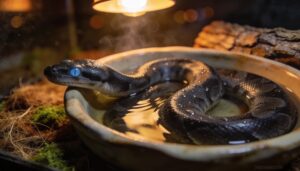
Shedding is one of the most common reasons a snake camps out in its water dish — and once you know what to look for, it makes a lot of sense. The process puts real physical demands on your snake’s body, and the water dish often becomes its go-to solution when the enclosure isn’t quite meeting those needs.
Here’s what’s actually happening at each stage.
Early Signs of an Incoming Shed
Your snake doesn’t announce a shed — it shows you.
Eye Cloudiness comes first: that milky, opaque look means fluid is building under the old eye covering. Faded Color and a matte texture follow, then Skin Loosening around the lips. Quiet Behavior and Appetite Decline round out the picture.
Recognizing these signs early is the first step in Shedding preparation and humidity management.
Why Dry Air Leads to More Soaking
Low humidity doesn’t just affect comfort — it actively pulls moisture from your snake’s skin through evaporation acceleration. When ambient vapor pressure drops, the microclimate around the bowl becomes a drying zone, not a refuge.
Watch for these dehydration signs tied to airflow dryness:
- Skin barrier weakening causes flaking, or dull, papery texture
- Increased time in the water bowl between normal activities
- Reduced skin hydration visible as slight wrinkling near the neck
- Enclosure humidity levels dropping below 50%, especially with screen tops
Humid Hides Versus Water-bowl Soaking
A humid hide outperforms a water bowl for targeted moisture retention during shedding. It creates a controlled microclimate using damp sphagnum moss, while a water bowl soaks the whole body indiscriminately.
| Feature | Humid Hide | Water Bowl |
|---|---|---|
| Microclimate Control | Localized, precise | Broad, uncontrolled |
| Hide Material Selection | Moss or damp substrate | N/A |
| Behavioral Preference | Shedding support | Cooling, drinking |
| Energy Efficiency | Heat-assisted evaporation | Passive evaporation |
Retained Shed and Stuck Eye Caps
When a shed goes wrong, one of the most serious outcomes is spectacle retention — where the eye cap, the clear scale covering your snake’s eye, doesn’t come off cleanly. Retained spectacle signs include cloudy or opaque eyes that don’t clear post-shed.
Left unaddressed, vision impairment can become permanent. Skip forceful eye cap removal; book a veterinary eye exam instead.
Could The Enclosure Be The Problem?
Sometimes the water dish isn’t the issue — the enclosure is. Before assuming your snake is sick or stressed, it’s worth checking whether the setup itself is pushing it toward that bowl.
A few common mistakes can quietly create the wrong conditions, and here’s what to look for.
Incorrect Warm and Cool Side Temperatures
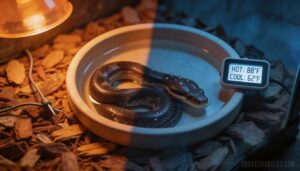
When the cool side becomes too warm or the warm side fails to reach its target, your snake loses its ability to thermoregulate — and the water dish becomes its only real option. Temperature gradient collapse often stems from thermostat miscalibration, improper probe placement, or incorrect heat lamp height.
Uneven substrate heating creates misleading hot spots. Verify both sides independently: maintain surface-level temperatures of 75–85 °F to ensure a functional gradient.
Humidity Levels That Are Too Low
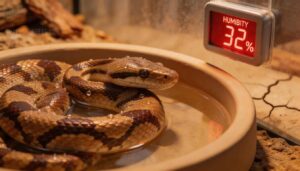
Temperature isn’t the only culprit. When humidity levels drop below 40–50%, your snake’s skin shedding process stalls — and the water bowl becomes a makeshift fix. Seasonal humidity fluctuations hit hard in winter, when indoor air dries out fast.
Microclimate mapping, humidity management through substrate moisture management, sensor calibration, and a humidifier use strategy will keep humidity control consistent before your snake starts compensating.
Water Bowl Placement Near Heat Sources
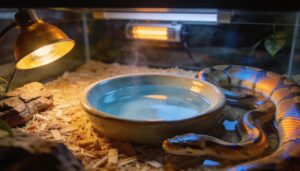
Placement matters more than most keepers realize. A water bowl sitting too close to a basking spot or under-tank heater — poor heat source proximity management — warms quickly, evaporates fast, and can even crack from thermal shock if water spills onto heating equipment.
Keep these in mind:
- Position the bowl centrally, never directly over a heat source
- Use ceramic for better material thermal conductivity control — it warms slowly
- Practice evaporation rate control by checking water temperature after every heating cycle
- Maintain electrical hazard prevention by keeping water away from thermostat probes and wiring
Too Few Hides or Too Much Exposure
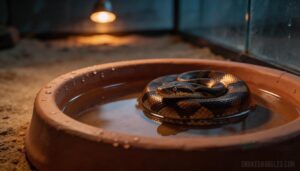
When your snake can’t find a secure retreat, the water dish becomes the next best option — and that’s a husbandry gap worth fixing. Hide quantity and hide placement directly shape how often your snake soaks.
| Hide Issue | Exposure Zone Created | Stress Indicator |
|---|---|---|
| Only one hide total | Entire opposite thermal zone | Extended water-dish sitting |
| Hides missing on warm side | Warm end left open | Avoiding basking area |
| No overhead cover near center | Open mid-enclosure corridor | Restless, repetitive movement |
| Poor enclosure design layout | Large exposed surface areas | Refusing food, hiding in bowl |
| Insufficient environmental enrichment | Full enclosure visibility | Pressed against glass walls |
Snakes feel safest with enclosed ceiling effects overhead. Without that, they’ll treat the water dish as their hiding place.
Ventilation and Screen Tops Drying The Tank
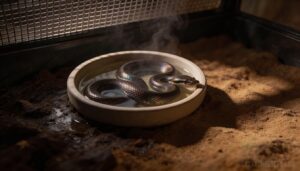
A screen top pulls moisture out faster than most keepers expect. Rising warm air escapes through vents, accelerating the evaporation rate from your water dish and disrupting the humidity gradient across the enclosure.
Vent placement directly affects where dry zones form — and if airflow circulation targets your bowl, humidity fluctuation follows quickly.
Covering part of the screen top improves microclimate control without sacrificing ventilation requirements.
When Soaking Signals Illness or Parasites
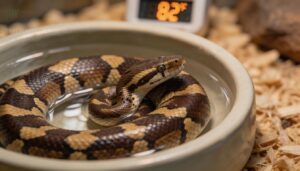
Sometimes the water dish isn’t a comfort zone — it’s a warning sign. When soaking becomes constant despite proper temperatures and humidity, something else is usually going on.
Here are the health-related reasons your snake might be spending too much time in its bowl.
Snake Mites and Constant Irritation
Mites are a serious cause of stress-related soaking behavior — and they’re easier to miss than you’d think. Ophionyssus natricis, the most common snake mite, bites constantly, driving your snake to the water bowl for relief from skin irritation.
Check for tiny dark specks near the eyes, vent, and chin folds.
Prompt mite treatment and thorough water bowl maintenance are essential once mite infestation is confirmed.
Skin Infections and Scale Damage
Damaged scales don’t just look bad — they’re an open door for Bacterial Dermatitis and Fungal Scale Loss. Once the skin barrier is compromised, Secondary Infections move in fast, turning minor Moisture‑Induced Erosion into scale rot.
Prolonged soaking worsens Skin Barrier Compromise, so prioritize skin infection management alongside water quality for reptiles and humidity management to prevent bacterial infections from taking hold.
Dehydration, Lethargy, and Weight Loss
Dehydration runs deeper than just thirst. When your snake lingers in the water bowl for hours, it may be compensating for Fluid Intake Monitoring failures — losing more than it can replace.
Watch for these red flags:
- Sunken eyes and tented skin signal Electrolyte Imbalance
- Lethargy reflects Metabolic Rate Decline from low hydration
- Appetite Suppression often accompanies dehydration-driven weight loss
- Compromised Kidney Function worsens fluid regulation
- Persistent hydration and water bowl usage indicate an underlying issue
Breathing Problems Alongside Soaking
Soaking and labored breathing together isn’t a coincidence — it’s a warning. Respiratory inflammation from Waterborne Pathogens or poor water quality drives Lung Irritation that compounds existing respiratory infections.
Airway Aspiration can occur if water contacts the glottis during prolonged submersion, triggering Oxygen Deprivation and respiratory distress.
| Sign | Possible Cause | Action |
|---|---|---|
| Wheezing while soaking | Respiratory Inflammation | Vet visit immediately |
| Open-mouth breathing | Reptile respiration failure | Emergency care |
| Bubbling around mouth | Diagnosing reptile respiratory problems | Same-day consultation |
Sudden Behavior Changes That Are Concerning
Beyond breathing issues, watch for sudden shifts that don’t fit your snake’s normal pattern — Feeding Refusal, an Aggression Spike, Nighttime Activity Shift, Eye Opacity, or Scale Discoloration paired with soaking in their water dish signal something deeper than hydration needs.
These behavioral signs of illness, especially when clustered, suggest stress signs or respiratory distress that warrant same-day veterinary attention.
What Should You Do Next?
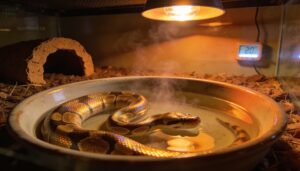
Once you’ve ruled out illness, the fix usually comes down to a few practical changes in how the enclosure is set up. Most issues trace back to temperature, humidity, hiding spots, or water bowl care — and each one has a straightforward solution.
Here’s exactly what to check and adjust, step by step.
Check Temperature and Humidity First
Always start here: thermometer placement and hygrometer positioning. Place your thermometer probe at substrate level — where your snake actually rests — and run a temperature spot check on both the warm and cool sides.
Digital hygrometers drift, so build a calibration routine monthly. Check nighttime humidity too, since temperature gradients shift after lights out and humidity control often fails precisely when you’re not watching.
Clean and Refill The Water Dish Daily
Once your temperatures and humidity check out, shift focus to the water bowl itself. A dirty dish can drive soaking just as much as a broken thermostat.
Follow this Daily Water Change routine every day:
- Dump and inspect for feces, shed, or cloudiness
- Scrub with hot water — a Soap-Free Rinse prevents residue irritation
- Target corners where Biofilm Prevention matters most
- Complete your Fresh Water Refill to room temperature
Clean water changes everything.
Add Secure Hides and a Humid Hide
Clean water helps, but it won’t fix a snake that’s soaking because it has nowhere else to feel safe. A secure hide entrance — snug enough to contact your snake’s flanks — delivers genuine stress relief.
Use at least two hides, one per thermal zone. For skin moisture regulation and microclimate humidity control, add a humid hide on the warm side with damp substrate inside.
Adjust Heating, Airflow, and Bowl Placement
Even small adjustments to your setup can stop unnecessary soaking immediately. Run through these four fixes:
- Thermostat programming — set warm side to 85–88°F; heat pad placement should never overlap the bowl zone.
- Temperature probe placement — position a secondary probe near the water dish to catch hidden heat spikes.
- Airflow direction — redirect ventilation away from the bowl to slow evaporation.
- Bowl depth — center it in the cool zone, away from any heat source.
Know When to Call an Exotic Vet
If your snake combines prolonged soaking with unresponsive behavior, paralysis, severe bleeding, rapid swelling, or uncontrolled vomiting, don’t wait — call an exotic vet immediately. Health issues indicated by prolonged soaking rarely resolve on their own.
Signs of dehydration in corn snakes, like sunken eyes or tented skin, also warrant veterinary consultation.
Diagnosing reptile respiratory problems — open-mouth breathing, wheezing — requires professional assessment.
Frequently Asked Questions (FAQs)
What are signs of overfeeding a ball python?
Overfeeding a ball python shows up fast — Rapid Weight Gain, a Rounded Body Shape, Reduced Activity, lethargy, Frequent Regurgitation, and Constipation Issues all signal that feeding frequency has exceeded what your snake actually needs.
Can snakes absorb water through their skin?
Not meaningfully.
The lipid barrier in your snake’s scales keeps cutaneous permeability extremely low — they hydrate by drinking, not through skin absorption. Think of the water bowl as refreshment, not a hydration station.
How often should I replace my snakes water?
Think of your snake’s water bowl like a coffee cup — you wouldn’t drink yesterday’s cold, stale cup.
Change the water daily, scrub the bowl weekly, and always dechlorinate fresh tap water before refilling.
What water bowl size suits my snake best?
Choose a bowl with a 6–8 inch interior diameter for a 3-foot snake, or 10–12 inches for a 5–6-footer. Ceramic material resists tipping, and depth should reach halfway up the body.
Should I add anything to my snakes water?
Plain, clean water is all your snake needs. Skip the vitamins, salts, or electrolytes — they cause more harm than good.
If your tap water contains chlorine, a reptile-safe dechlorinating product neutralizes it.
Can stress from handling increase water-dish soaking?
Yes. A handling cortisol surge can trigger post-handling anxiety, pushing your snake straight to the water dish as a coping behavior.
Stress-induced hydration-seeking is real — the bowl becomes its first available safe spot.
Conclusion
Your snake sitting in its water dish is like a check engine light—it’s signaling that something needs attention. By now, you see it’s not just quirky behavior.
Addressing the root cause—whether it’s temperature, humidity, shedding, or health issues—gets your snake back on track.
So, why does your snake sit in its water dish? It’s time to troubleshoot and make adjustments.
With these insights, you’re equipped to identify and fix the issue, ensuring your snake’s well-being and peace of mind for you.
- https://www.berrypatchfarms.net/how-long-to-soak-snake-for-shed/
- https://scalecompanions.com/rat-snake-skin-shed/
- https://www.furrycritter.com/pages/pharma/reptiles/soaking_warm_baths.htm
- https://blog.groomerschoice.com/how-to-tackle-the-de-shed
- https://books.rsc.org/books/monograph/773/chapter-abstract/508277/Soaking?redirectedFrom=fulltext