This site is supported by our readers. We may earn a commission, at no cost to you, if you purchase through links.

Your snake sitting in its water dish once or twice is nothing to worry about. Your snake doing it every day is your enclosure telling you something is wrong.
Snakes don’t soak out of preference. They soak because something in their environment, or their body, is pushing them toward water. A too-warm cool side, humidity that’s bottomed out, mites irritating their scales, a shed cycle ramping up, these are the real drivers behind the behavior.
Identifying the cause quickly protects your snake’s health. Here’s what to look for and how to fix it.
Table Of Contents
- Key Takeaways
- Why is My Snake in Its Water Dish?
- Is Sitting in The Water Dish Normal?
- Is My Snake Soaking Because It’s Shedding?
- Could Enclosure Conditions Cause Water-Dish Sitting?
- Could Mites or Illness Cause Constant Soaking?
- What Should I Check and Change First?
- Frequently Asked Questions (FAQs)
- Is it normal for snakes to lay in their water bowl?
- Why is my snake just sitting in water?
- How often do I change my snakes water bowl?
- Why is my snake soaking in his water bowl?
- What are signs of overfeeding a ball python?
- Can snakes absorb water through their skin?
- How often should I replace my snakes water?
- What water bowl size suits my snake best?
- Should I add anything to my snakes water?
- Can stress from handling increase water-dish soaking?
- Conclusion
Key Takeaways
- Snakes soak in their water dish as a behavioral signal, not out of preference — it points to a specific problem like overheating, low humidity, an upcoming shed, or mites.
- The difference between normal and concerning is frequency: brief, occasional soaking is fine, but daily or prolonged use of the dish means something in the enclosure is failing your snake.
- Your first diagnostic steps should always be temperature and humidity — a collapsed thermal gradient or dry air resolves most soaking behavior without a vet visit.
- If enclosure conditions check out, inspect closely for mites around the eyes, chin, and vent, and watch for signs of respiratory infection, since both drive snakes toward water and worsen quickly if ignored.
Why is My Snake in Its Water Dish?
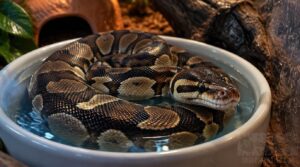
A snake sitting in its water dish is one of the most common concerns that reptile owners raise. It’s rarely random. Your snake is communicating something about its environment, its body, or both.
Since your snake’s water dish is both a refuge and a signal, keeping it genuinely clean matters — here’s a practical guide to cleaning your snake’s water bowl the right way.
Snakes thermoregulate by moving between warm and cool zones. When that gradient fails, the water dish becomes the coolest accessible surface, and thermal stress pulls your snake toward it. Humidity levels also matter. Dry air drives snakes toward moisture-rich spots, making the dish the default location for hydration monitoring and skin comfort.
Shedding is another common driver. Before ecdysis begins, snakes actively seek moisture for shedding assistance and to ease skin separation. If your snake’s soaking behavior is new or constant, that’s your cue to investigate further.
Is Sitting in The Water Dish Normal?
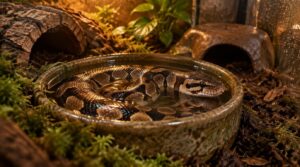
Occasional use of the water bowl is completely normal. Most snakes drink from it, soak briefly before or during a shed, or rest near it without any root issue. Short, infrequent sessions don’t require intervention.
The concern begins when soaking becomes frequent or prolonged. If your snake is spending hours in the bowl, returning to it repeatedly, or choosing it over available hides, that’s a behavioral signal worth investigating. Normal behavioral thermoregulation doesn’t rely on the water dish as a primary resting site. The dish is a resource, not a substitute enclosure microclimate.
When your snake treats the water dish as a hide, the enclosure has failed it
Watch the pattern. Intermittent soaking behavior falls within normal range. Constant or recurring hydration-seeking behavior points to something off in the enclosure microclimate or your snake’s health.
Is My Snake Soaking Because It’s Shedding?
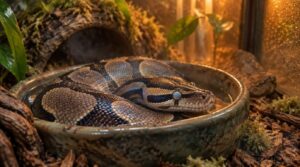
Shedding is the most common reason a snake soaks. During active shedding cycles, the old skin needs moisture to loosen from the new layer beneath. If your enclosure’s humidity levels aren’t high enough to keep that skin pliable, your snake will compensate by sitting in the water dish.
Corn snakes in particular can be sensitive to low humidity during sheds, so reviewing a detailed albino corn snake care and husbandry guide can help you dial in the right conditions before problems arise.
Watch the timing. Soaking behavior that clusters in the days before and during a shed is your clearest signal. A blue-gray tint to the skin, dull eyes, and increased water-dish use together strongly point to a shedding-linked moisture need rather than something else.
The quality of the completed shed tells you whether it worked. A single-piece shed, eye caps included, means hydration was adequate. Pieces or stuck eye caps mean it wasn’t.
Could Enclosure Conditions Cause Water-Dish Sitting?
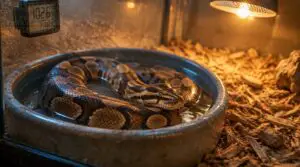
Before assuming illness, check your snake’s enclosure — the setup itself is often the real culprit. Three specific conditions push snakes toward their water dish more than almost anything else. Getting these right can resolve the behavior without a vet visit.
Overheating and Missing Cool Areas
Your enclosure may feel like a furnace your snake can’t leave. When the temperature gradient collapses, behavioral thermoregulation fails, pushing it into the only cool spot: the water dish.
- Cool side temperature too high
- No thermal buffering substrate
- Poor enclosure airflow optimization
- Heat source too close
- Probe misplaced, reading wrong
Check every surface temperature carefully, not just the hot spot.
Low Humidity and Dry Air
In dry air, Low Humidity Levels force your snake toward the water dish to compensate for rapid moisture loss. The surface creates a humidity gradient your snake exploits for both respiratory and skin hydration support. Use a hygrometer to guide humidity control and reduce dehydration risk.
| Reading | Next Step |
|---|---|
| Below 40% | Raise humidity now |
| 40–50% | Monitor closely |
| 50–60% | Maintain as-is |
Too Few Secure Hides
When hides are absent or poorly placed, your snake defaults to the water dish as its only safe refuge. Check these four common hide problems:
- Too few hides across each thermal zone
- Poor reptile hide placement away from preferred areas
- Entrances too large for full body concealment
- No cool-side hide for stress relief
Fix this first.
Could Mites or Illness Cause Constant Soaking?
You might assume your snake simply enjoys a bath, but prolonged soaking is rarely recreational. It’s usually a distress signal.
Snake mites are the most common culprit. Check the eye rims, chin grooves, and vent for tiny black or red specks, and look for fine white dust on scales or debris sunk in the water dish. Excessive soaking is often the first sign, before anything else looks wrong.
Illness matters too. A respiratory infection drives snakes toward water when wheezing, crackling breath, or lethargy accompany the soaking behavior. Kidney disease and internal parasites can also cause it.
| Sign | Likely Cause | Action |
|---|---|---|
| Black/red specks, silvery dust | Snake mites | Treat enclosure and snake |
| Wheezing, weight loss | Respiratory infection | See a vet immediately |
| Sunken eyes, wrinkled skin | Dehydration signs | Review humidity and water bowl maintenance |
| Failed sheds, retained eye caps | Mites or low humidity | Inspect scales, adjust setup |
Heavy mite burdens cause anemia, so don’t delay treatment.
A dedicated reptile mite treatment spray can help clear infestations quickly before anemia sets in.
What Should I Check and Change First?
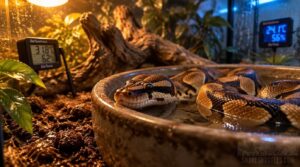
A snake that won’t leave the water dish is one of the more common calls I receive, and the fix is almost always the same.
Start with your temperature gradient. Use a digital thermometer on both ends, not a stick-on strip. If your cool side exceeds 80°F or your warm side doesn’t reach 88-90°F, the water becomes the only consistent refuge. Fix that first.
Next, check humidity levels. Persistent soaking signals unmet hydration needs or pre-shed skin discomfort. If you’re below your species’ required range, add a humid hide to support shedding assistance.
Frequently Asked Questions (FAQs)
Is it normal for snakes to lay in their water bowl?
Like a cooling tile on a hot floor, your snake’s water bowl does a real purpose. Occasional soaking behavior is completely normal. But persistent daily soaking despite a proper temperature gradient signals something worth investigating.
Why is my snake just sitting in water?
It’s often looking to regulate its body temperature, find moisture, or prepare for an upcoming shed. Don’t rule out enclosure conditions, external parasites, or an early illness as the actual reason it keeps sitting there.
How often do I change my snakes water bowl?
Do a daily water change without exception. If you spot feces, shed, or substrate in the bowl, replace it immediately, not at your next scheduled change. Sanitize the dish itself weekly with a reptile-safe cleaner.
Why is my snake soaking in his water bowl?
It’s not always a health concern, but your enclosure conditions are almost always the root cause. He’s too hot, dehydrated, or shedding. Check your thermal gradient and humidity before assuming something more serious is wrong.
What are signs of overfeeding a ball python?
Watch for a thickened mid-body, reduced waist taper, and rapid weight gain despite stable care. Overfed ball pythons often show decreased mobility and inconsistent stool timing, both signaling that your feeding frequency needs immediate adjustment.
Can snakes absorb water through their skin?
Snakes can’t meaningfully absorb water through their skin. Their skin barrier function is highly impermeable, making cutaneous absorption negligible under normal conditions. Your snake meets its hydration needs by drinking, not by sitting in water.
How often should I replace my snakes water?
Replace the water bowl contents at least once daily, but if you notice slime, floating debris, or any odor, change it immediately. Warmer enclosures accelerate contamination quickly, so don’t rely on a fixed schedule alone.
What water bowl size suits my snake best?
Think your current bowl is actually oversized? For most adult snakes, six to eight inches in diameter works well, but ball pythons need ten to twelve, wide enough to fully coil and soak comfortably inside.
Choosing the right fit matters more than you might think, as reptile water bowl sizing directly impacts whether your snake drinks adequately and soaks properly during shedding cycles.
Should I add anything to my snakes water?
Your snake’s water bowl needs only plain, dechlorinated water. Use a reptile-safe dechlorinating product if your tap water is chlorinated, and don’t add electrolytes, salt, or anything else unless your vet prescribes it for treatment.
Can stress from handling increase water-dish soaking?
Water becomes a refuge when the world feels threatening. Rough or frequent handling elevates corticosterone, triggering risk-avoidant behavior. Your snake may retreat to its dish as a stress-induced soaking response, actively seeking immediate sensory relief.
Conclusion
Water is comfort and water is a warning. When you understand why does my snake sit in its water dish, you stop seeing the behavior as quirky and start seeing it as data.
Check your temperatures. Raise your humidity. Inspect for mites. Give your snake somewhere dark and snug to feel safe. One small fix often resolves it completely.
Your snake can’t tell you something’s wrong. But it’s trying.