This site is supported by our readers. We may earn a commission, at no cost to you, if you purchase through links.
A snake that looks like it was dipped in sunrise—reds bleeding into orange, eyes glowing pink against pale white scales—sounds almost too vivid to be real. That’s your first glimpse of an albino corn snake, and it stops most people cold. What makes this morph striking isn’t just the color.
A single genetic mutation, a retrotransposon insertion in the OCA2 gene, switches off melanin production entirely, turning a common southeastern U.S. species into something that looks hand-painted.
Captive-bred for decades, these snakes live 15–20 years and handle like a dream—everything a first reptile keeper could want, wrapped in exceptional color.
Table Of Contents
- Key Takeaways
- Albino Corn Snake Overview
- Albino Corn Snake Pictures and Appearance
- Size, Lifespan, and Growth
- Habitat and Tank Setup
- Juvenile Tank Size Requirements
- Adult Enclosure Size: 40-Gallon Breeder Minimum
- Warm Side, Cool Side, and Basking Spot
- Humidity Range for Healthy Shedding
- Best Substrates: Aspen, Coconut Fiber, Bioactive Mixes
- Hides, Water Bowl, Branches, and Enrichment
- Lighting Needs and UVB Considerations
- Starter Kit Options for New Keepers
- Feeding and Daily Care
- Temperament, Handling, and Safety
- Health, Shedding, Breeding, and Cost
- Common Health Issues: Mouth Rot, Parasites, Retained Shed
- Healthy Shedding and Humidity Management
- Brumation and Seasonal Behavior
- When to Contact a Reptile Veterinarian
- Breeding Season and Egg-Laying Facts
- Albino Morph Genetics and Popular Variations
- Average Albino Corn Snake Price
- Initial Setup and Ongoing Care Costs
- Frequently Asked Questions (FAQs)
- What are some fun facts about albino corn snakes?
- How big will an albino corn snake get?
- What are albino corn snakes?
- Do albino corn snakes live long?
- Why do albino corn snakes look different?
- What is the origin of albino corn snakes?
- Are albino corn snakes worth it?
- Are albino corn snakes good pets?
- How do albino corn snakes hunt?
- Do albino corn snakes have health problems?
- Conclusion
Key Takeaways
- A single recessive gene mutation in the OCA2 gene eliminates all melanin, giving albino corn snakes their vivid red, orange, and white coloration along with their signature pink or red eyes.
- They’re one of the easiest pet snakes you can own—nonvenomous, calm by nature, and happy on a simple diet of frozen-thawed mice fed once every one to three weeks depending on age.
- Your setup needs three temperature zones (cool side at 72–78°F, warm side at 85–88°F, basking spot at 90°F), humidity around 65–75%, and a 40-gallon enclosure minimum once your snake reaches adulthood.
- This isn’t a short-term commitment—albino corn snakes routinely live 15 to 20 years in captivity, so budget, planning, and consistent care matter from day one.
Albino Corn Snake Overview
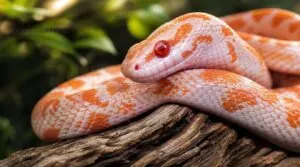
The albino corn snake is one of the most recognizable pet snakes in the hobby—and for good reason. It’s a color morph of Pantherophis guttatus, bred to showcase striking reds, oranges, and whites that wild corn snakes never display.
If you’re curious how the albino stacks up against other standout varieties, this roundup of unique-looking corn snake morphs puts the color diversity in perspective.
Before delving into specifics, here’s what you need to know: these snakes owe their popularity to their vibrant, unnatural coloration, a result of selective breeding rather than natural evolution.
Scientific Name: Pantherophis Guttatus
The albino corn snake’s full scientific name is Pantherophis guttatus — and knowing it actually matters. This taxonomic classification places your snake within the rat snake genus Pantherophis, reflecting its phylogenetic placement among North America’s most successful constrictors.
The genus history shifted from Elaphe to Pantherophis in the early 2000s. Key taxonomic details include:
- P. guttatus translates loosely to "spotted panther snake" in Latin etymology
- The genus history shifted from Elaphe to Pantherophis in the early 2000s
- Species authority confirms it’s native to the southeastern United States
They serve as a valuable rodent control agent in many habitats.
Amelanistic Corn Snake Morph Explained
The term "albino" actually refers to something more specific: the amelanistic morph, often called "amels" by hobbyists. A retrotransposon insertion disrupts the OCA2 gene, blocking melanin transport into melanocytes entirely.
Recessive inheritance governs this trait, so your snake needs two copies to express it. The result? Zero dark pigment — just stable reds, oranges, and whites, with that unmistakable red eye pigmentation.
Beginner-Friendly Pet Snake Facts
Albino corn snakes are genuinely one of the easiest first pet snakes you can choose. They’re non-venomous, calm, and easy to maintain. No legal requirements in most regions, no special permits.
Common myths suggest they’re fragile, but a solid beginner’s guide proves otherwise.
Wild Corn Snake Vs. Captive Albino Morph
Wild corn snakes roam the southeastern United States, relying on camouflage and natural prey to survive predator pressure year-round.
Captive albino morphs share the same species but carry recessive amelanistic genetics — no black pigment, just vivid red, orange, and white. That difference matters. Without wild habitat demands or seasonal activity shifts, your albino thrives under controlled temperature, humidity, and a steady frozen-thawed diet.
Quick Facts Table: Size, Lifespan, Diet, Cost
Four numbers tell you almost everything you need to know before committing. Average size runs 3–5 feet, fitting your dimensional range expectations easily. A lifespan of roughly 15 to 20 years means real budget planning upfront.
For an albino corn snake’s diet and feeding, frozen-thawed mice cover nutritional requirements fully.
Cost and purchasing information for albino corn snakes starts near $50, though albino corn snake lifespan greatly influences long-term economic comparisons.
Albino Corn Snake Pictures and Appearance
Albino corn snakes are some of the most visually striking snakes you’ll find in the pet trade.
Their bold coloration and clean patterns ensure no two look exactly alike as they grow.
Here’s what to look for when identifying one.
Red, Orange, Yellow, and White Coloration
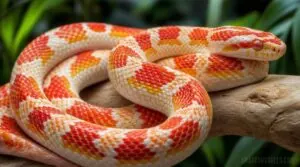
Albino corn snakes’ vivid colors stem from pigment chemistry: a melanin deficiency eliminates dark tones, leaving carotenoids—pigments responsible for their striking red, orange, and yellow scales.
This genetic trait, combined with coloration and genetics, produces distinct color morph patterns. Over time, age-dependent hue deepens with each molt, gradually intensifying the snake’s appearance.
Additionally, dietary color impact subtly influences carotenoid expression, shaping the snake’s coloration as it matures.
Red or Pink Eye Color
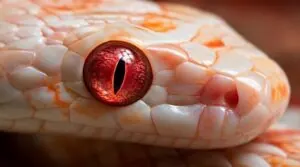
One of the most striking identification cues on an albino corn snake is the eyes. Melanin deficiency leaves the iris nearly pigment-free, so ambient lighting reflects off underlying blood vessels — giving you those signature bright red eyes or softer pink hues.
Iris translucency varies by individual due to pigment genetics. If eyes appear cloudy instead, that’s a veterinary eye sign worth checking out for this color morph.
Saddle Blotches and Checkerboard Belly
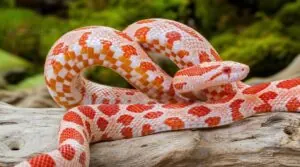
Flip your albino corn snake over and you’ll spot two signature features at once. Along the back, bold saddleback pattern blotches—orange-red on white—run symmetrically from neck to tail. Underneath, a checkerboard belly confirms your field identification instantly.
Aging sharpens both markings after each shed cycle. For contrast analysis, use photographic lighting in natural daylight; molting effects can temporarily soften color intensity between sheds.
Scale Texture and Body Shape
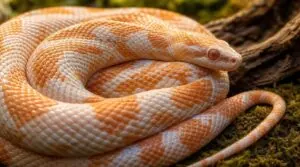
Run your fingers along an albino corn snake, and you’ll feel something unexpected—a subtle texture, not the slippery smoothness most people imagine. That’s the weakly keeled scales at work.
Here’s what makes their snake scale morphology and function so distinctive:
- Scale Row Count sits between 17–27 rows at midbody
- Ventral Scale Size is noticeably larger than dorsal scales, enabling smooth ground movement
- Keel Prominence stays low, giving a soft satin finish under light
- Texture Light Interaction creates a gentle shimmer rather than gloss
- Body Taper Ratio transitions gradually from a muscular midbody to a slim, balanced tail
Photo Examples by Age: Hatchling to Adult
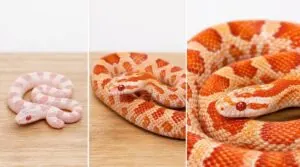
Watching an albino corn snake grow is like watching a painting come alive. Colors deepen, patterns sharpen, and the whole animal transforms.
| Age Stage | Visual Key |
|---|---|
| Hatchling | Pale pink-white base, soft contrast |
| Juvenile | Brighter orange, defined saddle blotches |
| Adult | Bold red-orange, crisp white background |
A sequential age layout with good lighting techniques and background selection highlights color saturation comparison beautifully — tracking growth rate monitoring has never looked this rewarding.
Similar-Looking Morphs and Identification Tips
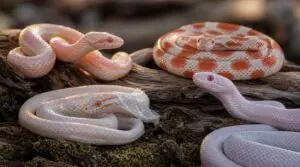
Not all pale corn snakes are the same morph. Once you know what to look for, identification gets easier fast.
Use these four clues:
- Scale edge hue — iridescent scale rims hint at hidden genetics
- Saddle pattern density — blotches appear tighter or more spread depending on lineage
- Head band visibility — fades with age-related color shift
- Eye tone — pink vs. translucent red separates many albino corn snake coloration and genetic lines
Size, Lifespan, and Growth
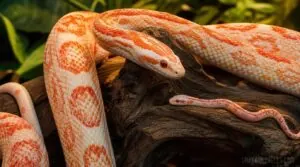
Albino corn snakes don’t stay small for long, and knowing what to expect helps you plan ahead. From hatchling to full-grown adult, their size and pace of growth tell you a lot about the care they’ll need.
Here’s what you should know about how big they get, how fast they grow, and how long they’ll be part of your life.
Average Adult Length: 3–5 Feet
Most adult albino corn snakes measure between 3 and 5 feet in length—a size range that directly influences critical care decisions, including enclosure size, feeding proportions, and scheduling. These benchmarks guide adjustments to their care as they mature.
| Growth Stage | Typical Length |
|---|---|
| 12 months | 24–36 inches |
| 18–24 months | 3 feet |
| 2+ years | 4–5 feet |
| Full adult | Up to 5 feet |
Growth variability is real, shaped by genetics, diet, and husbandry practices. While size perception can mislead new keepers, most healthy adults meet the minimum enclosure requirement of a 40-gallon tank by their second year. Accurate measurement techniques, such as using a soft tape measure along the spine, provide the most reliable length assessments.
Hatchling Size and Growth Rate
Fresh out of the egg, hatchlings are tiny — just 10 to 14 inches long and barely 5 to 10 grams. Early weight gain occurs rapidly, especially with a consistent juvenile corn snake feeding schedule and proper temperature-driven growth conditions. Clutch variability means siblings may grow at varying rates, making weight monitoring essential.
Key hatchling growth expectations include:
- Hatch weight: 5–10 grams
- Metabolic rate peaks in months 1–6
- Length gain: 12–24 inches in year one
- Prey size ratio: match to body girth
- Growth curve modeling shows fastest gains before month 12
Male Vs. Female Size Differences
Sexual dimorphism in albino corn snakes is subtle but real.
Females tend to grow larger overall — their bodies need extra mass to support egg clutch size and reproductive demands.
Males usually reach sexual maturity a few months earlier.
Don’t stress over telling them apart by length alone, though. Individual variation is common, and size overlap between sexes happens regularly.
Expected Captive Lifespan: 15–20 Years
Most albino corn snakes live a lifespan of roughly 15 to 20 years in captivity — though one record-holder hit 32.
Most albino corn snakes live 15 to 20 years in captivity, though one record-holder reached 32
Lifespan longevity and factors affecting age in captivity come down to consistent temperatures, proper feeding, and stress reduction.
Life stage adjustments matter too: aging nutrition and senior snake health needs shift over time.
Age-related care is a real, long-term commitment.
Long-Term Care Commitment
Owning one of these snakes for a lifespan of roughly 15 to 20 years means building real systems — not just buying a tank.
Here’s what long-term commitment actually looks like:
- Vet emergency plan — Find a reptile vet before you need one.
- Backup heating system — Thermostats fail; have a spare ready.
- Prey inventory management — Keep frozen feeders stocked consistently.
Habitat and Tank Setup
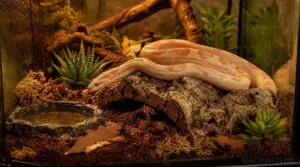
Getting the enclosure right is one of the most important things you can do for your albino corn snake. The good news is that their setup isn’t complicated once you know what to look for.
Here’s exactly what your snake’s habitat needs to thrive.
Juvenile Tank Size Requirements
Start small, but plan ahead. A 20-gallon tank works as your juvenile’s first enclosure setup — it provides enough coiling room without overwhelming a small snake. Aim for a minimum footprint of 24×18 inches and a healthy height ratio for climbing. Upgrade quickly, though. Once your snake hits 18 inches, that 20-gallon enclosure becomes cramped quickly.
| Growth Stage | Tank Recommendation |
|---|---|
| Hatchling (under 12 in) | 10–20 gallon tank |
| Young juvenile (12–18 in) | 20-gallon enclosure |
| Growing juvenile (18–24 in) | 30-gallon tank |
| Approaching adult (24+ in) | Future upgrade needed |
| Near adult size | 40-gallon glass vivarium |
Adult Enclosure Size: 40-Gallon Breeder Minimum
Once your snake reaches adulthood, a 40-gallon breeder aquarium becomes the minimum adult enclosure size — no exceptions. Its 36×18-inch floor area provides critical advantages, including temperature uniformity, microhabitat consistency, and stress mitigation through well-spaced hides.
Housing requirements for albino corn snakes also emphasize structural stability, which a quality 40-gallon tank reliably ensures. This size prevents underspacing and supports the snake’s behavioral needs.
Don’t undersize this one — compromising on enclosure dimensions risks your snake’s health and welfare.
Warm Side, Cool Side, and Basking Spot
Your tank needs three distinct zones to support healthy thermal regulation. Maintain the cool side at 72–78°F, the warm side around 85–88°F, and the basking spot near 88–90°F.
Use a reliable heat source—ceramic emitters work well—and always pair it with a thermostat. Careful probe positioning ensures accurate gradient monitoring.
Seasonal adjustments may be needed as room temperatures shift.
Humidity Range for Healthy Shedding
Humidity is your albino corn snake’s best friend during a shed. Keep relative humidity at about 65 to 75 percent as a baseline, then nudge it higher during blue phase—when the eyes cloud over. A humid hide microclimate lets you create localized moisture without soaking the entire enclosure.
Always confirm readings with a calibrated hygrometer, and maintain ventilation balance to prevent infection-triggering dampness.
Best Substrates: Aspen, Coconut Fiber, Bioactive Mixes
Your substrate choice sets the foundation for everything else.
Aspen shavings stay dry, resist mold, and support a burrowing depth of 2–4 inches — great for budget-conscious keepers given their low cost.
Coconut coir substrate excels at moisture retention, helping during sheds.
Bioactive soil mixes offer microfauna benefits and a lower environmental impact, though initial setup costs more.
Hides, Water Bowl, Branches, and Enrichment
Once your substrate is sorted, think about what goes on top of it. Place hide boxes on both the warm side near the basking spot and the cool side — your snake needs options. Position the water dish away from heat to keep it fresh.
Add cork bark branches for climbing, and rotate enrichment weekly. Sensory enrichment and enrichment rotation keep your snake genuinely curious.
Lighting Needs and UVB Considerations
Lighting is simpler for albino corn snakes than you’d expect. UVB lighting isn’t required and can actually stress their sensitive eyes. Skip the UVB bulb type setups entirely.
Focus instead on a 10–12 hour day-night cycle timing using a timer.
Keep your basking spot temperature consistent, and your snake stays comfortable without complicated lighting rigs.
Starter Kit Options for New Keepers
Starting out doesn’t have to feel overwhelming. A solid starter kit covers everything your snake needs from day one.
The essential components include:
- A 20-gallon tank with a secure lid and coconut fiber substrate
- Essential heating via a thermostat-controlled ceramic heat emitter and a high-quality hygrometer
- Two hide boxes plus simple lighting on a timer
- An affordable enclosure bundle, transport carrier, and basic first-aid kit
Feeding and Daily Care
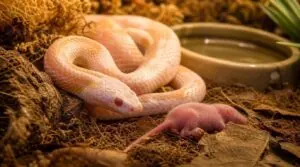
Feeding an albino corn snake is pretty straightforward once you know the basics.
The key is getting the right prey, the right schedule, and keeping their space clean. Here’s what you need to cover.
Frozen-Thawed Mice and Small Rats
Your albino corn snake’s diet is simple: frozen mice and small rats, nothing else.
Proper freezer storage in sealed bags keeps prey fresh for months. Thawing procedures matter — warm water works best, taking 20–40 minutes until prey feels evenly warm.
Always do a quick prey inspection before feeding. Following solid feeding guidelines and diet for corn snakes keeps your snake thriving long-term.
Why Live Prey is Not Recommended
Live rodent prey isn’t worth the risk. Injury risk is real — a defensive bite to your snake’s head or neck can mean emergency vet care. Disease transmission is another concern, as live prey can carry parasites and bacteria.
Prey welfare also matters ethically. Following smart feeding guidelines for corn snakes means choosing prekilled feeder rodents every time — safer, simpler, and stress-reducing for everyone involved.
Feeding Schedule by Age
Hatchling feeding frequency starts at every 5–7 days — their rapid growth demands it. Juvenile meal size increases steadily, with meals every 7–10 days. Subadult feeding intervals stretch to 10–14 days. For adult corn snakes, every 14–21 days works well.
Seasonal appetite shifts are normal; always let body condition guide your schedule.
Choosing The Right Prey Size
Match prey thickness to your snake’s midbody girth — that’s the golden rule. If the pre-killed mouse or rat looks wider than the thickest part of your snake’s body, it’s too big. Oversized meals trigger regurgitation quickly.
Size progression matters as your albino corn snake grows, so upgrade prey items gradually. Pinky mice work for hatchlings, but caloric balance shifts as they age.
Fresh Water and Soaking Needs
Fresh water isn’t optional — it’s daily care. Your snake drinks, soaks before shedding, and relies on its water dish to support a healthy humidity level. Proper Bowl Stability matters too; a heavy, tip-resistant bowl stays put during nighttime activity.
Keep these basics in check:
- Water Change Schedule: Refresh daily or immediately after contamination
- Temperature Comfort: Room-temperature water only — never cold or warm
- Soak Triggers: Increased soaking signals low relative humidity of about 65 to 75 percent
- Spot Hygiene: Remove debris fast to prevent bacterial buildup
Persistent soaking issues usually mean your humidity control needs adjustment first.
Calcium and Vitamin Supplement Considerations
Most albino corn snakes don’t need heavy supplementation — but growing snakes benefit from occasional support. Stick to occasional dusting — not every meal.
| Supplement Factor | What to Know | Why It Matters |
|---|---|---|
| Elemental Calcium | Active mineral your snake absorbs | Promotes bone health during growth |
| Vitamin D Pairing | Calcium and vitamin D3 aid absorption | D3 alone won’t help without calcium |
| Supplement Form Choice | A light dusting on frozen prey | Avoids overdose risks from overuse |
| Dosing Schedule | Every 3–4 feedings for juveniles | Consistent vitamin supplementation prevents gaps |
| Overdose Risks | Too much causes adverse effects | Match dose to the snake’s age |
Cleaning and Habitat Maintenance Routine
Keeping a clean enclosure isn’t glamorous, but it’s one of the biggest factors in your snake’s long-term health.
- Spot Cleaning daily — remove waste and refresh the water dish every 24 hours.
- Weekly Deep Clean — sanitize hides, decorations, and enclosure surfaces using Disinfection Protocols with reptile-safe products.
- Substrate Rotation monthly — replace your substrate material fully, whether you’re using aspen, coconut fiber, or a bioactive substrate blend.
Proper humidity levels and enclosure design make enrichment sanitization much easier over time.
Temperament, Handling, and Safety
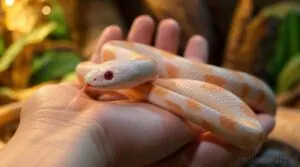
Albino corn snakes have a reputation for being genuinely calm and easy to handle — and it’s well-earned. With the right approach, most settle into regular handling without much fuss at all.
Here’s what you need to know about their temperament, how to handle them safely, and a few things worth watching for.
Are Albino Corn Snakes Friendly?
Albino corn snakes are genuinely docile. Their calm nature makes them one of the best choices for first-time keepers. Through consistent socialization practices and behavioral conditioning, most individuals settle into relaxed, curious pets.
They’re noise-sensitive, so a calm introduction matters.
Owner perception often shifts quickly once you realize how rarely they act defensively. Gentle handling and temperament of albino corn snakes go hand in hand.
Handling Tips for Beginners
Once you’re comfortable with their calm nature, handling techniques become the next focus. Support the body with both hands — hand position matters more than grip strength. Use slow movements when lifting. A secure surface, like a table or floor, keeps things safe if they shift. A calm environment helps too.
That’s the real foundation of handling and temperament of albino corn snakes.
How Often to Handle Them
Aim for 1–4 sessions per week — consistency matters more than quantity.
- Skip handling 24–48 hours post-meal (Digestive Rest Period)
- Keep Session Length Guidelines to 5–15 minutes initially
- Reduce frequency during sheds
- Apply Cold‑Weather Limits if temps drop
- Let Owner Availability guide your schedule
Watch Behavioral Cue Monitoring — calm snakes tell you everything.
Stress Signs to Watch For
Your albino corn snake will tell you when something’s off — you just need to know what to look for. Rapid breathing, tense posture, or increased hissing are clear warning signs. Watch for shedding issues, appetite loss, and unusual defensive behavior during health monitoring.
Adjusting your handling techniques early keeps stress low and enhances long-term snake temperament and wellbeing.
Bite Risk and Non-Venomous Safety Facts
Corn snakes are nonvenomous, but that doesn’t mean bites are consequence-free. Defensive bite triggers are usually avoidable with smart handling techniques. Here’s what every keeper should know about nonvenomous snake safety:
- Slow movements prevent startle-based strikes
- Clean bites immediately — infection risk management matters
- Apply pressure, then cover with a dry dressing
- Monitor for spreading redness — that’s your medical care threshold
- Handling bite avoidance starts before you even open the enclosure
Handling After Feeding or During Shed
After feeding, give your snake a 48-hour Post‑Meal Rest — that Digestion Wait Window isn’t optional. Handling too soon risks regurgitation and real stress.
During shedding, Shedding Stress Reduction means hands off entirely. Humidity Monitoring prevents shedding issues before they start.
If skin sticks, Warm Soak Assistance at 87–89°F helps.
Handling safety means reading your snake’s signals first.
Could You Mistake One for a Copperhead?
It’s an honest mistake. In dim light, the warm pinkish tones can trigger a copperhead scare. But look closer. Copperheads carry a distinct Hourglass Pattern Difference — wide at the sides, narrow at the spine.
Your albino shows saddle blotches instead. This contrast in markings is a critical identifier.
Add the triangular head shape contrast, loreal pit absence, and scale texture comparison — you’ve got your answer fast.
Health, Shedding, Breeding, and Cost
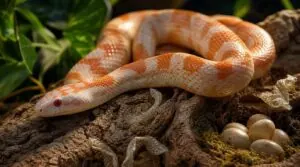
Keeping your albino corn snake healthy long-term comes down to a handful of things done consistently right. From spotting early signs of illness to understanding shedding cycles and breeding basics, there’s a lot worth knowing before problems show up.
Here’s what every keeper should be aware of.
Common Health Issues: Mouth Rot, Parasites, Retained Shed
Three common health issues in albino corn snakes are mouth rot, internal parasites, and dysecdysis (retained shed). Bacterial infection risks rise significantly when temperatures drop or enclosures remain dirty—a condition known as temperature stress—which causes substantial harm. Early warning signs include swollen gums or discharge.
Parasite screening methods, such as fecal exams, detect internal parasites before symptoms escalate. Proactive immune support strategies begin with clean husbandry practices, forming the foundation of preventive care.
Shedding aid techniques and consistent parasite prevention complete the essential toolkit for addressing these frequent health challenges in albino corn snakes.
Healthy Shedding and Humidity Management
Healthy shedding starts with getting your humidity right. Aim for 40–50% in the main enclosure, but always include a humid hide on the warm side—filled with damp sphagnum moss—so your snake can self-regulate. A calibrated hygrometer confirms your readings aren’t guesswork.
Adjust your misting schedule seasonally, as winter heating dries enclosures quickly. Dysecdysis occurs when moisture drops too low, making proper humidity management critical year-round.
Brumation and Seasonal Behavior
Brumation in albino corn snakes is a subtle metabolic slowdown, not a dramatic shutdown. Snakes detect shorter days and cooler temperatures, triggering this natural process.
Maintain a stable temperature gradient and ensure proper hydration. Confirm your snake’s health before brumation begins.
Arousal patterns remain irregular, with brief, wakeful periods. Post-brumation, appetite returns gradually.
When to Contact a Reptile Veterinarian
After brumation, your snake should bounce back quickly. If it doesn’t, that’s your first red flag.
Contact a reptile vet if you notice loss of appetite lasting over two weeks, respiratory distress like wheezing or open-mouth breathing, digestive issues, retained shedding after a warm soak, or lethargic behavior.
Bacterial infections, scale rot, and respiratory infections won’t wait — neither should you.
Breeding Season and Egg-Laying Facts
Breeding begins with a spring temperature cue — a gradual warmth shift that awakens your snake’s instincts. Courtship rituals follow, sometimes spanning several nights. After mating, females lay clutches with notable variability in clutch size, typically 6–12 eggs.
Maintain incubation humidity around 85–90% to prevent egg shrinkage. Use egg candling around day 10 to monitor embryo development.
Hatchlings emerge after 60–70 days.
Albino Morph Genetics and Popular Variations
The albino trait follows recessive inheritance — your snake needs two copies of the gene to show it. Carriers look normal but pass it on silently. That’s why carrier testing matters before pairing snakes.
Albino corn snake coloration and genetics open doors to stunning designer morph combos like Blizzard corn snakes, Snow, and Albino Striped corn snakes. Line breeding stability keeps these combinations consistent across generations.
Average Albino Corn Snake Price
Standard hatchlings from a reputable breeder usually range $90 to $150. Rare morph combos can reach $300 to $500.
Breeder reputation, regional price variation, and market trends all influence the price.
Online purchases incur $25 to $60 in shipping fees. For any serious pet investment, cost quality sourcing matters most.
Initial Setup and Ongoing Care Costs
Most keepers spend $200–$500 getting started. Your setup budget covers the 40-gallon glass vivarium, heating pad, thermostat, and substrate.
Monthly expenses run $20–$40 for food and supplies — pretty manageable.
Smart cost-saving means building a veterinary fund early. Emergency visits hit $100–$300 fast.
Equipment replacement for heating pad/tape and other gear adds $50–$100 annually.
Frequently Asked Questions (FAQs)
What are some fun facts about albino corn snakes?
These snakes are full of surprises. They can live past 32 years in captivity — that’s record longevity for a pet snake.
Their melanin deficiency gives them white and red scales that almost glow.
How big will an albino corn snake get?
Most adults reach 3 to 5 feet. Genetics, nutrition, and temperature all shape that final size. Give yours consistent warmth and proper feeding, and it’ll grow steadily for two to four years.
What are albino corn snakes?
Brilliantly bright and biologically fascinating, these are amelanistic corn snakes — a color mutation where melanin deficiency strips away all dark pigment, leaving stunning reds, oranges, and whites.
Do albino corn snakes live long?
Yes — and impressively so. With good care, your albino corn snake’s lifespan in captivity usually reaches 15 to 20 years. Stress mitigation, vet checkups, and proper habitat all play a role.
Why do albino corn snakes look different?
Melanin absence is the reason. Without it, pigment layering shifts — iridophore reflection brightens reds and oranges, resulting in vivid color contrast.
This phenomenon also causes the signature eye hue shift to pink or red.
What is the origin of albino corn snakes?
Albino corn snakes didn’t just appear overnight.
Early captive breeding in the 1960s revealed recessive amelanism — a melanin deficiency that strips dark pigment, leaving vivid red, orange, and yellow coloration through selective line establishment.
Are albino corn snakes worth it?
For most keepers, the investment return is real. They’re docile, low-maintenance, and genuinely rewarding to own. If you want a beginner-friendly snake, this one’s hard to beat.
Are albino corn snakes good pets?
Albino corn snakes are calm, manageable, and genuinely rewarding to keep. With a docile nature and beginner-friendly husbandry needs, they thrive with proper care.
They suit most owners — provided you are ready for the long-term commitment they deserve.
How do albino corn snakes hunt?
They use chemical detection via their forked tongues, thermal sensing to locate warm prey, and ambush positioning before striking.
After grabbing, they use constriction to subdue their prey.
Prey tracking relies on scent and subtle heat cues.
Do albino corn snakes have health problems?
Yes, they can. Light Sensitivity, mouth rot, Respiratory Infections, and shedding issues are the most Common Health Issues. Good husbandry prevents most problems before they start.
Conclusion
Something so rare-looking turns out to be one of the easiest snakes you’ll ever keep. That’s the quiet surprise waiting inside this albino corn snake guide, complete with pictures and facts.
The striking colors demand attention, but it’s the calm temperament and straightforward care that earn your trust over the years.
You’re not just choosing a pet—you’re choosing a 20-year companion that asks for little and gives back something most people don’t expect: genuine connection.