This site is supported by our readers. We may earn a commission, at no cost to you, if you purchase through links.

You can’t properly house a snake, feed it safely, or spot health problems without knowing where its body reaches maximum width. That measurement point—the widest part of snake body—sits at a precise anatomical location that varies by species, diet, and reproductive status.
Most snakes carry their greatest girth near midbody, roughly one-third down from the head, where essential organs cluster and muscle mass peaks. This region expands dramatically during feeding, shifts during pregnancy, and acts as your most reliable indicator of body condition.
Understanding this anatomy helps you choose the right enclosure dimensions, recognize when your snake is gravid or ill, and handle your animal without causing stress or injury.
Table Of Contents
Key Takeaways
- The widest part of a snake’s body typically sits near midbody, about one-third down from the head, where essential organs cluster and muscle mass peaks.
- Measuring maximum girth helps you choose proper enclosure sizes, recognize pregnancy or illness, and handle your snake safely without causing stress or injury.
- Body width expands dramatically during feeding as skin stretches and scales separate to accommodate prey, then gradually returns to baseline as digestion progresses.
- Gravid females experience girth increases of 10 to 60 percent, depending on species and clutch size, making girth measurement a reliable indicator of reproductive status.
What is The Widest Part of a Snake’s Body?
The widest part of a snake’s body isn’t always in the same place. Location depends on what’s happening inside—whether the snake just ate, carries eggs, or simply rests between meals.
Understanding where and why this width occurs helps you recognize normal anatomy from potential health concerns.
Definition and Terminology
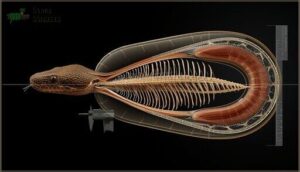
The widest part of your snake’s body—what herpetologists call maximum girth—refers to the thickest cross-sectional measurement along its length. You’ll ordinarily find this circumference at the midbody, though anatomical landmarks and body proportions shift across species. Knowing your snake’s maximum girth helps you determine the right enclosure size and accessories for its long-term health and comfort.
Understanding these scale variations in reptile anatomy helps you assess snake body structure accurately. Girth measurement differs from simple diameter, emphasizing the fullness of reptilian anatomy rather than just linear width.
Accurate measurements are vital for scientific study summaries, including those using methodological rigor to assess research quality.
Anatomical Location on The Snake
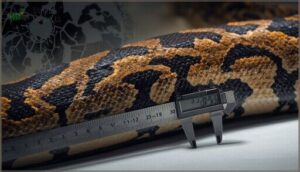
You’ll usually locate maximum girth near your snake’s midbody, around the second or third dorsal scale rows. In constrictors, the broadest trunk anatomy often sits between the neck and midtrunk. Once you’ve confirmed girth, you can apply those measurements to choosing a water bowl that accommodates your snake’s full body width.
Body axis measurement varies with posture and feeding, so consistent landmarks matter. Veterinarians use the widest midbody circumference, measured perpendicular to the spine, to assess reptile anatomy and overall snake body structure accurately. Overfeeding or choosing prey that’s too large can stress a snake’s digestive system, sometimes leading to regurgitation and serious health complications.
Variation Among Snake Species

Girth measurements differ sharply across snake families. Constrictors like anacondas and pythons display trunk diameters exceeding 30 cm, while slender colubrids stay under 10 cm. For a detailed comparison of body proportions and size ranges, check out this guide to the world’s largest snake species.
These body proportions reflect taxonomic variance and ecological adaptations—ambush predators maintain thicker midsections than fast-moving species.
Habitat shapes reptilian anatomy and physiology, revealing how evolution tailors snake external features to survival strategies within the biology of snakes.
Biological Factors Affecting Body Girth
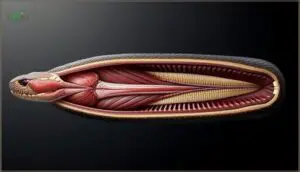
A snake’s body girth isn’t just about what it eats or whether it’s carrying eggs. The internal structure—how organs are arranged and how muscles work with the skeleton—plays a big role in determining width.
Let’s look at the two main biological factors that shape a snake’s body from the inside out.
Internal Organs and Body Segmentation
Your snake’s body width depends heavily on internal anatomy and how organs fill the coelomic space. The arrangement of snake internal organs follows a segmented pattern that directly impacts body segments and overall girth:
- The heart sits in the pericardial cavity, occupying the anterior thoracic position
- The liver extends ventrally beneath the stomach in the forward coelom
- Paired kidneys run dorsally along the body wall in the opisthonephric region
- The digestive system coils through the cavity, held by mesenteric attachments
Understanding reptile anatomy and physiology helps you assess your snake’s health and recognize normal versus abnormal body contours.
Role of Muscles and Skeletal Structure
Your snake’s powerful body relies on muscle flexibility and vertebral movement working in perfect sync. The skeletal system provides alignment, while intervertebral joints allow the fluid motion you see during axial locomotion. Here’s how the muscular system and skeletal structure control girth:
| Anatomical Component | Primary Function | Impact on Body Width |
|---|---|---|
| Segmental myomeres | Lateral flexion and propulsion | Enable expansion during feeding |
| Longitudinal muscle fibers | Regulate trunk contours | Control girth without losing stability |
| Intervertebral joints | Support spinal flexibility | Allow diameter changes during movement |
| Ribose structures | Provide skeletal framework | Maintain shape while accommodating prey |
| Oblique muscle layers | Coordinate body wall tension | Enable controlled width adjustments |
Understanding reptilian anatomy and physiology helps you recognize normal muscle tone in snake anatomy.
How Feeding Impacts Snake Body Width

When a snake eats, its body changes in ways that seem almost impossible. The skin stretches, the scales separate, and the midbody region expands to accommodate prey that can be larger than the snake’s own head.
When a snake feeds, its body performs an anatomical feat—skin stretching, scales separating, midbody expanding to swallow prey larger than its own head
Understanding how feeding affects body width helps you recognize normal digestion versus potential health problems.
Expansion During Prey Ingestion
When you watch a snake feed, you’re witnessing one of nature’s most dramatic anatomical feats. During prey ingestion, the body expands markedly as internal organs shift and surrounding tissues stretch.
This feeding behavior showcases impressive snake physiology:
- Body width increases correlate directly with prey size relative to gape diameter
- Muscular compression and relaxation cycles enable progressive stretching during digestion process
- Post-feeding, girth gradually returns to baseline as the digestive system processes the meal
Skin and Scale Adaptations for Stretching
Your snake’s exceptional stretching ability comes from specialized skin architecture. Collagen fibers allow controlled expansion, while dorsal scales and ventral scales temporarily flatten and refold during feeding. Epidermal growth accelerates in stretch-prone regions, and keratin composition includes flexible components that prevent fractures.
| Adaptation Type | Functional Role |
|---|---|
| Scale Flexibility | Allows temporary flattening during expansion |
| Skin Extensibility | Facilitates tensional growth across body intervals |
| Adaptive Overlap | Subcaudal scales refold without compromising movement |
| Epidermal Growth | Increases cell turnover in high-stretch areas |
| Keratin Composition | Reduces fracture risk during prey ingestion |
This snake anatomy ensures safe expansion without tissue damage.
Reproductive and Seasonal Influences on Girth

A snake’s girth doesn’t stay constant throughout the year. Female snakes undergo dramatic body changes during reproduction, swelling notably as they carry eggs or developing young.
Understanding these natural shifts helps you distinguish between healthy reproduction and potential health issues.
Changes in Gravid Females
When your female snake is carrying young, you’ll notice her body changing in striking ways. Reproductive cycles and gravidity patterns transform snake anatomy as embryo growth progresses through the gestation period. Her girth can swell by 10 to 60 percent depending on species and clutch size. Understanding reptile physiology and the reproductive system helps you provide better maternal care.
- Internal organs shift position to accommodate developing embryos without causing distress
- Abdominal expansion occurs gradually as the uterus enlarges throughout gestation
- Post-birth girth reduction happens quickly once eggs or live young are delivered
- Seasonal timing often aligns with prey availability in temperate species
Water Uptake and Embryo Development
During embryo development, water balance becomes critical to your snake’s reproductive success. Developing embryos absorb water through placental membranes or eggshells, relying on aquaporin channels to regulate fluid uptake.
Osmoregulation maintains proper hydration as eggshell permeability shifts throughout incubation. This embryo hydration directly affects body girth in gravid females, linking reptile physiology and reproductive system function to the digestive system’s resource allocation.
Practical Importance of Identifying Body Girth

Knowing where your snake’s body is widest isn’t just an anatomy lesson—it’s a practical tool for keeping your animal healthy. This measurement helps you assess body condition, spot potential health issues, and make informed decisions about care.
Let’s look at how identifying body girth matters in two key areas of snake keeping.
Health and Veterinary Assessment
You’ll want to track your snake’s girth regularly—it’s a window into reptile health. Veterinary care relies on body measurements to detect illness, pregnancy, or fluid retention.
Diagnostic tools like ultrasound reveal internal anatomy changes that affect girth. Health monitoring catches problems early, while medical interventions address swelling from infection or organ disease.
Snake nutrition directly influences body width, making reptile internal anatomy assessment essential in veterinary medicine.
Implications for Snake Care and Husbandry
Understanding girth helps you design the right snake enclosure and choose safe handling techniques. Regular girth measurement lets you spot health problems before they escalate, so veterinary care for reptiles becomes more effective.
Knowledge of snake anatomy and reptile anatomy and physiology guides your decisions on space, temperature, and feeding schedules—health monitoring that fosters long-term reptile health and husbandry through informed snake care and management.
Frequently Asked Questions (FAQs)
How do snakes flatten their bodies defensively?
Snakes compress their bodies laterally by contracting intercostal muscles, pressing ribs and scales outward against the ground.
This defensive posture increases apparent body width, creating a broader, more intimidating profile that deters predators effectively.
What determines maximum digestible prey size for snakes?
Jaw mechanics and esophageal stretch primarily determine prey size limits in snake anatomy.
Digestive capacity, ligament flexibility, and stomach distension further constrain feeding strategies, while venom efficiency affects safe ingestion within reptile biology parameters.
Do venomous snakes have wider body girths?
Does venom delivery determine body proportions? Not really—venomous snakes don’t consistently show wider girths.
Snake morphology varies by species, prey strategy, and habitat, not venom status. Girth variation reflects diet and ecology more than venom evolution.
How does temperature affect snake body expansion?
Temperature fluctuations drive metabolic responses in ectothermic snakes, altering tissue turgor and water turnover.
Thermal regulation affects body flexibility through peripheral blood flow changes, creating measurable but reversible girth variations across different species and conditions.
Can snakes control their body width voluntarily?
You won’t see a snake deliberately puffing up or slimming down on command. Snake muscle structure and body flexibility don’t support voluntary control over overall width—physiological limits tie girth changes to feeding, reproduction, or reflexive defensive flattening.
Conclusion
A snake’s head may capture your attention, but the widest part of snake body—that midbody region—tells the real story. It reveals organ health, reproductive status, and nutritional needs at a glance.
Measure there when selecting enclosures. Watch that zone for abnormal swelling or sudden narrowing. Handle with care around it.
This single anatomical feature transforms guesswork into informed husbandry, turning observation into action that keeps your snake thriving for years.
- https://ww2.jacksonms.gov/Resources/GLPyIP/8OK147/anatomy__of__a__snake.pdf
- https://animals.howstuffworks.com/snakes/snake-anatomy.htm
- https://www.researchgate.net/publication/304530700_The_physiology_of_lipid_storage_and_use_in_reptiles_Lipid_physiology_in_reptiles
- https://pmc.ncbi.nlm.nih.gov/articles/PMC9219438
- https://a-z-animals.com/blog/11-of-the-thickest-snakes-in-the-world-one-is-44-inches-thick