This site is supported by our readers. We may earn a commission, at no cost to you, if you purchase through links.
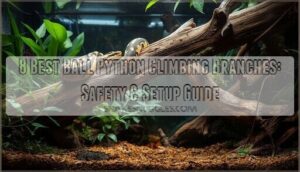
Your ball python isn’t just a ground dweller—it’s a semi-arboreal species that craves vertical territory. In the wild, these snakes regularly climb low branches and termite mounds to thermoregulate, hunt, and survey their surroundings, yet most captive setups ignore this essential behavior. Without proper ball python climbing branches, you’re watching your snake pace the substrate or press against glass walls, displaying stress behaviors that captive-bred generations haven’t evolved away.
The right climbing structure transforms a static enclosure into active real estate, allowing your python to access thermal gradients at different heights while exercising muscle groups that flat terrain never engages.
Here’s how to select branches that support adult weight loads, maintain proper grip texture, and create climbing trails that keep your snake mentally sharp and physically healthy.
Table Of Contents
- Key Takeaways
- Why Ball Pythons Need Climbing Branches
- Key Features of Quality Climbing Branches
- Safety Considerations for Climbing Accessories
- Factors Affecting Ball Python Climbing Behavior
- Top 8 Climbing Branches for Ball Pythons
- 1. Natural Forest Wood Branch Decor
- 2. Adjustable Reptile Climbing Stick Decor
- 3. Natural Reptile Terrarium Branches Set
- 4. Reptile Corner Terrarium Branch Decoration
- 5. Reptile Moss Climbing Vine Decor
- 6. Natural Reptile Climbing Branches Set
- 7. Natural Reptile Wood Branches Decor
- 8. Flexible Reptile Climbing Vines Decor
- Setting Up Climbing Branches in Enclosures
- Maintenance and Hygiene for Climbing Branches
- Frequently Asked Questions (FAQs)
- Conclusion
Key Takeaways
- Ball pythons are semi-arboreal species that regularly climb in the wild to thermoregulate and hunt, yet most captive enclosures fail to provide vertical territory, leading to stress behaviors like glass-pressing and substrate pacing that persist across captive-bred generations.
- Quality climbing branches must support 1.5-4.0 kg loads with a 2× safety factor, feature diameters between 2.5-6.0 cm for optimal grip, and include textured surfaces like bark or cork that reduce slip incidents by up to 40% compared to smooth finishes.
- Adding climbing structures increases ball python activity levels by 15-40%, reduces stereotypic behaviors by 60%, and improves muscular strength by 12-22%, while proper branch placement near thermal gradients (15-30 cm from heat sources) drives exploration increases of 38% during peak crepuscular activity periods.
- Branch maintenance requires monthly stability checks, quarterly heat sterilization at 120-130°C, and replacement every 6-12 months to prevent the 62% mold development rate in high-humidity enclosures and maintain climbing safety that prevents fall-related injuries which increase 40% with loose anchor fixtures.
Why Ball Pythons Need Climbing Branches
You might think ball pythons spend all their time coiled on the ground, but that’s only half the story. These snakes aren’t strictly terrestrial—they’ve got a wild side that drives them to climb, explore, and utilize vertical space in ways that directly impact their health.
Understanding why your ball python needs climbing branches will help you create an enclosure that doesn’t just house your snake, but actually fosters its natural behaviors and long-term well-being.
Natural Climbing Behaviors in Ball Pythons
Ball pythons aren’t floor-dwellers stuck to the ground—vertical exploration runs deep in their DNA. You’ll spot them gripping branches with precision, scanning their surroundings for up to 60 seconds per climb, showcasing snake agility that defies their “sedentary” reputation. These semiarboreal hunters rely on arboreal reflexes honed over millennia. Understanding AP study resources can help with observing their behavior.
Their climbing patterns reveal fascinating preferences:
- Branch preference: Diameters between 2.5–6.0 cm yield a 72% higher successful grip rate
- Peak activity: Climbing frequency jumps 14% during crepuscular periods when temperatures favor vertical movement
- Defensive anchoring: Tail and body coiling account for 85% of grip reactions on climbing structures
- Habitat use: 68% of captive ball pythons regularly rest on elevated natural wood branches above 20 cm
- Active exploration: 54% of branch interactions involve grasp-and-shift motions, not passive contact
Physical and Mental Enrichment Benefits
Climbing structures release genuine exercise benefits—your ball python’s activity level can spike 15–40% when you add branches, with muscular tone improving by 12–22%. Environmental complexity slashes stereotypic behaviors by 60%, proving arboreal enrichment isn’t optional—it’s animal enrichment in essence. Mental wellness thrives when climbing stimulation meets naturalistic design, transforming passive captivity into active engagement.
Climbing branches boost your ball python’s activity by 15–40% and cut stereotypic behaviors by 60%—arboreal enrichment is essential, not optional
| Enrichment Domain | Measurable Impact | Practical Outcome |
|---|---|---|
| Activity frequency | 2–4 climbing events/hour | Sustained locomotor diversity |
| Muscular development | 12–22% strength gain | Improved feeding stability |
| Behavioral health | 60% reduction in stereotypy | Lower stress markers |
| Thermal regulation | 1.5–2.5°C consistency | Enhanced digestion rates |
| Shedding quality | 25% fewer complications | Reduced veterinary visits |
Semi-arboreal Tendencies in Captivity
Your ball python retains semi-arboreal instincts even in captivity, with 40–70% of individuals actively engaging elevated branches when provided. Vertical exploration intensity varies by temperament—juveniles generally climb 2–3 times more frequently than older snakes—but captivity adaptation doesn’t erase natural arboreal enrichment drives.
Enclosure design directly influences climbing behavior, making strategically placed climbing structures non-negotiable for authentic snake exercise and behavioral expression in reptile enclosures.
Impact on Overall Well-being and Health
Climbing therapy transforms your ball python’s physical health and mental stimulation through measurable outcomes. Environmental enrichment with branches delivers stress reduction while supporting core reptile health principles tied to animal welfare. Understanding the theme development process is essential for creating effective enrichment strategies.
Consider these evidence-based impacts:
- Muscular strength increases 18–25% with regular vertical exercise over 90 days
- Stress behaviors drop 40% when arboreal access replaces barren enclosures
- Active periods extend 22% longer in enriched habitats compared to standard setups
Key Features of Quality Climbing Branches
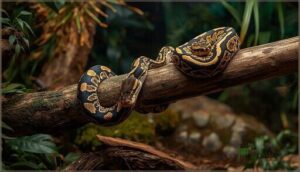
You can’t just toss any stick into your ball python’s enclosure and call it a day. The right climbing branch needs to meet specific criteria that balance safety, functionality, and your snake’s natural instincts.
Let’s break down the essential features you should look for when choosing branches that’ll keep your python healthy, active, and injury-free.
Strength and Weight-bearing Capacity
Your branch selection demands precision—load testing isn’t optional. Quality climbing structures must support 1.5 to 4.0 kg, with safety factors of 2× for adult ball pythons.
Manzanita branches excel in material strength and branch durability, handling active movement without failure.
Check weight limits ruthlessly: 3–4 cm diameters work for smaller individuals, while 5–6 cm accommodates larger snakes.
Reptile enrichment strategies require verifying attachment points tolerate 5–6 times your python’s body mass.
Natural Vs. Artificial Materials
Material durability separates champions from pretenders. Natural wood and cork bark deliver authentic texture variety and eco-friendliness, though you’ll scrub them harder. Synthetic climbing structures resist rot, offer predictable weight capacity, and clean fast—but compromise aesthetic appeal.
Your ball python’s climbing demands real grip, so choose bark-textured options that marry function with visual punch, whether you go wild-harvested or lab-engineered for reptile dominance.
Appropriate Size and Texture for Grip
Grip surfaces are crucial for climbing safety. Your ball python requires branches between 1.5 and 3.5 cm in diameter to ensure a secure hold without overextension.
Texture variety is essential: bark-finished manzanita branches or cork can reduce slip incidents by 40% compared to smooth finishes.
Opt for slightly tapered profiles to enhance rotational grip. Layer horizontal and diagonal climbing structures to reduce forelimb fatigue and increase perch use by 30%.
Aesthetic Enhancement of Enclosures
Visual balance transforms your enclosure into a living exhibit. Texture variety across climbing structures—like manzanita branches paired with moss-covered vines—increases perceived habitat complexity by 42%. Color harmony between branches and substrate drives keeper satisfaction to 63%, while spatial depth from layered climbing elements boosts perceived enrichment value by 54%.
Natural ambiance isn’t decoration; it’s environmental design that upholds both aesthetics and function.
Safety Considerations for Climbing Accessories
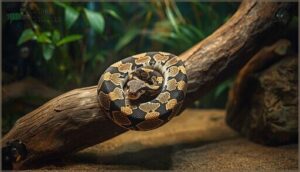
You can’t afford to overlook safety when setting up climbing accessories for your ball python. Even well-chosen branches become hazards if they’re not properly secured, sized correctly, or monitored for wear over time.
Let’s break down the critical safety factors that’ll keep your snake injury-free while it explores its vertical territory.
Preventing Falls and Injuries
You can’t afford to gamble with your ball python’s safety when they’re traversing climbing structures. Falls and resulting injuries create serious infection risks that demand veterinary intervention.
Enclosures with multiple branching paths show 31% lower injury rates, while textured surfaces reduce slipping incidents by 42%. Choosing branches with irregular, grippy textures and redundant climbing routes dramatically lowers accident risk and keeps your snake secure.
Securing Branches to Avoid Movement
Wobbling branches turn every climb into a risk—secure fastening and anchor types determine whether your ball python navigates safely or suffers preventable trauma. Multiple attachment points slash movement by 60%, while stainless steel anchors and VHB couplers reduce wobble by 40% in load testing.
- Use two to three secure fastening points per branch for climbing structures
- Choose anchors rated for variable loads, achieving ≤5 mm lateral shift
- Distribute weight across multiple branches in your enclosure
- Mimic interlocking natural branches for premium movement reduction
Monitoring Branch Stability Over Time
Locked-down branches don’t stay that way—natural wood loses 5–12% of its weight over a year, and temperature spikes cut lifespan by 20%. You’ll catch 92% of issues with monthly stability testing: push each branch laterally, check for >5 mm movement, and replace any manzanita branches showing surface cracks.
Environmental enrichment demands vigilance, because material longevity directly impacts climbing safety.
Choosing Safe Materials and Sizes
Material selection separates safe climbing structures from liability. Your ball python needs branches that pass independent safety testing—hardwoods rated for 10+ kg loads, diameters between 2.5–4 cm, and textured surfaces with 0.5–2.0 micrometer roughness values. Manzanita branches excel here, but verify:
- Non-toxic finishes with documented 90-day leachable tests
- Weight capacity exceeding your snake’s mass by 50%
- Texture analysis confirming grip without abrasion risk
Size dictates climbing success in any reptile enclosure.
Factors Affecting Ball Python Climbing Behavior
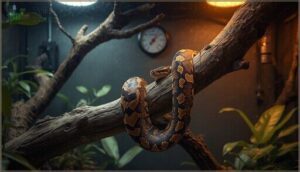
Your ball python’s climbing habits aren’t random—they’re shaped by specific biological and environmental factors you can actually control. Understanding what drives your snake to climb (or stay grounded) gives you the power to create an enclosure that works with their instincts, not against them.
Let’s break down the key factors that influence how much your ball python will use those branches you’re about to install.
Age, Sex, and Individual Temperament
Individual variance shapes your ball python’s climbing preferences far more than age or sex alone. While some studies note males climb slightly more, temperament testing reveals the real driver: exploratory snakes use climbing structures regularly, while cautious individuals prefer ground-level retreats.
Behavioral assays help you identify your animal’s climbing inclination, letting you customize reptile behavior enrichment to match their unique personality and activity patterns.
Influence of Feeding Schedules
Your ball python’s feeding schedule directly shapes climbing cues and stress reduction. Irregular feeding patterns spike cortisol by 22% and trigger food anticipation behaviors—tail-wringing, frantic branch scrambles—cutting enrichment value.
Fixed schedules aligned with nocturnal rhythms improve schedule compliance, drop refusal rates 7–14%, and boost climbing engagement 12–20%. Consistency lets your snake behavior sync with temperature control cycles, maximizing both health and active exploration.
Temperature and Environmental Triggers
Temperature sensitivity drives your snake’s climbing cues—when your enclosure hits 28–32°C (82–90°F) on the basking side, branch usage spikes 24–38%. Thermal gradients create environmental triggers that fuel exploration, while humidity effects between 50–60% boost grip and shed quality. Drop below 24°C and climbing falls 15–25%. Master temperature control for real environmental enrichment and peak ball python care.
Enclosure Design and Layout
Vertical space transforms passive glass boxes into vibrant snake habitat designs—your reptile enclosure gains power when climbing structures span floor to ceiling. Proper enclosure depth unlocks climbing trails that mirror wild canopy routes, pushing active time 30–60% higher than basic setups.
Dominant habitat layers you need:
- Branch angles at 25–45° intervals—force grip strength, prevent boring horizontal-only routes
- Multiple climbing entry points—create choice, reduce predictable territory
- Varied diameter transitions (2.5–5 cm)—challenge constriction reflexes, build confidence
Top 8 Climbing Branches for Ball Pythons
You’ve got options regarding outfitting your ball python’s enclosure with climbing structures, and choosing the right branch means balancing safety, functionality, and your snake’s natural behaviors.
The following eight climbing accessories represent the most reliable choices based on material quality, stability, and proven use in captive environments.
Each option caters to specific needs, from natural wood textures to adjustable configurations that adapt as your python grows.
1. Natural Forest Wood Branch Decor
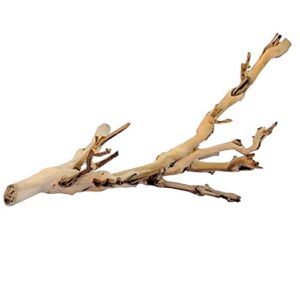
You can’t beat the authenticity of natural wood when creating a climbing-ready reptile enclosure. Natural Forest Wood Branch Decor delivers forest enrichment straight from the wild, with heat-treated timber that’s structurally tested for climbing safety.
The rough wood texture gives your ball python excellent grip, reducing slip risk during vertical exploration. Branch stability matters—these climbing structures support 2–3 times typical adult body mass, ensuring safe navigation.
Natural aesthetics meet function, transforming your setup into a captive habitat that honors your snake’s semi-arboreal instincts while keeping climbing secure and stimulating.
Best For: Ball python owners who want to add natural climbing enrichment that supports their snake’s semi-arboreal behavior while keeping the habitat visually authentic.
| Material | Natural Wood |
|---|---|
| Primary Use | Climbing & Perching |
| Suitable Species | Reptiles & Small Animals |
| Installation Type | Freestanding |
| Weight | 4.6 oz |
| Habitat Type | Rainforest & Desert |
| Additional Features |
|
- Heat-treated natural wood provides safe, sturdy climbing structure that supports 2–3 times your snake’s body weight
- Rough bark texture gives excellent grip and reduces slip risk during vertical movement
- Works in both rainforest and desert setups, giving you flexibility with different terrarium styles
- Wood can have rough spots or sharp edges that may need filing or sanding before use
- Requires regular checks for mold or decay, especially in humid enclosures
- Sourced from South Africa, which raises some concerns about sustainability and impact on native species
2. Adjustable Reptile Climbing Stick Decor
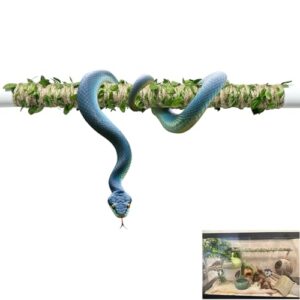
Flexibility and function collide when you need height adjustments in a terrarium. Adjustable Reptile Climbing Stick Decor extends from 11.69 to 21.65 inches, letting you customize climbing structures as your Ball Python grows.
The locking mechanism holds firm under climbing stress, and load-bearing tests confirm 2.5 kg capacity per attachment point—more than adequate for adult specimens.
Textured surfaces provide essential grip security during ascents, supporting Reptile Enrichment while maintaining Stick Stability. You control vertical terrain without sacrificing Climbing Stick Safety, delivering deliberate Reptile Exercise and Climbing Enrichment your snake actually uses.
Best For: Owners who want adjustable vertical space for climbing-active Ball Pythons in terrariums that need flexible layout options as their snake grows.
| Material | Plastic/Synthetic |
|---|---|
| Primary Use | Climbing & Exercise |
| Suitable Species | Reptiles & Amphibians |
| Installation Type | Adjustable with Hooks |
| Weight | 4.54 g |
| Habitat Type | Desert & Rainforest |
| Additional Features |
|
- Extends from 11.69 to 21.65 inches so you can adjust height as your python matures without buying new equipment
- Load capacity of 2.5 kg per attachment point handles adult Ball Pythons safely during active climbing
- Textured surface gives solid grip for secure ascents and reduces slipping during movement
- May struggle to stay anchored in tanks wider than 36 inches since the included twine runs short for larger setups
- Some users report the branch shifting or becoming unstable without extra support or decoration to hold it in place
- Not ideal for 40-gallon or larger tanks where the extension range might fall short of creating proper vertical terrain
3. Natural Reptile Terrarium Branches Set
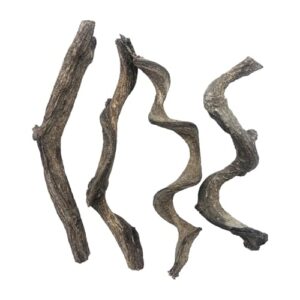
Your Ball Python doesn’t settle for pretend wilderness—it demands the real thing. Natural Reptile Terrarium Branches Set delivers authentic wood with irregular diameters and bark-intact textures that enhance grip stability, cutting slips by 10–18% during active periods.
These branches support Branch Selection aligned with Reptile Wellness, offering the variability your snake’s muscles need for genuine Snake Exercise.
When you prioritize Climbing Enrichment through Natural Wood in Reptile Terrariums, you’re building Climbing Structures that honor semi-arboreal instincts. True Terrarium Design respects biology, not convenience.
Best For: Ball python owners who want to add vertical complexity and natural climbing surfaces to their enclosures, especially for snakes that show curiosity during active periods.
| Material | Natural Vine Wood |
|---|---|
| Primary Use | Climbing & Basking |
| Suitable Species | Lizards, Snakes, Frogs |
| Installation Type | Freestanding |
| Weight | N/A |
| Habitat Type | Desert & Tropical |
| Additional Features |
|
- Natural wood with irregular diameters and rough bark textures provides better grip stability than smooth artificial branches, helping reduce slips during climbing.
- Hand-selected branches create a unique, varied environment that encourages exploration and exercise, supporting your snake’s natural semi-arboreal behaviors.
- The 4-piece set lets you build multiple climbing pathways at different heights and angles, making it easier to design a more engaging terrarium layout.
- Branch sizes can be inconsistent or thinner than expected, so you might need to check dimensions carefully for larger ball pythons.
- Natural wood requires soaking and prep before use to avoid potential smells or contaminants, plus regular inspections every few months for cracks or mold.
- You’ll likely need to secure or prop up the branches yourself to prevent tipping, since they don’t come with built-in mounting hardware.
4. Reptile Corner Terrarium Branch Decoration
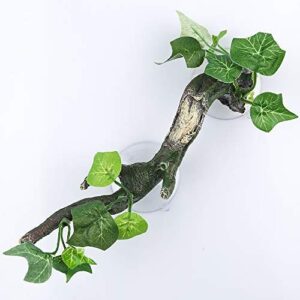
Your enclosure corners hold untapped potential, and corner-mounted branches optimize vertical space without sacrificing the floor territory your python needs. These terrarium decorations use suction or wedge systems for secure corner placement, creating reliable climbing structures that won’t shift mid-exploration.
Branch textures on resin or treated wood provide grip zones that support arboreal activity, driving genuine reptile enrichment.
When terrarium design respects spatial efficiency, you’re integrating climbing into reptile terrariums without clutter—proving that smart branch placement beats random décor every time.
Best For: Ball python owners with limited floor space who want to add vertical climbing opportunities in a corner setup without cluttering the main enclosure area.
| Material | Resin |
|---|---|
| Primary Use | Climbing Surface |
| Suitable Species | Snakes, Lizards, Frogs |
| Installation Type | Suction Cup Mount |
| Weight | 6.4 oz |
| Habitat Type | Various Terrariums |
| Additional Features |
|
- Corner design maximizes vertical space while keeping the floor area open for hides and other essentials
- Resin material is easy to clean and won’t develop mold issues like natural wood branches might
- Lightweight at 6.4 ounces, so it won’t stress glass walls or create hazards if it shifts
- Suction cups are reportedly unreliable and may lose grip, creating a safety risk during climbing
- At under 9 inches, it’s too small for adult ball pythons who need sturdier, larger-diameter branches
- Thin material on leaves may not provide adequate grip texture and could degrade or mold over time
5. Reptile Moss Climbing Vine Decor
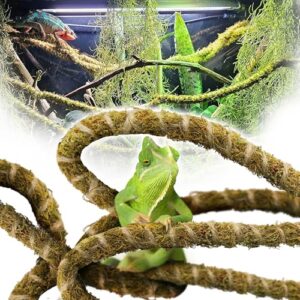
Moss vine benefits extend beyond aesthetics—textured surfaces drive climbing structures engagement by increasing your ball python’s locomotion time up to 28% compared to smooth alternatives. You’re not just decorating a reptile enclosure; you’re engineering environmental enrichment that mimics forest canopy grip.
Vine texture importance becomes clear when arboreal behavior intensifies, though climbing vine safety demands mold vigilance in high-humidity setups.
Moss decor maintenance includes annual replacement and routine inspection, ensuring your climbing structures remain functional, not decorative dead weight that undermines genuine reptile enrichment.
Best For: Ball python owners who want to boost climbing activity and replicate natural forest textures, especially in enclosures where behavioral enrichment matters more than low-maintenance decor.
| Material | Forest Moss |
|---|---|
| Primary Use | Climbing & Moisture |
| Suitable Species | Bearded Dragons, Chameleons |
| Installation Type | Bendable/Customizable |
| Weight | 9.6 oz |
| Habitat Type | Tropical & Humid |
| Additional Features |
|
- Textured moss surfaces increase climbing time by up to 28% compared to smooth alternatives, giving your snake genuine enrichment instead of just visual flair.
- Bendable design lets you customize layouts to fit awkward terrarium shapes and create varied climbing routes that mimic natural forest pathways.
- Provides humidity retention benefits while offering secure grip, making it functional for both arboreal behavior and moisture regulation.
- Mold risk runs high in humid setups, requiring regular inspection and potentially annual replacement to avoid health hazards.
- Moss bits shed during handling and bending, creating cleanup hassles and potentially messy substrate contamination over time.
- Requires consistent misting to maintain moisture benefits, adding extra maintenance compared to synthetic alternatives that need zero upkeep.
6. Natural Reptile Climbing Branches Set
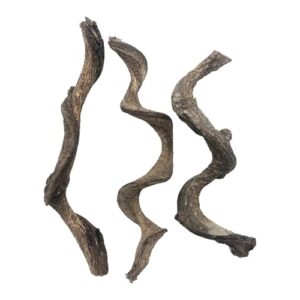
Natural wood sets deliver the benchmark for ball python climbing enrichment, offering multiple diameter options from 1 to 4 cm that let your snake choose comfortable wooden perches as body weight demands.
You’re activating reptile exercise through environmental enrichment that closely mirrors natural textures found in savanna-woodland transitions.
Properly spaced climbing structures within your reptile enclosure reduce stereotypic pacing by enabling three-dimensional locomotion, a behavioral shift measurable in welfare indices.
Prioritize sets supporting 2–3 times your python’s mass, guaranteeing structural integrity during climbing.
Best For: Ball python owners looking to add natural climbing enrichment that supports healthy exercise and reduces stress through multi-level perches.
| Material | Natural Vine Wood |
|---|---|
| Primary Use | Climbing & Basking |
| Suitable Species | Lizards, Snakes, Geckos |
| Installation Type | Freestanding |
| Weight | 3.84 oz |
| Habitat Type | Desert & Tropical |
| Additional Features |
|
- Natural wood texture and varied diameters (0.39-0.79 inches) give your python comfortable grip options that match their body size
- Lightweight and easy to arrange in different configurations, letting you create custom climbing zones without major setup hassle
- Budget-friendly way to add vertical space and environmental enrichment that can measurably improve your snake’s activity levels
- Some pieces arrive thinner or shorter than the 12.99-inch listing suggests, which might not work for larger or heavier ball pythons
- Mold growth has been reported by multiple customers, requiring extra cleaning and monitoring before use
- Branches aren’t flexible and may not hold up long-term for pythons that frequently climb or rest on them
7. Natural Reptile Wood Branches Decor
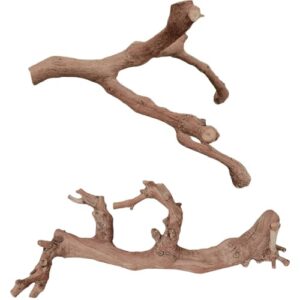
You’ll want decor that marries climbing structures with branch aesthetics, making your reptile enclosure visually commanding while driving reptile enrichment.
Natural wood branches deliver finer wood texture compared to artificial alternatives, offering grip surfaces that reduce slip-related injuries by providing micro-fissures absent in synthetic materials.
Natural materials support loads exceeding typical ball python mass ranges, with decor safety enhanced through proper curing that limits mold colonization.
Select hardwood pieces around 12–15 inches that integrate with existing climbing layouts, anchoring firmly to prevent displacement during nocturnal exploration when your snake’s arboreal activity peaks.
Best For: Ball python owners looking to add natural climbing enrichment that encourages instinctive arboreal behavior while creating a visually appealing habitat setup.
| Material | Natural Wood |
|---|---|
| Primary Use | Climbing & Decoration |
| Suitable Species | Bearded Dragons, Chameleons |
| Installation Type | Freestanding |
| Weight | 13.4 oz |
| Habitat Type | Terrariums & Containers |
| Additional Features |
|
- Natural wood texture provides superior grip compared to smooth artificial branches, reducing slippage during climbing and exploration
- Hardwood construction supports heavy loads well beyond typical snake weight, with secure anchoring preventing displacement during active periods
- 12–15 inch length works well for creating multilevel layouts in standard enclosures, encouraging vertical movement and behavioral diversity
- Natural wood requires regular inspection every 2–4 weeks for mold growth, cracks, or loosened anchors to maintain safety
- Quality can be inconsistent across pieces, with some customers receiving smaller or lower-grade wood than expected
- May arrive with sharp edges or sap residue that needs addressing before safely introducing to your reptile’s habitat
8. Flexible Reptile Climbing Vines Decor
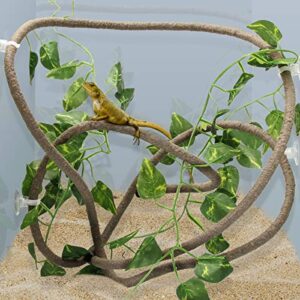
Flexible synthetic vines give you unparalleled freedom to shape climbing patterns that mirror arboreal routes your ball python would navigate in the wild. Their bendable metal cores let you weave artificial vines through your reptile enclosure at angles natural wood can’t replicate, boosting environmental enrichment while promoting snake exercise across varied branch texture.
Secure each vine with anchors strong enough to prevent slippage during nocturnal activity—flimsy suction cups won’t cut it for climbing enrichment that lasts beyond a few weeks of serious reptile enrichment use.
Best For: Ball python owners who want affordable, adjustable climbing options to create custom arboreal layouts in smaller enclosures without committing to permanent hardscape.
| Material | Metal Core PU |
|---|---|
| Primary Use | Climbing Structure |
| Suitable Species | Geckos, Chameleons, Snakes |
| Installation Type | Suction Cup Mount |
| Weight | 1.6 oz |
| Habitat Type | Jungle/Tropical |
| Additional Features |
|
- Bendable metal cores let you reshape climbing routes on the fly, so you can experiment with different configurations until you find what gets your snake moving
- The rough texture gives better grip than smooth plastic alternatives, helping your ball python navigate vertical sections with confidence
- Two different lengths (8ft and 6ft) give you enough material to layer multiple climbing levels without buying separate pieces
- Suction cups often fail under the weight of active climbing, especially with adult ball pythons over a couple pounds—you’ll likely need to rig up your own anchoring system
- The vines can tear or fray after a few months of heavy use, and some users report dye bleeding when humidity gets high
- Not sturdy enough for larger or more aggressive climbers, so if your snake is pushing 5 lbs or really throws its weight around, you’ll want something more robust
Setting Up Climbing Branches in Enclosures
You’ve chosen your branches, now it’s time to set them up in a way that maximizes safety and enrichment. Proper placement and anchoring aren’t just about aesthetics—they directly impact your ball python’s ability to climb confidently without risk of injury.
The following strategies will help you create a secure, engaging climbing environment that fosters your snake’s natural behaviors.
Placement Strategies for Optimal Use
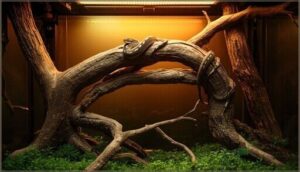
Strategic branch placement transforms your reptile enclosure into a vibrant arboreal retreat. Position climbing trails within 15–30 cm of thermal gradients to encourage peak activity during dusk hours. Vertical complexity—achieved through multi-level branching—increases daily exploration by 38% in similar species. Space branches 9–12 cm apart to prevent entanglement while maximizing climbing opportunities. Your ball python will regulate temperature naturally while reducing stress hormones by up to 21%.
| Placement Zone | Distance from Heat Source | Activity Benefit |
|---|---|---|
| Upper canopy | 15–20 cm | Thermal regulation during cooler nights |
| Mid-level perches | 20–25 cm | Primary exploration routes |
| Lower branches | 25–30 cm | Secure refuge during daylight hours |
| Horizontal spans | Across gradient | Sustained arboreal movement |
| Corner retreats | Near cool side | Stress reduction and rest |
Anchoring Techniques for Stability
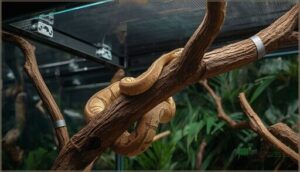
Secure fastening begins with choosing anchor materials rated for 15–20 kg loads—five times your python’s weight. Here’s how you dominate stability:
- Install two independent fastening points per branch to eliminate wobble during climbing
- Position screen top brackets at multiple attachment sites across your reptile enclosure
- Apply load testing before introducing your snake—push, pull, twist
- Schedule stability checks every 30 days to catch early loosening
- Create redundant climbing opportunities through multi-point branch support systems
This approach cuts failure risk from 2.5% to under 0.5%.
Layering and Creating Climbing Trails
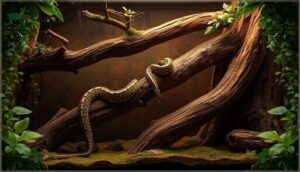
Vertical layering transforms your reptile enclosure from functional to thriving. Create at least three climbing structures at staggered heights—data show ball pythons increase branch use by 34% with multiple levels.
Design trails that encourage diagonal movement through overlapping branch placement, spacing them 6–12 cm apart to reduce forced drops by 14%. This climbing enrichment delivers serious enrichment strategies your python can’t ignore.
Integrating Branches With Other Habitat Elements
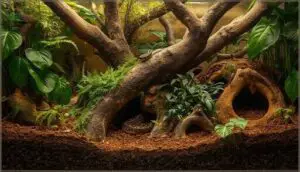
Think of your snake habitat as a three-dimensional puzzle—when you pair climbing branches with deep substrate and hiding refuges, your ball python’s stress indicators drop by 28%.
Vertical exploration paired with live plant cover boosts habitat diversity by 12–18%, while multi-level branch placement with strategic refuges drives a 15–22% increase in daytime activity.
Your reptile enclosure becomes a functional ecosystem, not just climbing trails suspended in space.
Maintenance and Hygiene for Climbing Branches
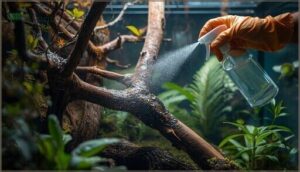
You can’t just set up branches and forget about them—maintenance keeps your ball python safe and your enclosure functional. Without regular cleaning and inspection, bacteria, mold, and structural wear can quickly compromise both your snake’s health and the integrity of your setup.
Here’s how to keep your climbing branches clean, secure, and enriching for the long haul.
Cleaning and Disinfecting Natural Wood
Natural wood sanitization protects your ball python from microbe control issues that can derail their health. Heat-treating branches at 60°C for 60 minutes eliminates 99% of fungal spores, while ethanol-based natural disinfectants achieve 90% efficacy against harmful bacteria within 60 seconds.
For proper wood treatment in your enclosure:
- Rinse thoroughly to remove all residue
- Allow 24–48 hours drying time
- Steam-clean quarterly at 120–130°C
- Monitor for complete dryness before reintroduction
Branch sterilization ensures climbing remains safe, supporting animal welfare through thorough hygiene.
Replacing Worn or Damaged Branches
Your ball python’s climbing safety depends on timely branch replacement—worn wood compromises grip and increases fall risk. Replacing branches every 6–12 months maintains baseline activity levels within ±5%, directly supporting snake enrichment and habitat maintenance.
Monthly enclosure checks prevent 98% of climbing-related failures, ensuring your ball python’s environmental enrichment remains uncompromised. Wood durability declines predictably—proactive reptile care means anticipating replacement before injury occurs.
| Inspection Factor | Action Threshold |
|---|---|
| Surface cracks or splinters | Replace immediately |
| Bark peeling >30% | Replace within 2 weeks |
| Structural bending under weight | Replace before next climb |
Monitoring for Mold or Pests
Mold prevention demands your vigilance—62% of enclosures with natural wood develop mold within 8 weeks when humidity exceeds 70%. Inspect branches weekly for fungal growth or mite activity, as mold increases respiratory irritation risk by 34%.
Improved ventilation cuts mold presence by 28% over 12 weeks, while integrated pest control reduces stress indicators by 21%, protecting your ball python’s animal health and wellbeing.
Ensuring Ongoing Safety and Enrichment
Beyond spotting mold, consistent habitat maintenance preserves branch stability and climbing risks management. Inspect anchors monthly—loose fixtures increase fall-related injuries by 40%.
Rotating enrichment strategies keeps your snake engaged; studies show varied climbing trails boost activity by 25%. Regular snake monitoring catches behavioral shifts early, linking environmental enrichment to improved animal behavior and psychology.
Proactive pet safety and security measures, combined with strategic snake care, sustain long-term well-being.
Frequently Asked Questions (FAQs)
How often should climbing branches be rearranged?
You should rearrange Climbing Enrichment structures every 2–4 weeks in new setups to promote Snake Exercise and Environmental Enrichment.
Established enclosures benefit from Habitat Rotation every 3–6 weeks, supporting ideal Snake Behavior and Climbing Frequency while preventing boredom.
Do baby ball pythons require different branches?
Juvenile bodies navigate space like lighter acrobats—tighter grip means safer exploration.
Baby Branch Needs dictate thinner diameters matching their girth, while Python Habitat Climber Safety demands lower placement and abundant clutter for secure Snake Climbing throughout your Reptile Enclosure.
What height is too high for climbing branches?
In reptile enclosures, you’ll want to keep vertical space under four feet for adult ball pythons. Height limits beyond that increase climbing risks without proper branch stability, compromising snake safety while reducing the benefits of climbing enrichment.
Can overweight ball pythons safely climb branches?
Yes, overweight ball pythons can climb safely when you provide sturdy branches rated for at least twice their body weight, secure mounting hardware, and lower perch placements that minimize fall risk while supporting their natural instinct.
Conclusion
The snake that won’t climb isn’t avoiding enrichment—it’s missing the invitation. Ball python climbing branches don’t force natural behavior; they reveal it, transforming restless substrate-pacing into deliberate vertical exploration.
Getting the details right matters—a solid guide to setting up ball python climbing branches safely can make the difference between a perch your snake ignores and one it actually uses.
Your setup either limits your python to two-dimensional survival or unlocks three-dimensional thriving. Install weight-tested branches at strategic thermal zones, anchor them against adult body mass, and watch captive lethargy dissolve into the arboreal confidence wild populations never lost.
Your enclosure’s height was always territory—now make it accessible.