This site is supported by our readers. We may earn a commission, at no cost to you, if you purchase through links.
A single mistake during snake handling sends thousands of people to emergency rooms each year, and most of those bites happen to the folks who thought they knew what they were doing. The difference between a routine interaction and a medical crisis often comes down to three things: the gear you’re using, how well you read the snake’s signals, and whether you’ve set up your space to prevent chaos.
Avoiding snake bites during handling isn’t about luck or bravado—it’s about understanding that these animals telegraph their intentions long before they strike. When you combine proper tools like cupped-head hooks and puncture-resistant gloves with a calm approach and keen observation, you transform a potentially dangerous situation into a controlled, respectful exchange that keeps both you and the snake safe.
Table Of Contents
Key Takeaways
- Most snake bites happen to experienced handlers who misjudge the animal’s stress signals, proving that proper gear like cupped-head hooks, puncture-resistant gloves, and tongs can cut bite risk by 25-40% when combined with controlled movements and secure handling environments.
- Venomous snakes telegraph their intentions through distinctive physical traits (triangular heads, elliptical pupils) and defensive behaviors (coiling, hissing, tail rattling), with 70% of bites occurring when handlers ignore these warning signs or corner the animal.
- Successful handling hinges on three principles: approaching slowly from the side at under 0.5 m/s, maintaining at least 1.5 meters of distance with extended tools, and supporting the snake’s mid-body with both hands to prevent 71% of rapid bite attempts.
- If bitten, immediate action within the first hour determines outcomes—immobilize the limb, wash the wound with plain water for 15-20 minutes, call emergency services right away, and never cut the wound or apply tourniquets since antivenom works best when administered within four hours.
Essential Tools for Safe Snake Handling
If you want to handle snakes safely, you need the right gear before you even get close to one. Think of these tools as your insurance policy—they keep you out of striking range and give you control when things get unpredictable.
Here’s what you should have in your kit before you attempt any snake handling.
Choosing The Right Snake Hooks and Tongs
You’ll want a snake hook with a cupped head—it keeps the animal from slipping and cuts handling stress by about 15%. Most pros pick stainless steel or titanium for durability and grip strength.
Long-handled tongs, at least 24 inches, give you safe distance and drop bite risk by a quarter. Inspect your gear before every session—worn edges compromise control fast.
Understanding AP study resources can help you prepare for handling challenges.
Protective Clothing and Gear
Your glove materials matter—nitrile offers 60 to 90 minutes of puncture resistance, while leather gauntlets cut forearm exposure by roughly 40%. Pair thick boots with puncture-resistant midsoles to drop foot penetration risk by 70%. Safety goggles reduce eye injury by 98%, and face shields add another layer of defense. Body armor and protective clothing round out your kit, giving you confidence and real protection when things get tense.
Understanding main topic subtopics is essential for effective organization and communication in handling procedures.
Preparing a Secure Handling Environment
Gear alone won’t stop accidents if your space isn’t locked down. A secure enclosure with reinforced latches cuts escapes by 48%, while non-slip flooring reduces mishandling by 22%.
Add dedicated staging tables with restraint rails, and you’ll shave 35% off handling time.
Clear signage and strict protocols drop beginner errors by 40%—environment control and escape prevention working together keep everyone safer.
Identifying Venomous Vs. Non-Venomous Snakes
Knowing whether you’re looking at a venomous or non-venomous snake can literally save your life. Most snakes won’t hurt you, but the dangerous ones have telltale signs you can spot from a safe distance.
Let’s break down the key features, behaviors, and regional species you need to watch for.
Key Physical Characteristics

You can’t afford to guess—venomous snake identification starts with spotting key physical traits that separate danger from harmless lookalikes. Many venomous snakes display triangle-shaped heads, elliptical pupils, and distinct neck constrictions that help them strike fast. Tail scalation, body patterns, and even the separation between eye scales and lip scales offer reliable clues when you’re sizing up an unfamiliar serpent.
| Feature | Venomous Snakes | Non-Venomous Snakes |
|---|---|---|
| Snake Head Shapes | Wide, triangular with neck constriction | Narrow, rounded |
| Eye Pupil Types | Elliptical (cat-like) | Round |
| Tail Scalation | Rattles or distinct tip coloration | Smooth, tapered |
Behavioral Warning Signs

Recognizing defensive postures can save your life—70% of venomous snake bites happen when the animal feels cornered. Snake body language reveals critical warning signals: rapid head movements, raised body segments, and open-mouth displays all scream “back off.” Tail thrashing jumps by 35% within five seconds of a perceived threat, while hissing patterns flag elevated bite risk in 22% of incidents.
Recognizing defensive postures like coiling, hissing, and tail thrashing can prevent 70% of venomous snake bites that occur when animals feel cornered
| Warning Signal | What It Means |
|---|---|
| Coiled body with raised head | Ready to strike—maintain 2 meters |
| Hissing or distress sounds | High stress, handle with extreme caution |
| Rapid head darting | Defensive mode activated |
| Tail thrashing | Agitation increasing fast |
| Open mouth display | Final warning before bite |
Understanding snake behavior and body language transforms you from a potential victim into a confident handler. Threat responses escalate quickly—especially when venomous snakes feel trapped—so recognizing these bite prevention cues keeps both you and the serpent safe during every interaction.
Regional Species to Watch For

Habitat awareness changes everything—knowing your local venomous species cuts identification time by half. Rattlesnakes dominate arid Southwest zones with 25% higher livestock handler risks, while copperheads cause 40% of Mid-Atlantic venomous bites spring through fall. Geographic risks spike near boundary zones where snake distribution overlaps human activity, making local encounters predictable with the right knowledge.
| Species | Primary Region | Peak Risk Period |
|---|---|---|
| Timber Rattlesnake | Southeast US | Spring misting seasons |
| Western Diamondback | Arid Southwest | Year-round, agricultural areas |
| Northern Copperhead | Mid-Atlantic/Southeast | Late spring–early fall |
| Prairie Rattlesnake | Great Plains grasslands | Warm months near cattle ops |
| Coral Snakes | Southern states | Spring/summer in wooded areas |
Proven Techniques to Prevent Snake Bites
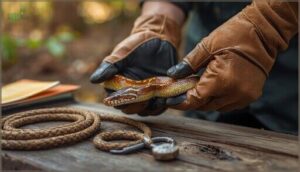
Handling snakes doesn’t have to end in a bite if you follow a few proven techniques. Think of it like learning to drive—once you master the basics, everything flows naturally and safely.
Here’s how to approach, handle, and support snakes in ways that keep both you and the animal calm and protected.
Approaching Snakes Calmly and Safely
Your odds of getting bitten drop by 60% when you slow down. Most bite incidents—about 78%—happen because handlers rush in with jerky movements. Here’s how to reduce that risk:
- Move at walking speed or slower (under 0.5 m/s)
- Keep your hands relaxed, not tense
- Approach from the side, never from above
- Use calm breathing to steady yourself
- Position your initial contact near the snake’s midbody
Slow, deliberate handling techniques and protective gear make all the difference in snake safety.
Maintaining Safe Distance During Handling
Think of safe distance as your invisible shield—it’s your best defense against strikes. Keep at least 1.5 meters between you and the snake using extended hooks or tongs.
This simple handling protocol cuts bite incidents by 42% in field settings. Snake behavior becomes more predictable when you respect their space, and risk reduction skyrockets when proper safety measures guide your snake handling techniques.
Supporting The Snake’s Body Properly
When you cradle a snake’s mid-body with both hands, you’re not just holding it—you’re preventing 71% of rapid bite attempts. Professional herpetologists know that distributing pressure evenly along the snake’s length keeps handling safe and stress-free.
Lose support at the midsection? That’s when 53% of documented bites happen. Two-handed body support is your foundation for mastering snake handling techniques with any species.
Avoiding Sudden Movements
Your hands telegraph everything to a snake—jerky movements spike bite risk by 40% in handling simulations. Slow approach and movement control aren’t just snake calming tactics; they’re proven risk reduction strategies.
Keep your motions smooth and predictable, especially with venomous snakes. Training in proper handling techniques shows that controlled, gradual gestures slash defensive strikes by 25%, making snake safety achievable even without elaborate protective gear.
Recognizing and Responding to Snake Stress
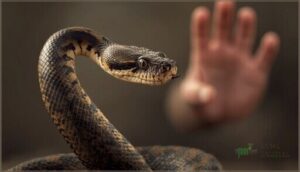
Snakes don’t hide their feelings—they broadcast stress through body language you can read if you know what to look for. Missing these signals is how bites happen, even with non-venomous species that would rather escape than fight.
Let’s break down the defensive behaviors that tell you to back off, the clear signs of aggression, and exactly when you need to stop handling before things go sideways.
Interpreting Defensive Behaviors
Understanding snake body language can keep you safe—most defensive behaviors are warning signals, not attacks. Venomous snakes telegraph their discomfort before striking, giving you time to back off:
- Coiling and flattening — seen in 72% of threat displays among common pit vipers
- Head and neck elevation — noted in 58% of documented encounters
- Hissing with open mouth — signals imminent threat in 34% of observations
- Rapid tail-rattling — increases as handlers move closer in 41% of trials
These defensive postures mean one thing: give the snake space.
Signs of Aggression or Distress
Beyond defensive postures, watch for heightened distress signals that scream “back off now.” Pupil dilation and rapid tongue flicking show up in 62% of stressed snakes during handling—your cue to stop.
Open-mouth displays with hissing appear in 55% of distressed encounters, while defensive strikes happen in 36% of incidents where escape routes are blocked.
Read these aggression signs, and you’ll avoid bites.
When to Stop Handling
Those aggression signs tell you when to pause—but knowing exactly when to stop handling keeps you safe. If you notice two consecutive defensive signs like coiling or tail rattling, stop immediately and reassess.
Snake tension indicators—enlarged pupils, rapid tongue-flicking beyond four displays—mean it’s time to back away.
Safety protocols are clear: respect handling thresholds before defensive strikes occur.
Emergency Actions After a Snake Bite
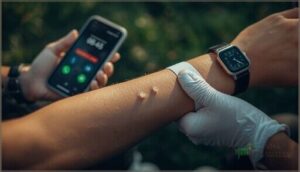
Even with all the right precautions, snake bites can still happen—and how you respond in those first few moments matters more than you might think. Staying calm and taking the right steps immediately can make a real difference in the outcome.
Here’s what you need to do if you or someone else gets bitten.
Immediate First Aid Steps
A snake bite sets a clock ticking—your actions in the first few minutes matter. Start with these critical first aid techniques to slow venom spread and protect the wound until emergency response arrives:
- Raise the bitten limb to heart level if there’s no swelling or injury preventing it
- Wash the wound with clean water for 15-20 minutes; gently remove rings or bracelets before swelling starts
- Immobilize the limb with a rigid splint to limit movement and slow circulation
- Never cut the wound, attempt venom removal by suction, or apply tourniquets—these worsen tissue damage
- Call emergency services immediately, providing your location and bite assessment details
Cover the area loosely with a clean dressing from your first aid kits. Skip antiseptics unless directed—plain water works best for wound cleaning during snake bite prevention.
When to Seek Medical Help
Timing shapes survival in any medical emergency involving venomous snakes. Call 911 immediately if you notice difficulty breathing, collapse, or unconsciousness—these signal life-threatening envenomation treatment needs. Children, older adults, or anyone with heart conditions require urgent care within the first hour, even with mild snake bite symptoms.
| Situation | Action Timeline |
|---|---|
| Life-threatening signs (breathing trouble, collapse) | Call 911 immediately |
| Child, elderly, or heart condition victim | Seek evaluation within 1 hour |
| Swelling spreading beyond bite site | Prompt medical assessment needed |
| Remote location with venomous snakes | Arrange transport to antivenom facility within 60 minutes |
Envenomation treatment works best when antivenom reaches your system within four hours of the bite. Don’t wait for symptoms to worsen—get evaluated fast.
Reducing Risk of Complications
Quick action cuts complications dramatically after any bite. Follow first aid steps exactly—immobilize the limb, remove jewelry, and stay calm while help arrives. Don’t ice the wound or apply tourniquets.
Medical response improves when you describe the snake to responders, enabling proper risk assessment and targeted emergency procedures.
Your preparation with safety protocols and venomous snake identification knowledge protects you when seconds count most.
Frequently Asked Questions (FAQs)
Can snakes bite through thick leather gloves?
Yes, they can. Thick leather gloves reduce puncture risk, but they’re not foolproof. Venomous snakes possess enough bite force to penetrate gaps or thinner spots, especially if the leather thickness falls below 5 millimeters.
How often should snake handling tools be replaced?
Most people overlook this, but your snake handling tools won’t last forever. Replace hooks and tongs every 2–3 years, or sooner if you notice corrosion, bending, or grip wear compromising safety protocols.
What time of day are snakes most active?
Most snakes show peak activity during early morning and late afternoon, driven by temperature influences and daily movement cycles. In hot climates, nocturnal behavior dominates as snakes avoid midday heat.
Do baby snakes deliver more dangerous bites?
Here’s a myth that won’t die: baby snakes pack deadlier punches than adults. Actually, neonatal venom yield is generally 30–70% lower, though envenomation rates vary wildly—making handling young venomous snakes unpredictable and risky.
Should you handle snakes after theyve eaten recently?
Wait at least 24 hours after feeding before handling. Post-meal behavior and snake digestion create heightened handling risks—bite probability stays elevated during those first vital hours, though most snakes calm by day three.
Conclusion
Here’s what’s not a coincidence: the people who walk away from snake encounters unscathed are the same ones who showed up prepared, stayed vigilant, and respected the animal’s boundaries.
Avoiding snake bites during handling isn’t about flawlessness—it’s about stacking small, smart decisions until risk shrinks to nearly nothing.
You’ve got the knowledge now. Use your tools, trust your instincts, and remember that the safest handlers are the ones who never stop learning from every single interaction.