This site is supported by our readers. We may earn a commission, at no cost to you, if you purchase through links.

Your ball python’s hunting instincts kick in the moment prey appears—pupils dilate, muscles coil, strike reflex primed. But choosing the best ball python prey isn’t just about triggering that response. It’s about matching nutritional needs to life stage, minimizing injury risk, and creating a feeding routine that keeps your snake healthy for decades.
Rats offer dense calories for growing snakes, while mice work better for smaller individuals prone to weight gain. Frozen-thawed prey eliminates bite wounds and parasites, though some keepers swear by live feeding for reluctant eaters.
Getting the size, type, and preparation right means the difference between a thriving python and one struggling with obesity, malnutrition, or feeding strikes.
Table Of Contents
- Key Takeaways
- Best Prey Types for Ball Pythons
- Choosing Prey Size for Ball Pythons
- Live Vs. Frozen-Thawed Prey Options
- How to Prepare and Offer Prey
- Feeding Frequency and Monitoring Health
- Unsafe and Inappropriate Foods to Avoid
- Top 3 Products for Ball Python Feeding
- Frequently Asked Questions (FAQs)
- Conclusion
Key Takeaways
- Rats pack more calories for growing snakes while mice work better for smaller pythons or weight control, with prey size matching 1 to 1.5 times your snake’s girth behind the head.
- Frozen-thawed prey eliminates bite wounds and parasite risks that live feeding creates, though you’ll need to thaw in the fridge and warm to 90–105°F to trigger strikes.
- Hatchlings eat every 5 days while adults need feeding only every 2–6 weeks, with overfeeding showing up as rapid girth increases and underfeeding causing weight loss and lethargy.
- Avoid fish, amphibians, oversized rodents, and spoiled prey—whole frozen-thawed mice or rats cover all nutritional needs without supplements in most cases.
Best Prey Types for Ball Pythons
Choosing the right prey for your ball python isn’t complicated, but some options work better than others. Rats and mice dominate the menu for good reason—they’re nutritious, easy to source, and match what these snakes hunt in the wild.
Let’s break down your main prey choices and what makes each one worth considering.
Mice Vs. Rats as Primary Prey
You’ll face a classic choice: mice or rats. Both work well, but rats pack more calories—ideal once your snake reaches about 500 grams or needs faster growth. Mice suit smaller ball pythons and help prevent overconditioning when you’re controlling feeding costs.
Match prey size guidelines to your snake’s girth, not length. Think of it like tailoring nutrition needs: the right prey item comparison ensures your snake thrives without the risk of obesity.
Proper research papers require clear science writing.
Day-Old Chicks and Alternative Options
Day-old chicks offer higher moisture and different nutrition than rodents, but availability varies by region. Some juveniles accept chicks when rodent feeding aversion develops—handy for picky eaters.
However, prey sanitation matters more with chicks due to bacterial risks, and digestive health can shift with alternative prey. Monitor your snake’s weight closely and consult a reptile vet before cycling between prey types regularly.
Understanding the main topic and its subtopic branches can help in organizing complex information about Ball Python prey.
Nutritional Value of Common Prey
While chicks work in a pinch, understanding protein content and fat analysis helps you fine-tune your snake’s dietary needs. Mice deliver 14–18% protein and moderate fat, while rats pack similar protein with richer calories—ideal for growing ball pythons.
Nutrient balance comes from varying prey size and type, so mix rodent ages occasionally. Proper reptile nutrition means matching snake food to your python’s body condition and growth stage.
Choosing Prey Size for Ball Pythons
Getting prey size right is one of those feeding fundamentals that makes all the difference for your ball python’s health. Too small and they’re left hungry—too large and you’re risking regurgitation or worse.
Let’s break down how to match prey to your snake’s girth, adjust portions as they grow, and avoid the most common sizing mistakes.
Matching Prey Size to Snake’s Girth
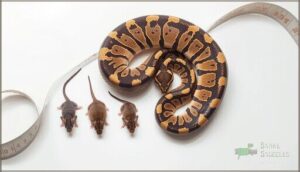
Getting prey size right is like finding the perfect shoe—it needs to fit just right. You’ll want to match prey to about 1 to 1.5 times your ball python’s widest girth.
Here’s your feeding ratio optimization checklist:
- Measure your snake’s girth right behind the head using a soft tape
- Select rodents that create a slight visible bulge when swallowed
- Track measurements regularly to prevent regurgitation and maintain digestion efficiency
This approach ensures proper snake nutrition without overloading their system.
Prey Progression by Ball Python Age

Your ball python’s prey progression follows its growth patterns—think of it as upgrading meal sizes as your snake matures. Hatchlings start with pinky mice, while juveniles around 6–12 months can handle small rats based on age factors and girth.
Proper prey selection promotes steady weight gain and meets nutrient needs, ensuring your feeding schedule aligns with snake nutrition requirements and safe prey progression for ideal ball python health.
Risks of Incorrect Prey Sizing

Precision matters—prey size errors trigger feeding complications that put your snake at risk. Oversized rodents cause regurgitation risks and potential snake injury during swallowing, while undersized snake food leads to nutrient deficiencies and poor growth. Both extremes disrupt your feeding schedule and mask health problems.
Matching prey size to your ball python’s girth protects digestive health and ensures proper ball python care.
Live Vs. Frozen-Thawed Prey Options

One of the biggest decisions you’ll make as a ball python owner is whether to feed live or frozen-thawed prey. Both options come with real trade-offs—safety concerns, convenience, and your snake’s feeding response all play a role.
Let’s break down what each choice means for you and your python so you can make the best call for your situation.
Benefits and Risks of Live Prey
Live prey can fire up your ball python’s hunting instincts and coax reluctant eaters—but it comes with real stakes. Rodents fight back, causing bites or scratches that threaten your snake’s health. They also carry parasites and demand your full attention during feeding. Here’s what you need to weigh before offering live prey:
| Live Prey Ethics | Feeding Safety Risks | Prey Handling Requirements |
|---|---|---|
| Stimulates natural hunting behavior | Higher injury risk from defensive bites | Requires constant supervision |
| May improve feeding response in picky snakes | Potential parasite transmission | Use feeding tongs to minimize contact |
| Provides movement-based enrichment | Stress from repeated failed strikes | Remove prey immediately if unsafe |
| Can aid transitional feeding periods | Escaped prey damages property | Source from quarantined suppliers |
| Mimics wild foraging conditions | Requires environmental containment | Track weight and post-feeding health |
Live feeding risks often outweigh the benefits for snake nutrition and long-term safety.
Advantages of Frozen-Thawed Prey
Frozen-thawed rodents offer pathogen reduction, consistent prey size, and zero bite risk, ensuring your snake’s safety while providing feeding convenience. You can store them for months, thaw them overnight in the fridge for bacterial control, and warm them in water to trigger strikes. Here’s why frozen-thawed beats live every time:
| Snake Safety Benefits | Feeding Convenience Gains | Nutrient Retention Quality |
|---|---|---|
| Eliminates defensive bite injuries | Longer shelf life (6–12 months) | Preserves vitamins when thawed properly |
| Reduces parasite transmission risk | Pre-sized for consistent feeding | Whole prey delivers complete nutrition |
| No escaped rodents in your home | No last-minute pet store runs | Thawing maintains digestive compatibility |
Frozen-thawed prey simplifies snake food management while protecting your ball python’s health through advanced feeding techniques.
How to Safely Transition to Frozen
Switching your ball python from live to frozen prey demands patience—think of it like teaching a new skill rather than flipping a switch. Start with prey matching your snake’s girth, then thaw rodents overnight in the fridge before warming them in water to mouth temperature. This gradual approach prevents prey refusal and feeding stress while building consistent frozen-thawed acceptance.
| Safe Shift Strategy | Why It Works |
|---|---|
| Match frozen prey size to current live size | Familiar dimensions reduce refusal |
| Thaw in fridge, warm gently in water | Mimics natural texture and temperature |
| Maintain regular feeding schedule | Consistency minimizes stress responses |
How to Prepare and Offer Prey
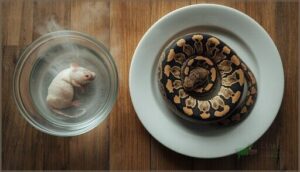
Preparing frozen prey correctly isn’t complicated, but doing it wrong can make your ball python sick or refuse to eat. The process comes down to three key steps: thawing safely, warming to the right temperature, and keeping your snake calm during mealtime.
Let’s walk through each one so you can feed with confidence.
Safe Thawing Techniques for Frozen Prey
Proper thawing methods protect your ball python from bacterial contamination and digestive upset. Follow these safe handling steps when preparing frozen-thawed snake food:
- Place frozen prey on a plate in your refrigerator at 39°F for 12–24 hours to guarantee gradual, even defrosting.
- Keep thawed prey separate from other foods to prevent cross-contamination during storage.
- Use dedicated tongs when handling prey—never re-freeze items once they’ve thawed.
- Inspect prey for off odors or unusual textures before offering; discard anything questionable.
- Wash your hands before and after each feeding to maintain proper hygiene.
These temperature control practices guarantee prey size and quality remain consistent while minimizing health risks.
Warming Prey to Optimal Temperature
Once you’ve thawed your frozen rodents safely, warm them to 90–105°F (32–40°C) for effective thermal stimulation. Submerge the prey in warm water until its body—not just the tip—reaches this ideal warming range.
Heat management matters because ball pythons rely on infrared detection to trigger strikes. Check temperature control with your fingers; prey should feel warm but never scorching.
This simple snake feeding technique dramatically improves frozen-thawed acceptance rates.
Reducing Stress During Feeding
Beyond temperature, your feeding environment and presentation style directly impact stress levels and strike response. Ball pythons read their surroundings carefully—so you should too.
- Offer prey in a quiet, low-distraction area away from vibrations or sudden movements
- Maintain consistent feeding routines aligned with your snake’s age and feeding schedule
- Watch for stress signals like tail-waving or reluctance to strike after presentation
- Use appropriately sized prey to minimize struggle and guarantee smooth snake acclimation
- Keep the feeding surface clean and scent-free to encourage natural feeding behavior
Feeding Frequency and Monitoring Health

Getting your feeding schedule right is just as important as choosing the right prey. Too much food leads to obesity and health issues, while too little stunts growth and weakens your snake’s immune system.
Let’s break down how often to feed your ball python and what signs tell you they’re thriving.
Feeding Schedules by Age and Size
Generally, you’ll feed your ball python based on where it falls in its growth stages—hatchlings eat every 5 days, juveniles around 7–14 days depending on weight, and adults every 2–6 weeks.
A feeding chart helps track prey size and frequency as your snake moves through size progression. Age factors matter, but individual nutrient needs and body condition guide the best feeding schedule.
Recognizing Overfeeding or Underfeeding
Knowing your snake’s healthy weight and growth rate is half the battle—feeding issues often show up as sudden spikes or drops. On the flip side, lethargy and weight loss signal underfeeding. Regular weight monitoring and matching prey size to body condition keeps nutrition balance on track.
If your ball python’s girth increases faster than expected or you see frequent regurgitation, you’re likely overfeeding.
Tracking Weight and Eating Habits
Weekly weight tracking on a digital scale gives you hard data on growth rates and feeding cycles. Log each measurement and compare it to your snake’s baseline—hatchlings might gain 5–15% per week, while adults plateau.
If your ball python refuses prey for two consecutive feeding cycles or drops weight steadily, reassess prey size, nutrition, and health monitoring protocols immediately.
Unsafe and Inappropriate Foods to Avoid

Your ball python’s diet is surprisingly simple—but it’s easy to mess up if you stray from whole prey items. Offering the wrong foods can lead to serious nutritional deficiencies, digestive problems, or even life-threatening blockages.
Let’s break down what you should never feed your snake and why these choices can backfire fast.
Foods Ball Pythons Should Never Eat
Your ball python’s diet isn’t as flexible as you might think. Never feed avian prey like birds or quail—they can transmit disease and lack proper calcium balance. Skip high fat foods, spoiled meat, and contaminated prey that harbor dangerous pathogens.
Diseased rodents or toxic prey items will disrupt your snake’s nutrition and feeding habits, potentially causing serious digestive problems or infections.
Dangers of Improper Prey Choices
Poor choices trigger a cascade of health complications your snake can’t afford. Prey injury risk skyrockets with oversized rodents—causing regurgitation, snake stress, and feeding refusals that spiral into nutrient deficiencies.
Wrong prey size or spoiled frozen-thawed snake food disrupts nutrition, masks weight changes, and makes detecting metabolic problems nearly impossible.
Every meal either builds your ball python’s health or quietly undermines it.
Every meal you offer your ball python either strengthens its health or slowly breaks it down
Recognizing Toxic or Harmful Prey
Toxic prey signs—unusual odors, discoloration, or slimy texture—warn you before feeding. Prey contamination and bacterial risks multiply when snake food sits too long or thaws improperly, threatening your python’s health and nutrition.
Spoilage detection starts with your senses: if it smells off or looks questionable, toss it. Prey screening and monitoring proper prey size protect against hidden dangers no reptile should face.
Top 3 Products for Ball Python Feeding
Having the right tools on hand makes feeding your ball python safer and more efficient. A reliable scale, quality water dish, and vitamin supplement can help you monitor health, maintain hydration, and support overall nutrition.
Here are three products that’ll make your feeding routine easier and more effective.
1. Nicewell Digital Food Scale

You can’t eyeball prey portions reliably—that’s where a digital scale becomes essential. The Nicewell Digital Food Scale offers precise feeding with 0.1 oz increments, helping you track weight and match prey size to your ball python’s diet needs.
Its tare function zeroes out container weight, ensuring accurate food measurement every time. The backlit LCD display works in dim lighting, while scale calibration stays consistent for monitoring snake feeding habits and nutrition.
This tool takes the guesswork out of your feeding schedule, giving you confidence in portion control.
- Tare function removes container weight so you get exact prey measurements every time, making it easier to follow feeding guidelines based on your snake’s girth
- Backlit LCD display lets you weigh prey in low light conditions, which is helpful since many reptile setups have dimmer lighting
- 0.1 oz precision helps you track small weight changes in prey portions as your snake grows, supporting gradual size adjustments
- The Ash Silver model may scratch easily with regular use, which could affect longevity in a feeding setup
- Some users report occasional display or accuracy issues that might require recalibration or battery replacement
- 22-pound weight limit means it won’t work if you ever need to weigh your adult ball python directly for health monitoring
2. Herptivite Reptile Multivitamin Supplement
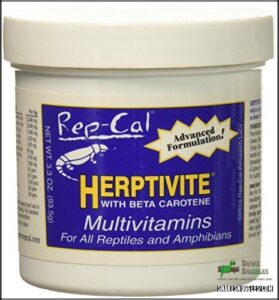
Whole prey covers most nutritional bases, but supplementation fills gaps in reptile nutrition that frozen rodents can miss. Rep-Cal’s Herptivite provides balanced vitamins and minerals that support your ball python’s growth and long-term health—especially if you’re varying prey types or feeding less frequently.
You’ll dust prey lightly with this flavorless powder before offering it. The supplement safety profile works well for snake nutrition when used sparingly, though some keepers mix it with calcium powder to encourage acceptance. It’s dietary insurance for your pet’s nutrition needs.
- Fills vitamin and mineral gaps that frozen prey sometimes lacks, supporting steady growth and immune function without complicated dosing
- Flavorless powder dusts easily onto rodents and won’t spook picky eaters the way stronger supplements might
- Works across different life stages, so you can use the same product whether you’re feeding fuzzies to a juvenile or rats to an adult
- Some ball pythons ignore dusted prey entirely, forcing you to mix it with calcium powder or skip supplementation altogether
- Quality control isn’t FDA-regulated, so you’re trusting the manufacturer’s testing without independent lab verification
- Costs more than comparable multivitamins, which adds up if you’re feeding multiple snakes or supplementing frequently
3. Zoo Med Reptile Rock Water Dish
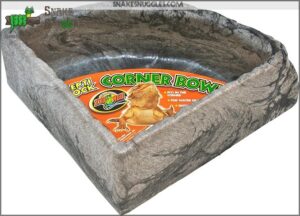
Water bowl safety matters as much as prey size when you’re setting up your ball python’s home. Zoo Med’s Reptile Rock Water Dish gives your snake a stable place to drink and soak—especially helpful during shedding when enclosure humidity support becomes critical.
The stone construction resists tipping better than lightweight plastic, and the corner design saves space while promoting reptile hydration. You’ll need to scrub it regularly for dish cleaning, but the chew-resistant material supports your snake’s weight without cracking when it climbs in for a proper snake soaking session.
- Stone construction prevents tipping when your snake climbs in to soak
- Corner design saves tank space while keeping water accessible
- Durable material holds up to regular cleaning and snake weight
- Gets heavy when filled, making water changes awkward
- Sticker residue can be annoying to remove
- Color options are random—you don’t get to pick
Frequently Asked Questions (FAQs)
Can ball pythons eat fish or amphibians?
While ball pythons can technically digest fish or amphibians, these aren’t recommended as staple prey. Think of them as nutritional fast food.
Stick with rodents for proper dietary diversification, parasite control, and balanced animal nutrition.
Do ball pythons need vitamin or calcium supplements?
You usually won’t need vitamin supplements or calcium—whole prey already covers their dietary needs and nutrition requirements.
However, documented mineral balance issues or calcium deficiency warrant veterinary guidance on reptile care and nutrition.
What causes ball pythons to refuse food?
Feeding refusal stems from environmental factors like low temperatures, snake stress from handling, health issues such as parasites, incorrect prey size, or natural hunger strikes during seasonal cycles—all disrupting your ball python’s normal feeding schedule.
Should you feed ball pythons inside their enclosure?
Yes, you can—but use frozen-thawed prey and a feeding dish to limit substrate contamination.
Supervise closely, maintain strict cleaning schedules, and monitor your snake’s behavior to reduce feeding stress and environmental impact.
Conclusion
Your python won’t complain about menu mistakes—it’ll just stop eating or pack on unhealthy weight. Dialing in the best ball python prey means watching girth ratios, sticking to frozen-thawed rodents, and adjusting portions as your snake matures.
A hatchling thrives on pinky mice; an adult demands small rats every two weeks. Nail these basics and you’re not just filling a stomach—you’re building decades of feeding confidence and preventing the headaches that derail most keepers.