This site is supported by our readers. We may earn a commission, at no cost to you, if you purchase through links.
Your snake’s enclosure isn’t just a cage—it’s the entire universe your animal will experience for its lifetime, and getting the fundamentals wrong leads to preventable tragedies every year. Respiratory infections from improper humidity, thermal burns from unregulated heat sources, and metabolic bone disease from inadequate UVB exposure don’t announce themselves until the damage is done.
The difference between a thriving snake and one that merely survives comes down to precision: maintaining species-specific temperature gradients within 2-3°F, calibrating humidity levels to match natural habitats, and establishing biosecurity protocols that prevent pathogen transmission.
Mastering best practices for maintaining snake enclosures requires understanding that every substrate choice, every cleaning protocol, and every environmental parameter directly impacts your animal’s physiological processes.
Table Of Contents
Key Takeaways
- Your snake’s enclosure size isn’t negotiable—inadequate space creates chronic stress and thermoregulation failures, with minimum requirements ranging from 20 gallons for juvenile corn snakes to 40+ gallons for adult ball pythons and kingsnakes.
- Precision climate control with thermal gradients of 79–90°F warm-side and 72–82°F cool-side, plus species-matched humidity levels (30–40% for desert species, 60–90% for tropical), prevents the respiratory infections and metabolic disorders that send 21% of pet snakes to emergency care.
- Daily spot cleaning combined with monthly deep disinfection protocols and 60–90 day quarantine periods for new animals form your primary defense against bacterial colonization, parasitic infestations, and disease transmission that most keepers discover only after damage is done.
- Substrate choices directly impact your snake’s health—aspen bedding works for low-humidity species with 191% absorbency for odor control, while tropical species need moisture-retaining options layered 4–6 inches deep to support natural burrowing behavior and humidity regulation.
Choosing The Ideal Snake Enclosure
Your snake’s enclosure isn’t just a container—it’s the foundation of their health, behavior, and longevity. Choosing the right setup requires balancing species-specific needs with practical considerations like material durability, thermal efficiency, and escape prevention.
Let’s break down the critical factors you need to evaluate before making this decision.
Minimum Size Requirements by Species
Your snake’s enclosure size isn’t negotiable—it’s dictated by species-specific space needs and the snake’s full adult length. Inadequate enclosure volume creates chronic stress and compromises thermoregulation, turning what should be a sanctuary into a preventable tragedy.
Minimum tank size requirements by species:
- Corn snakes need 20 gallons as juveniles, expanding to 40 gallons minimum for adults measuring 4–6 feet in length.
- Ball python hatchlings start in 10-gallon setups, but adults require 40+ gallons to accommodate their 3–5 foot frames.
- Garter snakes thrive in 20–30 gallon enclosures for juveniles, with species size limits determining final volume.
- African house snakes and king snakes follow similar snake length guidelines: 20 gallons for juveniles, 40+ for adults.
Proper reptile enclosure design prioritizes horizontal space over height for terrestrial species, ensuring your snake can stretch fully across one dimension. This fundamental principle of species-specific care prevents musculoskeletal issues and fosters natural behaviors essential for long-term snake care and maintenance. Ensuring the accuracy of scientific study summaries is vital, and tools like methodological audits can help verify the information.
Glass Vs. PVC Vs. Wooden Enclosures
Once you’ve settled on size, material durability becomes your next decision point. Glass offers excellent scratch resistance and instant visual inspection but adds significant weight—expect 40+ pounds fully stocked. PVC balances lightweight handling with rigid humidity tolerance, though UV exposure gradually discolors panels.
Wooden enclosures provide natural insulation properties that stabilize thermal gradients with lower energy input, yet porous surfaces demand vigilant sealing against moisture infiltration and mold. Your choice shapes maintenance costs and long-term enclosure aesthetics.
Secure Lids and Escape Prevention
After considering material durability, locking mechanisms become your primary safeguard against escape routes. You’ll need lids with spring-loaded clasps or magnetic latches—not simple sliding panels that snakes leverage open through persistent pressure.
Inspect enclosure security weekly, checking for gaps around vents and door seams where even juvenile snakes wedge through. Secure materials like reinforced mesh over ventilation prevent the preventable tragedy of discovering an empty enclosure.
Proper Ventilation Solutions
While lids keep your snake contained, ventilation systems determine whether it thrives or develops respiratory infections. Aim for 0.5 to 5 air exchange rates per hour depending on enclosure size—cross-ventilation through opposite-end vents creates uniform airflow management without drafts.
Install hygrometers at multiple points to confirm vent design balances humidity control with adequate gas exchange, preventing the ammonia buildup that precedes disease.
Setting Up Substrate and Decor
Your substrate and décor choices form the foundation of a functional, species-appropriate habitat—and mistakes here can lead to respiratory infections, impaction, or chronic stress.
You’ll need to balance practical maintenance demands with your snake’s biological need for security, thermoregulation, and behavioral enrichment.
Let’s examine the critical substrate options, proper depth requirements, essential structural elements, and habitat replication strategies that separate thriving captive environments from preventable welfare failures.
Safe Substrate Options (Aspen, Paper Towels, Etc.)
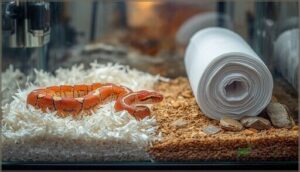
Your substrate selection sets the foundation for thermoregulation, hygiene, and natural snake behavior—so skip cedar or pine, which release toxic phenols. Aspen bedding provides low dust and high absorbency for dry to moderate humidity species, supporting burrowing materials without compacting. Paper towels offer clinical simplicity for quarantine or medical monitoring.
Match your reptile substrates and decor to your species’ moisture needs and natural digging instincts.
Substrate Depth and Maintenance
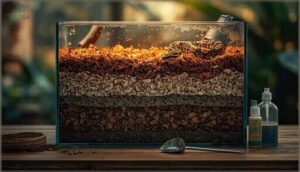
You’ll layer substrate two to four inches deep for smaller or arboreal snakes, four to six inches for burrowing species—a depth that facilitates natural digging behavior while buffering humidity control and preventing compaction. Proper depth management transforms substrate selection into functional reptile substrates and decor.
- Replace completely every one to three months when odor prevention fails or caking occurs
- Spot-clean daily during enclosure maintenance to remove waste without stripping beneficial microbes
- Assess depth after cleaning to maintain consistent burrowing needs and thermal insulation
Regular substrate replacement keeps your animal healthy and your setup odor-free.
Hides, Branches, and Climbing Structures

You’ll anchor thermal hides on both warm and cool zones—snug, non-porous retreats that reduce stress while simplifying sanitation. Climbing structures demand secure placement at varied heights and diameters (one to three inches) to promote natural locomotion, with visual barriers near elevated perches to minimize perceived threat. These hiding spots and climbing elements transform enclosure design into genuine environmental enrichment.
Install branch placement to create non-linear pathways—irregular routes that encourage exploration and prevent repetitive pacing behaviors common in poorly designed reptile substrates and decor setups.
| Feature | Thermal Hides | Climbing Structures |
|---|---|---|
| Placement | One warm, one cool side | Multiple heights with cover |
| Material | Non-porous, easy-clean | Pesticide-free, splinter-free |
| Size | Snug fit for security | 1–3″ diameter branches |
| Function | Stress reduction, thermoregulation | Muscle development, snake enrichment |
Mimicking Natural Environments

Environmental simulation transforms maintenance from routine into artful habitat replication—your goal isn’t decoration, but behavioral stimulation through precise thermal gradients, humidity control, and sensory enrichment that mirror wild conditions.
- Design temperature gradient zones (88–92°F basking, 75–80°F retreat) for active thermoregulation
- Match substrate moisture to native biomes—arid species need dry layers, tropical snakes require humid microclimates
- Layer visual barriers and natural lighting cycles to reduce stress responses
- Rotate climbing structures and textured surfaces for ongoing environmental enrichment
Managing Temperature and Humidity
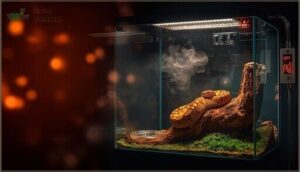
Your snake’s survival hinges on precision climate control. Without accurate thermal gradients and species-matched humidity levels, you’re inviting respiratory infections, regurgitation, and failed sheds.
Most enclosure failures trace back to poorly positioned heat sources or inadequate monitoring equipment—problems that are entirely preventable with the right setup from day one.
Here’s how to establish the temperature and humidity parameters your snake needs to thrive.
Establishing Thermal Gradients
Your snake’s enclosure isn’t a simple box—it’s a thermoregulation toolkit. Establish thermal gradients spanning 26–32°C (79–90°F) on the warm side and 22–28°C (72–82°F) on the cool side using radiant heating from under-tank pads or ceramic emitters.
Monitor temperature fluctuation with digital thermometers at multiple points, ensuring your heat source creates stable gradient control without hotspots exceeding 35°C—preventing burns while facilitating natural thermal regulation.
Species-Specific Humidity Levels
Humidity control isn’t one-size-fits-all—tropical species demand 60–90% relative humidity, while desert climates require just 30–40%. Monitor microclimates near basking sites and hides using calibrated hygrometers at multiple zones, ensuring species-specific care that prevents shedding problems and respiratory infections.
- Tropical arboreal snakes: 60–90% humidity with frequent misting
- Desert species: 30–40% sustained through ventilation
- Shed cycles: Boost to 70–80% temporarily for snake hydration
- Seasonal adjustments: Vary levels to mimic natural patterns
Placement of Heat Mats and Lamps
Position your heat source with deliberate strategy—place heat mats beneath one-third of the enclosure floor on a stable, non-slip surface, always paired with a thermostat for temperature control.
Mount overhead lamps 8–12 inches above the basking zone to create a thermal gradient from 85–90°F warm-side to 70–75°F cool-side.
This heating system design prevents burns while enabling natural thermoregulation—never rely on mats alone for proper enclosure setup.
Monitoring Tools for Climate Control
You can’t manage what you don’t measure—digital hygrometers and infrared thermometers verify your gradient with ±1–2°C precision, while data logging tracks trends over days. Wireless probe sensors alert you via smartphone when temperature control or humidity control drift beyond safe thresholds.
Sensor calibration against certified standards prevents costly errors, and thermal imaging reveals hidden cold spots your thermostat might miss, transforming guesswork into evidence-based husbandry.
Maintaining Hygiene and Health
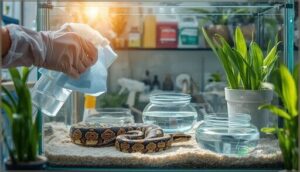
A spotless enclosure isn’t just about aesthetics—it’s your first line of defense against respiratory infections, parasitic infestations, and the bacterial buildup that sends 21% of pet snakes to emergency veterinary visits.
A clean enclosure is your primary defense against the respiratory infections and parasites that send 21% of pet snakes to emergency care
You’ll need a multi-layered approach combining daily vigilance with systematic deep cleaning protocols, plus the ability to recognize early warning signs before minor issues escalate into preventable tragedies.
Let’s break down the four pillars of enclosure hygiene and health monitoring that separate thriving snakes from those struggling with entirely avoidable conditions.
Daily Spot Cleaning Techniques
Every morning, you’ll remove visible feces and urates using a dedicated scoop—this daily sanitizing prevents bacterial colonization before it starts. Wipe water bowls with reptile-safe disinfectant, spot clean spilled substrate behind hides, and inspect for mold or unusual residues.
Record what you observe: changes in waste consistency signal health shifts. Consistent waste removal and odor management transform enclosure maintenance from reactive crisis to proactive animal enclosure management.
Monthly Deep Cleaning Protocols
Once a month, you’ll transfer your snake to a secure holding container and strip the entire enclosure, removing substrates and decor for full tank clean protocols.
Scrub all surfaces with reptile-safe disinfectant selection, targeting biofilm removal on water features and climbing branches. Inspect ventilation checks for blockages, document cleaning schedules, and verify lock integrity.
This thorough enclosure sanitizing prevents the accumulation of pathogens that daily cleaning and maintenance can’t address.
Quarantine and Disease Prevention
Isolation is your first line of defense against introducing infectious agents into your collection. House new snakes in completely separate quarantine housing for 60 to 90 days—extending to six months for pythons at risk of serpentovirus.
Implement strict biosecurity protocols: dedicate tools, handle quarantined animals last, and conduct disease screening with fecal PCR tests spaced two weeks apart.
Rigorous hygiene practices and vector control prevent parasites from devastating your established reptile health. Effective quarantine protocols involve following a reptile quarantine procedure to guarantee the health and safety of your reptile collection.
Monitoring for Health Issues
Vigilance is your most powerful diagnostic tool—weekly weigh-ins and nose-to-tail visual inspections detect early health indicators before disease prevention becomes crisis management.
Watch for respiratory checks revealing open-mouth breathing, appetite shifts signaling stress signals, or abnormal shedding patterns compromising reptile health and wellness.
Document changes in snake behavior and schedule prompt vet visits when you spot persistent lethargy, swelling, or fecal abnormalities—proactive veterinary care transforms snake health outcomes.
Feeding and Watering Best Practices

Feeding your snake isn’t just about dropping prey into the enclosure—it’s about understanding nutritional timing, prey safety, and hydration protocols that directly impact your animal’s metabolic health and longevity. Get the feeding schedule wrong, and you’re looking at regurgitation, obesity, or worse: a slow decline masked as normal behavior until the damage is done.
The following practices will guide you through whole-prey selection, thawing protocols, water maintenance, and nutritional balance with the precision your snake’s physiology demands.
Whole Prey Diets and Feeding Schedules
Your snake’s health hinges on proper prey item selection and feeding frequency. Juveniles thrive on 2–3 weekly meals, while adults need just 1–2.
Choose varied whole prey (rodents, rabbits, occasional quail) sized at 10–20% of your snake’s widest girth to maintain nutrient balance and dietary variety.
Consistent feeding schedules reduce stress, regulate digestion, and prevent the nutritional deficiencies that compromise snake health and behavior.
Safe Handling of Frozen-Thawed Prey
Thawing prey correctly prevents bacterial control disasters that compromise snake health. Never thaw at room temperature—use refrigeration (4–5°C) or cool water (20–25°C), changing it frequently to maintain feeding techniques standards.
Inspect for off odors or discoloration before offering, and discard anything questionable. Use dedicated tongs for handling safety, clean feeding areas immediately, and never refreeze thawed items—these prey thawing methods protect nutrition quality and support ideal reptile care.
Water Bowl Selection and Maintenance
Your water dish choice impacts hydration management more than you’d expect—ceramic or stainless steel bowls resist scratches that harbor biofilm, while plastic options degrade faster in reptile enclosures.
Place bowls away from heat sources, ensuring your snake can soak comfortably.
Daily water quality checks and cleaning schedules (rinse daily, disinfect weekly) prevent microbial growth and support proper snake enclosure maintenance.
Preventing Nutritional Deficiencies
Nutrient balance isn’t optional—deficiencies trigger metabolic bone disease and immune collapse before you notice symptoms. Maintain peak snake health through:
- Dietary variety: Rotate prey species (rats, mice, chicks) to prevent amino acid imbalances
- Feeding frequency: Match schedules to metabolism—juveniles every 5–7 days, adults every 10–14
- Calcium sources: Dust prey with calcium/D3 supplements biweekly
- Monitor body condition: Track weight and muscle tone monthly
Top 5 Essential Products for Maintenance
You don’t need a cabinet full of specialized reptile products to maintain a healthy snake enclosure—just five reliable tools that handle daily care, emergency cleanups, and long-term hygiene.
These items form the backbone of your maintenance routine, addressing substrate management, humidity control, waste removal, and disinfection with precision.
Here’s what belongs in every snake keeper’s supply kit.
1. Van Ness Cat Litter Scoop

Efficient spot cleaning keeps your snake enclosure sanitary without daily headaches—and that’s where the Van Ness Cat Litter Scoop proves surprisingly effective.
Designed with high-impact plastic and a polished, stain-resistant finish, this affordable tool manages reptile substrates like aspen shavings and paper towels with ease. Its 11-inch design reaches into corners without strain, while slotted construction sifts debris efficiently during enclosure maintenance.
Rinse between uses to prevent cross-contamination, and inspect regularly for cracks that compromise tool durability. You’ll maintain hygiene standards without breaking your budget.
| Best For | Snake keepers who need an affordable, easy-to-clean tool for daily spot cleaning of loose substrates like aspen shavings or paper towels in small to medium enclosures. |
|---|---|
| Material | High impact plastic |
| Brand | Van Ness |
| Weight | 1.12 ounces |
| Easy to Clean | Yes |
| Primary Use | Litter scooping |
| Durability | May bend with heavy use |
| Additional Features |
|
- High-impact plastic construction resists odors and stains, making it easy to rinse clean between enclosures
- 11-inch design with comfortable handle reaches into corners without awkward bending or wrist strain
- Budget-friendly option that works effectively with common reptile substrates for routine waste removal
- Slots may be too large for finer substrates, allowing small particles to pass through during sifting
- Handle and construction may feel flimsy or bend with heavy use or deep substrate layers
- Plastic material can retain odors over time unless thoroughly cleaned and air-dried after each use
2. Exo Terra Spray Mister Bottle
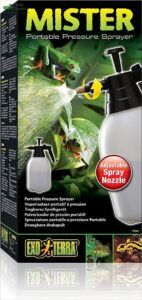
Beyond scoops, precision humidity control separates thriving snakes from those struggling through ecdysis—which is where the Exo Terra Spray Bottle becomes indispensable for reptile enclosure maintenance.
This handheld mister delivers a fine, even mist through an adjustable spray nozzle, targeting 50-90% humidity ranges without oversaturating substrate. The hand-pump design gives you one-handed operation during routine enclosure maintenance, while the 250-500 ml reservoir minimizes refills.
Use distilled water to prevent mineral clogging, and clean the pump mechanism monthly. Proper misting technique—never directly at nostrils—protects respiratory health while maintaining ideal microclimates around hides.
| Best For | Snake keepers who need reliable humidity control during shedding cycles and daily terrarium maintenance without constantly removing enclosure lids. |
|---|---|
| Material | Plastic |
| Brand | Hagen |
| Weight | 0.25 Kilograms |
| Easy to Clean | Requires maintenance |
| Primary Use | Misting/spraying |
| Durability | Requires depressurizing |
| Additional Features |
|
- Adjustable nozzle creates fine, even mist that raises humidity without drenching substrate or causing mold growth
- One-handed pump operation lets you mist multiple enclosures quickly during routine care
- Large 67.5 oz reservoir means fewer refills when maintaining several terrariums
- Top seal may leak if you forget to release pressure after each use
- Nozzle clogs over time when using tap water instead of distilled
- Some buyers report receiving units with damaged pumps or used bottles
3. Bounty Paper Towels
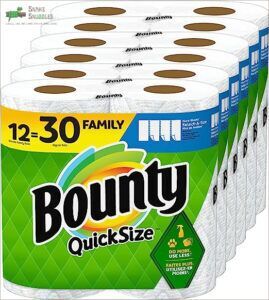
While misting manages humidity control, you’ll rely on disposable materials for daily sanitation methods—and Bounty Paper Towels excel at reptile enclosure cleaning without introducing lint or contaminants.
Their 2-3x absorbency testing ratings mean you’ll manage fecal residue and water spills efficiently during spot cleaning and maintenance. The select-a-size feature reduces waste management costs while maintaining cleaning protocols.
Choose unscented varieties to prevent respiratory irritation, and dispose immediately after each use—reusing towels invites cross-contamination that negates your entire habitat maintenance routine.
| Best For | Reptile keepers who need reliable, absorbent towels for daily spot cleaning and spill management without introducing lint or contaminants into snake enclosures. |
|---|---|
| Material | Paper |
| Brand | Bounty |
| Weight | 8.67 Pounds |
| Easy to Clean | Disposable |
| Primary Use | Cleaning spills |
| Durability | Single-use sheets |
| Additional Features |
|
- Super absorbent design handles fecal residue and water spills 2-3 times more effectively than standard towels
- Select-a-size feature lets you tear exactly what you need, cutting down waste during routine maintenance
- Strong, durable sheets won’t fall apart in high-humidity environments or when cleaning tight corners
- Higher price point compared to generic paper towel brands may add up with frequent enclosure cleaning
- Rolls can run out quickly during intensive cleaning cycles, requiring frequent restocking
- Some rolls may contain fragrances or additives that could irritate sensitive reptiles unless you choose unscented varieties
4. Clorox Splash Less Bleach
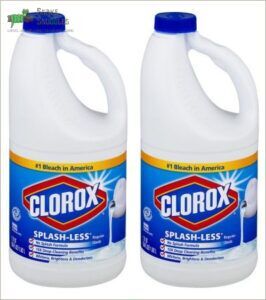
Once disposable materials clear surface debris, you’ll need proper disinfectant uses for deep sanitation methods—and Clorox Splash Less Bleach delivers hospital-grade cleaning solutions when diluted correctly for reptile enclosure cleaning.
The surfactant-thickened formula minimizes splash during habitat maintenance, though you must rinse non-porous surfaces thoroughly to eliminate chemical risks from sodium hypochlorite residues. Apply only to sealed glass or acrylic during monthly pet maintenance routines, never to porous substrates.
Proper ventilation during bleach safety protocols prevents respiratory compromise—work in open-air spaces and store cleaning and maintenance products away from enclosures.
| Best For | Snake owners who need hospital-grade disinfection for non-porous enclosure surfaces like sealed glass or acrylic and want a thickened formula that reduces splashing during cleaning. |
|---|---|
| Material | Liquid |
| Brand | Clorox |
| Weight | 110 ounces total |
| Easy to Clean | Liquid formula |
| Primary Use | Disinfecting/whitening |
| Durability | Stable liquid |
| Additional Features |
|
- Thickened surfactant formula minimizes splashing and spills during reptile habitat maintenance
- Hospital-grade disinfection when properly diluted eliminates pathogens on sealed glass and acrylic surfaces
- Works effectively for monthly deep cleaning routines when followed by thorough rinsing
- Only safe for non-porous surfaces—can’t be used on substrates or unsealed materials
- Requires careful dilution, complete rinsing, and proper ventilation to prevent chemical exposure to snakes
- Some reviewers report receiving smaller bottles than advertised and question the splash-less claims
5. Natural Aspen Snake Bedding Supply
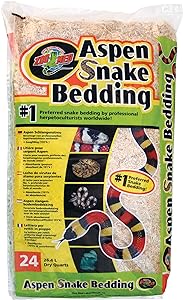
Your substrate selection determines whether burrowing behavior thrives or fails. Zoo Med Aspen Bedding delivers 191% absorbency for exceptional odor control while maintaining the dry conditions necessary for corn snakes, kingsnakes, and other low-humidity species.
The dust-free, kiln-dried American aspen allows natural tunneling without respiratory compromise, though you must remove damp sections immediately: mold colonization begins within 48 hours in wet spots.
This reptile substrate requires complete replacement monthly during enclosure maintenance—partial changes leave bacterial reservoirs that threaten snake health.
| Best For | Snake owners with burrowing species like corn snakes and kingsnakes that need low-humidity environments and strong odor control. |
|---|---|
| Material | Aspen |
| Brand | Zoo Med |
| Weight | 5.35 Pounds |
| Easy to Clean | Yes |
| Primary Use | Animal bedding |
| Durability | Long-lasting substrate |
| Additional Features |
|
- 191% absorbency rating keeps enclosures dry and controls ammonia odors effectively
- Dust-free, kiln-dried texture allows natural tunneling and burrowing without respiratory issues
- Made from 100% pure American aspen with no harmful oils or additives
- Molds quickly when wet and requires immediate removal of damp spots
- Not suitable for snakes needing high humidity since it doesn’t retain moisture well
- Needs complete monthly replacement to prevent bacterial buildup
Frequently Asked Questions (FAQs)
How often should I replace climbing branches?
Think “branch out” with purpose—inspect climbing structures monthly for cracks or rot, replacing them every 6–12 months depending on wood durability, bite marks, and material degradation to maintain safe environmental enrichment in reptile cages.
Can I use tap water for misting?
You can use tap water for misting snake enclosures after dechlorination methods remove chlorine. Tap water safety depends on local water quality—sensitive species benefit from distilled water to prevent respiratory irritation and mineral buildup.
What lighting schedule works best for snakes?
Most species thrive on a 12 to 14 hour photoperiod with gradual dawn-dusk transitions. UVB lighting systems for basking zones support calcium metabolism, while thermal cycles maintain natural thermoregulation patterns essential for long-term health.
How do I prevent substrate from molding?
Keeping your substrate drier than 60% humidity discourages mold prevention challenges. Adequate ventilation systems, prompt waste removal, and choosing aspen over resin-heavy options reduce fungal management risks while maintaining proper humidity control for your snake’s health.
Should I handle my snake after feeding?
Holding your snake feels like bonding—yet it’s the opposite during digestion. Post-Feeding Stress triggers Regurgitation Risk within 24–72 hours.
Species Variability matters: wait longer for large meals, minimizing Handling Alternatives until digestion completes.
Conclusion
The myth that snakes thrive on neglect falls apart when you examine mortality data: most captive deaths trace directly to environmental mismanagement.
Your mastery of best practices for maintaining snake enclosures—precise thermal gradients, species-matched humidity, rigorous biosecurity—transforms survival into thriving.
The difference between a lethargic animal and one exhibiting natural behaviors isn’t luck; it’s your commitment to replicating the physiological conditions evolution designed them for. Your snake’s health begins and ends with environmental precision.
- https://en.wikipedia.org/wiki/Hygrometer
- https://www.stitcher.com/podcast/herp-nation-radio/e/51162653?autoplay=true
- https://academichelpexpress.blog/2024/08/please-use-the-bulleted-points-and-the-rubric-below-to-guide-your-work-your-pa/
- https://x.com/godofprompt/status/1990526288063324577
- https://www.sciencedirect.com/science/article/pii/S0749208123000268