This site is supported by our readers. We may earn a commission, at no cost to you, if you purchase through links.
Your snake isn’t being antisocial when it disappears into its hide for hours—it’s following millions of years of evolutionary programming. In the wild, snakes spend up to 95% of their time concealed in burrows, beneath rocks, or under vegetation, a behavior hardwired from birth as their primary defense against predators and environmental extremes.
When you strip away these refuge options in captivity, you’re not just removing furniture from their enclosure; you’re eliminating the foundation of their psychological security and physiological regulation. Without adequate hiding places, captive snakes experience elevated cortisol levels, compromised immune function, and disrupted thermoregulation—conditions that manifest as feeding refusal, incomplete sheds, and chronic stress behaviors.
The solution isn’t complicated, but the science behind why snakes need hiding places in their tank reveals how these seemingly simple structures serve as the cornerstone of proper husbandry.
Table Of Contents
Key Takeaways
- Snakes need hiding places to feel secure, regulate stress, and avoid predators—these instincts are hardwired from millions of years of evolution.
- Proper hides help your snake control body temperature and humidity, supporting healthy shedding cycles and preventing illness.
- Multiple, well-placed hides reduce stress and encourage natural behaviors like ambush hunting, exploration, and peaceful coexistence in shared enclosures.
- Hides must fit your snake’s size, be made from safe materials, and be positioned across thermal gradients to create a healthy, enriched habitat.
Why Do Snakes Need Hiding Places?
Snakes aren’t just looking for a cozy corner—they need hiding places to survive. Whether it’s dodging predators, managing stress, or staying at the right temperature, these enclosed spaces do serious work for your snake’s health and well-being.
A well-designed snake cage setup for beginners should include at least two hides to give your pet options based on temperature needs.
Let’s break down the three main reasons your snake can’t thrive without proper hides.
Instinctual Need for Security
Security drives every move your snake makes. From the moment they hatch, snakes instinctively seek enclosed refuges that minimize exposure to threats—a survival tactic hardwired into their biology. This refuge selection reduces defensive arousal and aids calmer activity cycles.
Even in captivity, hiding spots tap into evolved predator evasion strategies, lowering baseline stress and promoting energy-efficient rest periods essential for long-term welfare.
Predator Avoidance in Nature
In the wild, snakes can’t outrun hawks, coyotes, or other predators—making hiding spots a life-or-death necessity. Secure refuges let them employ Camouflage Tactics and reduce detection risk through background matching and disruptive patterns. Predator Evasion depends on stealth:
In the wild, hiding spots aren’t optional—they’re the only reason snakes survive predators they can’t outrun
- Enclosed rock crevices block aerial attacks
- Burrows offer escape routes from mammals
- Dense foliage conceals body outlines
- Thermal refuges mask infrared signatures
- Ambush locations double as Defensive Behaviors
These Survival Strategies showcase snake behavior shaped by relentless Environmental Adaptation pressure.
Stress Reduction in Captivity
Captive stressors—bright lights, handling, and the absence of environmental enrichment—trigger reptile anxiety without proper hiding spots. Hide designs that offer thermal comfort transform enclosures into low-stress environments.
| Stressor | How Hides Help |
|---|---|
| Bright lights | Dark refuge reduces overstimulation |
| Handling | Quick retreat rebuilds security |
| Open spaces | Enclosed shelter mimics natural cover |
| Temperature swings | Microclimates support stress reduction |
Effective reptile care hinges on understanding how hiding spots deliver animal welfare benefits through targeted environmental enrichment. It’s vital to acknowledge that can greatly impact reptile stress and well-being.
Research shows that proper hiding spot selection can reduce stress-related behaviors and support healthier cardiovascular function in captive reptiles.
The Role of Hides in Snake Health
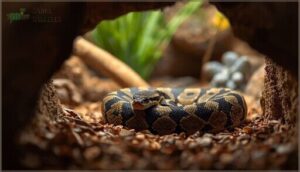
Your snake’s health depends on more than just food and water—hides play a direct role in everything from body temperature to immune function. Without proper hiding spots, even well-fed snakes can develop physical and behavioral problems that shorten their lives.
Let’s look at three critical ways hides protect your snake’s health.
Thermoregulation and Microclimates
Your snake can’t warm itself like you do—it’s completely ectothermic, relying on environmental heat sources to survive. Hides positioned along a thermal gradient create critical microclimates inside your enclosure, giving your snake precise temperature control across distinct climate zones. Here’s how hiding spots facilitate thermoregulation:
- Warm-side hides maintain 28–32°C for digestion and activity
- Cool-side refuges offer 22–26°C to prevent overheating
- Insulating materials stabilize temperatures inside each hide
- Dual hides enable flexible movement between temperature zones
- Proper placement facilitates efficient heat management without stress
Supporting Healthy Shedding Cycles
Molt management hinges on stable microclimates your hides create throughout the shedding cycle. When your snake retreats, it accesses humidity control zones—often 70–80%—that soften old skin and prevent incomplete sloughs.
Thermal gradients also matter: warm-side hiding spots accelerate metabolic processes, while cool refuges reduce friction-related trauma. This dual-zone thermoregulation facilitates complete, stress-free molts and protects skin health during vulnerable periods.
Preventing Chronic Stress and Illness
Stress Management transforms hiding spots into medicine for your snake’s immune system. Without secure retreats, elevated cortisol suppresses digestion, weakens disease resistance, and triggers respiratory infections. Chronic Prevention depends on proper Hide Design:
- Full-body concealment eliminates visual exposure anxiety
- Strategic placement promotes natural thermoregulation rhythms
- Multiple refuges reduce territorial stress in shared enclosures
Effective hiding spots deliver measurable Health Benefits through consistent predator avoidance behavior and stress reduction.
How Hiding Spots Influence Snake Behavior

Beyond the basics of health and temperature, hiding spots shape how your snake moves, hunts, and interacts with its environment. The presence—or absence—of proper hides directly affects activity levels, hunting behavior, and even social dynamics in multi-snake setups.
Let’s break down the three main ways hides influence what your snake actually does day to day.
Natural Ambush and Hunting Strategies
You’ll notice your snake’s ambush hunting behavior transforms when it has proper hiding spots. Stealth tactics depend on camouflage and concealment—your pet situates itself near prey detection zones, using strike timing refined over millions of years. Energy conservation drives this approach: why chase when you can wait? Reptile hides support these instincts even in captivity.
Habitat selection matters—snakes instinctively choose hides that mirror natural burrows or rock crevices where prey travels predictably. Even captive-bred snakes retain these hardwired behavior patterns.
| Ambush Strategy | How Hiding Spots Help | Behavioral Impact |
|---|---|---|
| Camouflage positioning | Provides visual cover that breaks up the snake’s outline | Snake remains motionless for extended periods without detection |
| Prey funnel zones | Creates natural pathways near hide entrances | Increases strike success by concentrating prey movement patterns |
| Thermal ambush posts | Offers temperature-controlled waiting areas | Maintains ideal body heat for explosive strike speed |
| Scent concealment | Reduces chemical cues that alert prey to danger | Prey approaches closer before detecting the predator |
| Escape routes | Supplies quick retreat options after failed strikes | Reduces injury risk and allows repositioning for next attempt |
Encouraging Exploration and Activity
Multiple hides don’t just provide security—they actively stimulate snake behavior and environmental enrichment. Varied hide textures invite your snake to explore different surfaces, while rotating hide novelty maintains curiosity without stress.
Try scented hide sub (substrates infused with prey scent) near entrances to trigger investigative slithering. Strategic habitat design transforms passive retreats into exploration checkpoints, promoting stress reduction through controlled activity between thermal zones.
Social Stress Relief for Multiple Snakes
When you house snakes together, hiding spots become social tools that reduce confrontation and promote enclosure stability. Social buffering occurs when nearby companions lower stress responses—but only if each snake can retreat independently.
Strategically placed hiding areas limit visual contact, preventing territorial disputes while supporting behavioral cues like selective thermoregulation. Multiple hides transform shared spaces into peaceful coexistence zones, directly improving animal stress and wellbeing.
Providing environmental enrichment strategies can further reduce stress and encourage natural behaviors in cohabitated enclosures.
Essential Features of Effective Snake Hides
Not every hide works equally well for every snake. The right one depends on size, snugness, and how you position it within the enclosure’s thermal zones.
Here’s what separates an effective hide from a useless one.
Size and Shape Considerations
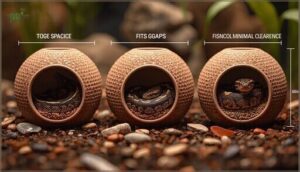
Your snake’s hide must fit like a well-tailored glove—too loose and security vanishes, too tight and stress spikes. Proper habitat design demands precision around girth diameter, internal height, and entry hole shape to deliver genuine contact comfort and stress reduction.
- Hides sized at 1.0 to 1.5 times your snake’s girth diameter allow full curling without excessive space.
- Internal dimensions of 2.5 to 3.5 times head length entry promote natural movement and reduced anxiety.
- Round entry holes prevent scale snagging while cylindrical shapes minimize panic during retreat.
Placement for Thermal Gradient Access

Once you’ve nailed hide dimensions, position each one at opposite ends of your reptile enclosure to anchor proper gradient ends. Place one hide over your heat source and another where temperature drops—aim for a 6 to 12 degree Celsius temp difference.
This plate design aids natural thermoregulation and lets your snake’s behavior dictate comfort. Position your sensor placement near each hide, and consider a dual thermostat for precision habitat design.
Material Choices for Safety and Durability
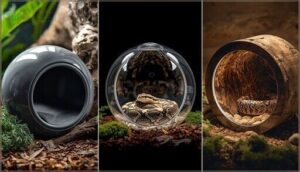
Beyond positioning comes the question of build quality. Your choice of hide construction impacts both safety and longevity:
- Plastic hides with non-porous surfaces resist bacterial growth and simplify cleaning while offering lightweight durability for reptile care.
- Acrylic safety panels provide shatter-resistant viewing without compromising security in animal enclosure design.
- Natural materials like resin-treated wood deliver environmental enrichment through realistic textures and protective microclimates.
Best Practices for Providing Hides in Enclosures
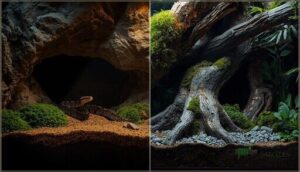
You’ve learned what makes a hide effective—now it’s time to put that knowledge into practice. Different snake species have unique requirements based on their natural behaviors, and recognizing when your setup falls short can prevent serious health issues.
Let’s break down the practical steps for creating an enclosure that meets your snake’s biological needs.
Types of Hiding Spots for Different Species
Different species demand specialized hiding spots customized to their natural behavior and thermoregulation needs. Terrestrial snakes thrive with burrow designs and rock caves positioned along thermal gradients, while arboreal species require elevated tree hides that support ambush hunting and camouflage. Semi-arboreal varieties benefit from ceramic shelters at ground level plus vertical options. Fabric enclosures work well for smaller, heat-sensitive species needing adaptable microclimates.
Signs Your Snake Needs More Hides
Your pet’s behavior reveals when it needs extra refuge options. If repeated escape attempts occur or food refusal persists for several feedings, add another hide immediately.
Irregular shedding patterns signal insufficient humidity and security. Watch for persistent digging behavior or excessive time spent in one corner—both indicate stress from inadequate hiding spots.
Frequent tail rattling near enclosure edges means your snake seeks secure cover now.
Creating a Secure and Enriched Habitat
You need at least two hides—one warm, one cool—to establish proper thermal gradients. Position them at opposite enclosure ends so your snake can thermoregulate while staying secure.
Add elevated options or substrate variation to create environmental enrichment that mirrors natural reptile habitat and ecology.
This habitat design promotes captive care, reduces stress, and encourages natural snake behavior like exploration and camouflage-based ambush tactics.
Frequently Asked Questions (FAQs)
Why do snakes need hides?
Snakes instinctively seek shelter to avoid predators and regulate stress levels. Hiding spots provide thermal gradient zones for thermoregulation while supporting healthy shedding cycles—cornerstones of reptile stress relief and captive snake enrichment.
Should I leave my snakes shed in the tank?
Remove shed skin within a day or two to maintain Tank Hygiene and prevent bacterial growth. Prompt Shed Disposal promotes Snake Safety, reduces odor, and keeps your enclosure clean during normal Reptile Care and Management routines.
Can snakes share hiding spots with tank mates?
Most species shouldn’t—cohabitation risks include resource guarding and aggressive hide distribution conflicts.
Garter snakes tolerate tank mate compatibility better than ball pythons, but shared hide stress often triggers predator avoidance behaviors even without actual threats present.
How often should hiding spots be cleaned?
You should wipe down your snake’s hides with reptile-safe disinfectant every 1-2 weeks to prevent mold prevention issues.
Weekly cleaning schedules work best for warm enclosures, where sanitation tips matter most.
Do baby snakes need different hide sizes?
Yes, baby snakes need snug hides roughly 5 to 2 times their girth when curled.
Growth stage hides should be replaced as they reach 12 to 18 inches, ensuring ideal thermoregulation and predator avoidance behavior.
Can too many hides harm a snake?
Too many hides can clutter the enclosure and disrupt thermal gradients, preventing your snake from reaching ideal basking temperatures.
Excess hiding spots may also hinder airflow, complicate maintenance, and inadvertently increase stress rather than reduce it.
What materials should be avoided in hides?
Avoid toxic woods like cedar, untreated materials that rust or splinter, non-breathable fabrics trapping moisture, low-quality plastics releasing fumes, and metal hazards causing burns—all compromise reptile health in snake habitats.
Conclusion
A ball python owner once removed all hides to “encourage activity”—the snake stopped eating for six weeks and developed scale rot from stress-induced immune suppression. This isn’t about aesthetic choices or optional enrichment.
Understanding why snakes need hiding places in their tank means recognizing them as non-negotiable biological requirements, not decorative accessories. Your snake’s willingness to emerge and interact depends entirely on knowing it has somewhere safe to disappear.