This site is supported by our readers. We may earn a commission, at no cost to you, if you purchase through links.

Managing heat across a single snake enclosure takes practice. Managing it across several at once demands a system. One mat running too hot, one probe placed slightly off-center, or one thermostat shared across incompatible setups—and you’re looking at stressed animals, feeding refusals, or worse.
Reptile heat mats for multiple snake enclosures aren’t just a convenience purchase; they’re the foundation of consistent thermoregulation when your collection starts to grow. The right mat, sized and positioned correctly, keeps each species hitting its target gradient without constant manual adjustment. What follows breaks down exactly how to choose, install, and maintain that foundation.
Table Of Contents
- Key Takeaways
- Choosing Heat Mats for Snake Setups
- Installing Mats for Safe Heat Gradients
- Top 5 Heating Options Compared
- Managing Temperatures Across Multiple Enclosures
- Frequently Asked Questions (FAQs)
- Can I put a heating pad under my snakes tank?
- Should I leave my snakes heat pad on all night?
- Is a heat lamp or heat mat better for snakes?
- Can one thermostat control multiple heat mats?
- How often should heat mats be replaced?
- Do heat mats work inside rack systems?
- Are heat mats safe for gravid females?
- Can heat mats cause respiratory issues in snakes?
- Can heat mats be used under glass tanks?
- Do heat mats work with bioactive enclosure setups?
- Conclusion
Key Takeaways
- Cover one-third to one-half of your enclosure’s floor with a heat mat on one end only, so your snake always has a cool side to retreat to when it needs to cool down.
- Every enclosure needs its own thermostat with its own probe—sharing one controller across multiple tanks means you’re flying blind on at least half of them.
- Match your mat’s wattage to your tank size (roughly 4W for a 10-gallon up to 24W for a 50-gallon) and keep substrate over the warm zone between 10–20mm so heat actually reaches your snake.
- A mat running without a thermostat overnight isn’t just inefficient—it’s a genuine safety risk, so treat the thermostat as non-negotiable, not an optional add-on.
Choosing Heat Mats for Snake Setups

Getting the right heat mat starts with knowing your enclosure dimensions, snake’s temperature needs, and how many tanks. Each of those factors shapes which mat size, wattage, and control setup will actually work for your situation.
A quick look at a snake terrarium heating options comparison can help you weigh the tradeoffs before you buy.
Here’s what to look at before you buy.
Matching Mat Size to Each Enclosure
Matching mat size to each enclosure isn’t guesswork — it directly shapes heat distribution and your snake’s ability to thermoregulate. A reptile heat mat that’s too large eliminates the cool zone; too small, and the warm hide underperforms. Follow an enclosure size guide for each tank individually, accounting for species-specific needs, floor shape, and any raised trim that reduces usable contact area.
When selecting a heat mat, consider the importance of precise temperature control to secure ideal heat distribution.
Applying The One-third to One-half Rule
Size matters, but coverage controls the gradient. The one-third to one-half rule keeps your reptile heat mat to one end, leaving the cool zone intact so your snake can thermoregulate freely — a non-negotiable for species-specific needs.
- Cover 33–50% of the tank’s longest side
- Position for safe heat placement at one end only
- Apply heat gradient tips by monitoring both zones
- Follow a mat size guide for each enclosure individually
- Pair with thermostat control for efficient energy use
Calculating Wattage for Multiple Enclosures
Once you’ve locked in your mat coverage, wattage calculation becomes your next checkpoint. Each enclosure has its own heat load — a 10-gallon needs roughly 4W, a 50-gallon around 24W. Add every mat together for your total circuit capacity demand.
| Enclosure Size | Recommended Wattage | Monthly Energy Cost |
|---|---|---|
| 10-gallon | 4W | ~$0.35 |
| 20-gallon | 8W | ~$0.69 |
| 30-gallon | 16W | ~$1.38 |
| 40-gallon | 20W | ~$1.72 |
| 50-gallon | 24W | ~$2.07 |
Smart power planning prevents overloaded circuits and keeps species-specific needs met across every enclosure.
Picking Waterproof, Humidity-resistant Mats
Humidity-prone environments demand more than basic heat mats. Polypropylene and rubber waterproof materials resist moisture absorption, keeping your reptile heat mat functional long-term.
- Mold Resistant Mats with quick-dry synthetic surfaces
- Drainage Design with perforated or raised-channel construction
- Non-Slip Backing that stays grippy even on damp floors
- Cleaning Durability through wipe-clean, nonporous surfaces
Consistent heat distribution depends on materials that won’t soften, warp, or harbor buildup.
Using Separate Thermostats or Multi-zone Control
Each enclosure in a multi-zone system needs its own thermostat—one controller simply can’t regulate independent mats accurately. Zone temperature stays stable because each thermostat reads only its assigned area and cycles the reptile heat mat on or off accordingly.
This approach covers multispecies habitat heating solutions cleanly, improves energy efficiency, and strengthens heat mat safety by preventing one warm enclosure from overheating the others.
For a deeper dive into balancing warmth across species, the snake enclosure heating system guide walks through practical setups that keep every zone safe and efficient.
Installing Mats for Safe Heat Gradients
Getting the mat in the right spot makes all the difference for your snake’s health and comfort.
A few key installation steps will help you build stable heat gradients, place probes accurately, and ensure everything running safely.
Focus on these priorities before you plug anything in.
Positioning Mats on One Enclosure End

Position your reptile heat mat at one end of the enclosure — never in the center. This single mat placement tip is the foundation of heat gradient creation, giving your snake a warm zone on one side and a cooler retreat on the other.
Keep the mat flat against the surface for efficient heat transfer.
Fix your thermostat probe directly above the heated area for accurate temperature regulation.
Creating Warm and Cool Zones

Your snake cannot regulate its own body temperature without a real thermal gradient — that’s the whole point of zoned heating solutions.
Without a real thermal gradient, your snake has no way to regulate its own body temperature
Place the reptile heat mat under one end only, letting the warm side reach species-specific needs like 90–95°F for ball pythons, while the opposite end stays cooler.
Smart heat mat sizing and distribution give your snake genuine choice, which is what reptile habitat design is really about.
Placing Thermostat Probes Correctly
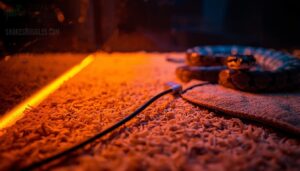
The probe is your thermostat’s only set of eyes — put it in the wrong spot and your whole temperature gradient control falls apart.
Follow these probe placement tips for accurate thermostat calibration:
- Rest the probe on the substrate surface directly above the reptile heat mat
- Secure it against a stable surface to prevent air-gap false readings
- Place your thermometer probe in the same spot for enclosure temperature mapping
- Use a separate thermometer at the cool end for full heat source positioning verification
Preparing Surfaces for Adhesive-backed Mats
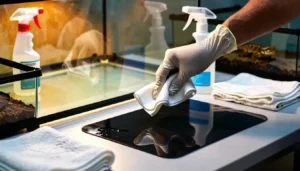
A poorly prepped surface is the fastest way to ruin an adhesive backing before it ever does its job.
| Surface Preparation Step | Why It Matters |
|---|---|
| Wipe with isopropyl alcohol | Removes oil, dust, and residue |
| Allow complete drying | Moisture blocks adhesive bonding |
| Confirm floor flatness | Gaps cause edges to lift |
| Apply on nonflammable surface | Prevents heat mat fire risk |
Managing Cords, Ventilation, and Surge Protection

Tangled cords and blocked vents are silent hazards in any multi-enclosure setup. Route power cords along the back or sides of your rack using cable ties — solid Cable Management Tips that keep things accessible during maintenance.
Always plug your reptile heat mat into a UL-listed surge protector for reliable electrical safety. Inspect cords weekly for fraying, and never block vent openings.
Avoiding Deep Substrate and Blocked Heat Transfer

Substrate Depth Issues matter more than most keepers expect. Keep substrate over the warm zone between 10–20 mm — anything deeper creates Thermal Blocking Prevention problems, where heat stays trapped below and never reaches your snake.
That’s Surface Contact Methods in action: thin, flat material transfers warmth efficiently. For Probe Positioning Tips, rest the thermostat probe at surface level to read actual reptile contact temperature, not buried substrate heat.
Top 5 Heating Options Compared
Not all heat mats are built the same, and when you’re running multiple enclosures, the differences really start to matter.
Each option below was chosen based on size range, temperature control, and practical day-to-day reliability.
Here’s how the top five stack up.
1. Oiibo Reptile Heating Panel
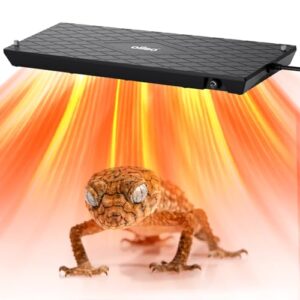
The Oiibo Reptile Heating Panel is a ceiling-mounted 60W unit designed to emit heat downward from beneath the terrarium lid, making it ideal for larger enclosures up to 48"L x 24"W x 24"H. Its built-in fan distributes warmth evenly, eliminating hot spots while preserving your snake’s day-night cycle by emitting no light.
The panel features a knob-style control for easy adjustment of ambient warmth. At $56.99, it offers practical functionality, though the manufacturer explicitly warns against using it with a thermostat or timer.
| Best For | Reptile owners with larger enclosures who want steady, light-free warmth for snakes, geckos, tortoises, or bearded dragons without the clutter of multiple heaters. |
|---|---|
| Power Output | 60W |
| Thermostat Compatible | No |
| Enclosure Size | Up to 48″L x 24″W x 24″H |
| Waterproof | Not specified |
| Installation Type | Lid-mounted |
| Suitable Animals | Snakes, geckos, tortoises, bearded dragons |
| Additional Features |
|
- Mounts under the lid and pushes heat downward, which mimics a more natural warm environment without messing with your reptile’s day/night cycle
- The built-in fan spreads heat evenly so you’re not dealing with hot spots in different corners of the tank
- One panel can replace several ceramic heaters, keeping your setup cleaner and simpler
- Can’t be paired with a thermostat or timer, so temperature control is fully manual — not ideal if you want set-it-and-forget-it automation
- Some buyers have reported units arriving defective, running loud, or giving off a chemical smell right out of the box
- May not keep up with heating demands in tanks at the upper end of its size range, especially in cooler rooms
2. ReptiKing Reptile Heat Pad
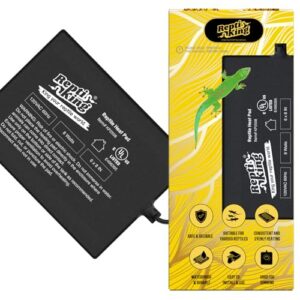
The ReptiKing Reptile Heat Pad offers a straightforward alternative to ceiling-mounted panels. This 8×12-inch, 16W under-tank mat is designed for small to medium enclosures, ideal for 10 to 20-gallon tanks. It provides a practical heating solution without unnecessary complexity.
Mounting is simple: the pad adheres cleanly to the exterior bottom or side of the enclosure using its adhesive backing. Its waterproof construction ensures durability in humid environments, preventing degradation over time.
For stable temperature control, the heat pad pairs effectively with an external thermostat, maintaining consistent floor temperatures. While not suitable for large enclosures as a sole heat source, it excels at creating targeted warm zones for daily use.
| Best For | Reptile owners with small to medium tanks (10–20 gallons) who want a simple, affordable way to keep bearded dragons, geckos, snakes, or lizards warm. |
|---|---|
| Power Output | Unspecified |
| Thermostat Compatible | Yes |
| Enclosure Size | Small to medium tanks |
| Waterproof | Yes |
| Installation Type | Adhesive-backed |
| Suitable Animals | Snakes, lizards, bearded dragons, hermit crabs |
| Additional Features |
|
- Sticks right to the bottom or side of the tank — setup takes minutes
- Waterproof build holds up well in humid enclosures and wipes down easily
- Energy-efficient and works great with a thermostat for steady, reliable heat
- Too small to heat a large enclosure on its own
- You’ll need to buy a separate thermostat to use it safely
- The adhesive backing isn’t repositionable, so you have to get placement right the first time
3. BN Link Reptile Heating Pad
BN-LINK tightens the specs with a familiar form factor. The 8×12-inch, 16W pad rapidly reaches 104–122°F and adheres directly to glass terrariums via its self-adhesive, waterproof backing.
Designed for 10 to 20-gallon setups, it occupies the sweet spot for corn snakes and ball pythons.
Pairing it with an external unit isn’t optional, it’s necessary due to the lack of a built-in thermostat. The 15-month warranty offers confidence for budget-conscious, multi-enclosure setups.
| Best For | Reptile keepers running multiple 10–20 gallon enclosures who want a reliable, no-frills heat mat without spending a lot. |
|---|---|
| Power Output | 16W |
| Thermostat Compatible | Yes |
| Enclosure Size | 10–20 gallon |
| Waterproof | Yes |
| Installation Type | Self-adhesive |
| Suitable Animals | Reptiles, amphibians, small animals |
| Additional Features |
|
- Heats up fast and holds a solid 104–122°F range, plenty of warmth for most reptiles
- Self-adhesive waterproof backing makes setup clean and simple on glass tanks
- 15-month warranty is a nice bonus at this price point
- No built-in thermostat, so you’ll need to buy a separate temperature controller
- Adhesive can weaken over time, especially in humid setups
- Some users have reported uneven heat distribution or partial pad failure
4. Kabasi Reptile Heating Pad
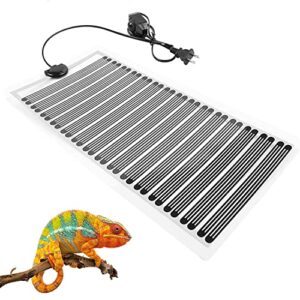
The KABASI reptile heating pad covers a 16.5 × 11-inch footprint at 20W, making it a practical fit for medium enclosures housing corn snakes or ball pythons.
Its waterproof, moisture-proof construction—crafted from PET and graphene carbon paste—withstands humid terrariums without degrading.
The non-adhesive design allows easy repositioning during tank reconfigurations, offering flexibility across multiple setups.
However, it won’t regulate itself, so an external thermostat is essential to maintain safe, consistent temperatures.
| Best For | Hobbyists and small-scale breeders looking for an affordable, flexible heating solution for reptiles, amphibians, or invertebrates in small to medium enclosures. |
|---|---|
| Power Output | 25W |
| Thermostat Compatible | Yes |
| Enclosure Size | Varies |
| Waterproof | Not specified |
| Installation Type | Non-adhesive |
| Suitable Animals | Reptiles, amphibians, invertebrates |
| Additional Features |
|
- Budget-friendly at just $19.99, making it easy to outfit multiple tanks without breaking the bank
- Removable and reusable design means you can take it with you when you upgrade or reconfigure your setup
- The built-in rheostat lets you dial in heat manually, handy for seasonal adjustments or different species’ needs
- No built-in thermostat or temperature display — you’ll need an external controller to keep things safe
- Can’t be covered with wood chips, coconut substrate, or towels, which limits substrate options and risks hot spots
- Some users have reported overheating issues and even fire hazards when used without proper temperature monitoring
5. Fipasen Reptile Heating Mat Adjustable
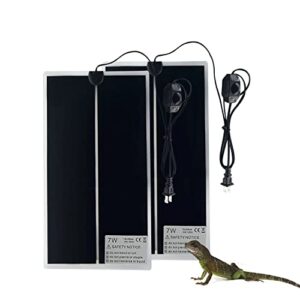
The FIPASEN Reptile Heating Mat stands out due to its built-in controller, allowing temperature adjustments between 68°F and 122°F without additional hardware—a significant advantage for budget-conscious users managing multiple enclosures.
The mat features a 7W carbon-film element that ensures even heat distribution across its 12×8-inch surface, encased in a flexible PVC shell designed to withstand repositioning without cracking.
For optimal use, keep the mat dry (as it is not waterproof) and allow 30 minutes for stabilization before relying on thermometer readings.
| Best For | Reptile and insect owners who want an affordable, low-wattage heating solution for small terrariums and don’t mind pairing it with a thermostat for precise control. |
|---|---|
| Power Output | 7W |
| Thermostat Compatible | Yes |
| Enclosure Size | Terrarium/vivarium |
| Waterproof | No |
| Installation Type | Non-adhesive |
| Suitable Animals | Reptiles, insects, tarantulas |
| Additional Features |
|
- Heats evenly across a solid 12×8-inch surface, giving your reptile a consistent warm spot
- Flexible and easy to reposition — works mounted vertically or horizontally on glass enclosures
- Compatible with thermostats, so you can dial in the exact temperature your pet needs
- No built-in temperature indicator, so you’ll need an external thermometer or thermostat to know what you’re actually getting
- Takes about 30 minutes to fully stabilize, which makes quick adjustments a bit frustrating
- Not waterproof and can be a fire risk if it shorts out — needs careful monitoring and proper setup
Managing Temperatures Across Multiple Enclosures

Running multiple enclosures means each snake has its own temperature needs, and getting those numbers right isn’t one-size-fits-all.
A ball python and a corn snake living side by side don’t share the same warm-side targets, so your setup has to reflect that.
Here’s what to know for each species and how to keep every enclosure dialed in.
Ball Python Temperature Range Planning
Ball pythons are one of the more forgiving species to manage across multiple enclosures — but their species-specific thermal requirements still demand precision. A proper temperature gradient gives each snake control over its own thermal regulation.
- Warm hide surface: 95–104°F
- Warm side ambient air: 88–92°F
- Cool side air: 75–80°F
- Nighttime drop: 70–78°F
- Humidity: 60–80% daytime, up to 100% at night
Corn Snake Temperature Range Planning
Corn snakes are more tolerant than ball pythons, but that doesn’t mean their needs are loose. Proper temperature gradient planning keeps your corn snake’s thermoregulation on track: warm side at 85–88°F, cool side around 75–78°F.
Use a reptile heat mat with a temperature-adjustable controller for enclosure climate control. Thermostat integration for precision control prevents dangerous hot spots without constant manual checks.
Monitoring Every Enclosure With Thermometers
Temperature monitoring demands a system, not guesswork. Use digital probe thermometers for precise warm-end and cool-end readings, and infrared guns for quick surface spot checks — two reading types working together.
Solid probe placement positions sensors at the snake’s level, away from vents and water bowls. Keep temperature logs daily to track conditions and ensure consistency.
Integrate thermostat systems with alert functions for real-time monitoring, and calibrate thermometers regularly to maintain accuracy across all tools.
Preventing Overheating and Hot Spots
A loose thermostat probe is all it takes to turn a safe setup into a danger zone. For heat mat safety and preventing overheating in enclosures, secure your probe flat on the substrate surface where your snake actually rests. Proper thermal gradient creation means one end stays warm, one stays cool.
Avoid blocking heat distribution with deep bedding, and always use a temperature adjustable controller to maintain safe installation standards.
Reducing Energy Costs With Thermostats
Cutting the costs of running those mats is the next key goal. Heat mat thermostats prevent continuous full-power operation, addressing the primary source of energy waste. By avoiding unnecessary power usage, these devices form the foundation for efficient heating management.
Smart thermostat systems amplify savings further through automated heating management, activating mats only when necessary. This precision, especially across multiple enclosures, ensures energy-efficient systems reduce monthly costs to under $2 per reptile heat mat. The cumulative impact of such temperature-adjustable controllers delivers significant long-term efficiency gains.
Maintaining Mats for Long-term Performance
Keeping mats running well costs less effort than replacing them. Wipe surfaces regularly with a damp cloth—that’s your first mat cleaning tip. Regular wear checks catch bubbles, cracked cords, or burned spots before they become real problems.
Use drip loops for cord protection methods, and store spares flat following safe storage practices. These steps ensure longevity and prevent avoidable damage during use or storage.
Prioritize preventing moisture damage by drying mats completely before powering them back on. This critical habit safeguards functionality and user safety.
Frequently Asked Questions (FAQs)
Can I put a heating pad under my snakes tank?
Yes, you can. A reptile heat mat works best mounted under one end of the glass tank, paired with thermostat control systems to regulate snake temperature needs safely and efficiently.
Should I leave my snakes heat pad on all night?
You can leave your snake’s heat pad on all night — but only if it’s connected to a thermostat.
Without thermostat control, overnight heat can spike dangerously beyond your snake’s safe range.
Is a heat lamp or heat mat better for snakes?
Both work, but each has a clear strength.
Heat lamps warm air from above, which better maintains temperature gradients across the full enclosure.
A reptile heat mat targets one warm zone, making it ideal for a hidden hide.
Can one thermostat control multiple heat mats?
One thermostat can control multiple heat mats if the total wattage stays within its rated capacity.
For true multi-zone control, use a dual-channel unit like the INKBIRD IPT-2CH, with separate thermostat probes per enclosure.
How often should heat mats be replaced?
Most heat mats last one to three years with daily use, though some run reliably for nearly a decade.
Replace yours when wear signs appear, heat output checks show drift, or safety inspection reveals cord damage.
Do heat mats work inside rack systems?
Yes, reptile heat mats work well inside rack systems. Mount them under plastic tubs with a small air gap for safe, uniform heat distribution.
Always pair with a thermostat for reliable multiple enclosure management.
Are heat mats safe for gravid females?
Used correctly, heat mats are safe for gravid females. Pair your reptile heating pad with a thermostat to prevent thermal stress.
Always make certain she can escape the warm zone.
Can heat mats cause respiratory issues in snakes?
Poor heat mat safety practices can disrupt humidity and temperature balance. Without proper snake enclosure ventilation and temperature control systems, respiratory health risks arise from bacterial growth or chronic stress.
Can heat mats be used under glass tanks?
Think of glass as a middleman — it passes warmth through, not perfectly, but well enough.
Under-tank heating works effectively beneath glass reptile enclosures when paired with a thermostat to ensure safe temperature control.
Do heat mats work with bioactive enclosure setups?
Heat mats can work in bioactive enclosure setups, but only as a secondary heat source. Thick substrate blocks heat transfer considerably, so pair any mat with a thermostat.
Prioritize overhead heating instead.
Conclusion
Picture a rack of enclosures humming quietly at night—every warm end holding steady, every snake coiled comfortably over its heat source. That’s what the right reptile heat mats for multiple enclosures deliver: not just warmth, but predictability your animals can count on.
Match mat size, control each zone with its own thermostat, and check your probes regularly. When the system runs right, your collection thrives without the guesswork.