This site is supported by our readers. We may earn a commission, at no cost to you, if you purchase through links.
A snake fed a calcium-rich diet, housed under bright lighting, still developing metabolic bone disease—this scenario plays out in reptile practices more often than most keepers expect.
The missing variable is almost never the food.
It’s the light.
Specifically, UVB radiation in the 290–320 nm range triggers the skin-based synthesis of vitamin D3, without which dietary calcium passes through the gut largely unabsorbed.
No D3 means no calcitriol, and without calcitriol, the intestinal transport proteins that pull calcium into circulation never activate.
Understanding how UV light helps snakes absorb calcium reframes the entire husbandry picture—from bulb selection to basking zone design.
Table Of Contents
- Key Takeaways
- Which UV Light Affects Calcium?
- How UVB Helps Calcium Absorption
- Why Calcium Matters for Snake Health
- What Happens Without Enough UVB
- Which Snakes Need Different UVB Levels
- How to Set Up UVB Safely
- How to Measure and Maintain UVB
- Frequently Asked Questions (FAQs)
- What does an UV light do for snakes?
- Does UVB light provide calcium?
- How do reptiles absorb calcium?
- Can seasonal changes affect a snakes UVB needs?
- Does stress impact how snakes use vitamin D3?
- How does melanin reduce UVB absorption in snakes?
- Can UVB exposure improve a snakes immune response?
- Do feeding schedules interact with UVB basking behavior?
- Conclusion
Key Takeaways
- UVB light in the 290–320 nm is the trigger for vitamin D3 synthesis in your snake’s skin—without it, dietary calcium can’t be absorbed, no matter how well you’re feeding.
- Bright visible light fools a lot of keepers, but it does nothing for calcium metabolism; only the right UVB wavelength activates the biological chain that ends with calcium reaching bone.
- Calcitriol—the hormone produced after UVB drives D3 through the liver and kidneys—can boost intestinal calcium uptake by up to 50%, something no oral supplement achieves without adequate UVB backing it.
- Bulb placement, material choice, and regular output measurement matter as much as bulb selection—glass and acrylic block nearly all usable UVB, and a fading bulb still glows long after its therapeutic output is gone.
Which UV Light Affects Calcium?
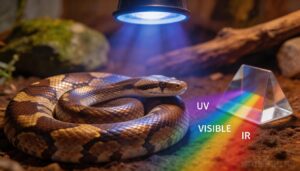
Not all UV light works the same way inside your snake’s body. The type of UV wavelength hitting the skin determines whether calcium absorption actually happens—or doesn’t.
UVB specifically (around 290–320 nm) is what triggers D3 synthesis, so if your bulb isn’t hitting that range, you may start noticing the signs your snake isn’t getting enough UV light no matter how bright the enclosure looks.
Here’s what separates the UV bands that matter from the ones that don’t.
UVB Vs. UVA in Snakes
UVA and UVB aren’t interchangeable—they do entirely different jobs. UVB, spanning 290–320 nm, drives vitamin D₃ synthesis in your snake’s skin, directly supporting calcium absorption. UVA, sitting above 320 nm, influences vision and coloration, behavioral enrichment, and photoreceptor distribution.
Melanin interaction affects how efficiently darker‑pigmented snakes process UVB.
Meeting your snake’s UVB lighting requirements for captive snakes at the right UVB intensity is what moves calcium—not UVA.
Desert species need high UVB output for desert species.
Why Visible Light Alone is Not Enough
Bright enclosures fool a lot of keepers. Visible light governs behavioral cues, but the visible light limitation is real—no amount of brightness triggers Vitamin D3 synthesis or facilitates calcium absorption.
Without the correct UVB lighting spectrum, hormonal balance dependency breaks down, immune function role weakens, and behavioral cue misinterpretation masks deficiency.
Melanin blocking effect compounds this further in darker snakes.
Importance of UVB for calcium metabolism in snakes can’t be overstated—UVA and UVB simply aren’t substitutes for each other.
UVB Wavelengths Linked to Vitamin D3 Synthesis
Not all UVB is equal. The action spectrum range of 290–320 nm drives vitamin D3 synthesis, with the ideal 297 nm wavelength triggering the most efficient photobiology of 7-DHC conversion. That wavelength-dependent yield matters—your UVB lighting spectrum must hit these peaks precisely.
Key UVB spectral peaks to understand:
- 290–300 nm — highest conversion efficiency
- Narrowband peak at 311 nm — still biologically active
- Above 315 nm — minimal UVB dose-response effect
Verify output with a calibrated UVB meter.
Why Calcium Absorption Depends on UVB, Not Brightness
bright enclosure doesn’t mean a healthy one—that’s the brightness misconception most keepers fall into.
Spectral specificity is what drives the previtamin D3 pathway, not visible intensity. The UVB dose-response relationship governs vitamin D₃ synthesis, which then activates the calcium transport mechanism in the intestine.
Without the right UVB lighting spectrum and UVB intensity, calcium absorption stalls—and metabolic bone disease follows.
How UVB Helps Calcium Absorption
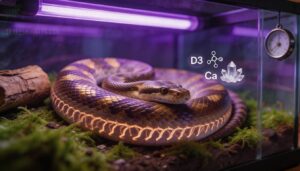
UVB doesn’t just light up your snake’s enclosure—it triggers a precise biological chain that ends with calcium actually reaching the bones. Each step in that process depends on the one before it, and a breakdown anywhere along the way means calcium goes to waste.
Here’s exactly how that chain works, from skin to skeleton.
UVB Converts Skin Compounds Into Previtamin D3
When UVB photons within the action spectrum range of 290–320 nm strike your snake’s outer skin layers, they hit a molecule called 7-dehydrocholesterol—the precursor sitting exactly where it needs to be. That photochemical conversion step opens the steroid’s B-ring, producing previtamin D₃. No enzyme triggers it.
The UVB dose-response matters: too little UVB lighting means the reaction simply stalls, halting vitamin D₃ synthesis entirely.
Basking Heat Completes Vitamin D3 Formation
Previtamin D₃ doesn’t finish the job on its own—it needs warmth to complete heat-driven isomerization into usable vitamin D₃.
That’s why heat-UVB synchronization matters: your snake must bask directly under the UVB beam, where skin temperature monitoring confirms the thermal gradient optimization is working.
Without adequate temperature thresholds at the basking site, vitamin D₃ synthesis stalls, and calcium absorption suffers regardless of UVB lighting quality.
Liver and Kidneys Activate Vitamin D3
Once vitamin D₃ forms in the skin, your body still has two more steps before it becomes useful. The liver runs CYP2R1 hydroxylation first—converting D₃ into 25‑hydroxyvitamin D₃, the primary circulating marker of vitamin D metabolism. Vitamin D transport then carries that intermediate to the kidneys, where CYP27B1 activation produces calcitriol—the hormone that actually drives calcium homeostasis.
- Liver enzyme variants (CYP2R1, CYP27A1) handle the first hydroxylation step
- Kidney hormone regulation via CYP27B1 completes vitamin D3 synthesis into active calcitriol
- Vitamin D binding protein keeps metabolites circulating until the kidney processes them
- Compromised organ function disrupts calcium absorption and accelerates metabolic bone disease risk
Calcitriol Increases Intestinal Calcium Uptake
Calcitriol is the hormone that actually opens the gate. Once it binds the VDR signaling receptor in intestinal cells, gene expression shifts—activating the TRPV6 channel at the cell’s entry surface, Calbindin protein for intracellular transport, and the PMCA1b pump for basolateral export.
That transcellular uptake pathway can raise calcium absorption by up to 50%, something no oral supplement triggers without adequate vitamin D3 synthesis behind it.
| Protein | Role | Triggered By |
|---|---|---|
| TRPV6 channel | Apical calcium entry | Calcitriol/VDR signaling |
| Calbindin protein | Intracellular calcium transport | Calcitriol activation |
| PMCA1b pump | Basolateral calcium export | Calcitriol/VDR signaling |
How UVB Supports Calcium-phosphorus Balance
Calcium doesn’t work alone—phosphorus regulation runs alongside it, and calcitriol signaling governs both.
UVB intensity effects on vitamin D3 synthesis directly shift the serum calcium ratio by enhancing intestinal uptake while suppressing parathyroid modulation that would otherwise pull calcium from bone.
Without adequate UVB intensity, the calcium phosphate ratio destabilizes, quietly setting the stage for metabolic bone disease before visible symptoms appear.
Why Dietary Calcium Alone May Not Be Enough
Feeding calcium-rich prey without UVB lighting is like filling a tank with a closed valve — the supply is there, but nothing moves through.
Without UVB, calcium-rich prey is just food your snake can never fully use
- Calcium Transport Mechanisms stall without calcitriol signaling.
- Precursor Skin Synthesis can’t begin without UVB wavelengths.
- Dietary Supplement Limits mean powders can’t replace the Role of UVB in vitamin D₃ synthesis.
- Endocrine Feedback Loops break down, raising metabolic bone disease risk.
- Species Metabolic Variability means calcium absorption gaps differ by snake.
Why Calcium Matters for Snake Health
Calcium does far more in a snake’s body than just building bones. It touches nearly every system—from how muscles contract to whether a female can produce viable eggs.
Here’s what’s actually at stake when calcium levels drop.
Bone Mineralization and Skeletal Strength
Your snake’s skeleton isn’t just calcium—it’s a collagen matrix hardened by hydroxyapatite crystals, and both components must develop correctly.
Without adequate vitamin D3 synthesis driven by UVB intensity measurement, bone mineralization stalls. Osteoid stays soft.
Cortical porosity increases, trabecular connectivity weakens, and mechanical loading adaptation fails.
The result is a skeleton that bends rather than bears weight—the structural foundation of metabolic bone disease prevention.
Muscle Function and Nerve Signaling
Skeletal integrity depends on calcium, but so does every contraction your snake makes.
At the neuromuscular junction, calcium release triggers acetylcholine transmission, which drives troponin activation inside muscle fibers.
Without adequate vitamin D3 supporting calcium absorption, that chain breaks down—producing tremors, weakness, and muscle fatigue.
Parathyroid hormone dysregulation and disrupted serotonin rhythm compound the problem, leaving hormonal regulation unstable and your snake visibly sluggish.
Growth in Juvenile Snakes
Juveniles push their metabolic rate hard—building vertebrae, skull, and muscle simultaneously. Without adequate UVB exposure, vitamin D3 synthesis stalls, calcium absorption drops, and skeletal ossification timing shifts off schedule.
That directly suppresses growth hormone levels and juvenile weight gain. Bone density suffers before visible deformity appears.
In corn snakes, UVB-exposed juveniles reached 196 nmol/L of circulating 25-hydroxyvitamin D3—more than triple controls—demonstrating how light cycle synchronization shapes early development.
Egg Production and Breeding Females
Growth demands are steep—but reproductive demand is steeper. In egg‑laying species, estrogen regulation triggers medullary bone formation, creating a fast‑access calcium reserve drawn down during shell gland function. Without sufficient vitamin D₃ synthesis and calcium metabolism in reptiles, that reserve depletes faster than it rebuilds.
UVB exposure guidelines for juvenile versus adult snakes diverge sharply here—breeding females need sustained UVB to support:
- Calcium mobilization from medullary bone during active shell formation
- Photostimulation timing to synchronize reproductive hormone cycles
- Role of UVB in reproductive hormone production, including estrogen and calcitriol
- Calcium absorption mechanisms mediated by vitamin D₃ to replenish intestinal uptake
- Shell gland function, which depends on consistent circulating calcium levels
Long-term Effects on Mobility and Lifespan
Chronic calcium deficiency doesn’t just weaken bones—it quietly dismantles your snake’s entire functional capacity.
Bone density loss and muscle wasting compound over time, producing mobility decline that mirrors what researchers observe in aging vertebrates.
untreated metabolic bone disease show reduced locomotion, impaired feeding strikes, and measurable longevity reduction.
Proper bone mineralization, driven by consistent UVB and calcium metabolism, is what separates a thriving animal from one in irreversible independence loss.
What Happens Without Enough UVB
UVB deficiency doesn’t announce itself loudly—it builds quietly until the damage is already done. The signs range from subtle behavioral shifts to serious structural collapse, and knowing what to watch for changes everything.
Here’s what actually happens when your snake isn’t getting enough.
Poor Calcium Absorption and Hypocalcemia
Without enough UVB intensity, Vitamin D3 synthesis through UVB exposure stalls—and calcium metabolism quietly unravels. Your snake’s gut can’t absorb dietary calcium efficiently, triggering parathyroid hormone imbalance that pulls calcium straight from the bone.
This bone resorption process depresses serum calcium monitoring values before visible symptoms appear. Stress-induced hypocalcemia compounds the problem, and enclosure behavior effects—like prolonged hiding—reduce usable UVB further, accelerating calcium deficiency toward metabolic bone disease.
Early Signs of Vitamin D3 Deficiency
Early vitamin D3 deficiency rarely announces itself loudly. Appetite decline often surfaces first—your snake refuses meals before bone deformities ever appear.
Watch for reduced mobility, stiff movement, and jaw weakness during feeding. Muscle twitching signals calcium metabolism starting to slip.
Shedding issues and dull body condition follow. These subtle cues, tied directly to dropping UVB intensity, demand attention well before metabolic bone disease takes hold.
Metabolic Bone Disease in Captive Snakes
Metabolic bone disease isn’t a sudden event—it’s the end result of prolonged UVB failure compounding calcium deficit over weeks or months. Captive snakes are especially vulnerable because husbandry gaps stack quietly.
Effective metabolic bone disease prevention demands combining vitamin D3 synthesis and calcium metabolism in reptiles through proper UVB lighting and maintenance best practices:
- Blood Biomarker Monitoring tracks 25-hydroxyvitamin D₃ decline before structural damage occurs
- Radiographic Bone Scoring confirms mineral density loss invisible to the naked eye
- Calcium Supplement Timing paired with active UVB exposure maximizes intestinal uptake
- Vitamin D3 Injection corrects severe deficiency when synthesis pathways can’t recover fast enough
- Rehabilitation Exercise Programs restore muscle tone alongside corrected UVB intensity guidelines
Soft Bones, Deformities, and Weak Jaw Tissue
Bone softening signs don’t appear overnight—they accumulate silently until the skeleton can no longer hold its shape. When vitamin D3 synthesis stalls due to inadequate UVB intensity, calcium metabolism breaks down structurally. Jaw tissue degradation makes feeding difficult; cartilage weakness destabilizes joints; fracture susceptibility turns routine movement into injury risk; spinal deformities lock in permanently without early intervention.
| Structure Affected | What You’ll Observe | Risk if Untreated |
|---|---|---|
| Jaw tissue | Pliable, rubbery lower jaw | Permanent feeding dysfunction |
| Spine | Visible kinks or lateral curves | Irreversible spinal deformities |
| Long bones | Bending under body weight | Spontaneous fractures |
Metabolic bone disease at this stage signals that bone health has been compromised far longer than the visible symptoms suggest.
Lethargy, Tremors, and Feeding Changes
Behavioral decline is often the first signal your calcium metabolism is failing—before bones visibly deform. Lethargy indicators, tremor patterns, and feeding refusal reflect worsening neuromuscular weakness tied directly to vitamin D3 deficiency from poor UVB intensity.
Health monitoring catches these early:
- Unusual stillness despite normal temperatures
- Muscle twitches progressing to tremors
- Sudden food refusal
- Coordination loss during movement
- Seizures in severe metabolic bone disease
Why Supplements May Fail Without Proper UVB
Calcium supplements won’t fix what a broken UVB setup creates.
Without adequate UVB lighting, calcitriol receptor activation stays suppressed—gut calcium transport stalls regardless of how much calcium dust coats your feeder.
Phosphorus imbalance worsens the problem, pulling metabolism further from bone mineralization.
UVB-driven D3 metabolite diversity and self-limiting D3 synthesis also prevent the toxicity risks that oral supplements carry, making proper UVB intensity non-negotiable for managing metabolic bone disease.
Which Snakes Need Different UVB Levels
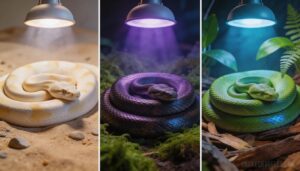
Not every snake needs the same amount of UVB—and getting that wrong can quietly undermine everything you’re doing right with diet and husbandry. Species, age, skin pigmentation, and natural habitat all pull the requirement in different directions.
Here’s how those factors break down across the most common captive snakes.
Low-UVB Needs in Nocturnal and Shy Species
Not every snake needs blazing UVB intensity — nocturnal reptiles and forest or shade-loving species thrive with minimal UVB exposure. A shade basking strategy works best here: brief, low-intensity access rather than constant overhead light.
Key reasons this matters for Vitamin D3 synthesis and calcium metabolism in reptiles:
- Nocturnal activity timing means shorter natural UVB windows
- Melanin effect slows synthesis in darker-pigmented individuals
- Species-specific tolerance keeps overexposure from triggering stress
- Ferguson Zone 1 sets the measurable UVB intensity standard
Moderate UVB Needs in Common Pet Snakes
Most common pet snakes fall between the extremes — they’re not sun-worshippers, but they’re not purely shade animals either.
That middle ground means that moderate UVB intensity, roughly Ferguson Zone 2–3, promotes healthy calcium metabolism without overwhelming them.
| Feature | Low UVB Setup | Moderate UVB Setup |
|---|---|---|
| UVB Intensity | ~0.35 UV Index | 1.0–2.6 UV Index |
| Daily Duration | 4–6 hours | 10–12 hours |
| Seasonal UVB Adjustment | Minimal | Recommended |
Automated UVB timers, UVB reflective surfaces, and careful UVB dose calibration through enclosure layout optimization keep exposure consistent and safe.
Ball Python, Corn Snake, and Boa Examples
Ball python nocturnality means they hide during peak daylight hours, so a 5–10% UVB tube placed 9–11 inches above the basking zone is enough to support vitamin D3 and calcium metabolism.
Corn snake activity patterns allow slightly more exposure at similar intensities.
Boas need careful boa basking height calibration—targeting UV Index 2.0–3.0—verified through UVB meter calibration.
Always confirm enclosure material choice allows UVB transmission.
Juvenile Vs. Adult UVB Considerations
Juvenile dosing demands more precision than adult maintenance—growing snakes are actively mineralizing bone, so gaps in UVB intensity compound quickly. Activity-driven exposure varies too: juveniles hide more, interrupting basking and lowering effective vitamin D3 synthesis. Age-specific UV index targets help prevent metabolic bone disease before it starts.
Age-specific UVB exposure guidelines:
- Juveniles: 10–12% UVB output
- Adults: 5–7% UVB output
- Molting cycle timing: maintain consistent UVB through sheds
- Juveniles: replace bulbs every 6 months
- Breeding females: temporarily increase UVB intensity
Skin Pigmentation and Enclosure Behavior
Darker snakes present a real dosing challenge.
Melanin UV absorption reduces how much UVB penetrates the epidermis, meaning skin photochemistry is less efficient even under adequate lighting.
Color basking and background matching compound this—a dark-morphed snake, gravitating toward shadowed hides due to thermal preference and pigment heat interaction, spends less time in the UVB zone, directly limiting Vitamin D3 synthesis through UVB exposure and the calcium absorption mechanisms mediated by vitamin D3.
Matching Exposure to Natural Habitat Patterns
Replicating natural habitat patterns means accounting for Seasonal UVB Variation, Diurnal Timing Patterns, and Weather-Driven UVB Fluctuations—not just peak intensity.
Ferguson Zones define Species-specific UVB needs across reptile species, guiding Basking Site Selection and Microhabitat Light Gradients within enclosures.
Designing UVB gradient and thermal zones in enclosures with timers reinforces Circadian rhythm regulation through UV exposure in reptiles, while UVB exposure guidelines for juvenile vs adult snakes guarantee appropriate dosing at every life stage.
How to Set Up UVB Safely
Getting the biology right is only half the work—the other half is building an enclosure that actually delivers UVB where your snake needs it. A few key decisions about bulb type, placement, and timing will determine whether your setup works or falls short.
Here’s what you need to get each one right.
Choosing The Right Bulb Type and Strength

Not every UVB bulb delivers what your snake actually needs. Spectrum Matching matters most—only bulbs hitting the Action Spectrum Range 290–320 nm drive vitamin D3 synthesis.
Prioritize Intensity Calibration over wattage labels, since UVB intensity at the basking surface determines real exposure. Factor in Lamp Lifespan, Heat Management, Energy Efficiency, and UVB degradation when selecting output strength—because a fading bulb still glows long after its UVB drops.
T5, T8, Mercury Vapor, and LED Options

Each bulb type carries real trade-offs that your snake’s health depends on.
- T5 fluorescent tube — strongest Spectral Output Consistency, best Enclosure Integration for taller setups
- T8 fluorescent tube — gentler output, suits low enclosures, shorter Bulb Replacement Schedule (~6 months)
- Mercury vapor lamps — combines heat and UVB, but limits control
- LED UVB lights — energy-efficient, yet long-term vitamin D3 safety unconfirmed
- Cost Comparison and Installation Safety — T5 wins overall reliability
Proper Bulb Distance and Basking Angle
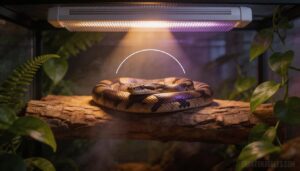
Distance is the single variable that makes or breaks your entire UVB lamp placement strategy. For most snake setups, 10–18 inches between the bulb and your snake’s back—measured at basking site height, not the enclosure floor—is the functional range. Mesh transmission loss can cut output considerably, requiring closer positioning.
Aim for direct overhead angle optimization; side-angled mounting disrupts calcium metabolism by creating unmeasurable UVB gradients that undermine consistent vitamin D3 synthesis.
Pairing UVB With a Heat Gradient
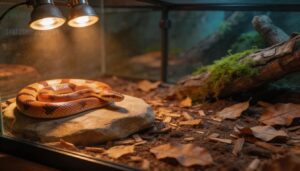
Once your bulb distance is dialed in, placement direction matters just as much. UVB Heat Pairing means positioning your UVB source and heat lamp over the same end of the enclosure—creating a Single Sun Zone where Behavioral Thermoregulation actually works.
- Align Heat Lamp Positioning directly above the basking site
- Overlap UVB intensity with peak thermal output
- Build a continuous Thermal Gradient Integration toward the cool end
- Support Calcium Metabolism and Bone Health through consistent basking behavior
- Follow UVB setup and maintenance best practices—temperature gradients must span the full enclosure length
Why Glass and Acrylic Block UVB
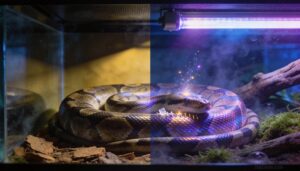
Even with your heat gradient dialed in, one overlooked mistake can erase all of it. Glass UV absorption happens because iron oxide impurities in standard soda-lime glass convert UVB photons into heat—blocking nearly 100% of the 290–315 nm spectrum.
Acrylic polymer blocking works similarly; Acrylic polymer works similarly; benzene rings dissipate UVB energy before it penetrates. Both glass and plastic barriers deliver zero usable UVB intensity inside.
Mount bulbs internally.
Daily Photoperiods for Diurnal and Nocturnal Snakes
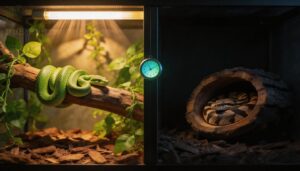
Once your bulb is mounted internally, photoperiod becomes the next variable.
Diurnal snakes need 10–14 hours of light phase length; nocturnal reptile species need extended darkness quality—genuine dark, not dim.
Use timers for timing consistency, avoiding abrupt on/off switches that disrupt circadian rhythm regulation through UV exposure in reptiles.
Seasonal day shifts can signal breeding cycles when applied gradually alongside stable UVB lighting schedules.
How to Measure and Maintain UVB

Getting the bulb in place is only half the job.
What actually determines whether your snake is thriving—or quietly falling short—is whether you’re measuring, monitoring, and maintaining that output over time. Here’s what that process looks like in practice.
Using a UV Index Meter or Solarmeter
A Solarmeter 6.5 removes the guesswork. Hold the sensor pointed upward—sensor positioning matters, since shading it skews the UV index reading entirely.
Follow a consistent calibration procedure: measure midday, record reading timing alongside your result, and note any shade impact from decor or barriers. Data logging these readings over weeks reveals real UVB dose trends, keeping your UVB exposure guidelines achievable and verifiable.
Creating a Usable UVB Gradient in The Enclosure
A well-designed UVB gradient isn’t about flooding the enclosure with light—it’s about giving your snake a choice. Sunbeam Layout concentrates peak UVB over the basking zone while a Shade Retreat on the opposite end stays UV-free.
- Position the lamp over two-thirds of the enclosure
- Use UVB Gradient Mapping to verify intensity drops across zones
- Apply Enclosure Zoning to separate basking from retreat areas
- Check Material Transparency—mesh reduces UVB dose measurably
- Confirm UVB lamp placement delivers species-appropriate UVI at basking height
When to Replace Aging Bulbs
Most keepers get tripped up by Visible Brightness Mislead—a bulb still glowing doesn’t mean it’s still working.
UVB degradation over time is invisible to the eye, so Output Decline Monitoring with a Solarmeter 6.5 is non‑negotiable.
Heat Degradation Rate accelerates in hot basking zones, and Fixture Blocking Effects compound the loss.
Track Operating Hours Threshold—replace T8s every six months, T5s annually—before UVB output stability collapses silently.
Cleaning Fixtures Without Reducing Output
Dirty fixtures quietly steal UVB output—no alarm, no warning light. Lens Dust Removal and Reflector Efficiency Restoration recover delivered µW/cm² without touching the bulb.
Follow this UVB lighting maintenance sequence:
- Safe Power Down before any contact
- Soft-brush loose debris first
- Chemical Free Wiping with a damp cloth
- Clear Vent Airflow, Maintenance openings
- Verify output with your Solarmeter afterward
Signs of Underexposure Vs. Overexposure
Too little UVB and too much both carry real consequences for calcium metabolism.
UVB underexposure mirrors Shadow Detail Loss in photography—critical biological processes go dark, triggering risks of UVB deficiency, hypocalcemia, and metabolic disease.
UVB overexposure resembles Highlight Clipping—corneal opacity, skin erosion, and stress-induced immunosuppression emerge.
Watch for Color Desaturation in behavior, Histogram Shifts in activity levels, and Noise Introduction through abnormal shedding.
Tracking Shedding, Activity, and Bone Health
Your records are the diagnostic trail you’ll thank yourself for later. A Shed Logbook capturing blue-phase dates, eye-clearing intervals, and shed completeness reveals humidity and UVB trends over months.
Pair it with an Activity Log, Mobility Scoring, and Growth Rate Monitoring every 2–4 weeks.
Together, these tools make the importance of UVB for calcium metabolism in snakes impossible to overlook.
Frequently Asked Questions (FAQs)
What does an UV light do for snakes?
Ever wonder why your snake seems more alert under the right lighting?
UVB drives vitamin D3 synthesis, aids hormonal regulation, facilitates calcium absorption, and prevents metabolic bone disease—benefits no visible-spectrum bulb can replicate.
Does UVB light provide calcium?
UVB light doesn’t deliver calcium directly — it triggers vitamin D3 synthesis in your snake’s skin, which then drives calcium absorption from food. Without UVB, that entire metabolic chain stalls.
Choosing the right supplement to support that process matters, and this guide to the best vitamins for snake health can help you avoid the stacking mistakes that lead to D3 toxicity.
How do reptiles absorb calcium?
Reptiles absorb calcium through the intestinal wall via calcitriol-activated gut transport proteins. Without adequate vitamin D3 from UVB lighting, even calcium-rich diets fail—leaving bones vulnerable to metabolic bone disease.
Can seasonal changes affect a snakes UVB needs?
Yes, seasonal changes absolutely affect your snake’s UVB needs.
Sun Angle Variability, shorter photoperiods, reduced Temperature Basking, and Metabolic Demand Shifts all alter effective UVB intensity—so adjust lighting to compensate year-round.
Does stress impact how snakes use vitamin D3?
Stress quietly undermines vitamin D3 synthesis.
Elevated corticosterone modulation disrupts kidney activation, impairment of calcitriol, reduces basking behavior shift, and weakens calcium metabolism and bone health—even when UVB exposure remains constant.
How does melanin reduce UVB absorption in snakes?
Melanin shielding works like a built-in spectral filter.
Pigment density in darker snakes drives UVB attenuation before those rays reach vitamin D3-producing skin layers—photoprotective mechanisms that balance UVB light exposure without eliminating it entirely.
Can UVB exposure improve a snakes immune response?
UVB exposure can improve immune function, but only at the right dose. Calcitriol drives Vitamin D Immunomodulation, supporting Leukocyte Activation and Cytokine Regulation—while overexposure triggers immunosuppression.
UVB Dose Balance determines whether your snake benefits or suffers.
Do feeding schedules interact with UVB basking behavior?
Feeding timing shapes how much UVB your snake actually uses.
Post-meal basking drives vitamin D3 synthesis, so meal timing, feeding location effect, and activity rhythm synchronization all determine whether dietary calcium gets properly absorbed.
Conclusion
Regarding calcium absorption, you can’t "shine a light" on the issue without considering UVB’s key role. A well-designed UVB setup is the linchpin of calcium metabolism in snakes.
By understanding how UV light helps snakes absorb calcium, you’ll create a supportive environment that fosters strong bones and overall health. Proper UVB exposure, paired with a balanced diet, ensures its snake thrives—don’t leave its calcium needs in the dark; brighten its path to wellness with informed care.