This site is supported by our readers. We may earn a commission, at no cost to you, if you purchase through links.

A heat mat running without a thermostat can hit 140°F in minutes—hot enough to cause deep-tissue burns before your snake shows a single outward sign of distress. That’s the part most keepers don’t realize: by the time you notice something’s wrong, the damage is already done.
Snakes can’t pull away from a heat source the way we’d yank a hand off a hot stove. They sit. They absorb. And internal tissue cooks silently.
Getting the setup right—correct temps, proper controls, smart placement—is the difference between a thriving snake and a vet emergency.
Table Of Contents
Key Takeaways
- An unregulated heat mat can spike to 140°F in minutes, causing deep-tissue burns your snake won’t visibly show signs until hours after the damage is done.
- A thermostat isn’t optional—it’s the only thing standing between your snake and a surface hot enough to burn tissue silently from the inside out.
- Keep your warm side between 88–92°F, cover only one-third of the enclosure floor, and always verify temperatures with an infrared thermometer—not just your probe.
- Watch for avoidance of the warm side, reddened belly scales, or unusual stillness—these are your earliest warnings before burns become a veterinary emergency.
Can Heat Mats Burn Snakes?
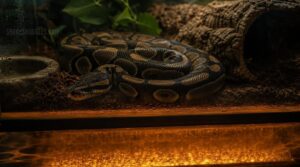
Yes, heat mats can absolutely burn your snake — and most owners don’t realize it until the damage is already done. Without a thermostat, surface temperatures can spike fast, and your snake won’t move away in time.
A thermostat is non-negotiable — check out these ball python habitat tips to set up a safe, burn-free enclosure from the start.
Here’s what you need to know about the risks before we get into how to prevent them.
Yes, Without Regulation
Yes — an unregulated heat mat can absolutely burn your snake. Without a thermostat, there’s no cutoff, no limit, nothing stopping continuous overheating from climbing to dangerous levels.
Thermostatless hazards compound quickly: probe failure removes the only feedback loop, temperature drift goes undetected, and the mat keeps running.
Deep tissue burns can develop silently before your snake shows any distress.
Dangerous Temperature Spikes
Unregulated mats can spike to 140°F within minutes — that’s Thermostat Failure Overshoot in action. A loose probe triggers Probe Misplacement Effects, reporting false readings while the mat keeps climbing. Hot Spot Formation concentrates heat unevenly across the floor. Watch for these four warning signs:
- Temperature drift beyond ±2°F
- No overheat alarm response
- Heat Soak Persistence after shutoff
- Unexplained heat mat burnout
Silent Deep-tissue Burns
Spikes cause surface damage — but the real danger lies in hidden tissue damage, which develops silently long before scales show visible signs. Thermal latency in heat mats means safety failures don’t manifest immediately; delayed swelling and subclinical inflammation emerge hours later. Pain perception masking keeps snakes still, worsening prolonged contact with heat sources.
National statistics on burn admissions reveal that thermal injury prevalence data confirm thermal burns are the most common mechanism, underscoring heat-mat risks for snakes.
| Burn Layer | Visible Sign | Timeline |
|---|---|---|
| Surface | Reddened scales | Minutes |
| Mid-tissue | Delayed swelling | 2–6 hours |
| Deep tissue | Blackened skin | 12–24 hours |
Signs of Overheating
Your snake’s behavior tells you what your thermometer might miss. Watch for these overheating risk signals:
- Avoidance behavior — retreating permanently to the cool side
- Skin flushing — reddened ventral scales at contact points
- Rapid respiration — open-mouth breathing under heat stress
- Lethargic posture — unusual stillness from elevated body temperature
- Excessive shedding — triggered by repeated thermal injuries
Temperature variance monitoring catches these patterns early.
When Burns Become Emergencies
Third-degree burns — charred, leathery, or white-patched skin — are emergencies. So are large-area burns exceeding 3 inches, circumferential limb burns that cut off circulation, and critical facial injuries near the eyes or mouth.
Thermal injuries from unregulated heat mats can escalate fast. Don’t wait for your snake to decline — burns of this severity need a reptile vet immediately.
Setting up safe heat mat placement in your snake’s enclosure with a proper thermostat is the simplest way to prevent these burns from happening in the first place.
Safe Heat Mat Temperatures
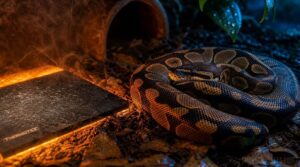
Getting the temperature right isn’t complicated — but the margin for error is smaller than most people think.
Your snake’s warm side needs to stay within a specific range to support digestion, immunity, and overall health.
Here’s what those numbers actually mean and why each one matters.
Warm Side 88–92°F
Maintain your warm side between 88°F and 92°F — that’s the temperature setpoint ensuring safe thermoregulation for most captive snakes. Gradient Balance is critical: provide a cooler retreat zone, avoiding a uniformly hot environment.
Probe Accuracy and Air‑Temp Calibration are interdependent; your thermostat relies entirely on the probe’s readings.
Monitor for Seasonal Temperature Drift, which can gradually shift readings beyond the target range.
Avoid Temperatures Above 100°F
Once surface temperatures cross 100°F, you are past the temperature safety threshold. Thermostat overshoot becomes a real risk, especially if probe accuracy is compromised or ventilation issues trap heat near the floor.
Hot spot detection is critical in these conditions. Always check multiple points using an infrared thermometer, not just a single location, to ensure accuracy.
Overheating prevention and heat mat safety rely on consistent temperature monitoring, not assumptions. Prioritize vigilance to avoid hazards.
Lethal Heat Above 110°F
Above 110°F, you have crossed the lethal temperature curve — and the margin for error disappears fast. Fatal heat duration can be measured in minutes, not hours. Rapid burn onset means irreversible tissue damage begins before a snake shows distress.
Above 110°F, fatal heat damage begins before your snake ever shows distress
Core overheat fatality is a real outcome at these levels. This isn’t a heat mat hazard you can walk back.
Temperature safety thresholds exist for a reason: overheating prevention and heat mat safety depend on never letting it get here.
Species-specific Temperature Needs
Not every snake runs on the same thermal blueprint. Ball Python heat tolerance sits around 88–92°F, while a Corn snake optimum skews slightly cooler. A Desert king snake tolerates drier, warmer gradients.
A Boa constrictor gradient requires more floor space to function effectively. Garter snakes demand cooler ambient swings due to their seasonal needs.
Match your thermostat and heat mat placement to your actual species — not a generic chart.
Stable Readings Within 2°F
A swing wider than 2°F indicates potential issues like improper probe placement, substrate shifts, or drafts. Digital thermostats with PID tuning hold setpoints within ±0.5°F, unlike basic on/off units, which lack comparable precision.
Run a calibration routine weekly: cross-check your probe against an infrared gun, monitor sensor lag compensation gaps, and address probe drift failures. This prevents tissue damage to your snake caused by undetected temperature inconsistencies.
Prevent Burns With Proper Setup
Getting the temperature right is only half the job — the setup around it determines whether your snake actually stays safe. A few straightforward adjustments make the difference between a well-regulated enclosure and a burn risk.
Here’s what to get right before your snake ever touches that warm side.
Understanding whether heating mats are safe for snakes can save your pet from burns they’d never signal until it’s too late.
Use Reptile-grade Thermostats
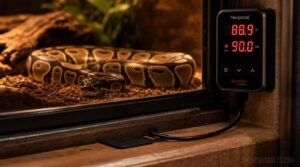
A reptile-grade thermostat isn’t optional — it’s the single component standing between your snake and a 140°F mat surface.
Digital PID thermostats use proportional control to adjust heat output smoothly, holding temperatures within ±0.5°F. Look for:
- Dual-output support for simultaneous heater control
- Weather-resistant housing with a moisture-proof thermostat probe
- Battery backup, alarm shut-off, and a weekly calibration routine
Temperature monitoring catches drift before it causes burns.
Warm Zone, Not Whole Tank

Thermostat control locks the temperature — gradient design decides where that heat goes. Cover one-third to one-half of the floor only. That’s your heat zone zoning boundary.
The cool refuge placement on the opposite end completes the thermal gradient, giving your snake a real choice.
Oversized mats erase that choice entirely — and a snake stuck on a uniformly warm surface can’t escape the heat.
Correct Probe Placement
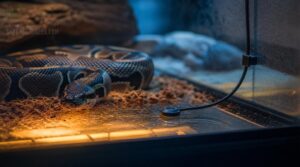
The mat controls the heat — the probe tells the thermostat what that heat actually is. Get probe placement wrong, and your digital thermostat is flying blind.
Keep these positioning rules tight:
- Wall Height Alignment: Set the probe at the snake’s resting height, not the floor edge.
- Air Gap Prevention: Ensure flush contact against the surface — no loose substrate between probe and glass.
- Strain Relief Methods: Secure the cable so the probe can’t shift when your snake moves.
Material Interface Matching and Probe Insulation Strategy also matter. If you swap substrates or liners, re-validate placement — same spot, different material, different reading.
Check With Infrared Thermometer
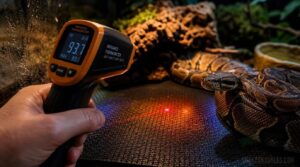
Your probe confirms what the thermostat sets—an infrared thermometer validates what your snake actually experiences. Scan multiple points across the warm zone; this is Multiple Point Scanning detecting uneven heat distribution.
Mind Emissivity Calibration for accurate surface material influence readings, as different materials affect temperature measurements. Always check after the mat stabilizes—Measurement Timing is critical for reliability.
Adjust Spot Size Optimization by maintaining close proximity to the target area. Prioritize safety: no surprises, no burns.
Add Alarm Shutoff Features
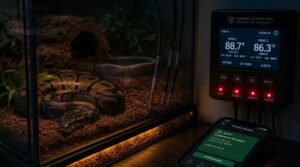
Temperature Thresholds trigger within 2 seconds of exceedance, ensuring rapid response to unsafe conditions.
Redundant Probes cross-check each other, detecting heat mat failures before burns occur and enhancing system reliability.
Alarm Logging records every event for thorough review, maintaining a detailed history of system activity.
Safety Interlocks prevent reactivation until manual inspection is completed, enforcing critical maintenance checks.
Remote Alerts notify your phone in under 5 seconds, enabling immediate awareness of potential issues.
Substrate and Placement Safety

How you place the mat—and what sits on top of it—changes everything. The wrong substrate or an oversized mat can quietly push temperatures into dangerous territory before you notice.
Here’s what to get right.
Cover One-third Enclosure
One rule controls heat mat ratio above everything else: cover only one-thirds of the enclosure floor. That single decision drives your entire thermal gradient. A proper Zone Boundary Design gives your snake real Cool Retreat Access — not just a warm box.
- Warm hide sits directly over the mat
- Cool hide anchors the opposite end
- Hide Placement Strategy defines the gradient boundary
- Gradient Calibration depends on thermostat precision
Hide Placement Strategy and thermostat precision collectively ensure the thermal gradient functions as intended, providing critical temperature variation for the snake’s health.
Avoid Oversized Heat Mats
Bigger isn’t better here — it’s a liability. An oversized mat destroys Gradient Uniformity by heating floor space your snake never uses, throwing off your entire thermal gradient design.
Mat Area Ratio matters: Excess coverage creates Heat Spot Detection nightmares and harms Power Efficiency. Properly managing mat size prevents these critical issues.
Stick to properly sized or Custom Cut Mats. Heat mat sizing is the foundation of safe heat mat installation.
Substrate Affects Heat Transfer
What’s under your snake matters as much as what’s above it. Substrate depth and thermal conductivity directly shape how much heat actually reaches your animal — and how fast.
- Thin paper towel or aspen transmits heat within 5°F of your mat setting
- Loose coconut fiber adds substrate insulation, dropping surface temps 9–14°F
- High material thermal mass smooths spikes but slows warm-up
- Moisture influence is real — wet substrate conducts heat differently than when dry
Use Tile Heat Guards
Ceramic or porcelain tile placed directly over your heat mat acts as a heat mat guard, diffusing radiant heat before it contacts your snake. Material selection matters here: Ceramic withstands temperatures above 400°F without warping.
For installation, extend the tile slightly beyond mat edges to optimize coverage. This ensures even heat distribution and protects the mat’s surface.
Wipe tiles weekly — a basic cleaning routine prevents insulating buildup and aids consistent temperature monitoring. This maintenance step is critical for safety and efficiency.
Recheck After Substrate Changes
Swap the substrate, and your thermal gradient shifts — sometimes dangerously. Recheck these five things immediately:
- Confirm probe placement hasn’t moved during the change
- Run hot spot mapping across the warm zone with an infrared thermometer
- Assess moisture impact if the new substrate holds humidity
- Monitor temperature drift over 24 hours post-change
- Watch for behavioral observation adjustments — burrowing changes contact time near the mat
Top 3 Heating Products
Getting the temperature right is only half the battle — you also need equipment that won’t let you down. The right products make it easier to stay within safe ranges without constant adjustments.
Here are three worth considering.
1. Aiicioo Under Tank Heater Thermostat
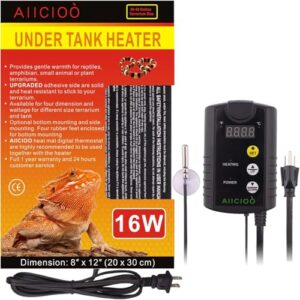
The Aiicioo Under Tank Heater Thermostat pairs a 16W, 8×12-inch heating pad with a built-in digital thermostat, eliminating the need to purchase components separately. This integrated design ensures seamless compatibility, allowing you to focus on setup rather than troubleshooting.
Set your target temperature and position the probe 1–2mm beneath the substrate directly above the mat. The thermostat then automatically regulates heating cycles to maintain the desired environment.
One key limitation is that the system uses simple on/off cycling, not proportional control, which may cause temperature fluctuations of 10–15°F. To ensure accuracy, verify with an infrared thermometer weekly.
| Best For | Reptile and invertebrate owners who want a simple, all-in-one heating solution without hunting down a separate thermostat. |
|---|---|
| Primary Use | Reptile terrarium heating |
| Heat Retention | Steady 104°F–122°F output |
| Safety Features | Adhesive stability, thermostat cutoff |
| Temperature Control | On/off digital thermostat |
| Portability | Adhesive-mount, not portable |
| Warranty/Support | Standard manufacturer warranty |
| Additional Features |
|
- Comes as a combo set — the heater and thermostat are already matched, so no guessing on compatibility.
- Strong adhesive holds up over time, so you’re not constantly fussing with a pad that keeps sliding or peeling.
- Works for more than just reptiles — handy for seedling trays, sourdough proofing, or other low-temp hobby uses.
- The on/off thermostat can swing 10–15°F before it kicks back in, which isn’t ideal for animals that need tight temperature control.
- Struggles in cooler rooms — if your space runs around 70–72°F, the pad may not keep up.
- Once it’s stuck, it’s stuck. Repositioning after bonding is a real headache and can mess up performance.
2. Maxdee Hot Stone Massage Kit
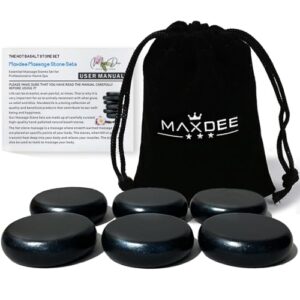
The Maxdee Hot Stone Massage Kit is a six-piece basalt set designed for human spa work, not reptiles. However, some reptile keepers repurpose these smooth basalt stones as passive heat diffusers over under-tank mats. The stones effectively spread heat evenly, reducing localized hot spots. Each stone measures approximately 2.4 × 2.4 inches, making it a manageable size for a warm-side hide.
When using these stones, pairing them with external temperature control is essential, as the kit lacks an integrated thermostat. Never use them unregulated, as this poses significant safety risks. Proper regulation ensures consistent, safe heat distribution for reptile enclosures.
| Best For | Anyone who wants an affordable, easy-to-use hot stone set for home spa sessions, athletic recovery, or light professional massage work. |
|---|---|
| Primary Use | Therapeutic muscle relief |
| Heat Retention | Basalt retains heat well |
| Safety Features | Monitor temp to avoid burns |
| Temperature Control | Manual flip and monitor |
| Portability | 6 lightweight stones |
| Warranty/Support | 1-year warranty, lifetime support |
| Additional Features |
|
- Basalt heats up fast and holds warmth long enough for a solid massage session
- At $14.99, it’s a steal — great entry point for beginners or casual home use
- Works with essential oils, so you can level up the relaxation without buying extra gear
- Heat can spread unevenly, so you’ll need to flip the stones and keep an eye on temps to avoid burns
- These are natural stone — drop one and it may chip or crack, so they’re not the most durable option
- Heat retention is decent but won’t match higher-grade professional stones, which may matter in a clinic setting
3. DREO Portable Space Heater with Remote

Unlike the basalt stones, the DREO Portable Space Heater isn’t a contact heat source — it warms ambient air instead. That distinction matters.
It runs a 1500W PTC ceramic element with a precise NTC thermostat adjustable in 1°F increments, capping at 95°F. The remote control and 12-hour timer let you manage room temperature without touching the unit.
For snakes needing warmer ambient air in cooler rooms, it’s a practical supplement — not a replacement for an under-tank mat.
| Best For | Snake keepers in cooler rooms who need a quiet, hands-free way to raise ambient air temps without adding another heat mat. |
|---|---|
| Primary Use | Room space heating |
| Heat Retention | PTC ceramic rapid heat |
| Safety Features | ETL certified, tilt sensor, overheat shutoff |
| Temperature Control | NTC chipset, 1°F increments |
| Portability | Built-in handle, tower form |
| Warranty/Support | ETL certification backing |
| Additional Features |
|
- Dead quiet at 34 dB — won’t stress out a light-sleeping snake (or owner)
- Remote and 12-hour timer mean you can set it and forget it
- Precise 1°F thermostat control helps you dial in temps without overshooting
- No oscillation, so heat distribution depends entirely on the fan
- One user reported it died after about 6 weeks of light use — durability is a question mark
- Running it on high continuously will bump your electricity bill noticeably
Frequently Asked Questions (FAQs)
How to tell if your snake is burned?
Burns don’t always announce themselves. Look for scale discoloration — pink, gray, or white patches — leathery texture, or blistering along the belly.
Avoidance of the warm side is often the first clue.
Can reptile heat mats catch fire?
Yes, they can. A faulty mat with damaged wiring can arc near flammable substrate and ignite it.
Always use a GFCI outlet, inspect cords regularly, and keep mats away from wood surfaces.
Can heat mats cause fires if left unattended?
Heat mats can absolutely start fires if left unattended. A faulty cord, missing thermostat, or moisture exposure can trigger electrical arcing.
If the mat sits on wood or fabric, ignition can occur rapidly.
How often should I replace my heat mat?
Replace your heat mat every 2–5 years — sooner if you notice frayed cords, inconsistent temperatures, or strange odors. Don’t wait for failure. When in doubt, swap it out.
Are heat mats safe for hatchlings and juveniles?
Safe, scrutinized setups work for hatchlings — but the margin for error shrinks fast. Juveniles can’t escape a hot spot the way adults can, so stricter temperature control and daily monitoring aren’t optional.
Can I use a heat mat with a wooden enclosure?
You can — but wood needs protection.
Place a non-combustible barrier, use a thermostat, and keep surface temperatures under 100°F to prevent scorching or fire.
Conclusion
A heat mat burn can quietly destroy more tissue than a week of visible wounds ever reveals. That’s the real danger—what your snake can’t tell you.
Now you know the temps, the controls, the placement. You know what a thermostat does and why substrate thickness changes everything. Can a heat mat burn my snake? Yes.
Every unregulated setup is a countdown. Lock in your temperatures, verify with a thermometer, and keep the guesswork out of your enclosure entirely.