This site is supported by our readers. We may earn a commission, at no cost to you, if you purchase through links.

A gopher snake cornered near a hiking trail will flatten its head, coil up, and shake its tail against the dirt, doing a convincing rattlesnake impression. People back away, hearts pounding, and sometimes that’s the right call. But mistaking one for the other has real consequences, whether it’s unnecessary fear of a harmless snake or, far worse, overconfidence around a venomous one.
These two species share territory across North America, and they cross paths with humans constantly. Knowing the difference between a rattlesnake vs gopher snake doesn’t take a biology degree. A few key details are all you need.
Table Of Contents
- Key Takeaways
- Rattlesnake Vs. Gopher Snake: Key Differences at a Glance
- Body Shape, Head, Tail, and Markings: What You Can See From a Distance
- Rattle or Tail Buzz? How Their Defensive Displays Compare
- Rattlesnake Vs. Gopher Snake: Habitat, Range, and Hunting
- What to Do if You Can’t Tell Them Apart
- Frequently Asked Questions (FAQs)
- How can you tell the difference between a gopher snake and a rattlesnake?
- Do gopher snakes scare away rattlesnakes?
- Can a rattlesnake breed with a gopher snake?
- Can a gopher snake hurt you?
- How do you tell the difference between a rattlesnake and a gopher snake?
- How do you tell if it’s a gopher snake?
- How can you tell if a snake is a rattlesnake?
- What rattlesnake looks like a gopher snake?
- How to tell the difference between a rattlesnake and a gopher snake?
- Do rattlesnakes avoid gopher snakes?
- Conclusion
Key Takeaways
- The single fastest way to tell these snakes apart is the tail: a rattlesnake has a segmented rattle that makes an unmistakable clicking sound, while a gopher snake’s tail simply tapers to a plain tip.
- Gopher snakes are expert bluffers — they flatten their heads, coil up, and buzz their tails to mimic a rattlesnake’s warning display, but that’s all it is, a bluff, since they carry no venom and can’t seriously hurt you.
- Head shape is your backup field check: a rattlesnake’s head is broad and distinctly triangular with a clear neck constriction, while a gopher snake’s head is narrow, oval, and blends smoothly into its body.
- When you can’t make a confident ID, the safest move is to back away and leave the snake alone, since most bites happen during handling attempts, not accidental encounters.
Rattlesnake Vs. Gopher Snake: Key Differences at a Glance
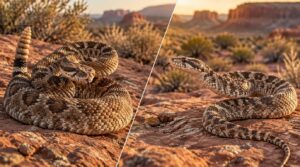
Although these two snakes share similar body coloring, only one of them can send you to the emergency room. Rattlesnakes are venomous pit vipers; gopher snakes are harmless constrictors. That single difference changes everything about how you should respond when you spot one on the trail.
The gopher snake even mimics rattlesnake behavior by coiling and hissing when threatened, making it one of the most convincing examples of non-venomous snakes with rattlesnake-like markings.
The fastest field tell is the tail. A rattlesnake produces an audible tail vibration using its iconic rattle, and it’s a warning you genuinely won’t mistake. Gopher snakes have no rattle at all.
Head shape is your next checkpoint. Rattlesnakes carry a distinctly triangular head, while gopher snakes have a narrower, more rounded profile. Their habitat overlaps heavily in arid regions, which is exactly why knowing these key differences before you head outdoors matters.
A snake identification field guide tucked in your pack gives you a quick visual reference for head shape comparisons when you’re unsure in the moment.
Body Shape, Head, Tail, and Markings: What You Can See From a Distance
Those key differences become even more useful when you can spot them from a safe distance. Here’s what to look for:
- Head shape contrast: Rattlesnakes have a broad, triangular head that abruptly widens from the neck. Gopher snakes carry a narrow, elongated head that blends smoothly into the body.
- Body coloring and scale pattern: Rattlesnake blotches are bold and irregular. Gopher snakes show a consistent, ladder-like saddle pattern along the dorsal surface.
- Tail tip: A rattlesnake’s segmented rattle is visible at rest. Gopher snake tail vibration produces no rattle, and the tail itself tapers plainly.
Rattlesnakes are also stockier near the shoulders with a pronounced neck constriction. Gopher snakes stay uniformly wide, a reliable tell across their shared habitat preferences.
This body shape difference is especially consistent across diverse North American snake habitats, where gopher snakes and rattlesnakes frequently overlap.
Rattle or Tail Buzz? How Their Defensive Displays Compare

Once you’ve noticed the tail, watch what it does. Gopher snakes are masters of tail vibration mimicry, buzzing their tails against dry leaves or gravel to sound like a rattlesnake. That’s Batesian mimicry in action, a harmless species copying a dangerous one’s signal to scare off would-be predators. This behavior is so remarkable that it’s featured in several wildlife behavior nature documentaries, where slow-motion footage reveals just how precisely the gopher snake times its bluff.
Here’s how their defensive displays actually differ:
- A rattlesnake’s rattle clicks rapidly and resonantly, each hollow segment amplifying the sound
- A gopher snake produces a faint, irregular buzz only if frayed scales scrape a rough surface
- Rattlesnakes rattle before striking; gopher snakes hiss, bluff, and retreat when pressed
That distinction matters. Venomous vs nonvenomous snakes behave very differently under pressure. A rattlesnake warns you deliberately. A gopher snake is only ever bluffing.
A rattlesnake warns you deliberately; a gopher snake is always bluffing
Rattlesnake Vs. Gopher Snake: Habitat, Range, and Hunting

Now that you know how these two snakes act, it helps to know where they actually live. Their ranges and hunting styles overlap more than you’d think, and that overlap is exactly why you might encounter both in the same backyard. Here’s what sets them apart in the wild.
Their native ranges don’t actually overlap at all — a detail worth exploring in this breakdown of python and boa differences in the wild.
Habitat and Geographic Range
Gopher snakes outnumber rattlesnakes across most western U.S. counties, largely because their geographic range covers far more habitat types.
Both species span North America, from Canada through Mexico. But they don’t share the same ground. Gopher snakes thrive in open grasslands, scrublands, and agricultural margins. Rattlesnakes stick to rocky terrain, desert foothills, and creviced hillsides that provide good ambush cover.
| Feature | Gopher Snake | Rattlesnake |
|---|---|---|
| Geographic range | Sea level to ~6,000 ft | Sea level to 8,000+ ft |
| Center habitat | Grasslands, open scrubland | Deserts, rocky terrain |
| Microhabitat | Rodent burrows, loose soil | Rock crevices, ledge undersides |
| Activity pattern | Diurnal to crepuscular | Crepuscular to nocturnal |
| Development tolerance | Adjusts to edge habitats | Less tolerant of rapid change |
Venom Vs. Constriction
When hunting, these two snakes couldn’t differ more, and knowing that difference keeps you safer.
| Rattlesnake | Gopher Snake |
|---|---|
| Highly venomous | Nonvenomous |
| Fangs inject neurotoxins | Coils restrict breathing |
| Rapid toxemia in minutes | Organ failure over time |
| Strikes as defensive display | Constriction follows capture |
A rattlesnake’s venom can kill prey within hours. A gopher snake squeezes prey until blood flow completely stops.
What to Do if You Can’t Tell Them Apart

When you genuinely can’t tell which snake you’re looking at, the safest move is simple: back up, give it space, and let it go about its day. Most snakes, rattlesnakes included, won’t chase you. They’re ambush hunters by nature, and moving away ends the encounter fast. The danger zone is within striking range, roughly one-third of the snake’s body length.
If it’s coiled and rattling, stop immediately. That’s a warning. Watch your feet near rocks and logs, because habitat overlap is real and both species use the same warm spots. Wearing snake proof hiking gaiters adds a layer of protection for your lower legs when navigating exactly these rocky, log-strewn zones.
Never try to move it. More bites happen during handling attempts than by accident. Snap a photo from where you stand. An expert needs only that for a positive ID. If a professional does need to relocate a snake, a snake hook reptile tool keeps safe distance between handler and animal throughout the process.
Frequently Asked Questions (FAQs)
How can you tell the difference between a gopher snake and a rattlesnake?
Look at the tail: a segmented rattle clearly means rattlesnake, full stop. Gopher snakes have a plain, tapered tail. Also check the head shape. Rattlesnakes are distinctly triangular, while gopher snakes are much more oval.
Do gopher snakes scare away rattlesnakes?
Biologists have filmed gopher snakes actively chasing rattlesnakes right off a shared territory. It’s never a permanent solution, though. That defensive display works briefly but it isn’t a lasting fix in areas of habitat overlap.
Can a rattlesnake breed with a gopher snake?
No, they can’t. Breeding compatibility between rattlesnakes and gopher snakes simply doesn’t exist. Chromosome differences, mismatched anatomy, and opposing reproductive strategies create strong reproductive isolation that blocks any viable hybridization. No confirmed wild hybrids exist.
Can a gopher snake hurt you?
A gopher snake won’t inject venom, but it will bite if you handle it roughly or corner it. They’re nonvenomous constrictors, so the real danger stays low. Give them space and you’ll be just fine.
How do you tell the difference between a rattlesnake and a gopher snake?
Around 8,000 venomous snakebites hit the U.S. each year. Start by spotting the rattle on the tail.
Then check head shape and scale pattern. Round pupils and a narrow head? It’s a nonvenomous gopher snake.
How do you tell if it’s a gopher snake?
They’re surprisingly convincing mimics. But a gopher snake has a rounded, slender head, round pupils, smooth glossy scales, and an evenly tapering tail. No heat pits, no rattle segment, just a faint buzz when threatened.
How can you tell if a snake is a rattlesnake?
Not every rattlesnake rattles right away. Look for a triangular head, heavy stocky body, and heat-sensing pits just below each nostril. Tail vibration paired with that signature rattle sound confirms you’re dealing with something venomous.
What rattlesnake looks like a gopher snake?
The Mojave rattlesnake looks the most like a gopher snake. Its diamond-striped scale pattern and similar tan coloring make the two easy to confuse. Check head shape and tail vibration to separate venomous from nonvenomous.
How to tell the difference between a rattlesnake and a gopher snake?
You spot a snake. Check head shape first: rattlesnakes have a distinctly broad, triangular head with a narrow neck. Note the scale pattern and listen for the tail rattle. That defensive buzz signals it’s venomous.
Do rattlesnakes avoid gopher snakes?
Research shows rattlesnakes back down from most encounters they face. In habitat overlap zones, they’ll generally retreat from gopher snakes rather than confront them. Their defensive behavior prioritizes escape, not engagement, unless they’re truly cornered.
Conclusion
Most snake bites happen when people react without thinking. Freeze, look, and give it space, and you’ll almost always walk away fine.
The rattlesnake vs gopher snake confusion is understandable, but it’s also fixable in seconds. Check the tail, the head shape, and the sound. Those three details cut through the panic and tell you exactly what you’re dealing with. One snake needs respect and distance. The other just needs an audience.