This site is supported by our readers. We may earn a commission, at no cost to you, if you purchase through links.
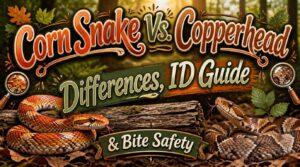
A red-and-tan snake curls under your porch step, and your heart jumps. Copperhead, you think. Nine times out of ten in the Southeast, you’re actually looking at a corn snake, a harmless rodent hunter wearing a similar coat of blotches.
That mistake gets snakes killed, and sometimes it gets people bitten by the wrong one entirely. Both species share the same woods, the same field edges, even the same taste for a good hiding spot, so mixing them up is easy to do. The corn snake vs copperhead snake question comes down to details you can actually spot, like head shape, pupil form, and how the pattern sits on the body.
Once you know what to look for, telling them apart takes seconds, not guesswork.
Table Of Contents
- Key Takeaways
- Corn Snake Vs. Copperhead: Key Differences
- How to Identify Corn Snakes and Copperheads
- Habitat, Behavior, and Reproduction Compared
- Venom, Bite Risk, and Medical Response
- Juveniles, Look-Alikes, and Safe Encounters
- Frequently Asked Questions (FAQs)
- What snake kills copperheads?
- What snake is commonly mistaken for a copperhead?
- What do copperheads hate the most?
- Can a copperhead breed with a rattlesnake?
- How to tell if it’s a copperhead or corn snake?
- What snake is mistaken for a corn snake?
- What snake is mistaken for a copperhead?
- How do you tell if a snake is a corn snake?
- How can one distinguish copperheads from other non-venomous snakes?
- Are there any look-alikes to copperheads one should be aware of?
- Conclusion
Key Takeaways
- The fastest way to tell them apart is checking pupil shape, head shape, and pattern: copperheads have vertical pupils, triangular heads, and hourglass bands, while corn snakes have round pupils, narrow heads, and squared blotches. Since copperheads lack rattles, you won’t hear a warning, so it helps to understand how copperheads signal danger without a rattle before heading outdoors.
- Copperheads are venomous and deliver a hemotoxic bite that needs prompt medical care, whereas corn snakes are harmless and their bite rarely needs more than soap and water.
- Most snakebites happen because of misidentification, not bad luck, so treating any unidentified banded snake as venomous until proven otherwise is the safest approach.
- Juvenile copperheads have a bright yellow tail tip they use to lure prey, and this feature alone is a reliable warning sign since corn snakes never have it.
Corn Snake Vs. Copperhead: Key Differences
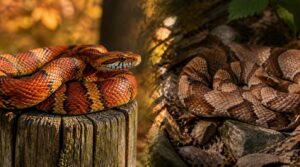
Mixing up a corn snake and a copperhead is an easy mistake, but the two aren’t nearly as similar as they look at first glance. Once you know what to check, telling them apart gets simple fast. Here are the five differences that matter most.
For a closer look at head shape, coloring, and pattern side by side, this guide to snakes that resemble copperheads breaks down the visual cues worth training your eye on.
Venomous Status and Human Risk
Since one snake carries venom and the other doesn’t, human risk starts here. Copperheads are venomous, delivering hemotoxic venom through fixed fangs that can cause swelling and tissue damage. Corn snakes are nonvenomous and harmless.
Even so, a copperhead bite is rarely fatal to healthy adults, though untreated wounds can turn serious — this guide on whether a copperhead snake can kill a human breaks down the real risks.
| Snake | Bite Risk |
|---|---|
| Copperhead | Painful, needs monitoring |
| Corn Snake | Minor, rarely treated |
Dry bites happen often, but don’t assume yours is one. Globally, snakebite envenoming carries a pooled global mortality rate of 0.33 per 100,000 people annually, underscoring why any venomous bite warrants prompt medical attention.
Typical Length and Body Build
Length alone won’t tell these two apart. Corn snakes stretch 24 to 60 inches, whereas copperheads stay shorter and stockier at 22 to 36 inches.
| Trait | Corn Snake | Copperhead |
|---|---|---|
| Length | 24–60 in | 22–36 in |
| Build | Slender, tapered tail | Stout, thick-bodied |
| Weight | Lighter for length | Heavier, chunkier |
Pick one up (carefully, if it’s a corn snake) and the weight difference gives it away fast.
Colors, Bands, and Blotches
Weight tells you build, but pattern seals the ID. Corn snakes show reddish-brown blotches on tan, ringed in black, with light spots circling each eye.
Copperheads wear hourglass crossbands, dark on top, fading paler at the sides, tapering as they reach the belly.
| Feature | Corn Snake | Copperhead |
|---|---|---|
| Pattern | Square blotches | Hourglass bands |
| Belly | Checkerboard | Cream, blotched |
| Tail | No marker | Yellow tip (juvenile) |
Native Range and Habitat
Where you find one, you might find the other. Copperheads and corn snakes overlap across the Southeastern United States, from the Carolinas through Georgia and Alabama.
| Habitat Feature | Preference |
|---|---|
| Copperhead | Deciduous forests, leaf litter |
| Corn Snake | Pine woods, forest edges |
| Both | Overlap zones, dawn/dusk activity |
| Juveniles | Grassy fields, farm edges |
Forest edges draw rodents, and rodents draw snakes.
Rat snakes in particular thrive along these wooded margins, skillfully working the canopy and understory as described in this guide to rat snake natural habitat preferences.
Egg-Laying Vs. Live Birth
Reproductive strategies split these two species right down the middle. The Corn Snake is oviparous, laying 10 to 30 eggs that hatch alone. The Copperhead is ovoviviparous, live-bearing 1 to 21 young after months of gestation.
| Trait | Corn Snake / Copperhead |
|---|---|
| Method | Oviparous / Viviparous |
| Offspring | Independent / Independent |
Parental investment ends fast either way.
How to Identify Corn Snakes and Copperheads
Knowing the differences on paper is one thing, but spotting them on a snake in front of you is another skill entirely. Your eyes need to know exactly where to look, from head to tail to belly, before panic or curiosity gets the better of you. Here’s what to check first, one feature at a time.
Body Color and Dorsal Markings
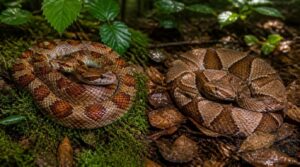
Color alone won’t save you here. Corn snakes run light tan to orange-brown with reddish saddle blotches, while copperheads show coppery-tan bodies with the telltale hourglass pattern, wider on the sides than the spine.
Scale sheen differs too: corn snakes glow glossy, copperheads stay matte. Watch for eastern ratsnake confusion and note juvenile copperheads’ sharper, fading bands.
Belly Pattern Differences
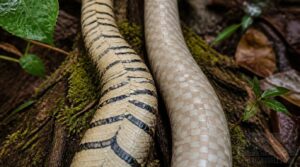
Flip the snake over, if you safely can, and the ID gets easier. Copperheads show bold, alternating bands breaking at scale seams, aligning midline for a zigzag look that aids ventral camouflage. Corn snakes display pale, checkerboard contrast instead.
Quick belly check:
- Bold vs pale color and pattern
- Bands breaking at seams (copperhead)
- Even checkerboard alignment (corn snake)
- Zigzag ventral camouflage function
Head Shape and Facial Pits
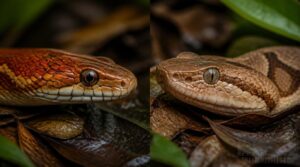
A triangular-shaped head is your fastest tell. Copperheads widen sharply behind the eyes; corn snakes stay narrow and rounded, blending smoothly into the neck.
Facial pit location matters too: copperheads carry loreal pits between nostril and eye. Pit visibility conditions improve in good light, but corn snakes show none, ever.
Rostral scale texture also differs, rougher on copperheads.
Eye and Pupil Features
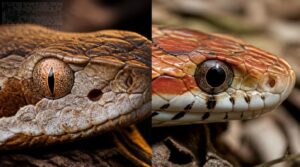
Look closely at the pupil shape before anything else. Copperheads have narrow, vertical slits, an adaptation for nocturnal vision that limits bright light while keeping edges sharp at dusk. Corn snakes carry large, round pupils year-round.
Iris color varies too, coppery-tan in copperheads versus grayish-brown in corn snakes, but pupil shape stays your most reliable field clue.
Scale Texture and Overall Sheen
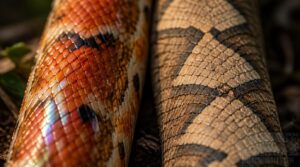
Run your thumb along the back and you’ll feel the difference before you see it. Corn snakes have smooth scales with a slick, almost polished feel; copperheads carry keeled dorsal scales, giving a grainy, matte finish.
That’s scale microtexture at work. Corn snakes show gloss and shimmer at oblique angles, while copperheads scatter light, staying dull even in bright sun. Humidity boosts corn snake sheen; copperheads barely change.
Habitat, Behavior, and Reproduction Compared
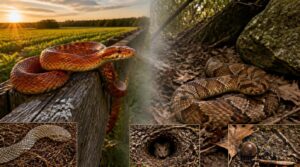
Where a snake lives and how it acts tell you as much as its markings do. Corn snakes and copperheads share more territory than you might think, but their daily habits and life cycles split off in telling ways. Here’s how the two compare, habitat by habitat.
Geographic Range and Overlap
By late spring, your odds of crossing paths with either snake climb sharply. Corn snakes range from New Jersey to Florida, west into Missouri and Kentucky, while copperheads stretch from New England to Missouri and Arkansas.
Overlap zones cluster here:
- Southern New England
- Mid-Atlantic states
- North Carolina
- Georgia
- The southeastern United States broadly
Warmer months push seasonal dispersal, widening habitat overlap further.
Preferred Natural Habitats
Range alone won’t tell you where to look. Copperheads favor rocky hillsides and leaf litter in deciduous woods, while corn snakes work grassland edges, agricultural margins, and woodland clearings hunting rodents. Both use riparian zones and rocky outcrops for cover.
This habitat overlap in snakes across the southeastern United States means eastern US snake species often share ground you’d never expect.
Daily and Seasonal Activity
Timing matters as much as habitat. Corn snakes run diurnal in warm months, foraging late morning through afternoon, while copperheads shift crepuscular, active at dawn and dusk to dodge heat. Rain brings copperheads out hunting amphibians.
If you want to pinpoint their daytime retreats before planning an outing, this guide to where copperheads hide during the day breaks down their favorite shelters.
Come autumn, they fatten up for brumation. Both species thermoregulate constantly, seeking sun or shade, and slow down sharply once cold settles in.
Temperament and Defensive Behavior
Personality matters too. Corn snakes are generally docile, rarely striking, while copperheads stay shy but freeze in an S-shaped coil when cornered, sometimes mimicking rattlesnakes by shaking their tails. Watch for rapid head jerks: that’s a copperhead’s stress signal.
Give either snake space and calm movements, and most defensive displays end without a strike.
Reproductive Strategies and Development
Nesting habits split these species apart. Corn snakes are oviparous, laying 10 to 30 eggs that incubate 60 to 75 days before hatching. Copperheads are ovoviviparous, nourishing embryos internally and birthing 6 to 12 live pups.
Both mothers move on quickly, parental care stays minimal, and hatchlings or pups reach sexual maturity within a few years, fending for themselves from day one.
Venom, Bite Risk, and Medical Response
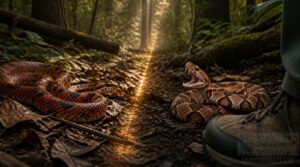
This is the part that matters most if you ever cross paths with one of these snakes in the wild. Knowing which species can actually hurt you changes how you should react, and what to do afterward. Here’s what you need to know about venom, bite risk, and getting the right care.
Copperhead Venom and Bite Effects
A copperhead’s bite delivers a true hemotoxin, a venom cocktail of metalloproteinases and serine proteases that disrupts clotting and damages tissue directly.
Expect burning pain within minutes, visible bruising as hemorrhagic activity spreads, and blood that won’t clot properly for hours.
This isn’t a mild scrape, it’s a venomous snake bite needing real respect, even when the dose stays small.
Corn Snake Bite Risk
Grab a corn snake wrong and you’ll likely get two tiny pinpricks, nothing more. No venom, no swelling crisis, just minor puncture marks from rows of small teeth.
- A quick sting, then it’s over
- No burning, no bruising spread
- Rare infection if you skip cleaning
- Calm handling keeps bites uncommon
- Soap and water usually does the job
That’s the real gap between venomous vs nonvenomous snakes: risk versus mild reflex.
Copperhead Bite First Aid
Bitten? Stay calm and immobilize the limb, keeping it below heart level. Call emergency services immediately, don’t wait for symptoms to worsen.
Skip the myths: no cutting, no venom suction, no ice, no tourniquets. These old-school fixes cause more harm than good.
Wash gently with soap and water. Watch for increasing swelling or pain, that’s your cue venom’s active and evaluation can’t wait.
Medical Monitoring and Antivenom
Once you’re in the ER, expect CroFab antivenom, 4-6 vials initially, repeated if control isn’t achieved in an hour. Doctors track coagulation (INR, fibrinogen) every 6-12 hours.
Admission runs 24-36 hours minimum, watching for:
- Worsening swelling near hands or airway
- Kidney function changes
- Delayed serum sickness (fever, hives)
Follow-up labs matter, up to 41% show lingering renal effects.
Dangerous Identification Mistakes
Most bites happen from misidentification, not bad luck. Pattern confusion tops the list: brown, hourglass-ish blotches read as "corn snake" to untrained eyes.
Most snakebites trace back to misidentification, not misfortune, as untrained eyes mistake hourglass blotches for a harmless corn snake
Size misjudgment kills good judgment too, small copperheads still bite. The eye shape myth (round pupils mean safe) fails since lighting distorts pupil shape in snakes. Head shape and habitat overlap add more risk, especially with juvenile look-alikes.
Juveniles, Look-Alikes, and Safe Encounters
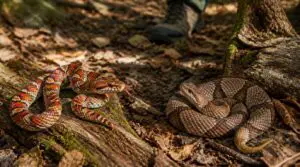
Young snakes and mistaken identities cause most of the confusion in the field. A juvenile copperhead doesn’t look quite like its parents, and plenty of harmless snakes get mistaken for one anyway. Here’s what to look for, and what to do once you’ve spotted a snake at all.
Juvenile Copperhead Yellow Tails
A bright yellow tail tip is nature’s warning label. Juvenile copperheads keep this lure until roughly one year old, using it to twitch and attract lizards or frogs within striking range while the rest of the body stays camouflaged.
- Vivid yellow tail against dull, coppery-gray body
- Slow, worm-like twitching motion near leaf litter
- Fading color as the snake approaches its first birthday
- Sharp pattern contrast even when overall coloring looks muted
Treat any yellow-tailed snake as venomous until proven otherwise.
Corn Snake Morph Variations
That yellow tail trick only applies to copperheads, never corn snakes, which instead wear wild-type saddles or bred morph variations. Amel drops black pigment for pink eyes; Anerythristic strips red tones for gray; Lavender softens everything lilac.
| Morph | Ground Color | Eyes |
|---|---|---|
| Amel | Pale yellow | Pink/red |
| Anerythristic | Silver-gray | Dark brown |
| Albino/Hypo | Peachy | Pale pink |
None are venomous. Ever.
Common Copperhead Look-Alikes
Corn snakes aren’t the only ones wearing a disguise. Several harmless species get mistaken for copperheads through mimicry patterns: juvenile ratsnakes show dark blotches but no true hourglass bands, watersnakes carry irregular crossbands on smooth scales, and scarlet kingsnakes flash red-black-yellow rings entirely.
Head shape comparison helps too. Non-venomous look-alikes keep narrow, uniform heads, lacking the copperhead’s broad, triangular profile.
Safe Distance and Next Steps
Head shape and pattern aside, treat any unidentified snake as venomous until proven otherwise. Keep a safe distance of three meters, back away slowly, and give it a clear exit.
Skip the photos-up-close approach. Snake identification matters, but not more than your ankles. Encounter Prevention Tips start with boots, long pants, and watching your footing on the trail.
When to Contact Experts
When identification feels shaky, don’t gamble on it. Call a wildlife expert if a copperhead turns up in your yard or porch, or reach a herpetologist when child pet safety is a concern.
Trapped in a pool? Ring emergency animal control.
Suspected venomous bite means calling medical professionals immediately, no waiting it out.
Frequently Asked Questions (FAQs)
What snake kills copperheads?
Kingsnakes top the list, thanks to a natural immunity to copperhead venom. Indigo snakes, black racers, and even hawks or owls will also kill copperheads when the chance arises.
What snake is commonly mistaken for a copperhead?
Eastern hognose snakes, milk snakes, and juvenile rat snakes cause the most banding confusion.
Juvenile mimicry in black racers adds to range overlap errors, since blotchy young patterns and stout builds echo copperhead camouflage before true coloring develops.
What do copperheads hate the most?
Copperheads avoid dry, windy areas with little cover, plus open lawns, chemical scents, and cold snaps. They also dodge bright sunlight for long stretches, preferring shaded brush where a venomous copperhead snake can hide from both predators and curious hikers.
Can a copperhead breed with a rattlesnake?
No. Different genera mean genetic compatibility is absent, causing fertilization failure. Despite both being venomous pit vipers, reproductive barriers enforce strict species isolation, so no viable hybridization between copperhead and rattlesnake has ever been documented.
How to tell if it’s a copperhead or corn snake?
Funny how two harmless-looking snakes split into "mild ER visit" and "just wash your hands."
Check pattern and head shape first: hourglass bands and a triangular head mean venomous copperhead; boxy orange-red blotches and a slim head mean nonvenomous corn snake.
What snake is mistaken for a corn snake?
Milk snakes, juvenile rat snakes, and even an Eastern hognose can pass for a corn snake at a glance. Their blotchy red-brown saddles and matching size drive most of this snake mimicry confusion in the field.
What snake is mistaken for a copperhead?
Nature’s copycats deserve an award nobody hands out. Juvenile Eastern ratsnakes get mistaken most, plus hognose, milk, and king snakes mimicking hourglass bands.
Juvenile black racers and watersnakes fool folks too, blending mimicry patterns beginners rarely catch quickly.
How do you tell if a snake is a corn snake?
Check for round pupils, glossy unkeeled scales, and a black-and-white checkerboard belly. Look for red-brown dorsal blotches edged in black, plus a narrow, spear-shaped head. These traits confirm a nonvenomous corn snake, not a copperhead.
How can one distinguish copperheads from other non-venomous snakes?
Look for the triangular head, narrow slits for pupils, and heat pits below the eyes. Check belly patterns and scale texture, keeled means venomous. Bright yellow juvenile tails and hourglass shapes confirm a copperhead over harmless look-alikes.
Once you’ve sharpened those field ID skills, learning snake species identification through structured guides and community resources can help you build the broader reptile knowledge that separates a confident observer from a cautious guesser.
Are there any look-alikes to copperheads one should be aware of?
Nature casts understudies for every star, and copperheads have five. Milk snake mimicry, watersnake confusion, an eastern ratsnake juvenile’s fading bands, pine snake resemblance, and garter snake similarity all trick quick glances in dim woodland light.
Conclusion
Test the theory yourself next time you spot a banded snake in the yard: check the pupils, check the head, check the pattern edges before you assume the worst. That habit is the real heart of the corn snake vs copperhead snake question.
One snake wants your rodents gone. The other just wants to be left alone. Learn the pits, the blotches, the belly checkers, and you’ll walk past both with calm confidence, not fear.