This site is supported by our readers. We may earn a commission, at no cost to you, if you purchase through links.
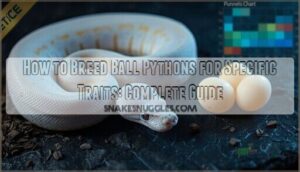
The first time you pair a pastel to a mojave and pull a gleaming blue-eyed leucistic from the clutch, you’ll understand why ball python breeding has become equal parts science and art.
Breeding ball pythons for specific traits isn’t about luck—it’s about understanding how dominant, recessive, and co-dominant genes interact to produce predictable outcomes. A single breeding decision can take years to reveal its full genetic potential, especially when you’re working with recessive carriers that hide their secrets until the right pairing unlocks them.
The difference between a random clutch and a designer collection comes down to knowing your genetics, selecting compatible pairs, and tracking bloodlines with the precision of a laboratory technician. Once you grasp how traits pass from parents to offspring, you’ll stop guessing and start engineering the exact morphs you envision.
Table Of Contents
- Key Takeaways
- Key Genetics in Ball Python Breeding
- Selecting Ball Pythons for Desired Traits
- Preparing Ball Pythons for Breeding
- Breeding Process and Incubation Steps
- Ethical Practices in Morph Breeding
- Frequently Asked Questions (FAQs)
- What makes a 007 blood python?
- What does 50% het clown mean?
- What is the most sought after ball python morph?
- How to tell if a ball python is ready to breed?
- How do environmental factors influence morph expression?
- What permits or licenses are required for breeding?
- How do you price and market designer morphs?
- What records should breeders maintain for breeding programs?
- How long between successful breeding attempts per female?
- Can Ball Pythons breed year-round in captivity?
- Conclusion
Key Takeaways
- Ball python breeding success depends on understanding how dominant, recessive, and co-dominant genes interact to produce predictable morphs, with tools like Punnett squares allowing you to forecast outcomes before pairing snakes.
- You’ll achieve consistent results by selecting compatible breeding pairs through verified genetics and documented bloodlines, avoiding assumptions about carriers versus visual morphs that can derail your entire program.
- Females need a minimum of 1,500 grams and 2-3 years of age before breeding, while males breed at 800-1,200 grams around 1-2 years—rushing these requirements compromises reproductive success and animal health.
- Ethical breeding prioritizes long-term genetic health over trendy morphs by running health screenings on every pair, maintaining genetic diversity through careful lineage tracking, and providing transparent morph disclosure to buyers.
Key Genetics in Ball Python Breeding
Before you pair your first snakes, you need to understand how traits actually pass from parents to offspring. The genetics behind ball python morphs aren’t as intimidating as they sound—once you grasp a few core concepts, you’ll be able to predict outcomes with confidence.
If you’re curious about how similar inheritance patterns work in related species, exploring boa constrictor morph types can give you a broader perspective on reptile genetics.
Let’s break down the fundamental genetic principles that drive every breeding decision you’ll make.
Dominant, Recessive, and Co-Dominant Traits
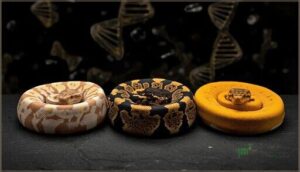
Your breeding success hinges on understanding genetic inheritance. Trait expression boils down to allele interactions: dominant alleles (capital letters) express with just one copy, while recessive traits (lowercase) need two. A thorough grasp of dominant traits and alleles is essential for predicting the outcomes of various pairings.
Co-dominant morphs reveal both alleles visibly, creating stunning phenotype variations no single gene dominance could produce.
Key principles for morph genetics:
- Dominant traits appear in every generation when present in at least one parent
- Recessive genotypes skip generations, hiding in carriers until paired correctly
- Co-dominant phenotypes blend both alleles, expanding your creative possibilities
- Heterozygotes mask recessive effects but pass hidden genes to offspring
- Epistasis occurs when multiple genes interact, complicating simple genetic variation predictions
Polygenic Traits and Genetic Complexity
Beyond single-gene morphs, polygenic inheritance creates subtle variations you’ll notice across your breeding lines. Multiple genes interact to control traits like pattern density and color intensity, making trait heritability less predictable than simple dominance.
Epigenetic factors and gene expression further complicate morph genetics, while epistasis masks or enhances effects within the genetic code. Understanding this genetic variation helps you anticipate outcomes when working with complex morphs.
Modern studies reveal how chromatin dynamics and gene expression play a key role in the regulation of complex traits.
Using Punnett Squares for Trait Prediction

You’ll simplify Genetic Forecasting and Morph Prediction by setting up Punnett Squares to track Trait Inheritance across pairings. Each grid cell represents possible Breeding Outcomes when you map one parent’s alleles across the top and the other’s down the side.
This Punnett Analysis reveals Genotype ratios and corresponding Phenotype probabilities—your blueprint for understanding Morph Genetics and managing Genetic Variation intentionally.
Identifying Carriers and Visual Morphs
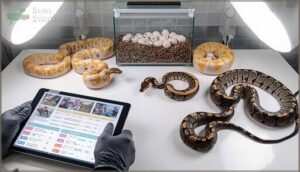
Once you’ve mapped potential outcomes, you need to verify which snakes actually carry hidden alleles versus those displaying full Visual Phenotypes. Carrier Testing through controlled pairings reveals Genetic Markers that predict Trait Inheritance and disclose new Morphs.
You’ll distinguish carriers from visual expressions by tracking:
- Offspring ratios after test breeding with known Genotype partners
- Phenotype appearance confirming homozygous or heterozygous status
- Pedigree records showing parental Morph Genetics and outcomes
- Consistent patterns across multiple clutches validating carrier status
- Genetic Variation producing predictable versus surprise visual results
Selecting Ball Pythons for Desired Traits
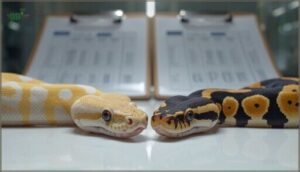
Selecting the right breeding stock sets the foundation for your entire morph project. You’ll need to verify genetics, assess compatibility between snakes, and understand the health history behind each animal before making any pairing decisions.
Many breeders start by researching popular ball python morphs and their genetic inheritance patterns to understand which combinations will produce the offspring they’re aiming for.
The strategies below will help you choose ball pythons that consistently produce the traits you’re working toward.
Researching and Confirming Morphs
You can’t predict what you don’t confirm—morph identification starts with verifying both phenotype and genotype through careful examination and breeding records. Use genetic testing when visual traits don’t match the snake pedigree, ensuring you’re working with actual carriers or visuals.
Document morphs, genetic variation, and trait verification thoroughly, because assumptions about morph genetics will derail your entire breeding strategy before you even start pairing.
Choosing Compatible Breeding Pairs
Your breeding pair is only as strong as the genetic matching you put into it. Check compatibility by pairing complementary morphs—one visual, one carrier—to boost morph prediction accuracy.
Review each snake’s pedigree to avoid close kinship, which drains genetic variation and crashes your breeding program. Smart pair selection drives breeding strategies that consistently produce the traits you’re targeting.
Tracking Bloodlines and Genetic Health
Documentation is your breeding program’s backbone. You’ll need structured bloodline analysis across at least three generations to spot inheritance patterns and avoid genetic bottlenecks. Health screening before every pairing protects your line’s genetic variation and prevents passing on recessive defects.
- Record birth dates, origin, and registration numbers in a centralized ledger for full traceability
- Log health events, vet visits, and disease diagnoses with treating clinician notes
- Screen for common recessive conditions through genetic testing and carrier identification
- Track pedigree management data showing parental links, offspring counts, and morph genetics
- Flag discrepancies like mismatched parentage or missing linebreeding records for immediate investigation
Using Genetics Calculators for Outcomes
A Punnett square calculator transforms guesswork into precision. Input parental genotypes—such as a het clown paired with a visual clown—and observe trait prediction through breeding simulations, revealing morph probabilities for every hatchling. These genetic modeling tools decipher gene expression patterns, from simple dominance to epistasis, illustrating how genotype translates to phenotype across morph genetics and genetic variation in your clutch.
| Calculator Type | Primary Use |
|---|---|
| Punnett Square Tools | Generate 2×2 or 4×4 grids showing all parental allele combinations with immediate genotype probabilities |
| Dominant/Recessive Calculators | Predict offspring probabilities for single locus traits using Mendelian inheritance with percentage outputs |
| Linkage Aids | Model linked genes and compute recombination fractions to adjust offspring probabilities based on loci distance |
| Hardy-Weinberg Helpers | Estimate allele frequencies in breeding populations under equilibrium using chi-square tests for deviation |
Preparing Ball Pythons for Breeding

Before you pair your ball pythons, you need to make sure they’re actually ready to breed. This means checking their age, weight, and overall health—not just tossing two snakes together and hoping for the best.
Let’s walk through the essential preparation steps that set the foundation for a successful breeding season.
Assessing Age and Weight Requirements
Your snakes won’t tell you when they’re ready—you have to know the signs. Age Verification and Weight Thresholds form your foundation for successful Ball Python Breeding, but Maturity Signs and Body Condition reveal the full picture:
- Females need 1500+ grams and 2–3 years minimum
- Males breed at 800–1200 grams around 1–2 years
- Track consistent weight gains over single measurements
- Check for rounded midbody without visible ribs
- Verify stable appetite and regular shedding cycles
Ensuring Optimal Health and Quarantine
You can’t breed healthy morphs from sick snakes—that’s why Quarantine Protocols anchor your Ball Python Breeding program. Isolate new arrivals for 60–90 days using separate Biosecurity Measures: dedicated tools, PPE, and daily Health Screening for respiratory signs or appetite loss.
Sanitation Practices with reptile-safe disinfectants prevent Disease Prevention failures.
Monitor weight, feeding response, and stool consistency to confirm Reptile Health and Wellness before pairing.
Pre-Breeding Conditioning and Diet
Once your quarantine clears, shift focus to pre-breeding conditioning. Your females need strategic Nutrient Balance to support egg development.
Feed high-quality prey at 2–3 percent of body weight weekly using consistent Feeding Schedules, targeting a Calcium Ratio of 1.5–2.0:1 through whole prey or Dietary Supplements.
Health Monitoring catches weight plateaus early, ensuring ideal body condition before pairing begins.
Setting Up Enclosure Conditions
After conditioning, your breeding environment becomes the catalyst for pairing success. Temperature Control and Humidity Management drive reproductive readiness—maintain 78–88°F with a basking zone at 90–92°F using thermostatic controllers.
Your enclosure setup must include:
- Cypress mulch or aspen Substrate Selection (2–4 inches deep)
- 50–60% humidity monitored via hygrometer
- Adequate Ventilation Systems preventing mold
- 12-hour Lighting Design photoperiod
- Secure, escape-proof housing with tight lids
Log temperatures daily to catch fluctuations exceeding 1–2 degrees.
Breeding Process and Incubation Steps

Once your breeding pair is healthy and conditioned, the real work begins—getting them to mate and managing the entire reproductive cycle. You’ll need to stimulate breeding behavior, watch for key signs during mating and egg development, and create the right environment for incubation.
Here’s how to navigate each critical stage, from pairing to hatchling care.
Stimulating Breeding Behavior and Pairing
Generally, courtship rituals begin after you’ve simulated a cooling period mimicking breeding season. Adjust temperature and light cycles to trigger mating cues, then introduce your breeding pair into a clean breeding environment. Monitor for gentle nuzzling and tongue-flicking—these behaviors signal snake compatibility and readiness.
| Pairing Strategies | Expected Behavior |
|---|---|
| Initial introduction | Calm exploration, reduced aggression |
| Active courtship | Nuzzling, scent tracking |
| Successful mating | Prolonged connection (hours to days) |
Allow mutual tolerance to develop naturally before assuming ball python breeding will proceed smoothly.
Monitoring Mating, Ovulation, and Egg Laying
Once mating begins, watch for clasping jaws and wraparound embraces that can last hours—sometimes up to two days during breeding season.
After successful pairing, ovulation signs appear within weeks: swelling near the vent, a thickened abdomen, and noticeable follicle development.
Prepare a lay box with damp moss when you spot these indicators, ensuring your female has a secure, humid spot for egg deposition.
Incubating Eggs and Environmental Control
Remove eggs gently and transfer them to an incubation substrate that feels slightly damp—never wet—to prevent mold.
Set your incubator to 32°C (90°F) and maintain humidity around 90 percent initially, then lower it to 70 percent as hatch approaches.
Proper ventilation systems prevent CO2 buildup, while regular incubator maintenance ensures stable temperatures throughout the 55-day incubation period.
Managing Hatchlings and Morph Identification
You’ll need careful documentation as hatchlings emerge to track genetic variation accurately. Photograph each neonate under natural light, capturing scale patterns and coloration for morph tracking—visual traits often shift after the first shed. Label containers immediately and record parentage details for future genetic testing.
- Monitor neonate health daily during the critical first two weeks
- Compare hatchling morphs against breeding predictions to identify hidden traits
- Maintain separate housing to prevent stress and support ideal growth
Ethical Practices in Morph Breeding

Breeding for specific traits comes with real responsibility—not just to your snakes, but to the entire hobby. The choices you make today shape the health and reputation of ball pythons for years to come.
Let’s walk through the essential ethical practices that separate responsible breeders from those chasing quick profits.
Prioritizing Health Over Market Trends
When flashy morphs dominate the market, you might be tempted to chase trends, but true breeding ethics demand that reptile health always comes first.
True breeding ethics demand that reptile health always comes first, even when flashy morphs dominate the market
Run genetic testing and health screening on every breeding pair to prevent disease before it appears. Build your breeding program around welfare standards that prioritize sturdy immune systems and longevity over quick profits—responsible breeding means saying no to risky pairings, even when demand is high.
Avoiding Genetic Defects and Overproduction
Overproduction dilutes genetic diversity and fuels inbreeding depression—track your lineage records to catch carriers before defect prevention becomes crisis management.
Keep your breeding pool moderate to maintain genetic variation and sidestep epistasis interactions that create hidden problems. Population control isn’t about limiting ambition; it’s sustainable breeding that protects your reputation.
Linebreeding demands precision, not guesswork, to uphold breeding ethics and genetic risk management.
Responsible Sales and Long-Term Care
Your breeder accountability doesn’t end when the buyer drives away—ethical pricing and post-sale care determine whether you’re building lasting trust or just moving inventory. Customer support enables new owners to navigate the learning curve of pet ownership and responsibility without fear, while animal welfare thrives through ongoing reptile care and breeding guidance.
- Schedule check-ins at 1, 3, and 6 months to monitor health transitions and answer husbandry questions
- Provide written care sheets customized to each morph’s specific needs in animal husbandry and care
- Offer access to reptile veterinary contacts for emergencies that support exotic animal care and breeding standards
Transparency in Morph Representation
Morph disclosure starts with honest phenotype descriptions backed by genetic testing and visual verification—not guesswork dressed up as certainty.
You strengthen breeder accountability when you document genotype alongside observable morphs, confirming genetic variation through transparency standards that protect buyers from misrepresentation.
Clear morph genetics build trust faster than any marketing claim, turning skeptical customers into loyal advocates who refer others to your breeding program.
Frequently Asked Questions (FAQs)
What makes a 007 blood python?
You’ll instantly recognize a 007 blood python by its jaw-dropping red to orange base with tight, high-contrast pattern expression.
This morph stability is a result of selective trait inheritance tracking specific genetic markers for intensified color intensity.
What does 50% het clown mean?
When you see “50% het clown,” it means there’s a fifty percent probability that the ball python carries one copy of the recessive clown allele without displaying clown phenotype visually.
What is the most sought after ball python morph?
Blue Eyed Leucistic tops Morph Market Trends with its pure white phenotype and striking blue eyes, though Pied and Banana morphs remain highly coveted for their dramatic contrast and vibrant Ball Python Genetics appeal.
How to tell if a ball python is ready to breed?
Your ball python reaches breeding age when males weigh at least 700 grams around one year, while females need 1,200+ grams at two to three years.
Look for consistent weight gain, healthy shedding cycles, and visible reproductive readiness signs.
How do environmental factors influence morph expression?
While morph genetics provide the blueprint, temperature effects during incubation, humidity control, light exposure, and nutrient intake fine-tune color intensity and pattern sharpness—environmental stress can suppress or exaggerate traits unexpectedly.
What permits or licenses are required for breeding?
You’ll need a local business license, zoning permits for animal breeding, and health certificates for your stock.
Many states also require breeding registration, plus import-export documentation if you’re trading reptiles across state lines.
How do you price and market designer morphs?
Setting your price isn’t rocket science—pair morph rarity with lineage proof and transparent sales ethics.
Designer morphs range from $300 to $2,000, reflecting genetic complexity, market trends, and your breeding program’s reputation.
What records should breeders maintain for breeding programs?
You’ll need thorough breeding logs, pedigree tracking, genetic tests, health records, and compliance documents.
These breeding records guarantee your breeding program remains transparent, ethical, and scientifically sound when breeding ball pythons.
How long between successful breeding attempts per female?
Like a marathon runner needing rest between races, your female needs 12 to 18 months between successful breeding attempts.
This breeding interval allows complete recovery after egg laying and restoration of essential fat reserves before the next breeding season.
Can Ball Pythons breed year-round in captivity?
Yes, ball pythons can breed year-round in captivity with proper temperature control and humidity management. However, continuous breeding cycles without rest periods may stress females and deplete energy reserves markedly.
Conclusion
Patience pays dividends when breeding ball pythons for specific traits—rushing pairings or skipping health checks will cost you years of work. The morphs you produce reflect every decision you make, from choosing compatible genetics to tracking bloodlines across generations.
Start small, verify every pairing with calculators, and never sacrifice animal welfare for aesthetics.
Your reputation as a breeder depends on honesty, consistency, and the quality of what hatches. Build slowly, breed thoughtfully, and let your results speak for themselves.