
This site is supported by our readers. We may earn a commission, at no cost to you, if you purchase through links.

Pick an enclosure that’s too small and you’ll spend hours fighting to fit components inside. Go too large and you waste money on materials while creating unnecessary bulk.
The difference between a smooth installation and a frustrating mess often comes down to adding just two inches in the right direction. Most people underestimate how much space they need because they forget about wire bends, mounting hardware, and the clearance requirements around circuit breakers.
You can’t just measure your components and call it done. Getting the dimensions right requires understanding how protection ratings affect wall thickness, how heat dissipation demands extra room, and why that “perfect fit” mentality actually creates problems down the road.
Table Of Contents
- Key Takeaways
- Key Factors Influencing Enclosure Size
- Calculating The Proper Enclosure Dimensions
- Impact of Protection Ratings on Size
- Material Choices and Internal Space
- Thermal Management and Cooling Space
- Design Features That Affect Enclosure Size
- Custom Vs. Standard Enclosure Sizing
- Frequently Asked Questions (FAQs)
- How to calculate enclosure size?
- What size golf enclosure do I need?
- How do I know what size shower enclosure I need?
- How often should enclosures be inspected for damage?
- What tools are needed for enclosure installation?
- How does altitude affect enclosure pressure requirements?
- Are there weight limits for wall-mounted enclosures?
- Conclusion
Key Takeaways
- You need to add 12-24% extra space beyond your component measurements to account for wire bends, mounting hardware, and clearance around circuit breakers that most people forget.
- Higher protection ratings like IP65 or NEMA 4X require thicker walls and bulkier gaskets that can steal 5-20% of your internal volume, so factor this loss into your initial sizing.
- Reserve at least 15% of total enclosure volume for air movement and cooling, plus 2-4 inches above tall components, because heat buildup from power electronics causes premature failures if you don’t plan for it.
- Custom enclosures become necessary when you have oversized equipment, non-standard mounting footprints, or need room for future upgrades that standard boxes can’t accommodate.
Key Factors Influencing Enclosure Size
Choosing the right enclosure size isn’t just about fitting your components inside a box. You need to think about how everything will work together once it’s installed.
Start by reviewing the minimum enclosure size requirements to ensure your setup provides adequate space for movement and proper ventilation.
Three key factors determine whether your enclosure will actually do its job or leave you frustrated down the line.
Component Size and Quantity
Component sizing starts with counting every part you’ll install. Your bill of materials lists exact quantities to prevent overcrowding and guarantee proper box fill calculation.
Measure each component’s mounting dimensions, then add tolerances—usually a few millimeters—so connectors align without stress. Accurate quantity planning means you won’t run out of internal usable space when assembly begins, keeping your enclosure dimensions right the first time.
Notably, proper component sizing methods help prevent bottlenecks and guarantee reliable system performance.
Internal Layout and Space Planning
Once your components are counted, you need to map where each piece will sit inside. Component placement drives wiring optimization—group devices by function so cable runs stay short and neat. Leave at least 36 inches for circulation paths and plan for an access panel near high-use areas.
Internal shelving boosts space utilization without expanding enclosure dimensions, keeping your box fill calculation within safe limits. Understanding effective space planning principles is essential for maximizing usability within your enclosure design.
- Route power and data lines through separate color-coded sleeves to prevent interference
- Position terminal blocks within 18 inches of work surfaces for quick troubleshooting
- Reserve wall space for future upgrades so you won’t need to drill new anchor points
Mounting and Installation Constraints
After mapping your layout, you’ll face real-world mounting constraints that shrink usable dimensions fast. Wall-mounted boxes need 2 inches behind for cables and 4 inches on each side for door swing—surface preparation and fastener selection lock those clearances in stone.
Free-standing units require vibration isolation pads that raise the base. In seismic zones, structural reinforcements consume extra floor space to meet resistance standards.
Calculating The Proper Enclosure Dimensions
Getting the size right isn’t guesswork—it’s a process you can follow step by step. You’ll need to measure your components, calculate the necessary clearances, and leave room for growth.
Sizing an enclosure is a methodical process: measure your components, calculate clearances, and plan for future growth
Here’s how to work through each part of the sizing process to land on dimensions that actually work.
Step-by-Step Sizing Process
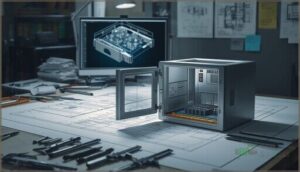
You’ll need a systematic approach to nail down the right enclosure size. Start by defining your protection level and listing every component with connectors. Then sketch an internal layout that reserves zones for power, electronics, and cooling.
Here’s your roadmap:
- Create a component mapping with exact dimensions and wiring clearances
- Allocate space for future expansion slots and mounting channels
- Check clearance for door swing, panel thickness, and gasket compression
- Build a 3D model to test fit and catch interferences before fabrication
- Validate dimension tolerances against code requirements and standards
This enclosure sizing and design process ensures your custom enclosure sizes match real-world needs. A standard size chart might work initially, but thorough enclosure sizing considerations prevent costly rework. Your mounting plans and clearance checks protect against assembly surprises. Dimension validation gives you confidence before ordering materials.
For classroom environments, durable snake terrariums designed for educational settings incorporate tempered glass panels that withstand daily student interaction while providing unobstructed viewing.
Box Fill Calculations for Safety

Box fill calculations keep your electrical enclosure selection safe and code-compliant. NEC 314.16 sets volume allowances based on conductor sizing and wire management needs.
Count every wire, device, clamp, and ground, then multiply by the cubic-inch value for your gauge. Undersized boxes cause overheating and arcing, so build in safety margins.
Proper fill calculations protect your installation and meet compliance standards for any NEMA rating.
Planning for Future Upgrades

Scalability planning starts with a 12 to 24 month upgrade roadmap. Reserve at least 20 percent extra power supply headroom and physical space for future modules. Modular design strategies let you add components without reworking existing hardware.
Custom enclosure sizing with growth strategies built in prevents costly replacements. Plan thermal management capacity for higher workloads, and verify future proofing maintains your protection ratings.
Impact of Protection Ratings on Size
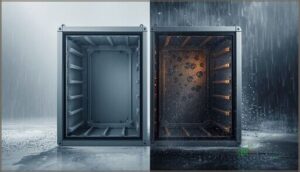
When you add weatherproofing and impact resistance to an enclosure, you’re not just getting tougher seals and thicker walls—you’re also changing how much space you’ll actually have inside.
Higher IP and NEMA ratings mean more protective features, and those features directly affect your final dimensions. Let’s break down how these ratings influence the size you’ll need and where you can find smart compromises.
IP Ratings and Size Requirements
IP ratings directly affect how much space your components actually get. Higher IP ratings like IP65 or IP67 need thicker walls and bulkier gaskets to keep water out.
Those seals and gasket materials can reduce internal volume by 5 to 20 percent. When you’re comparing enclosure size options, factor in the protection ratings you need—water resistance and submersion testing requirements will steal usable space.
NEMA Ratings and Wall Thickness
NEMA Ratings directly control how thick your enclosure walls need to be. Higher NEMA standards demand stronger construction to handle environmental stress and corrosion.
Here’s what you should know:
- NEMA 4X stainless units usually use 2.0 to 3.0 mm walls for outdoor corrosion resistance
- NEMA 12 indoor enclosures often require only 1.9 to 2.4 mm steel walls
- Wall-mounted boxes with thicker walls sacrifice internal space but gain structural integrity and enclosure durability
Balancing Protection and Space Efficiency
You can gain serious protection without blowing up your footprint if you match the rating to the real threat. Overkill wastes interior volume, while undersized specs risk component failure and safety hazards.
| Protection Levels | Space Optimization | Material Selection |
|---|---|---|
| NEMA Rating 3R | Compact Designs for outdoor | Aluminum with vents |
| IP65 dust-tight | Reserve 15% for Cooling Systems | Polycarbonate gaskets |
| NEMA 12 indoor | Add 2-inch buffer zones | Carbon steel 1.9 mm |
| High-humidity zones | Mounting and Installation clearance | Thermal Management and Ventilation foam |
Balance your Protection and Safety needs against usable Enclosure Size to avoid regret later.
Material Choices and Internal Space
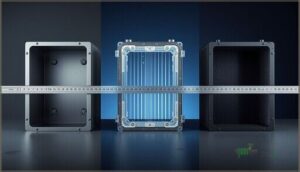
The material you choose for your enclosure directly affects how much usable space you’ll have inside.
Thicker walls provide better protection but eat into your internal area, while different materials handle environmental stress in unique ways. Let’s look at how each material impacts your enclosure’s size and performance.
Wall Thickness and Usable Area
When you pick an enclosure, wall thickness directly eats into your interior dimensions. A standard electrical enclosure with 4 to 5 inch walls reduces usable area noticeably compared to thinner designs.
Material selection drives thickness variations—steel and polycarbonate enclosure materials differ in wall thickness, affecting space optimization. For wall-mounted installations, mounting and installation constraints mean choosing slim walls preserves room for components without sacrificing protection.
Durability and Environmental Resistance
You need enclosure materials that hold up under real-world stress. Corrosion protection comes from epoxy and powder coatings that resist salt spray for over 1,000 hours in standard tests.
Weather resistance and UV stability prevent cracking and fading outdoors. Impact testing confirms that reinforced corners resist denting.
Seal integrity using silicone gaskets maintains environmental resistance from -40 to 120 C. NEMA ratings document proven durability and corrosion resistance across conditions.
Material-Specific Design Considerations
Material Selection for Electrical Enclosures extends beyond durability. Aluminum offers Thermal Conductivity around 200 W per meter-kelvin, spreading heat efficiently so you can use smaller boxes for the same wattage.
Steel provides natural Electromagnetic Shielding but runs hotter due to lower conductivity. Machinability Factors matter too—aluminum accepts dense gland plates without cracking, while polycarbonate needs wider spacing.
Wall Thickness in metal enclosures stays thinner than plastic, preserving usable volume and Corrosion Resistance.
Thermal Management and Cooling Space

Heat buildup is one of the most overlooked thermal risks when sizing an enclosure. Electronics and high-draw components generate warmth that needs somewhere to go, or you’ll end up with premature failures and safety issues.
The sections below walk you through the key thermal factors that should shape your enclosure’s dimensions.
Heat-Generating Components
Power electronics face efficiency losses between 5 and 50 percent, turning electrical energy into heat you must manage. Semiconductors generate thermal loads from switching and conduction losses.
Transformers and inductors add heat from core losses and copper losses. LEDs and lighting drivers contribute to power dissipation through non-radiative processes. Each component affects your heat management strategy and the cooling space your enclosure needs.
Ventilation, Fans, and Accessories
Once heat builds up, your Air Flow Systems and Ventilation Systems become the front line. Axial fans deliver high airflow at lower pressure, while centrifugal fans push air through Ducting Designs with greater force.
Speed control using variable frequency drives cuts energy use and noise. Proper Fan Mounting with vibration isolators reduces transmitted vibration by up to 60 percent.
Ventilation Controls like humidity and temperature sensors trigger your Cooling Solutions automatically, ensuring Thermal Management in Enclosures stays effective.
Allowing Room for Cooling Solutions
Planning your Cooling Space isn’t guesswork—it’s strategic Thermal Management in Enclosures. Leave at least 15 percent of total volume free for air movement around Heat Dissipation zones, and maintain 2 to 4 inches above tall components for convection flow.
Airflow Optimization depends on:
- Positioning inlet vents toward open spaces, not other hot components
- Dedicating a sub-chamber for high-heat devices to isolate thermal loads
- Installing modular Heat Sink Materials and cooling plates that can grow with your needs
Your Cooling System Design determines reliability.
Design Features That Affect Enclosure Size
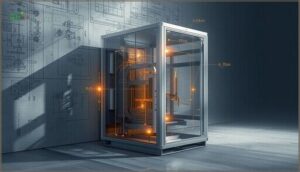
Your enclosure’s built-in features can add inches to the overall footprint before you even install a single component. Doors, cable routing systems, and interior layout choices all claim valuable real estate.
Let’s walk through the three main design elements that influence how much space you’ll actually need.
Doors, Panels, and Access Points
Your access control design directly impacts enclosure size and maintenance efficiency. Hinged doors that swing 110 to 120 degrees require clearance space around the electrical enclosure, while flush-mount panels minimize footprint.
Locking mechanisms and door seals add thickness to panel materials, increasing overall dimensions. Consider security features like cam locks for repeatable maintenance access. Reversible mounting systems offer installation flexibility without compromising your enclosure size requirements.
Cable Management and Organization
Cable routing and wire organization influence electrical enclosure size by adding internal volume for cable trays and raceways. You’ll need extra depth when panel management requires separation between power and data lines.
Cord protection sleeves and cable labeling systems occupy wall space, so factor these into your component selection. Grommets and entry points increase enclosure dimensions for proper cable management without pinching or interference.
Multi-Level and Vertical Space Utilization
Vertical storage inside an electrical enclosure transforms how you use available height without expanding the footprint. Mezzanine design with DIN rails or mounting plates on multiple levels lets you stack components efficiently in compact layouts.
- Wall-mounted terminal blocks free floor space for larger breakers and controls
- Multi-level rack systems optimize indoor enclosure capacity in tight installations
- Adjustable shelves allow reconfiguration as you add equipment over time
- Free-standing vertical towers support heavy transformers while maintaining space efficiency
Custom Vs. Standard Enclosure Sizing
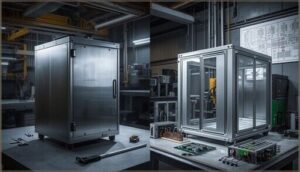
Standard enclosures work well when your components fit common dimensions and don’t have unusual requirements.
Custom sizing becomes necessary when you’re dealing with oversized equipment, strict space constraints, or specialized protection needs. Understanding when to choose each option helps you balance cost, timeline, and functionality for your specific project.
When Custom Sizes Are Necessary
When your component count exceeds what standard cavities can hold, a custom enclosure becomes essential. Non-standard mounting footprints, specialized housing for thermal sensors with extra component depth, or the need for specific mounting clearance all push you toward custom enclosure design.
Here’s when customization and fabrication beat off-the-shelf options:
| Situation | Standard Limitation | Custom Solution |
|---|---|---|
| Oversized busbars and terminal blocks | Fixed cavity capacity | Expanded internal space |
| Unique facility rails | Preset mounting patterns | Customized footprint alignment |
| Heat exchangers or moisture barriers | Generic ambient specs | Precise environmental clearance |
| Future module additions | No expansion room | Dedicated growth bays |
Material selection and properties matter too—stainless electrical enclosure walls may need extra thickness, affecting your final enclosure size.
Using Online Sizing Calculators
Most enclosure selector tools ask for component counts and targeted electrical enclosure dimensions as calculator inputs, then apply size algorithms to suggest boxes that meet IP code or NEMA ratings. You can often save user profiles to recall measurements, and many platforms provide measurement guides that improve sizing accuracy. Results usually include a confidence note and printable report.
| Input Type | What You Provide | How It Affects Output |
|---|---|---|
| Component list | Breaker count, terminal blocks | Minimum cavity volume |
| Protection level | IP code, NEMA ratings | Wall thickness and seals |
| Environment | Indoor, outdoor, corrosive | Material and custom enclosure design |
| Future growth | Planned module additions | Extra bay allocation |
| Mounting style | Wall, floor, pole | Footprint and access panel layout |
Ensuring Compliance With Standards
Once you’ve settled on dimensions, check that your box meets the regulatory framework for your location and application. Compliance testing confirms that materials and construction satisfy UL Listing, CSA Certification, CE Marking, or ATEX Certification requirements.
NEMA ratings guide the certification process, and quality assurance records support audit preparation by proving your enclosure design passed the necessary checks.
| Standard Type | Why You Need It |
|---|---|
| UL Listing | Electrical safety verification for North America |
| CSA Certification | Canadian regulatory compliance and product acceptance |
| CE Marking | European market access and safety conformity |
| ATEX Certification | Explosive atmosphere protection in hazardous zones |
| NEMA ratings | Environmental resistance and ingress protection levels |
Frequently Asked Questions (FAQs)
How to calculate enclosure size?
Start by measuring your largest components in cubic inches, then add 8 to 15 percent extra volume for protection rating wall thickness, thermal dynamics clearance, and mounting systems to guarantee safe electrical enclosure operation.
What size golf enclosure do I need?
You’ll need a minimum fourteen-foot width for safe clearance height during your golf swing space, ten feet of enclosure depth for ball flight, and nine-foot ceilings to prevent net contact during practice.
How do I know what size shower enclosure I need?
Measure your bathroom dimensions, then subtract fixtures and allow at least 2 inches of clearance around all sides.
Most compact shower enclosures start around 28 by 28 inches, with 22-inch door openings for comfortable access.
How often should enclosures be inspected for damage?
Think of your enclosure as a guardian under constant watch. Inspect every 6 months and after severe weather events to catch damage early, ensuring electrical safety, corrosion resistance, and environmental protection remain intact.
What tools are needed for enclosure installation?
You’ll need a cordless drill, drill bits, measuring tools, fasteners, safety gear, electrical testers, and cable routing accessories.
These items guarantee proper installation and maintenance access while meeting your electrical enclosure selection guide requirements.
How does altitude affect enclosure pressure requirements?
Altitude can be a decisive factor for pressure dynamics. Lower atmospheric pressure at elevation forces ventilation systems to compensate harder while thermal expansion and sealing integrity shift, demanding careful attention to environmental factors and protection ratings.
Are there weight limits for wall-mounted enclosures?
Yes, wall-mounted electrical enclosures have weight capacity limits between 20 and 90 kilograms. Load ratings depend on enclosure material, mounting hardware quality, and wall structure.
Always verify static loads against manufacturer specifications for safe installation and maintenance.
Conclusion
Choosing the right enclosure size isn’t rocket science, but it does require more than basic math. You need to account for wire bends, heat buildup, and future modifications before you commit to dimensions.
The two inches you add today prevent the headaches you’d face tomorrow when squeezing in that extra breaker or terminal block. Measure your components, apply the safety margins, and select an enclosure that gives your installation room to breathe. Your future self will thank you.
- http://www.osha.gov/
- https://www.specialchem.com/plastics/guide/polycarbonate-pc-plastic
- https://www.lianjer.com/electrical-enclosure-material-selection-guide/
- https://passive-components.eu/electromagnetic-housing-shielding-and-its-effectiveness/
- https://www.digikey.com/en/articles/weighing-the-pros-and-cons-of-enclosure-materials